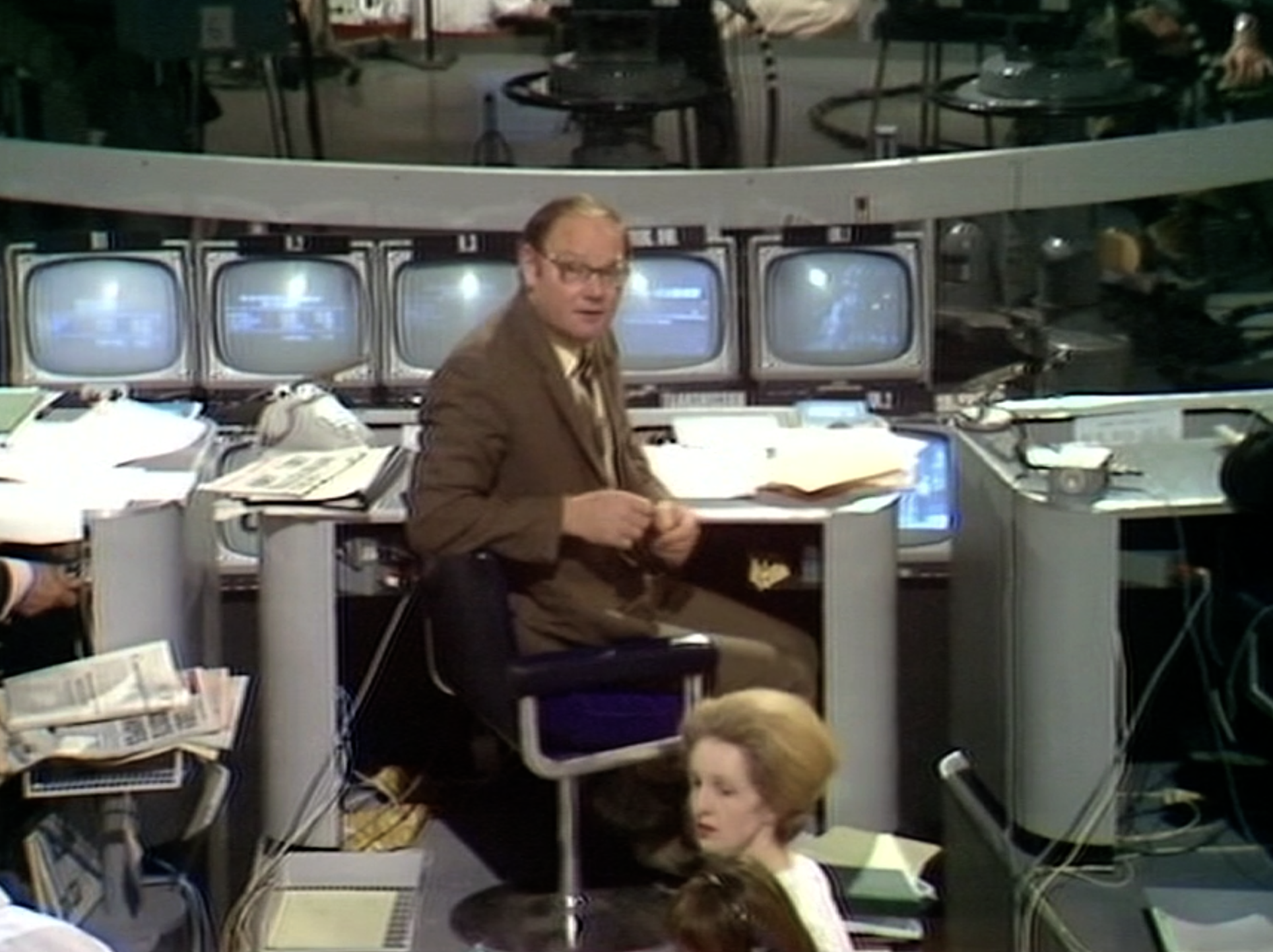
Cliff Michelmore at his desk during the BBC’s 1970 general election coverage
A live television broadcast that spends six to seven hours confined mostly to one studio, disappears for a short break, then returns for another six to seven hours in the same studio with many of the same faces talking about much the same thing, needs above all else to be the sort of programme with which you want to spend time.
And because that programme is confined mostly to the one studio – filled with all those faces talking about much the same thing – the studio in question needs to look and feel like a place in which you want to spend a lot of time.
The outcome of a general election generates plenty of its own excitement, with built-in suspense, guaranteed highs and dependable lows. This excitement would take place whether or not it is being covered live on television. But for more than 70 years, it has been covered live on television, and in a way that – in theory – sounds guaranteed precisely to subtract excitement and dilute suspense: by having the same location filled with the same faces talking about much the same thing.
In practice, however, television has only added to the excitement and suspense, as well as contributing a great deal of fun, outrage and nonsense. It has done this by deploying visual devices and presentational tactics that make us, the viewers, want to stay in the same place for hours on end, watching and listening to those same people talking about the same things.
Studio gadgets and on-screen graphics do some of this job; likewise the choice of personalities to pilot the coverage, marshal the experts and quiz the guests. Leading the charge, however, is the one element of proceedings that neither moves – be it stately like a swingometer or busily like a computer animation – nor speaks – be they warm and friendly like a Cliff Michelmore, or cold and surly like an Alastair Burnet.
It is the studio furniture. Those immobile, silent co-stars of every election broadcast, sometimes upstaging the stars themselves, at other times taking a (literal) supporting role. The chairs, desks, side tables, coffee tables, banquettes, perches, pragmatic joinery and ornamental flourishes that fill out the edges of your television picture.
A journey through the history of election furniture tells its own story of design successes and failures, of experimentation and retrenchment. It’s also a journey through the history of live television itself, particularly the treatment of national events, and how changing times and changing schools of thought impose a style and a decor on a studio – sometimes successfully, sometimes not.
The BBC pioneered the coverage of general elections on television and has also, in one form or another, made publicly available all its surviving results programmes, from 1955 onwards. Hence this particular journey follows the BBC, not ITV or any other broadcaster, through the decades to see how studio furniture both shaped and was shaped by the studios in which it was deployed.
There will be feasts for the eyes and kicks to the stomach. There will be examples of aesthetic taste collapsing with more speed and less dignity than the parliamentary majority of a disgraced MP, and of the judgment of designers and producers lurching further and more ferociously than even the most unsteady of electoral swings.
It involves BBC premises at Lime Grove, Television Centre, Elstree and Broadcasting House. It passes from monochrome to beige to brown to blue and on through a variety of mixed palettes, some gorgeous, some ghastly. It is a story of the nation, told from the smallest water glass to the largest drape, from sturdy ashtrays to wobbly ladders, via stacks and stacks of monitors and the occasional occasional table.
*
To start with, a reminder of where things end up: the most recent BBC general election results programme, based in Broadcasting House, in July 2024.
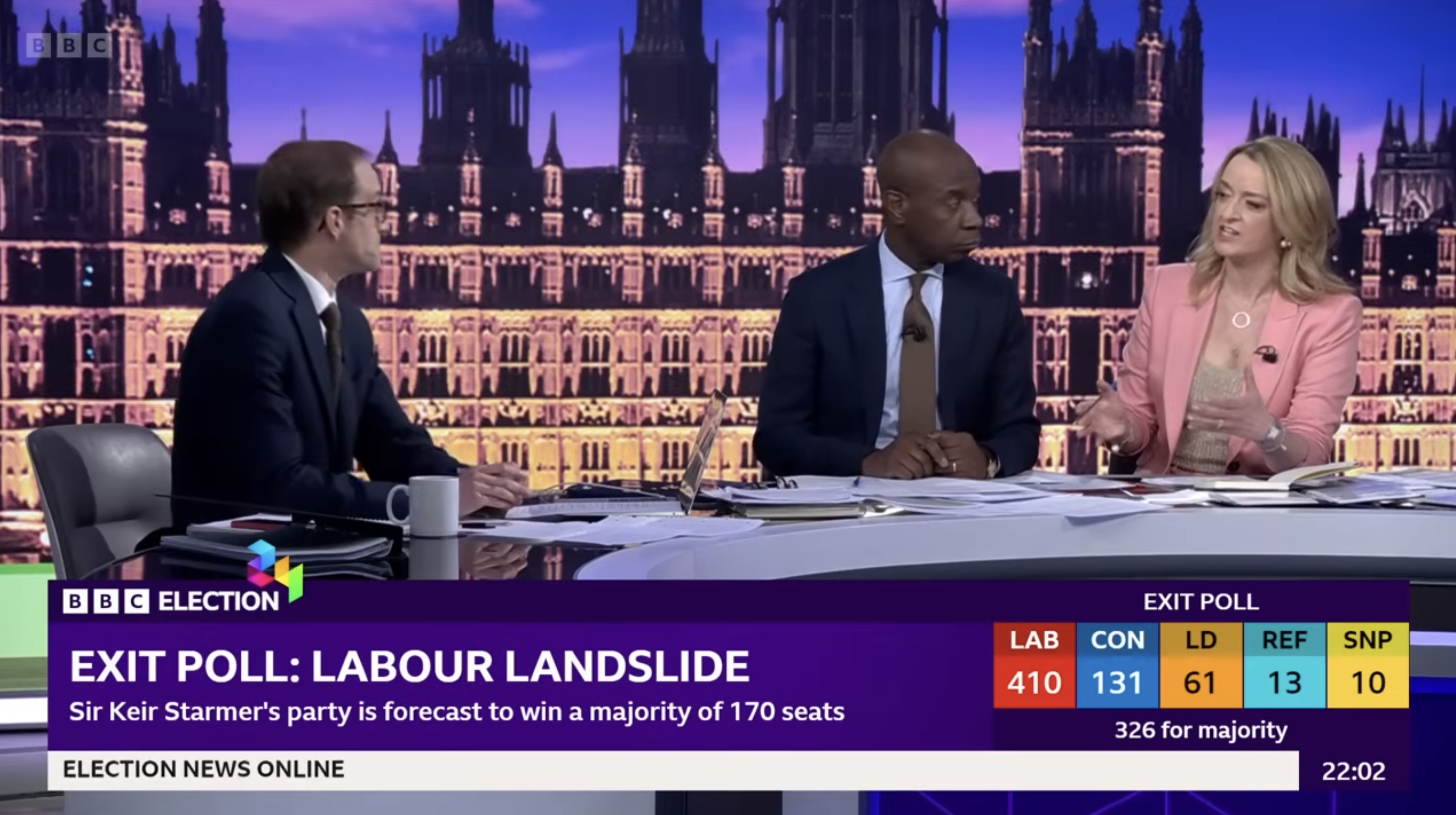
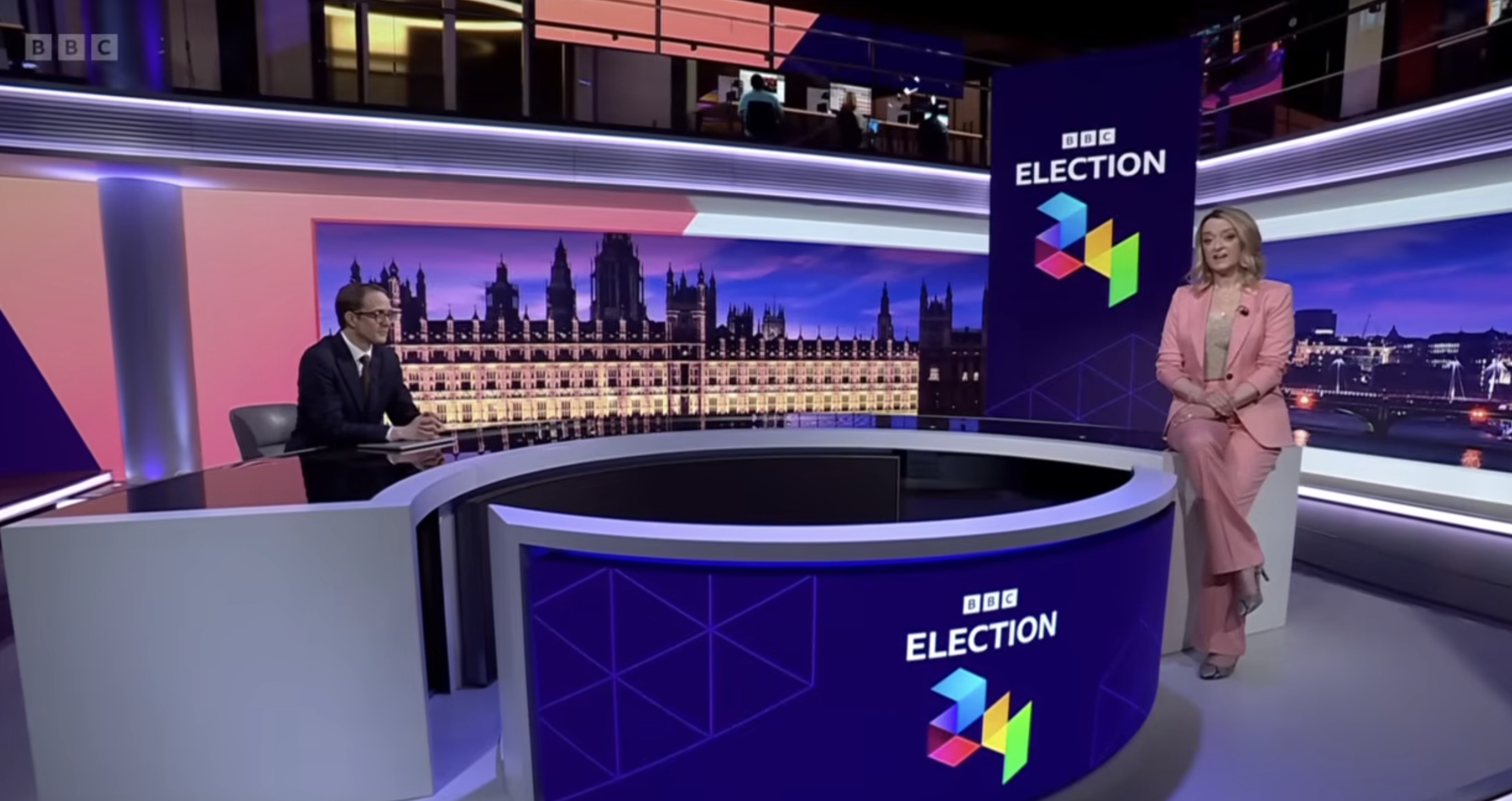
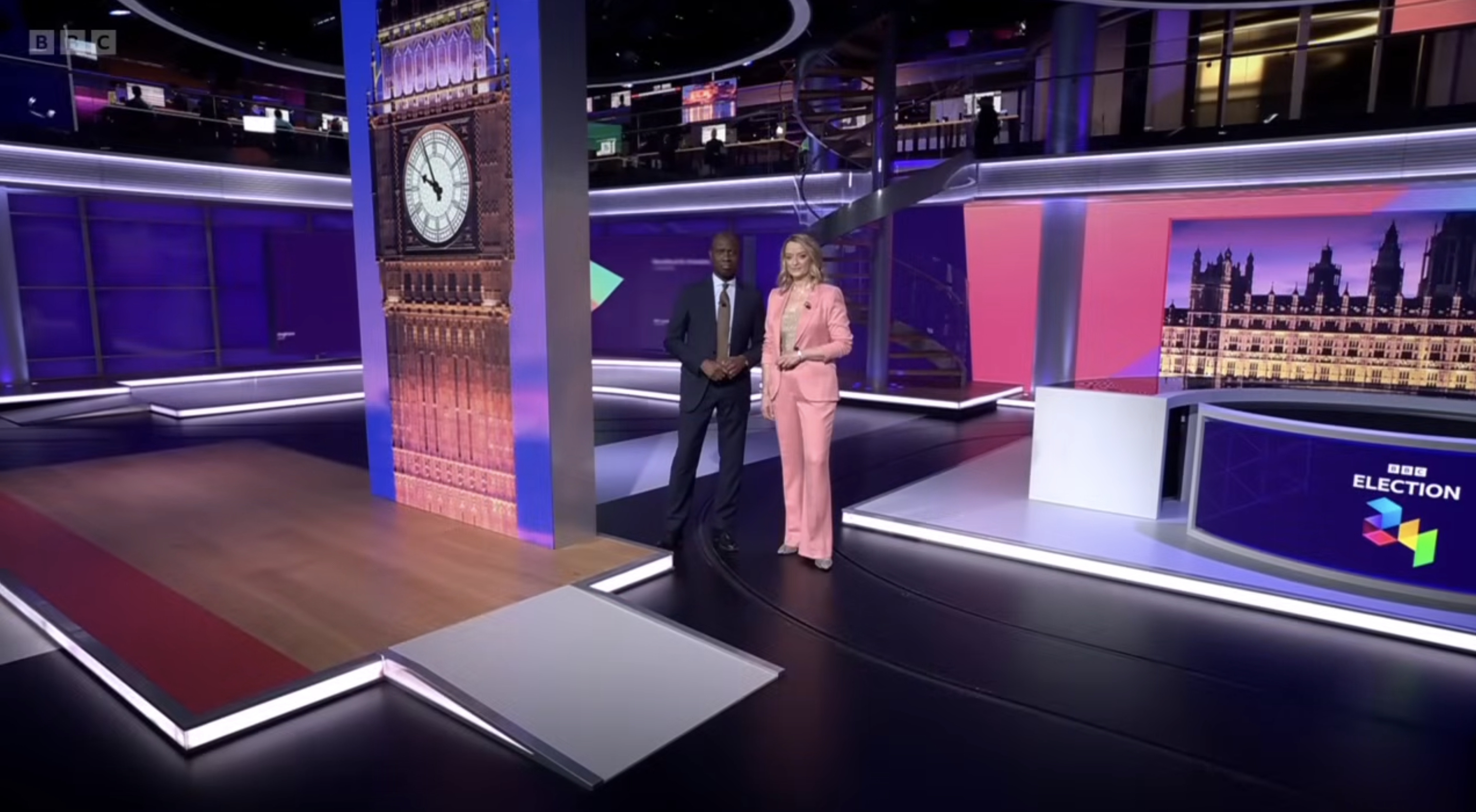
On a memorable night in British electoral history – whatever your political outlook – the BBC’s studio was distinctly unmemorable, not to say underwhelming. Presenters Clive Myrie and Laura Kuenssberg sat alternately too close together or too far apart, perched behind and periodically on top of an inelegant, awkwardly-shaped desk. The set was tiny and almost entirely bare, with next to no furnishings save a small ramp and a couple of slightly-raised platforms. The environment had no signature colour scheme or dominant sense of interior design. Aside from a couple of appearances of the word ELECTION, there was nothing to signify that anything important was going on or make you want to hang around.
How did we get here?
The BBC’s earliest surviving footage of an election results programme is from May 1955 and what there is of it – which isn’t much – suggests floor space at Lime Grove was just as scarce as at Broadcasting House in 2024. Yet the coverage has a visual coherence and an attention to detail that is almost entirely absent 69 years later.
Our main host is Richard Dimbleby and most of the time he is framed in a tight close-up, meaning his desk, what there is of it, remains out of view.
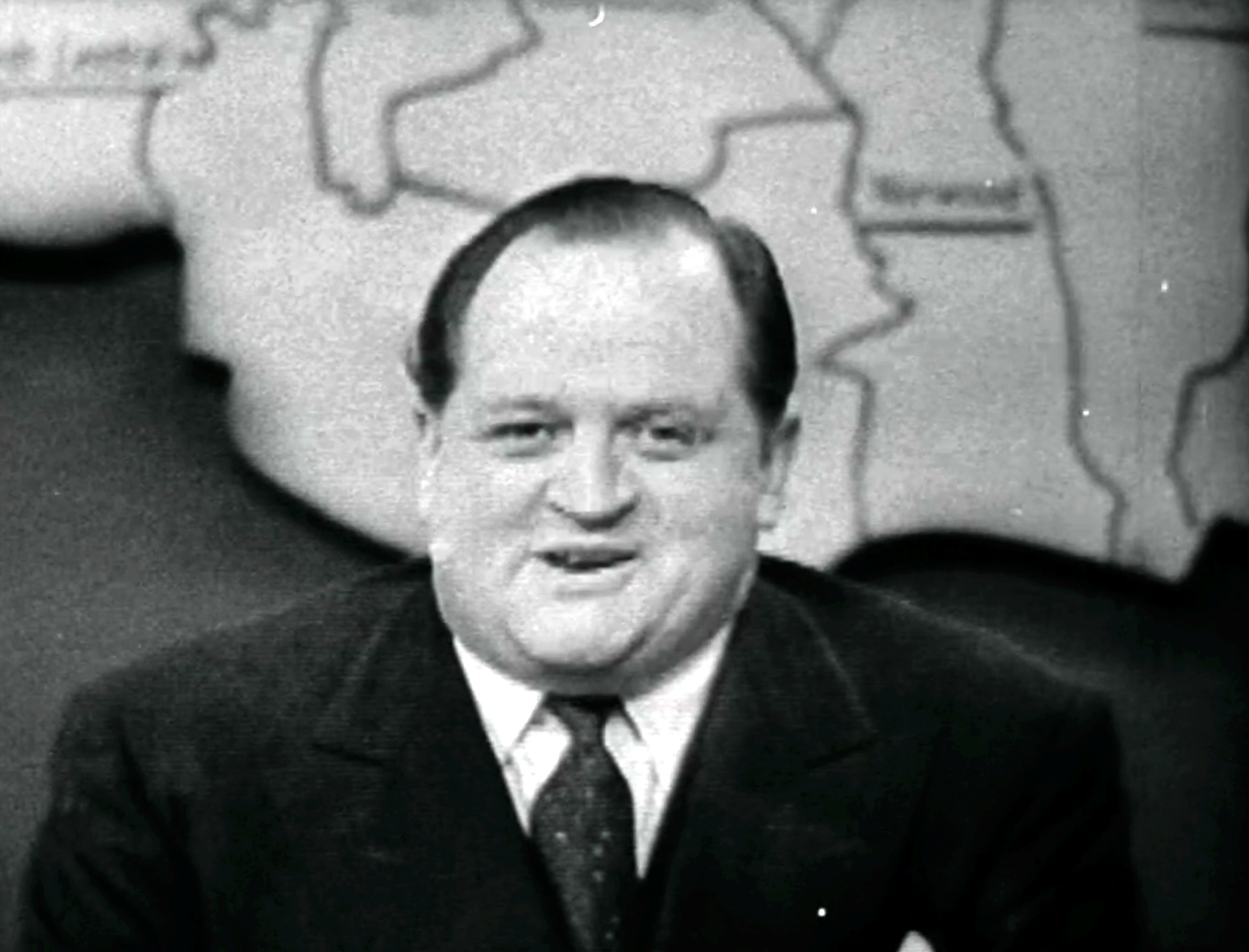
It’s left to the imagination of the viewer – and of the election furniture enthusiast – whether he is sitting behind a rudimentary table dug out of the Lime Grove store, or something more fancy that has been built from scratch for the occasion, perhaps garlanded with wires, drinking vessels and piles of paper.
A clue comes with a tantalising glimpse of the desk belonging to resident psephologist David Butler, when the camera cuts briefly to him and his team of young statisticians. The dapper ensemble are crowded together around a couple of plain tables in front of what seems to be a black curtain. But Butler’s desk looks a bit more roomy – we see a glass of water and an ashtray, two objects that will become as much a staple of election night as the presenters themselves, and there’s a hint of skilled woodwork at one end, where the surface of the desk appears to slope towards the floor.
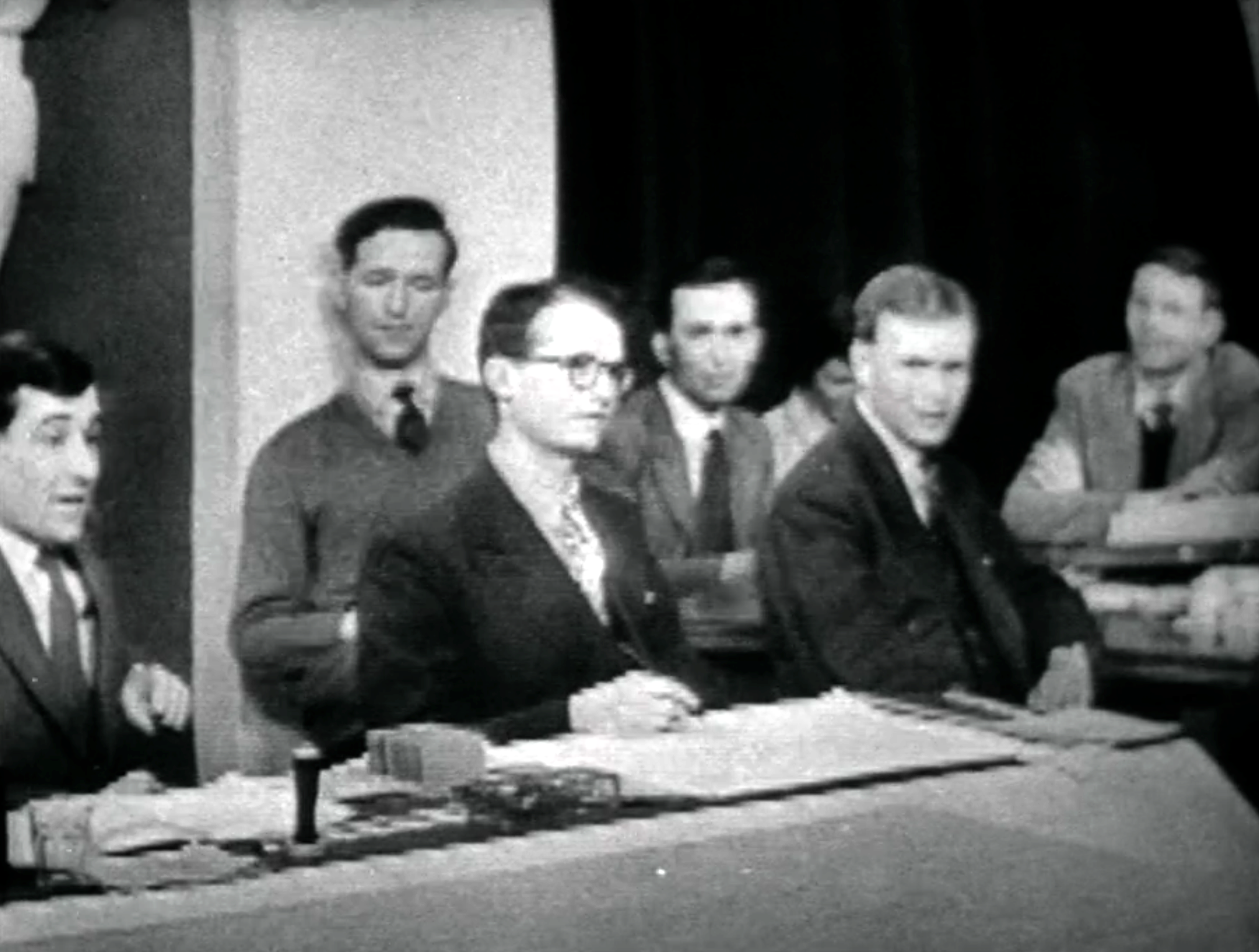
Early in proceedings, Dimbleby introduces a shot of “the big studio next door”, inferring he, Butler and co are having to make to do with something considerably smaller.
Next door turns out to be “full to the brim with backroom boys and girls”. It’s also full of a huge amount of clutter. Did nobody think to clear away those tall ladders?
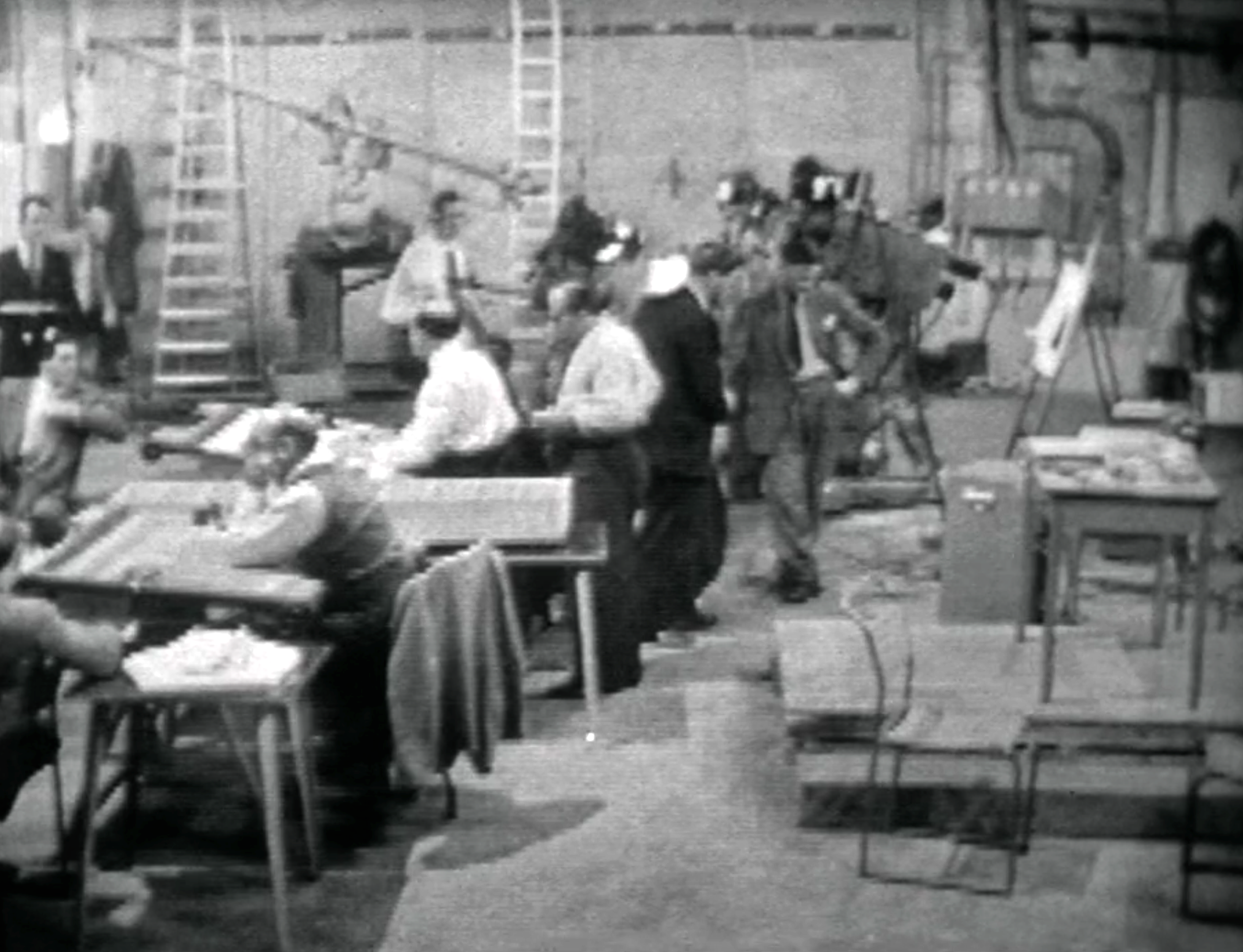
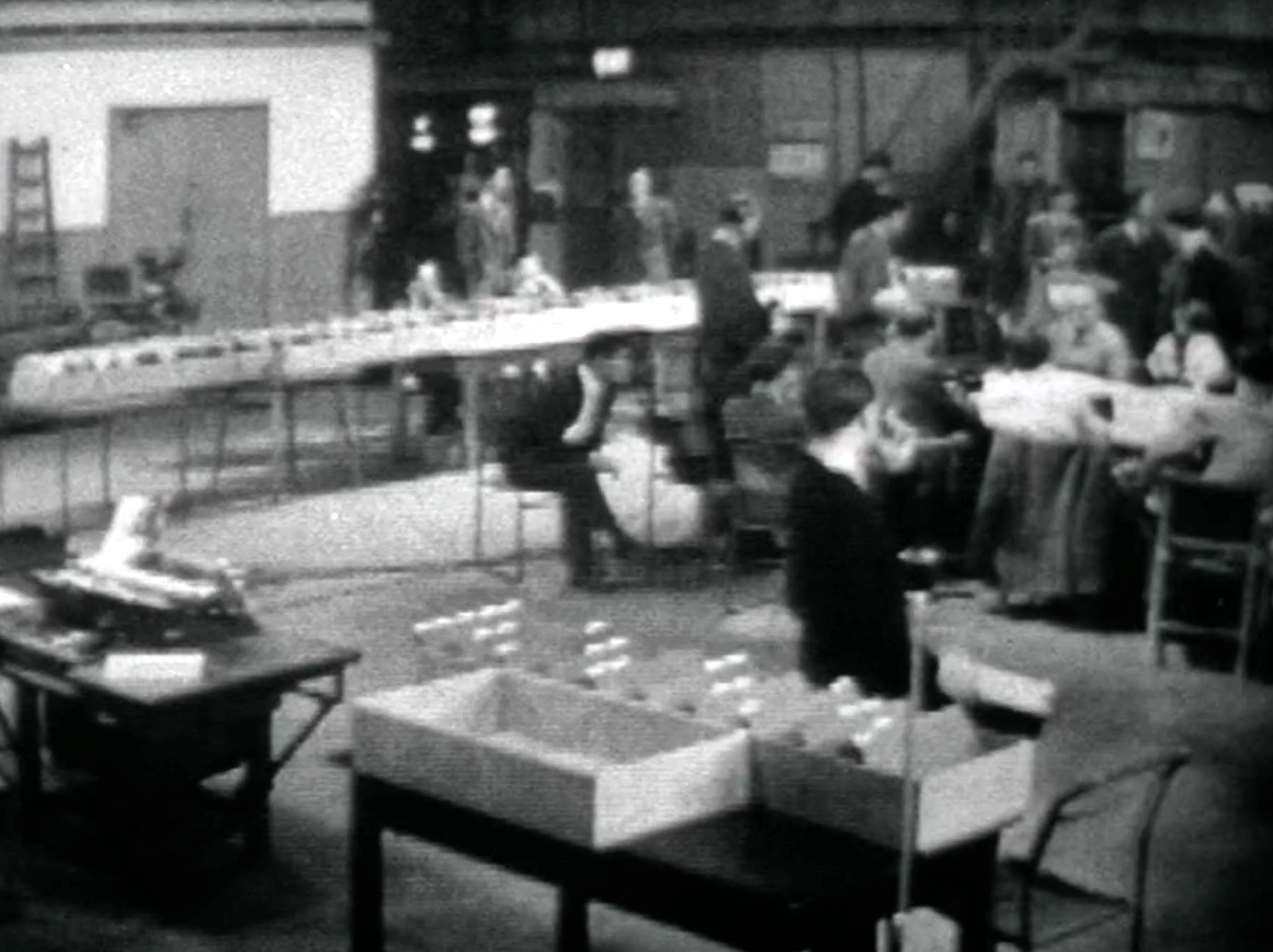
No attempt has been made to spruce up this part of Lime Grove and frankly it doesn’t look very comfortable or homely. Those metal-framed chairs must have been murder to sit on. But maybe this is, at least in part, deliberate. For here is the engine room of the operation, where speed and accuracy are of primary concern; appearances (and comfort) are not intended to matter so much. We should forgive the backroom staff for not standing on ceremony and – in a couple of cases – not wearing a smile. Besides, the cameras are only here for a peep; we don’t see this lot again.
Back in the studio next door, Richard Dimbleby and colleagues make do with what space they can find. At one point the camera pans from Butler to Dimbleby and you realise just how close they are to each other.
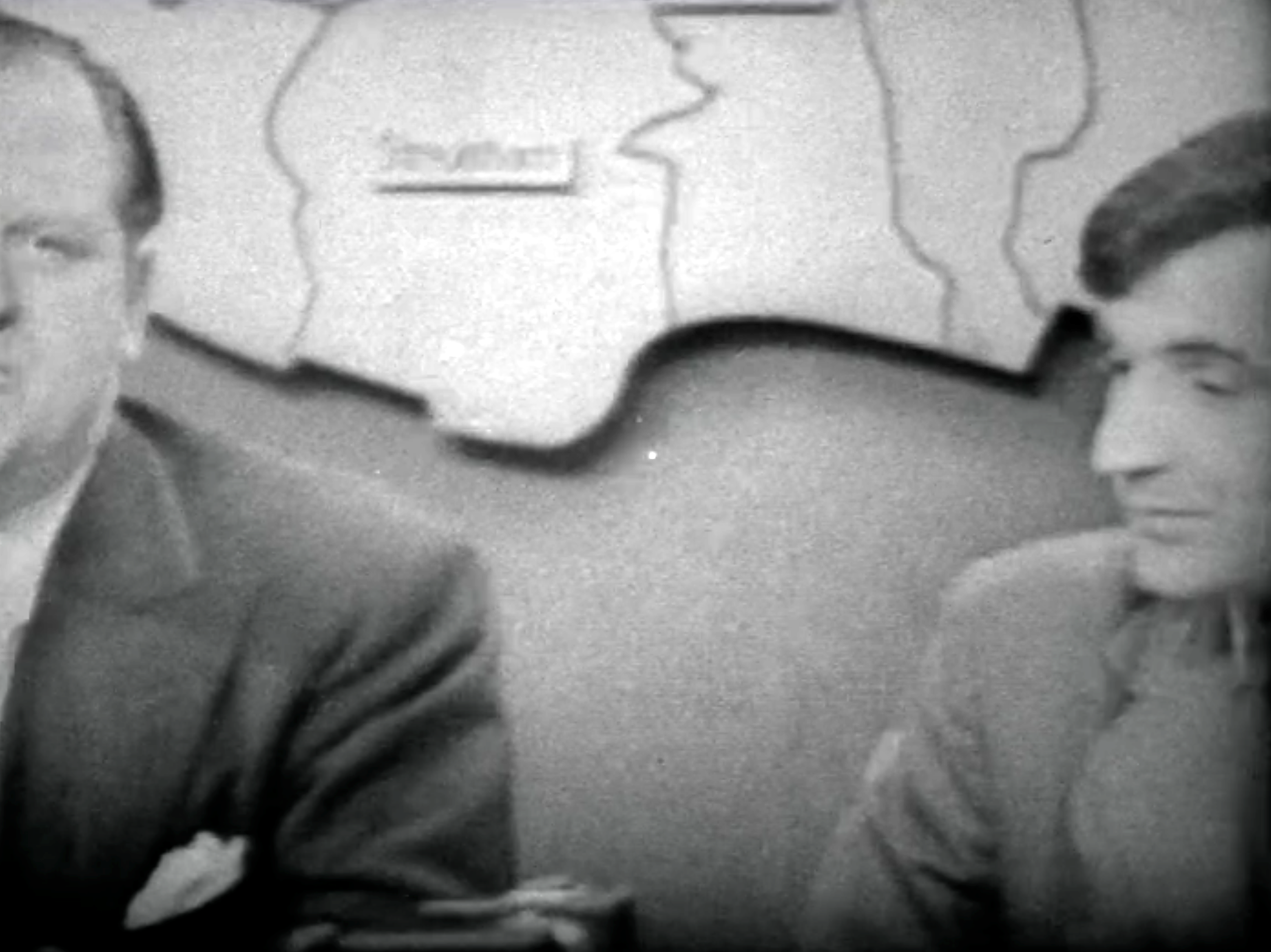
David Butler’s fellow psephologist Bob McKenzie isn’t in Lime Grove to begin with, having been sent to interview a bigwig at Conservative Central Office. For connoisseurs of election programmes, this doesn’t feel right at all: you expect him to be in the studio from the off, sitting not far from the others with an assortment of charts and devices close at hand. Thankfully, McKenzie does arrive later, as is he suddenly there in the studio, sitting on the other side of Dimbleby to Butler, all of them squashed together in front of the same giant map of constituencies.
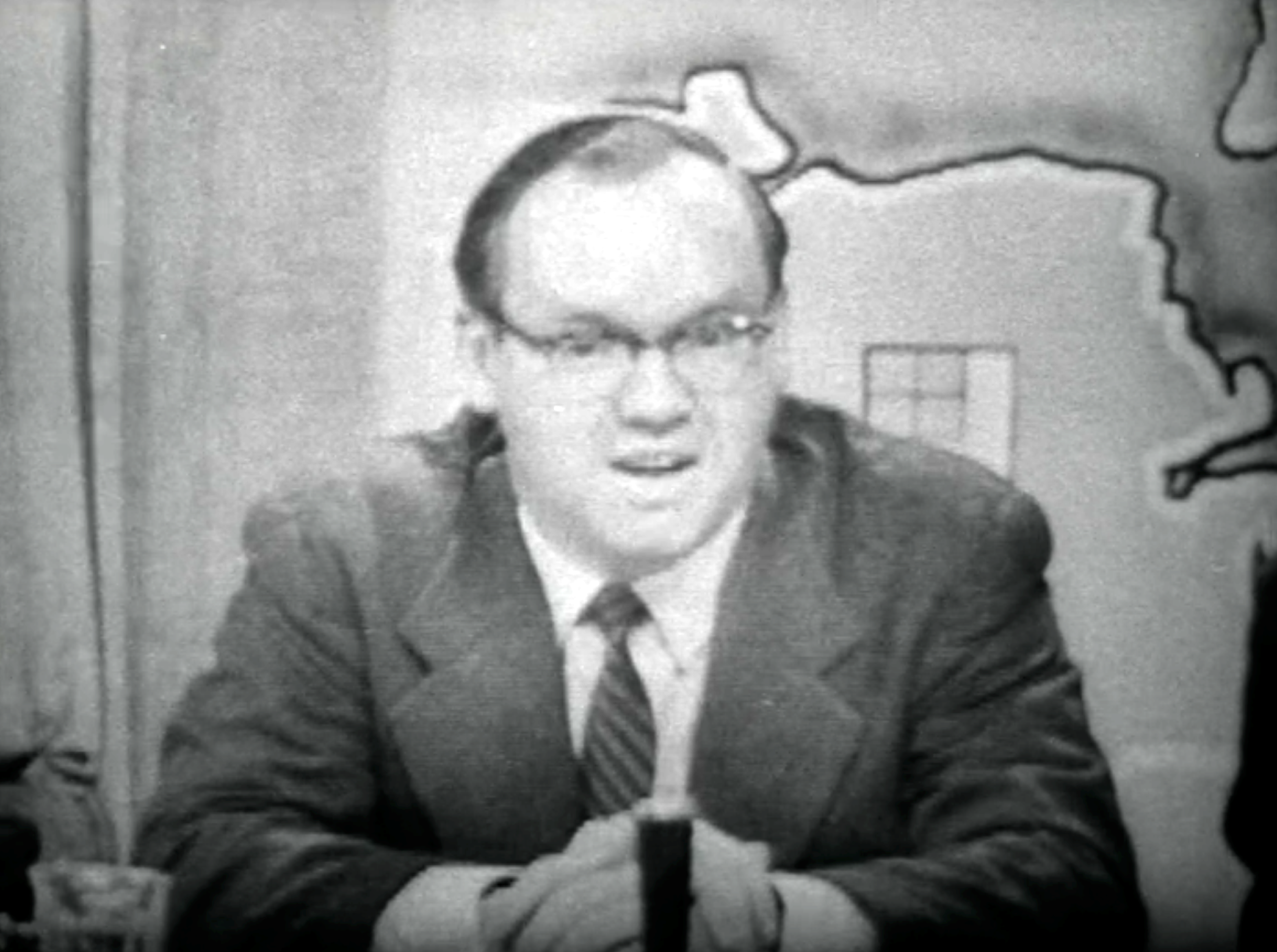
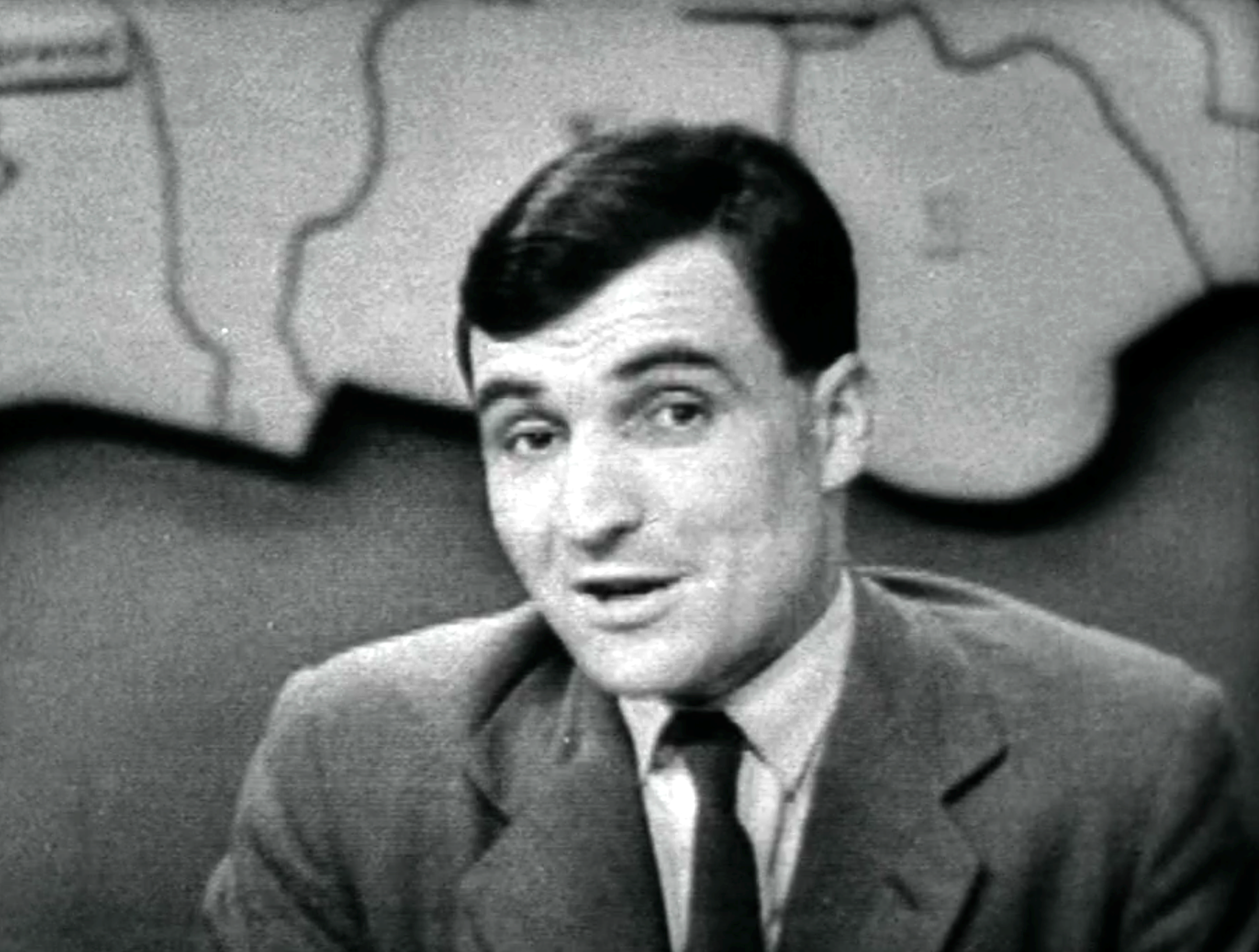
The coverage is spirited and confident, with a sense of economy and restraint, almost anti-spectacle, certainly compared with what is to come in the years ahead. Perhaps there was a reluctance or a nervousness among the BBC suits at being seen to splash too much money on the television service, at time when radio was still so dominant. Or perhaps there just wasn’t much money to splash about, even if they wanted to. But there is a coherence within the restraint, with thought given to the way the presenters sit and interact in the studio, and a concern for a smart and polished appearance.
Four years later, the balance has started to tilt away from the frugal and towards the grandiose. The October 1959 programme boasts a greater sense of occasion and more studio space. Someone seems to have realised the value of making an impression both through authority and through visual design. The two are not irreconcilable – indeed, they are mutually beneficial. We’re still at Lime Grove, but in a ritzified Lime Grove. There is more furniture and consequently more fun.
The new approach is evident right from the start. Viewers are not greeted by Richard Dimbleby at a desk, introducing us to his colleagues from a seated position. Instead he is up and about, roving around, pointing to people and gesturing at things. Straightaway we are treated to a full tour of the studio and all its furnishings, with Dimbleby making a great fuss of all the objects and gadgetry that surround him.
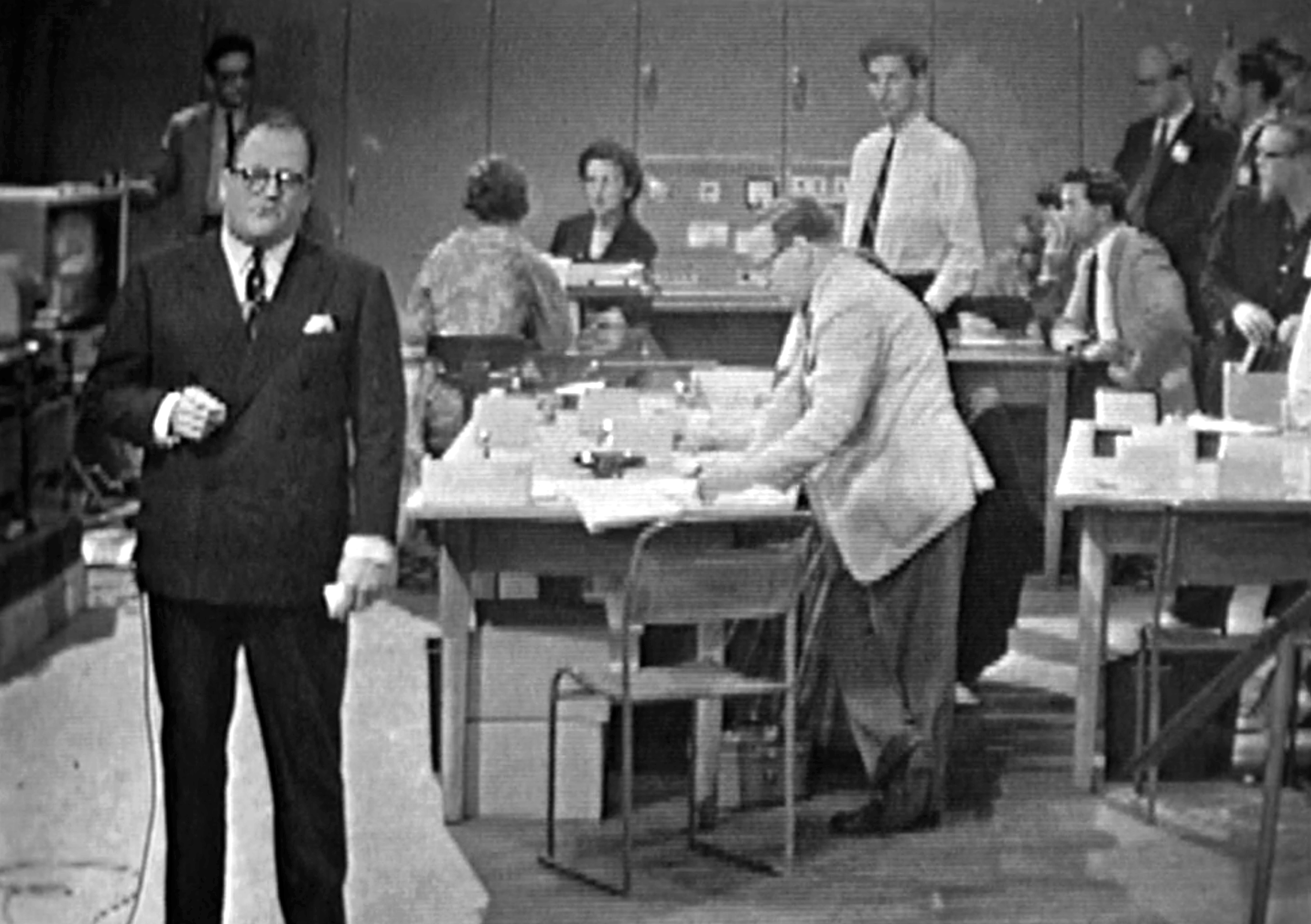
The metal-framed chairs are still present, but the tables look cleaner and the floor tidier. The electronic equipment feels more cutting edge and exudes an air of importance by virtue of being stacked on a neat row of trolleys along the wall.
The idea of the backroom gang sharing the same floor space as the presenters is simple but inspired. It establishes instantly a feeling of a nerve centre, of everyone being in this together, of the BBC straining every sinew, and of something very special about to happen. No wonder they stuck with this approach for the next 20 years.
Dimbleby bubbles with pleasure during this opening segment; there’s a lovely moment when he points across the studio at David Butler while sporting a big grin on his face.
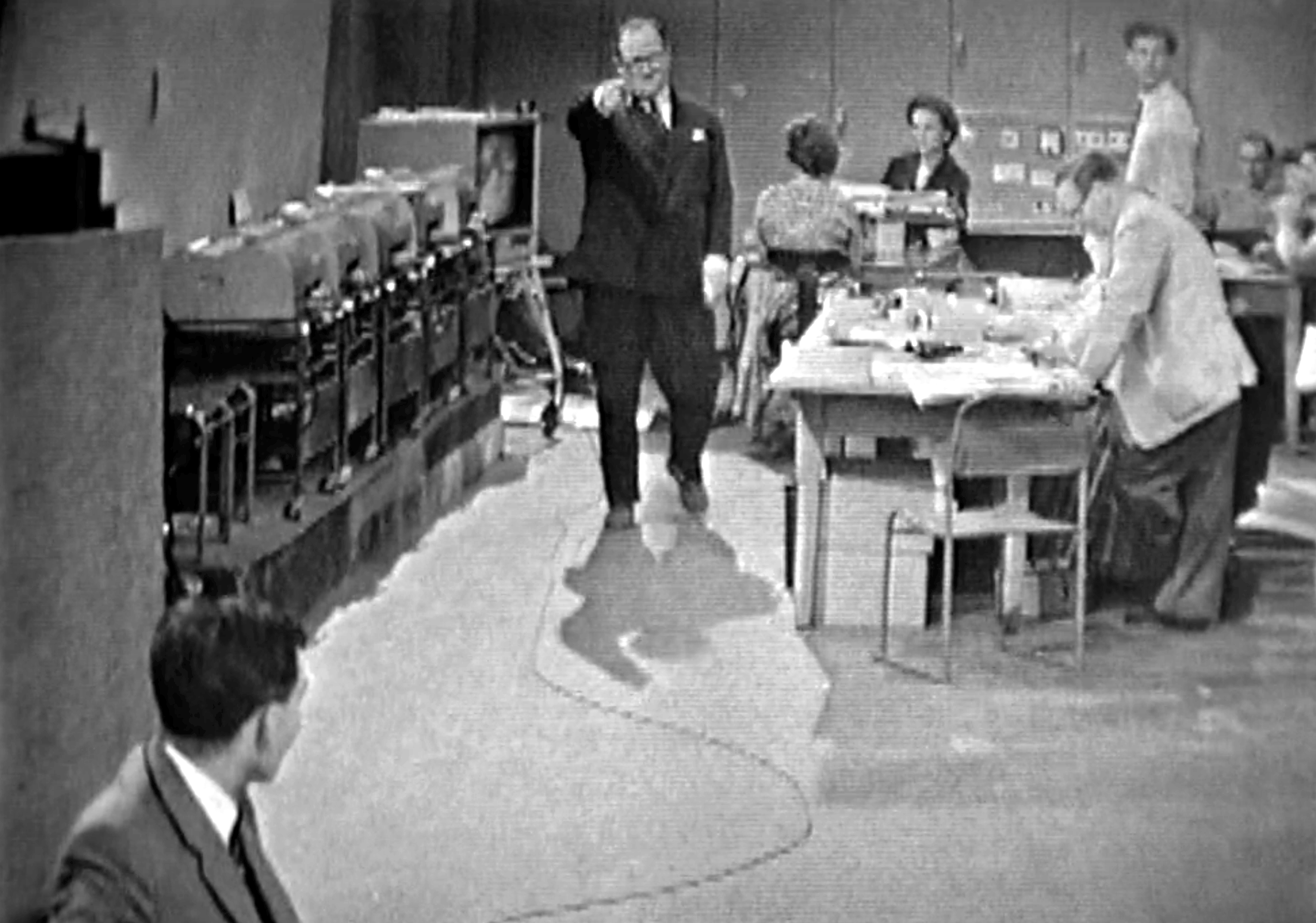
Like everyone else, David Butler has more room, seated at right angles to Richard Dimbleby with a full desk of his own, together with what looks like a long piece of apparatus for calculating the electoral swings. Butler’s assistants are on his right, once again looking well turned-out.
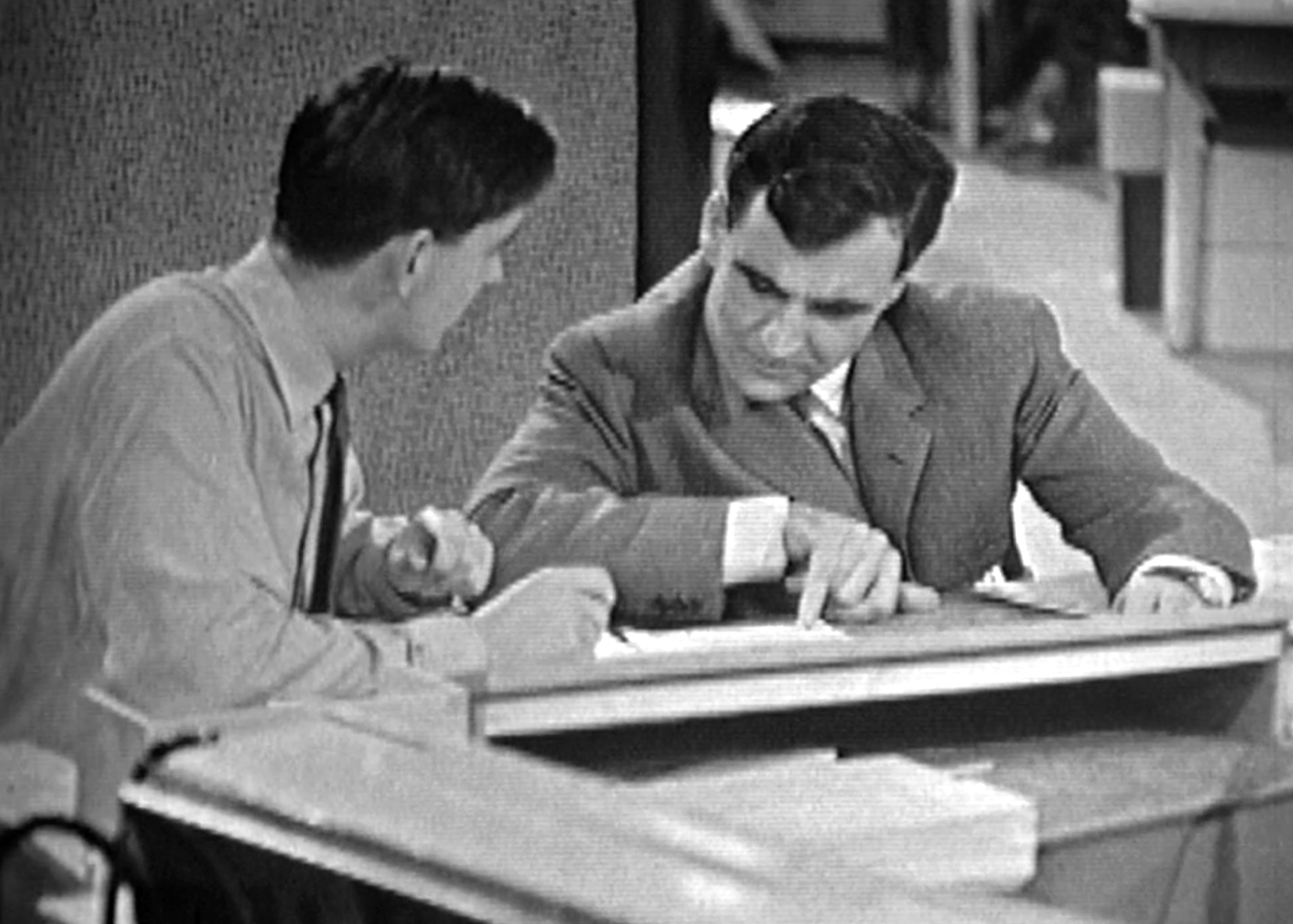
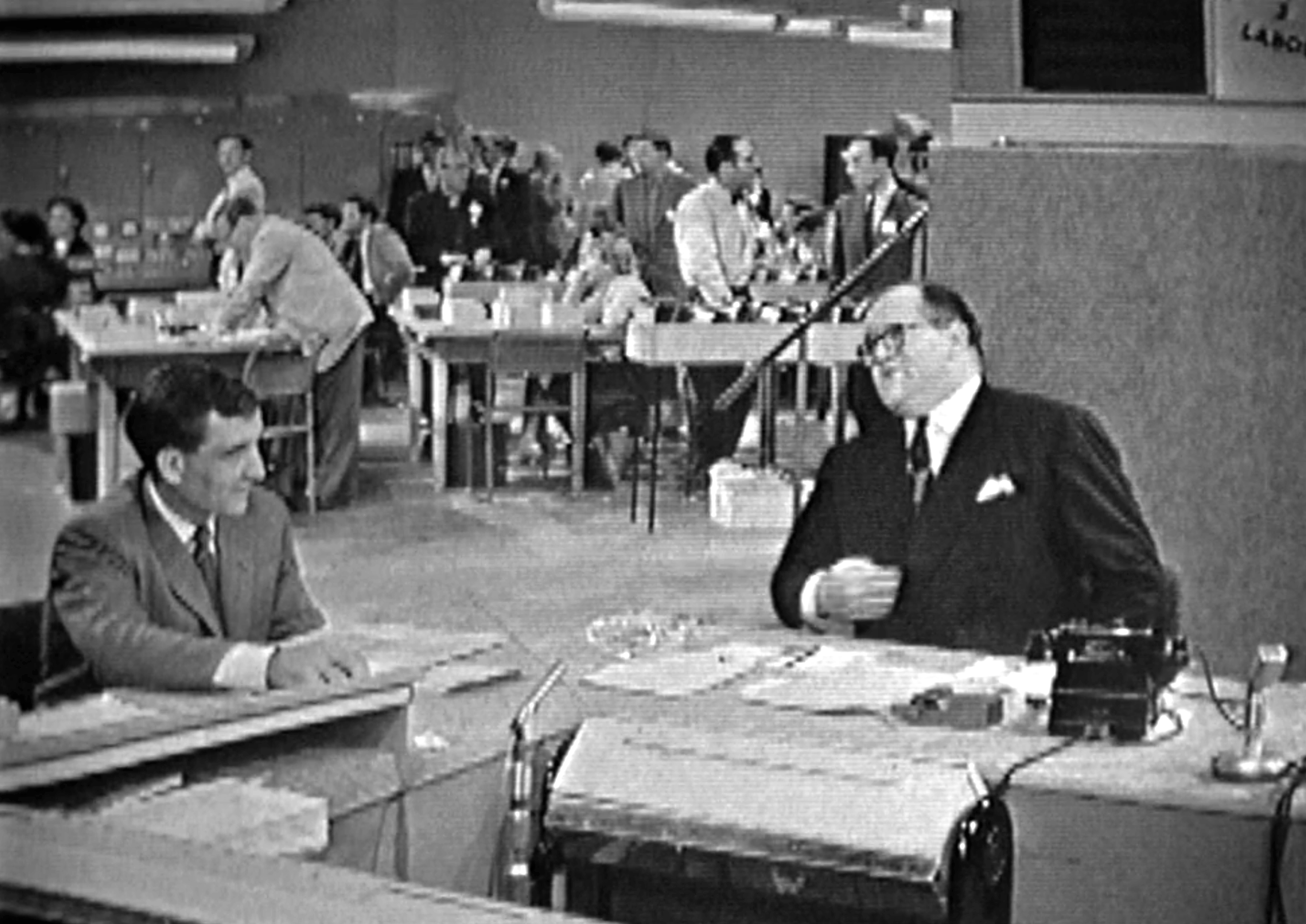
We see important-looking telephones and the tops of large monitors and lots of cables. We also see, for the first time on an election night and most definitely not the last, a very long desk. This one isn’t particularly flash: just solid, reliable and imposing, much like the people behind it.
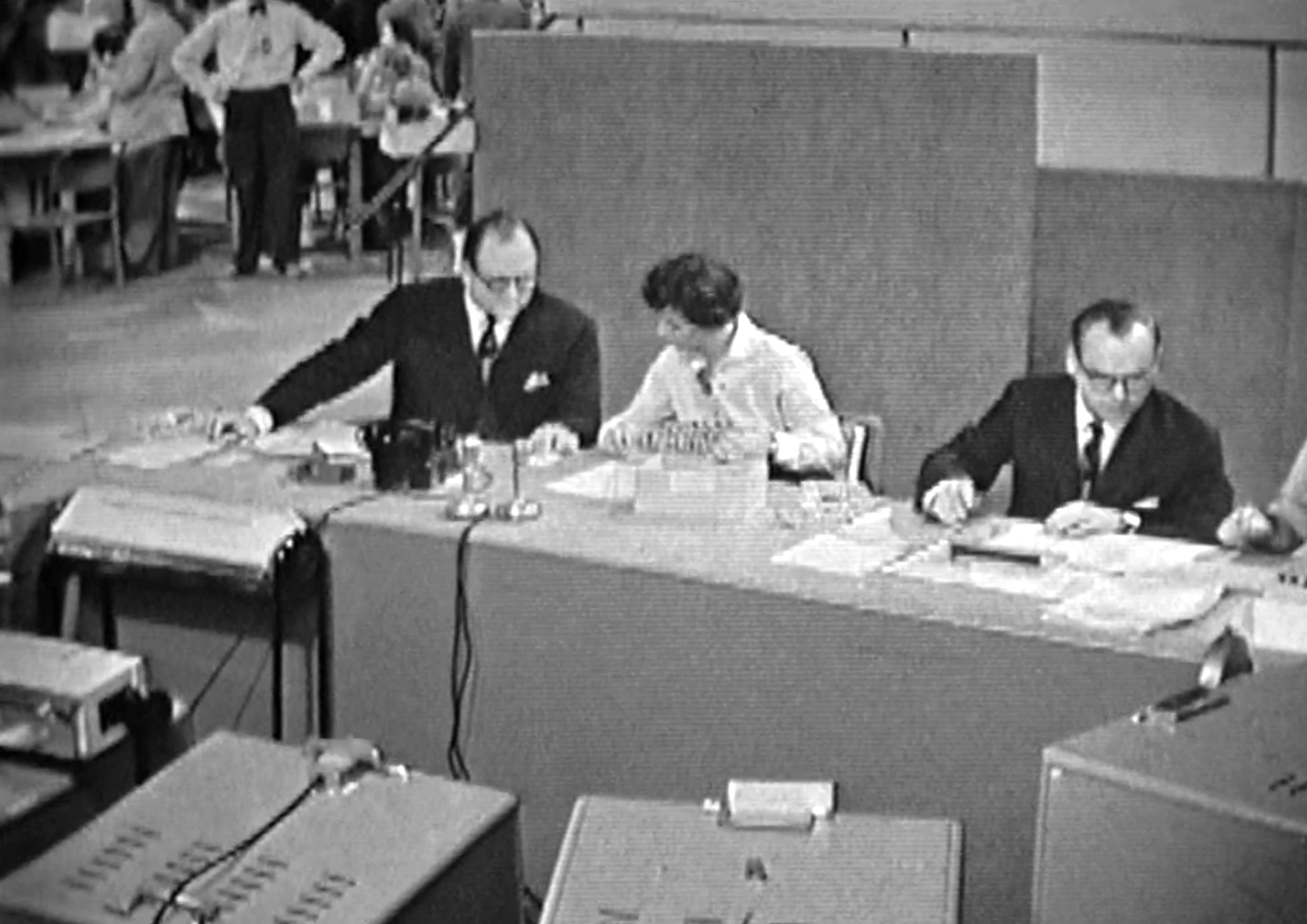
The desk is long enough to accommodate Dimbleby, his assistant – unnamed but in charge of the card index – plus Robert McKenzie and his own helper. McKenzie doesn’t stay seated, however. He is allowed to stand up and walk about, just like Dimbleby. But unlike Dimbleby, McKenzie gets to walk about on not one, but two levels.
For here is the very first split-level election studio, with a raised platform (and safety rail) installed to enable McKenzie to strut in front of assorted charts and illustrations, looking down on the others, who in turn are forced to look up to him.
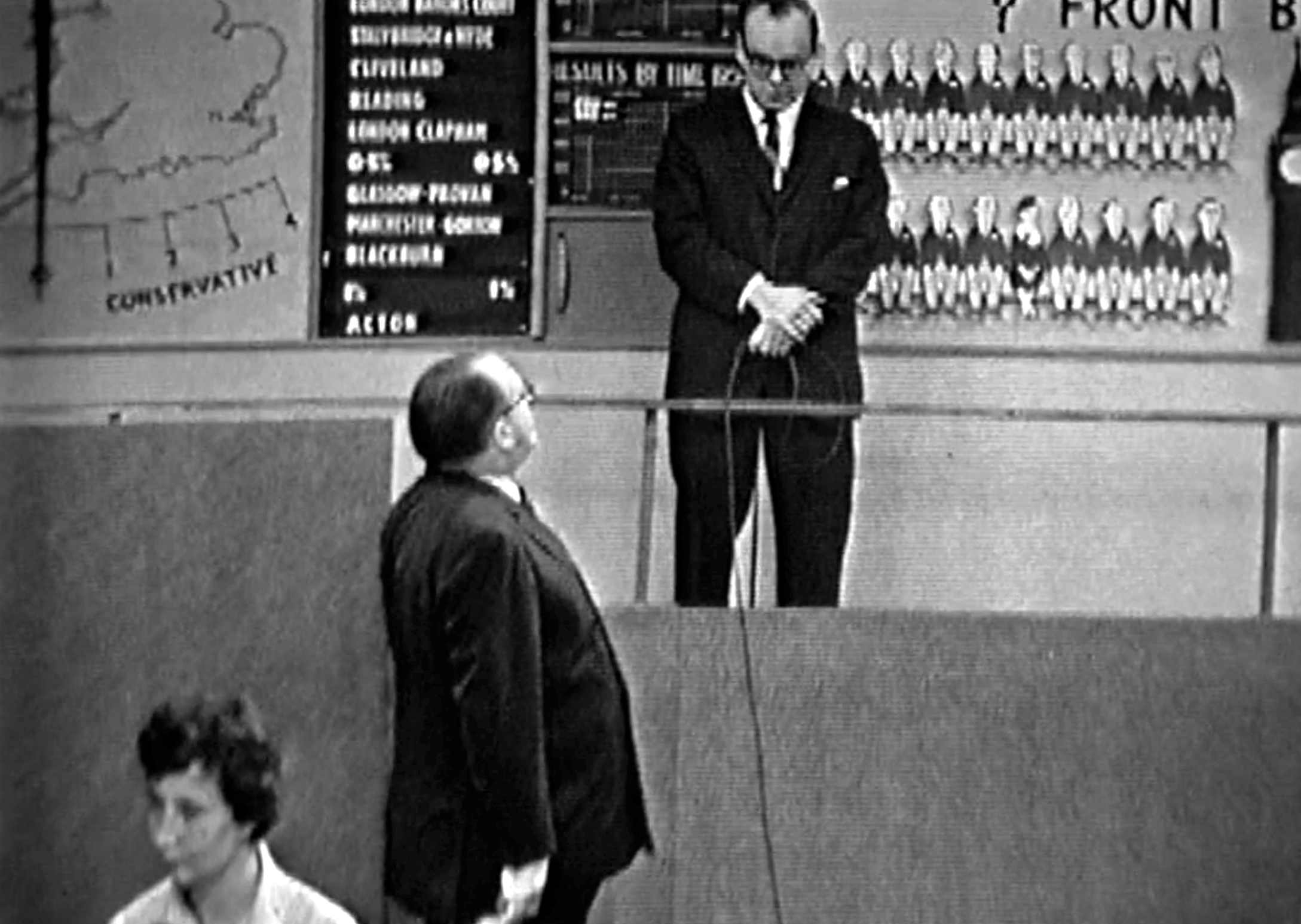
It’s another simple but hugely inspired idea. Indeed, it’s one that has a transformational impact on election coverage. It solves one of the biggest problems of 1955: presenters sitting in front of – and obscuring – the maps and charts. It enhances the drama and the storytelling of the occasion by enabling a greater variety of camera angles and studio perspectives. It also introduces movement and energy into proceedings; the viewer and the camera are not staring for hours at people sitting down.
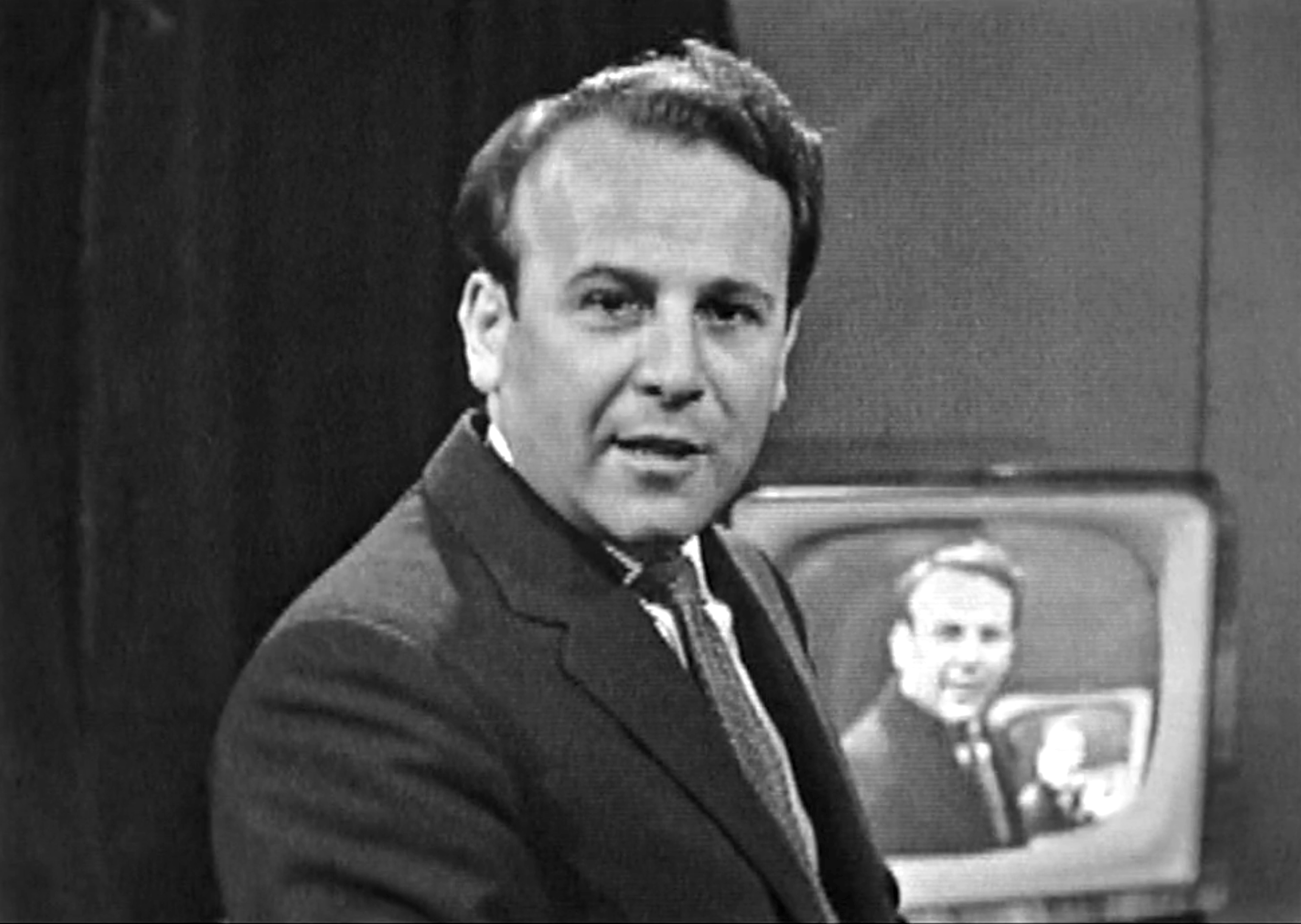
One further staple of election coverage makes its debut in 1959: the in-vision television set. Though not strictly a piece of furniture, these items nonetheless help furnish the studio as much as any of the desks and chairs. They fanfare the fact that technology is marching onwards and the BBC is marching in step. At one point, Derek Hart watches himself on television watching himself on television watching himself on television. The future has arrived!
*
By the time of the next general election, in October 1964, the BBC’s Television Centre was ready to welcome Dimbleby and co to the capacious splendour of Studio 1. This enormous space, roughly 100ft square, went into use only a few months earlier in April. It would be the home of most BBC election results programmes from now until the early 21st century and wisely so. A general election is political spectacle of the highest order; here, at last, was a place for it be a televisual spectacle as well.
1964 certainly delivers on that score. The opening seconds of the programme are still the most thrilling curtain-raiser to any election coverage, with more than a hundred people simultaneously walking into the studio: a stunt that immediately signals the vastness of what is about to take place, both in terms of ambition and resources. It also signals the intention of the BBC to do this sort of thing bigger and better than before.
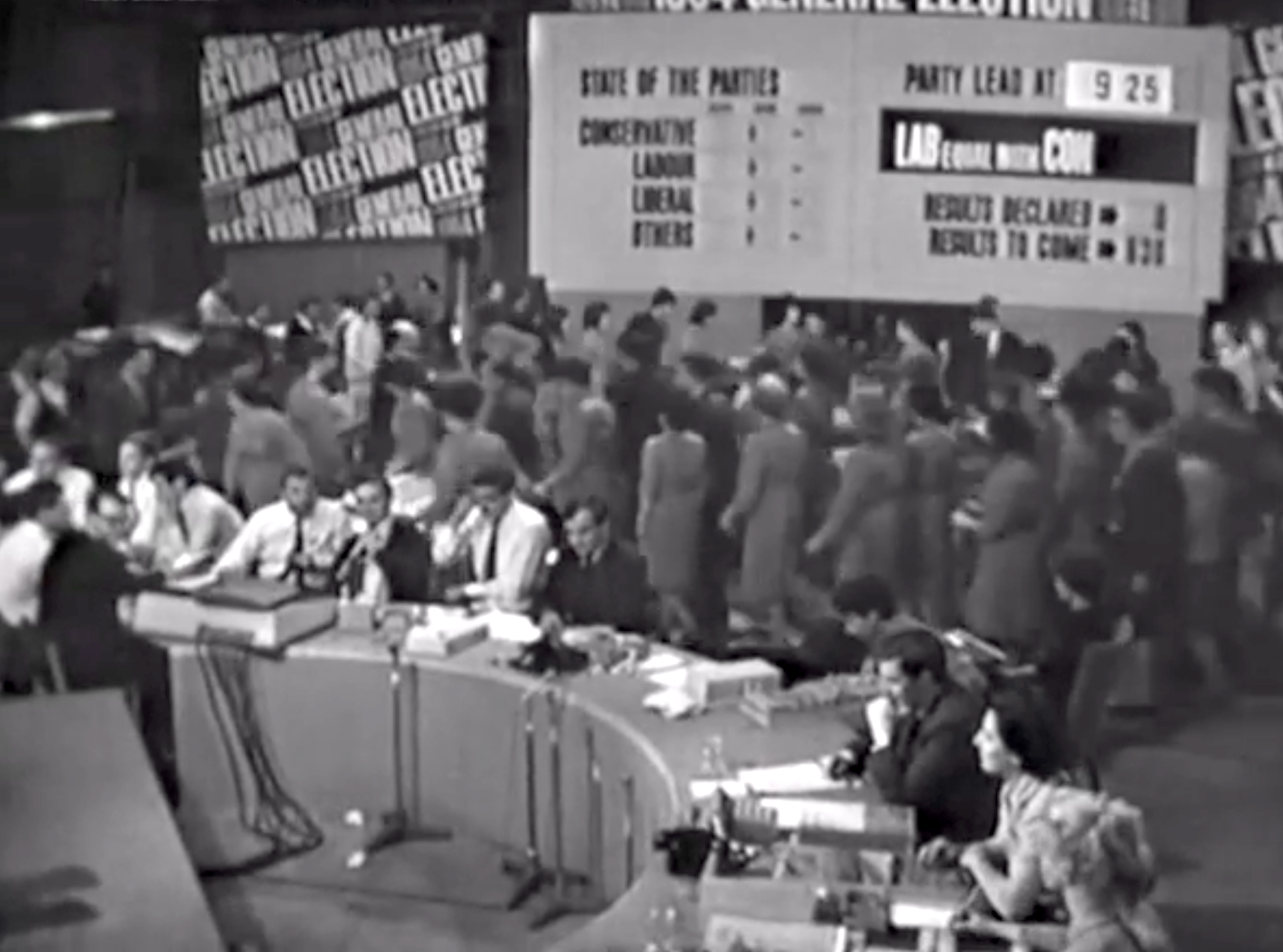
Out there in front of the gathering hordes is the very long desk, but with two crucial changes (and improvements). First, it is now long enough to accommodate the whole team, with nobody forced to sit at adjoining right angles; and second, it is now curved, making it easier for Dimbleby to keep everyone in his eye-line and for everyone, even those at either end, to see and talk to each other clearly.
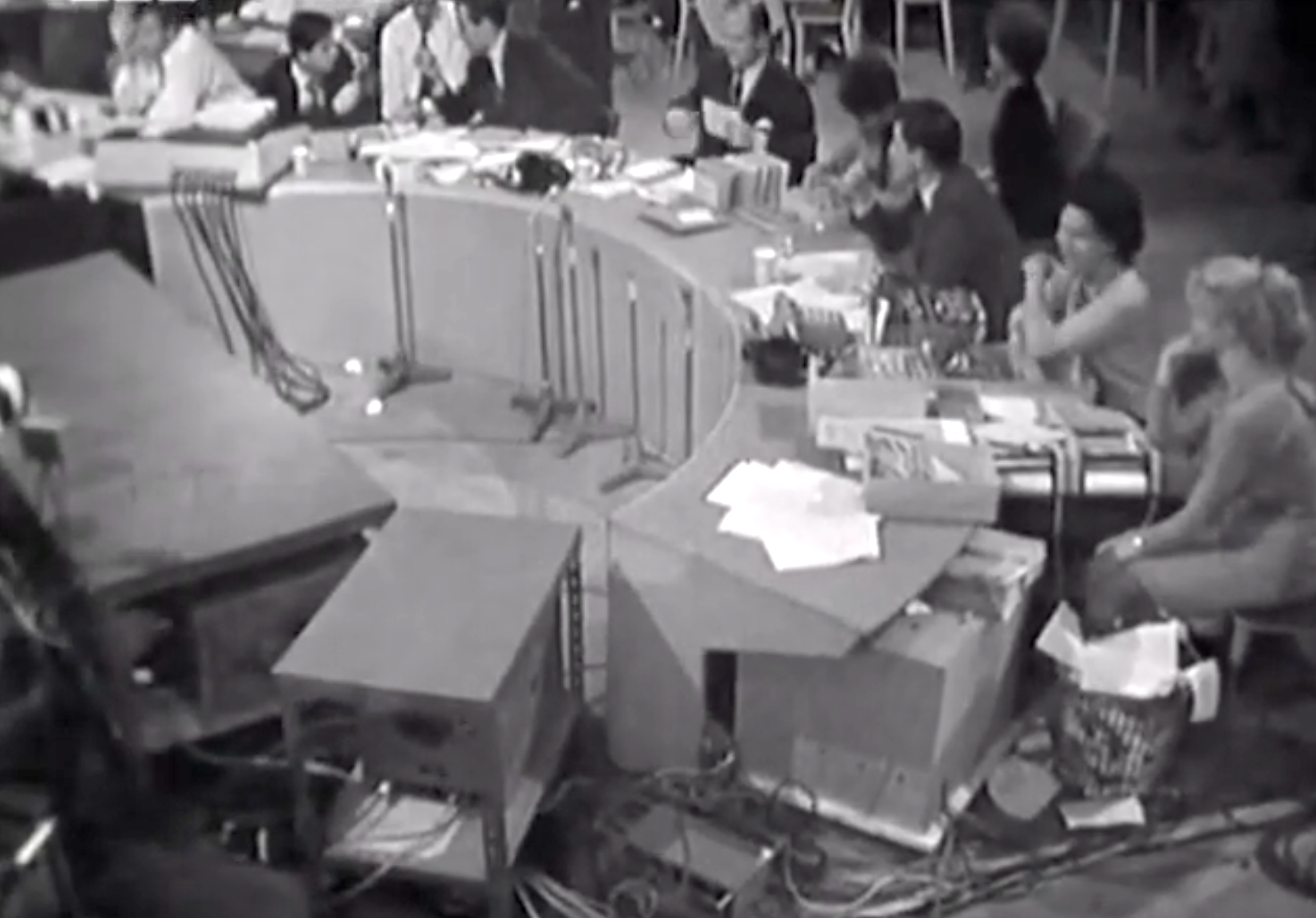
The curve also allows everyone to see into the row of monitors that sit in front of the desk, housed inside a functional but efficient custom-made piece of furniture: another step forward from 1959, when the monitors sat pretty much naked on the studio floor.
There’s still precious little cable management, though. Wires snake all over the place, especially at either end of the long desk, where they thread their way around overflowing waste paper baskets, other pieces of equipment, and the legs of both chairs and people. Part of one end of the desk has been cut away to allow more equipment to be shoved underneath, together with even more cables.
The whole resolute edifice has been bolted together smoothly from individual panels. All the team have enough space to sit together comfortably. No shoulder-brushing or paper-entanglement here. In close-up shots, you can see the nails that have been used to hammer the top of the desk into position.
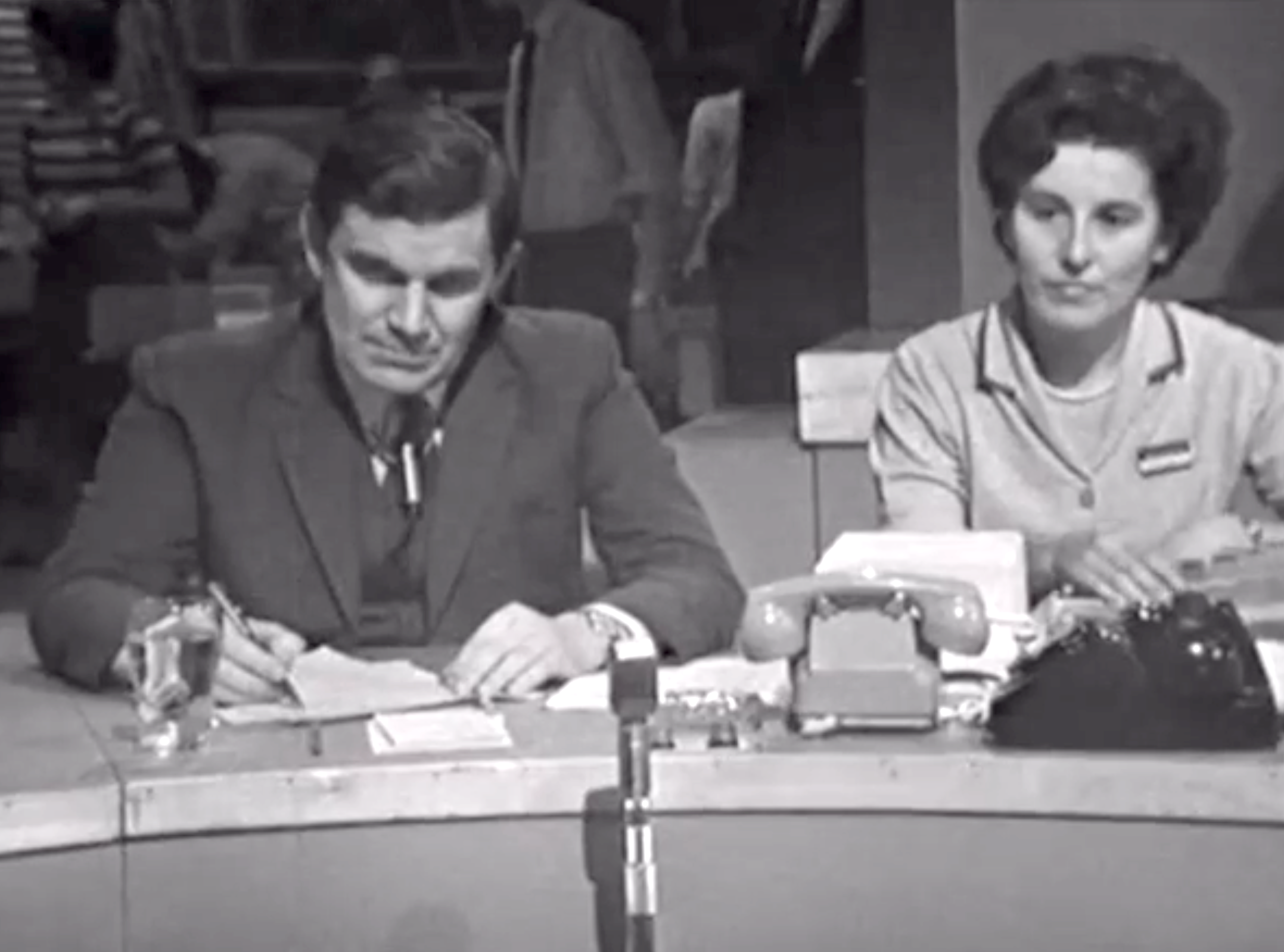
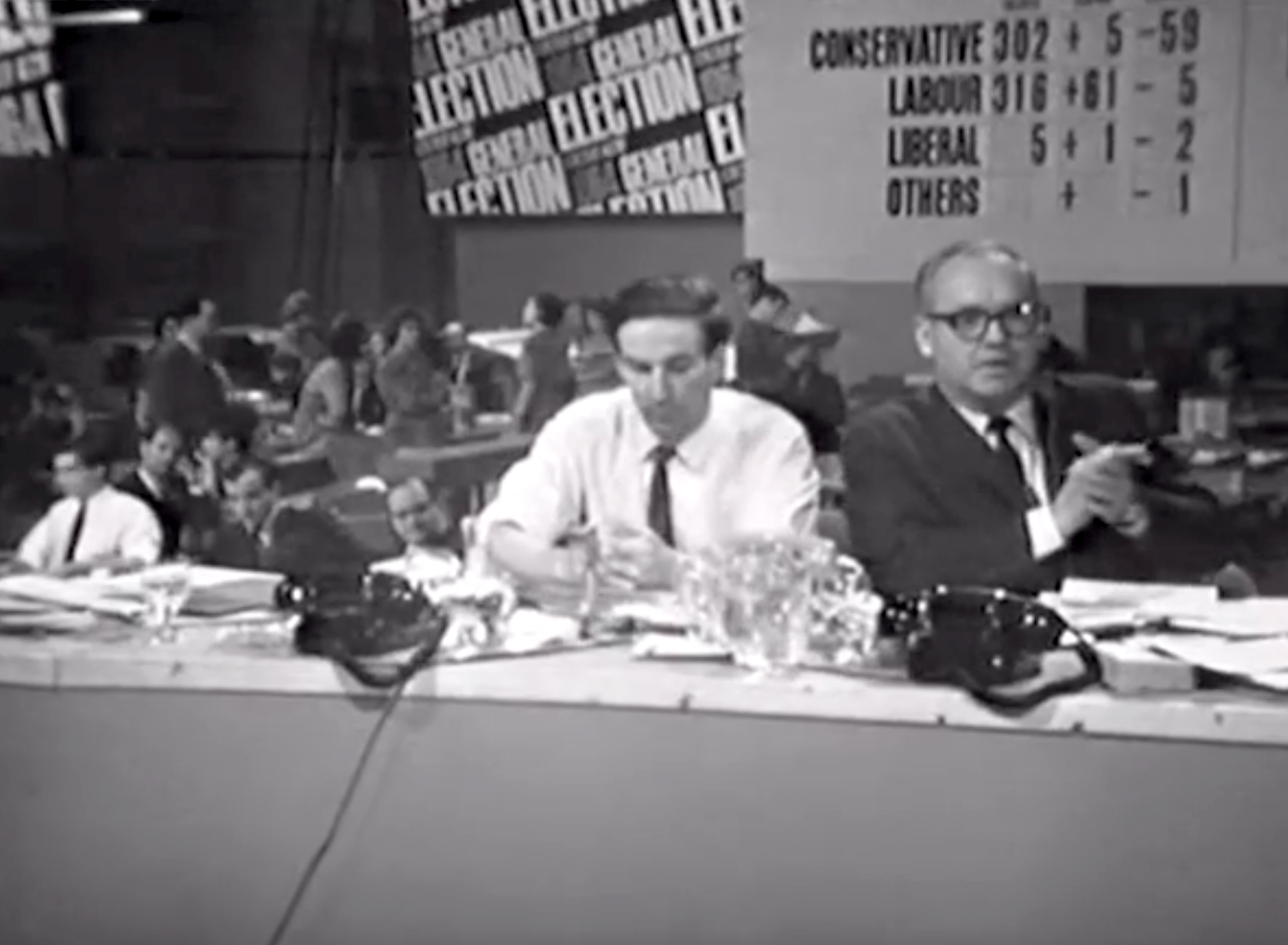
The desk is big enough to accommodate Dimbleby’s voluminous card index: something he compiled himself ahead of every election. It’s also big enough to support not just a telephone but several telephones – the different colours presumably indicating different lines of communication. It’s a mighty thing indeed.
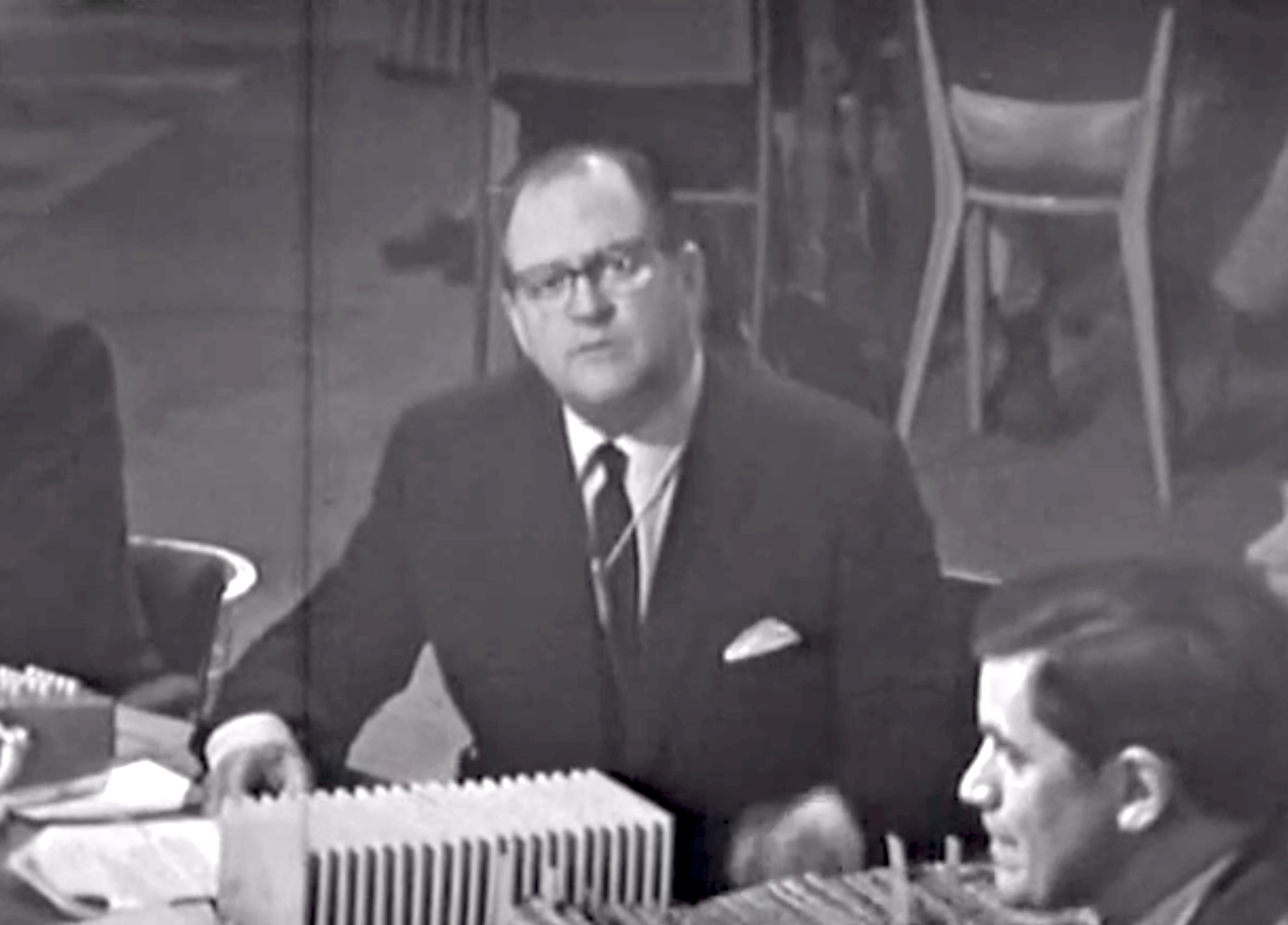
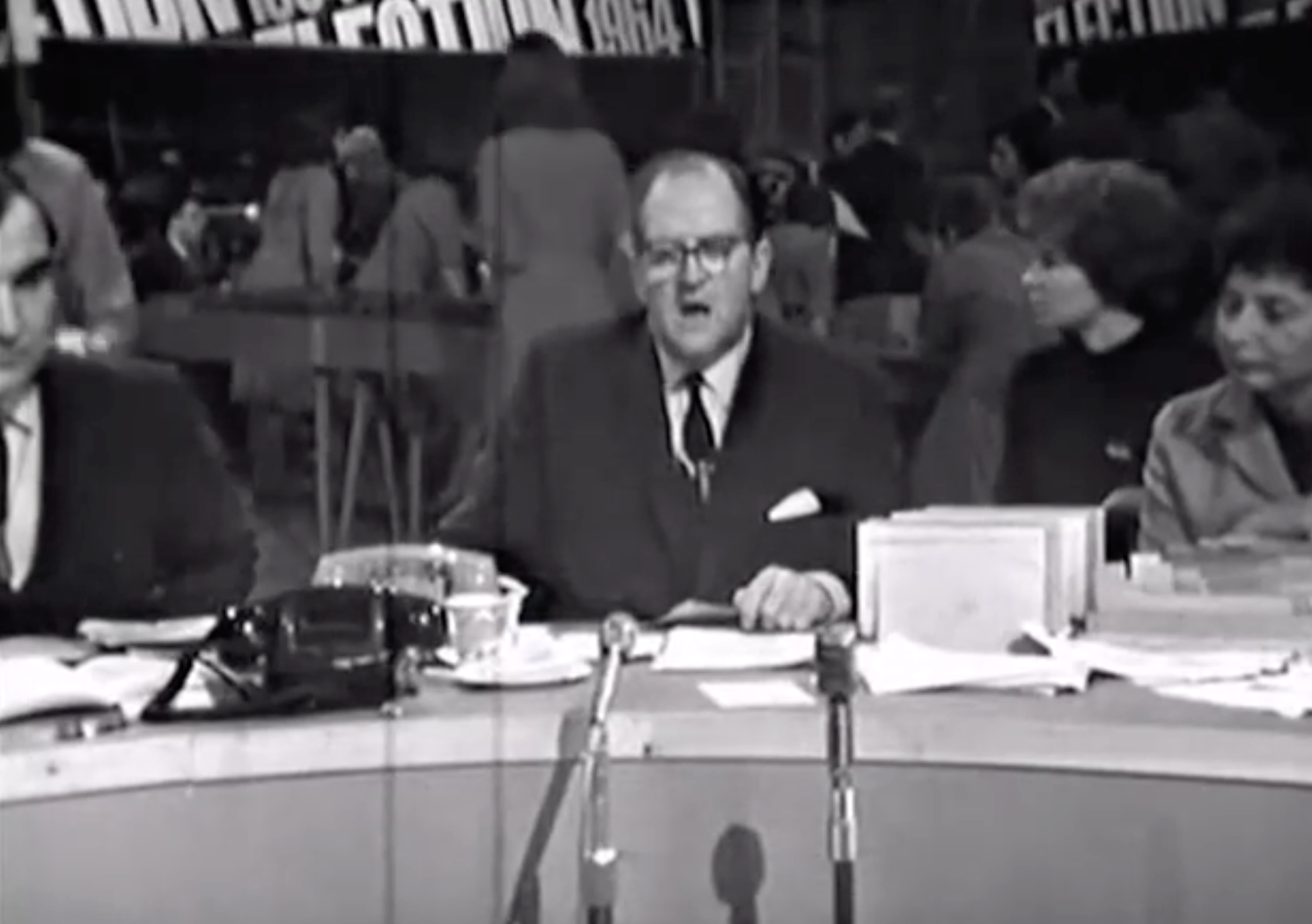
Robin Day – making his debut on the BBC’s election coverage – doesn’t just have two telephones on his desk. He has no fewer than four, one of which has special chunky buttons on it, while at right angles to his desk is one the largest television sets yet seen.
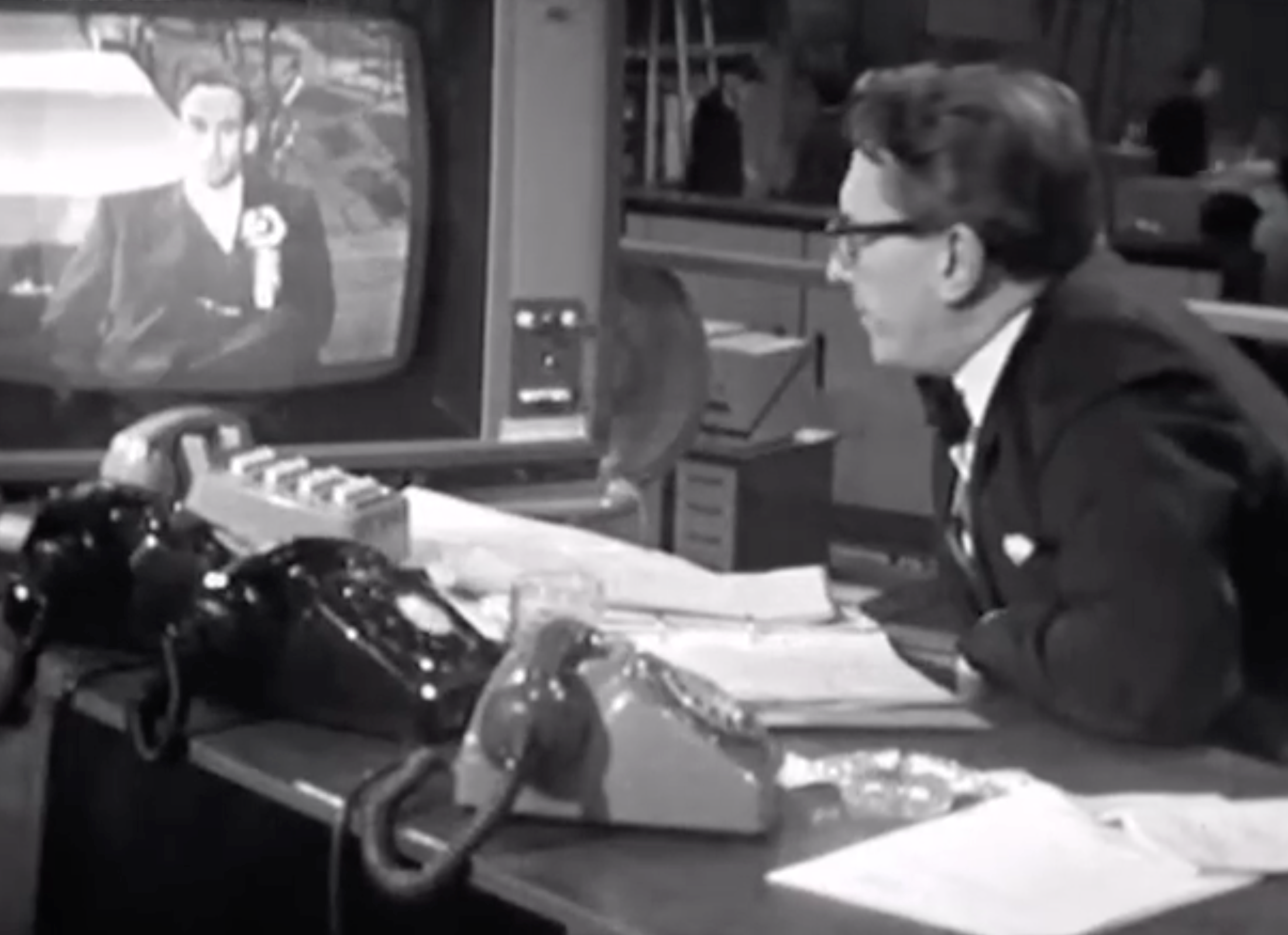
Day is not with the others on the studio floor, however. In an evolution of the split-level idea from 1959, Day is ensconced on his own private elevated enclosure, an area into which only his guests may enter. We never see any of the other presenting team up here; this is Day’s domain, his election eyrie, furnished bountifully with an enormous writing desk, snazzy plastic swivel chairs, ashtrays and sundry items to keep its occupants comfortable for the duration. A very desirable residence.
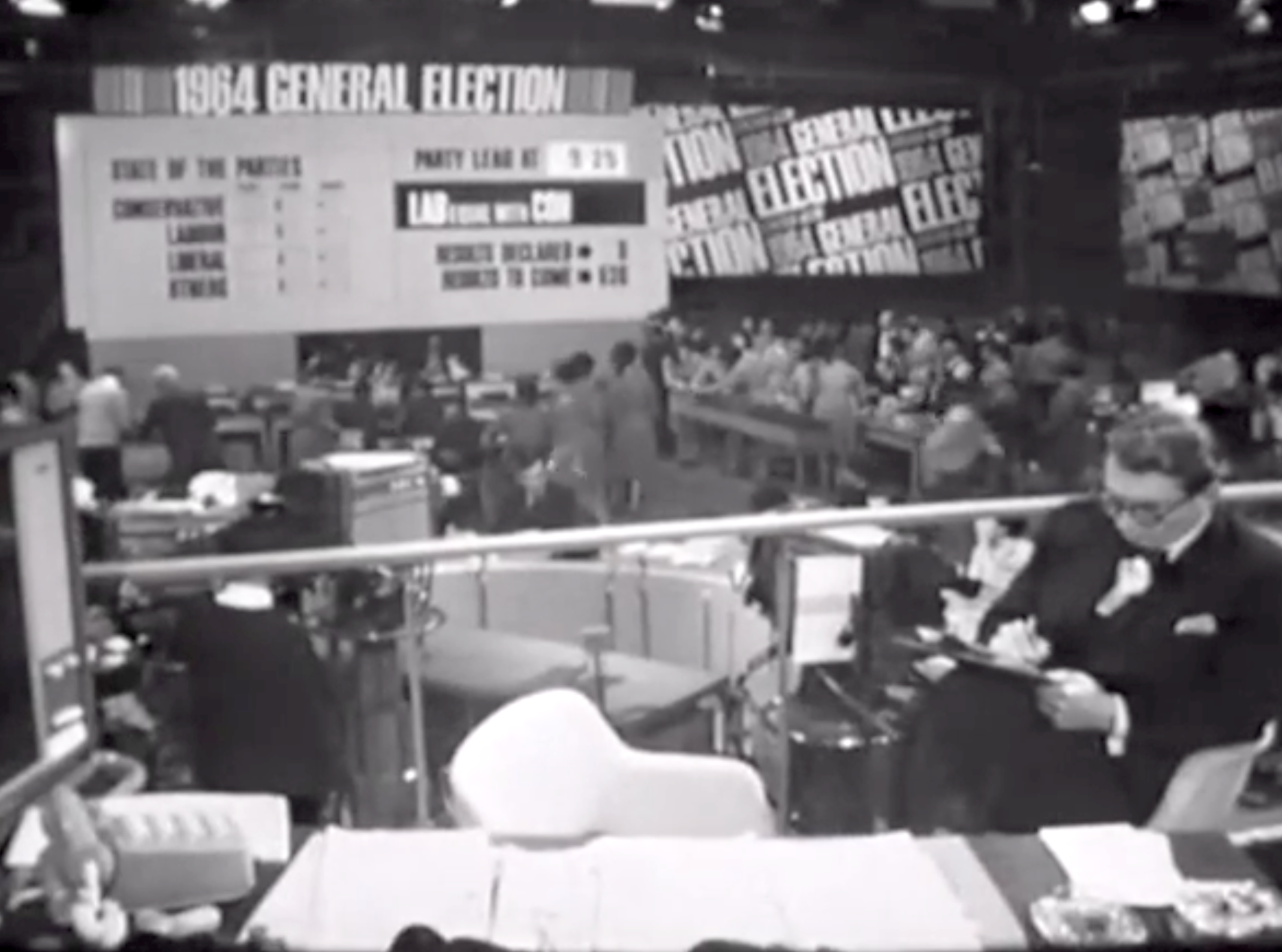
Cliff Michelmore is also on a platform, but at a lower level than Robin Day (perhaps at the latter’s insistence), meaning we not only have a split-level studio but also a multi-level studio. This in turn means even more positions and perspectives for cameras to shoot from, through and around, giving the viewer an even greater appreciation of the studio size. Here is an operation that extends upwards as well as outwards.
Michelmore hasn’t been given the same accessories as Day (again, note the hierarchy) but the minimal furnishings of what could be termed his conversation pad are nonetheless quite stylish: a chic banquette and a nest of occasional tables on top of a slightly raised dais, around which cables can be draped safely.
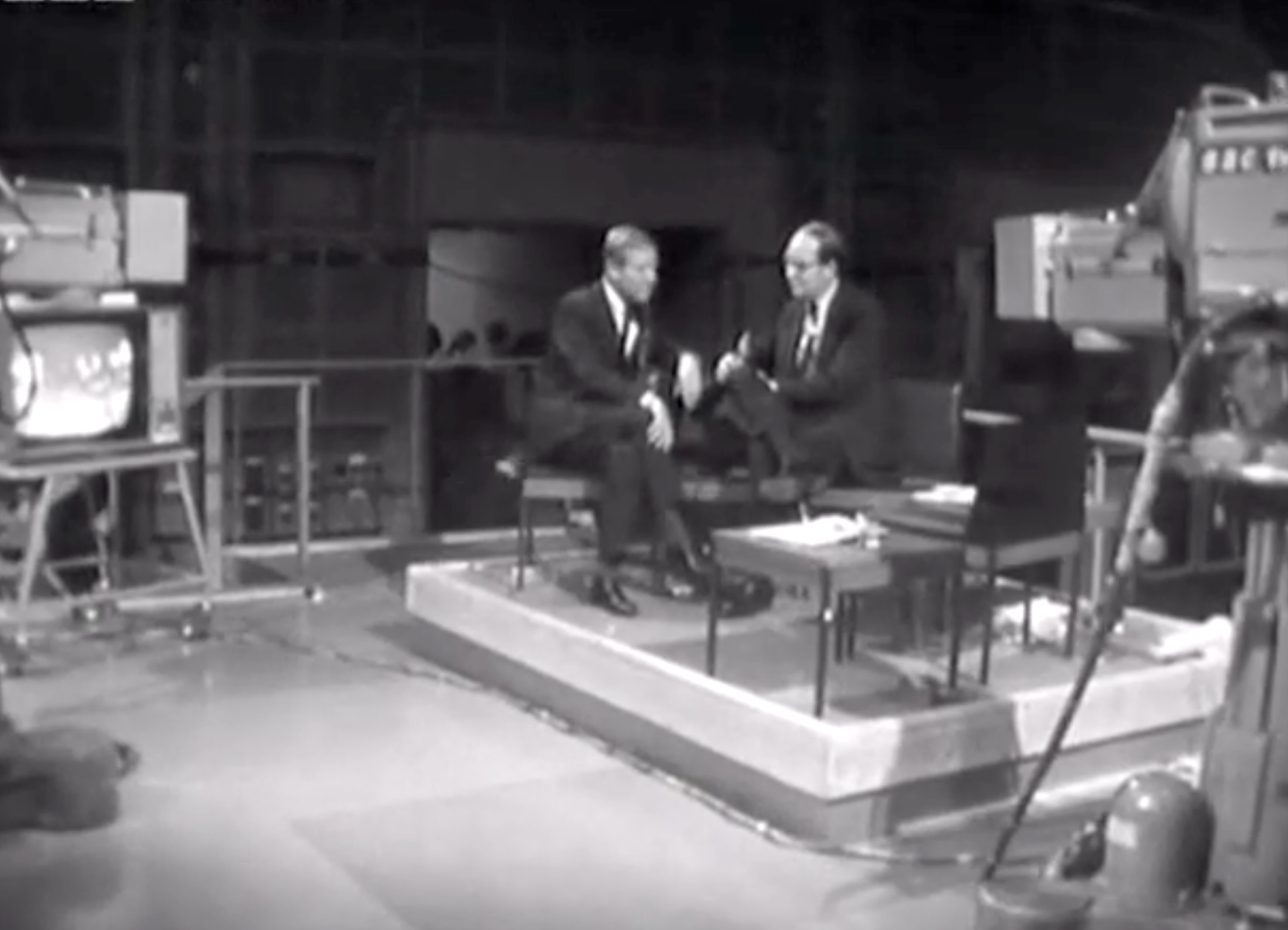
Look at how much of the workings of a television studio – its electrical nervous system – are boldly, unashamedly, on display. This approach is of a piece with that popularised by That Was The Week That Was, which aired on the BBC in 1962 and 1963 and which surely had some influence here – chiefly the notion that how something is put on television is just as important (and as interesting) as what is being put on it.
Thanks to TW3, viewers at the time must have been familiar to seeing the BBC’s innards being outwardly displayed to this extent, so it’s perhaps more of a shock to modern-day audiences, for whom all this intriguing and impressive paraphernalia is usually tucked out of sight.
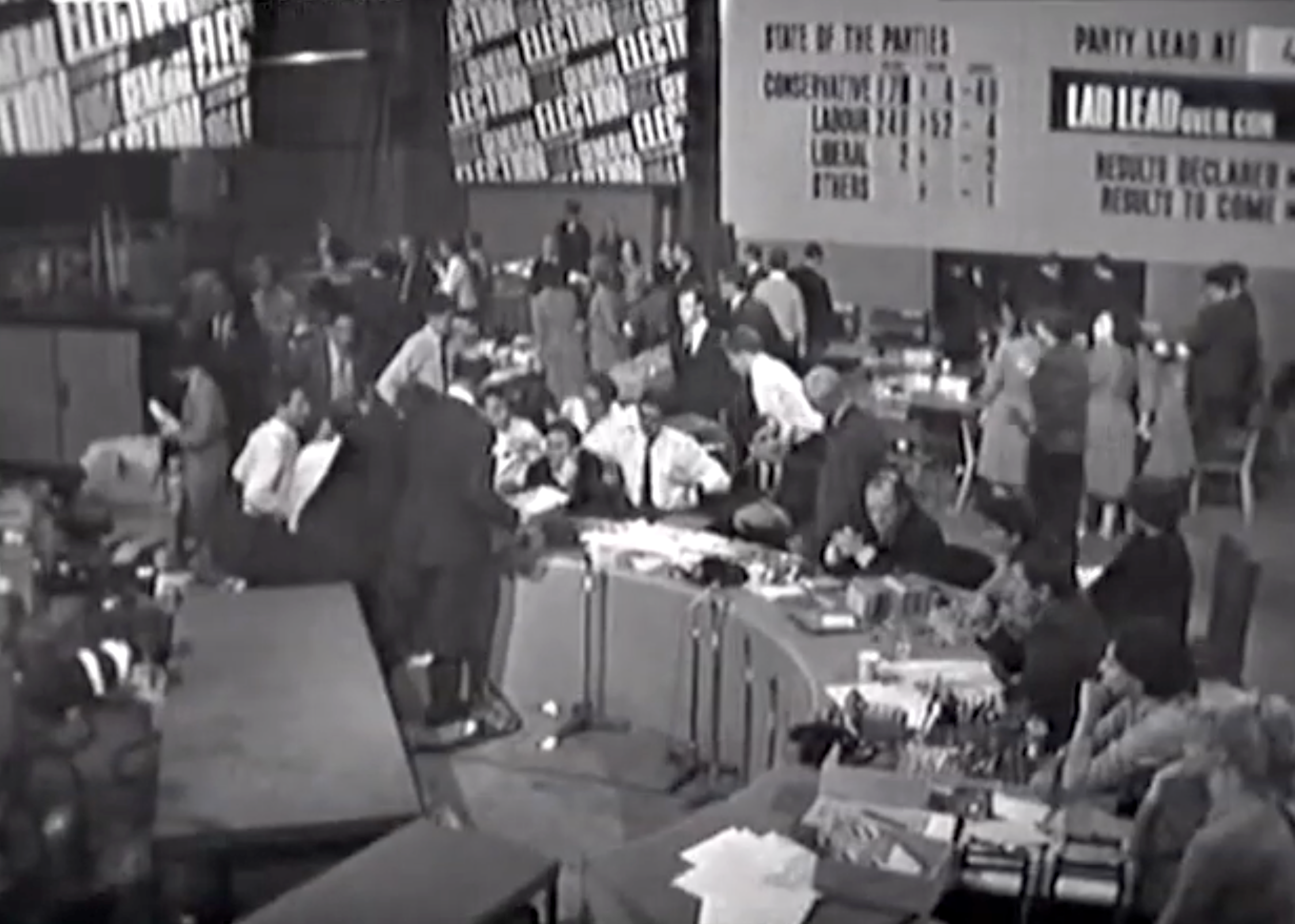
Just as traffic expands in number to fill a newly-enlarged motorway, so paperwork expands in volume to fill a newly-enlarged election desk. By the end of the night you can barely see its surface, which poses a problem when the canteen staff come round with coffee and sandwiches.
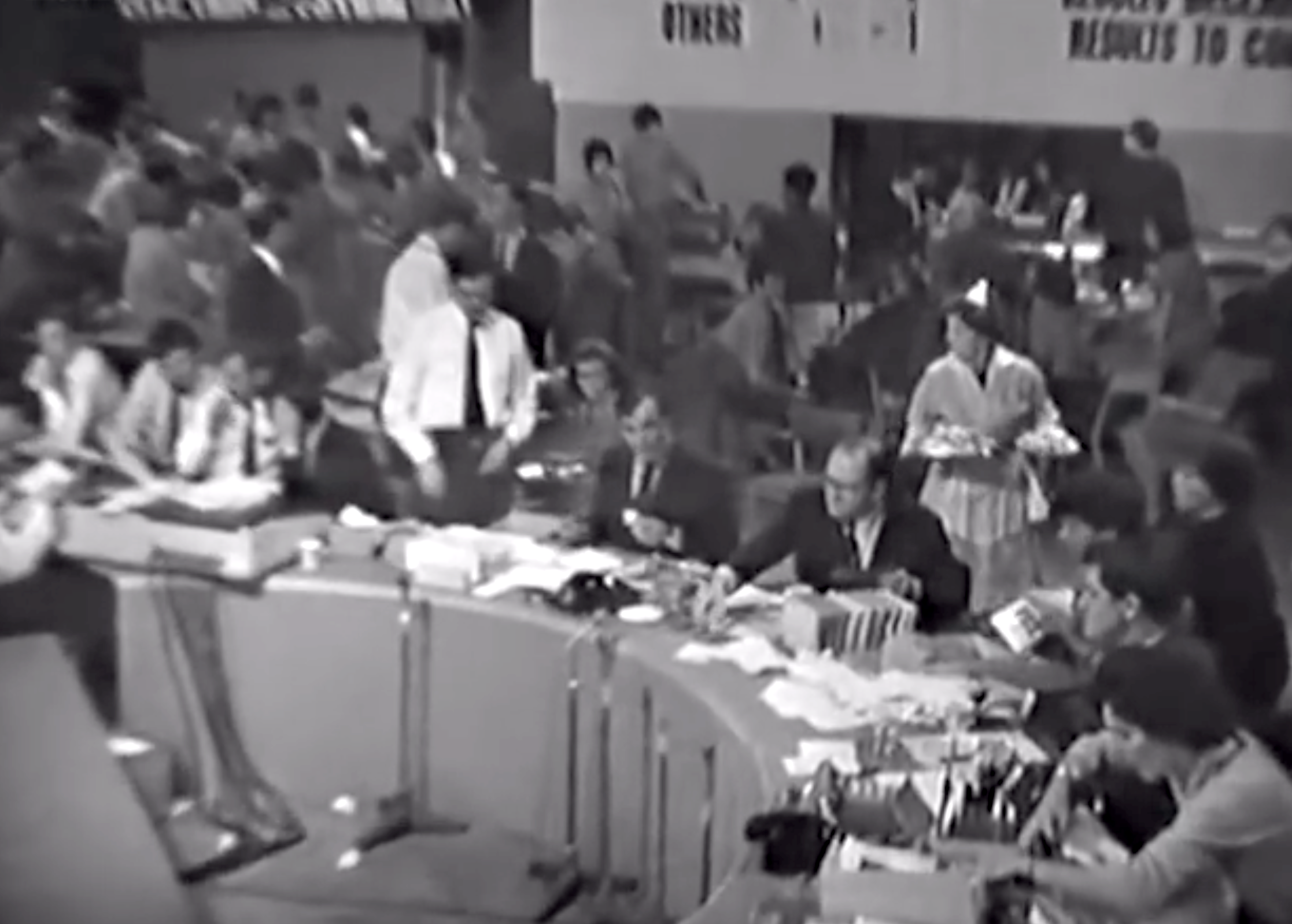
Elsewhere, it’s good to see the standard of chairs has improved since 1959. Some of the wooden seats used by the result-checkers look more sturdy and comfortable, though a few of those ghastly metal-frame affairs are still in evidence.
Wooden tables of all shapes and sizes fan out behind the presenting desk, and someone has wisely installed striped ramps to house the most dangerous and/or important cables, especially near the huge computer.
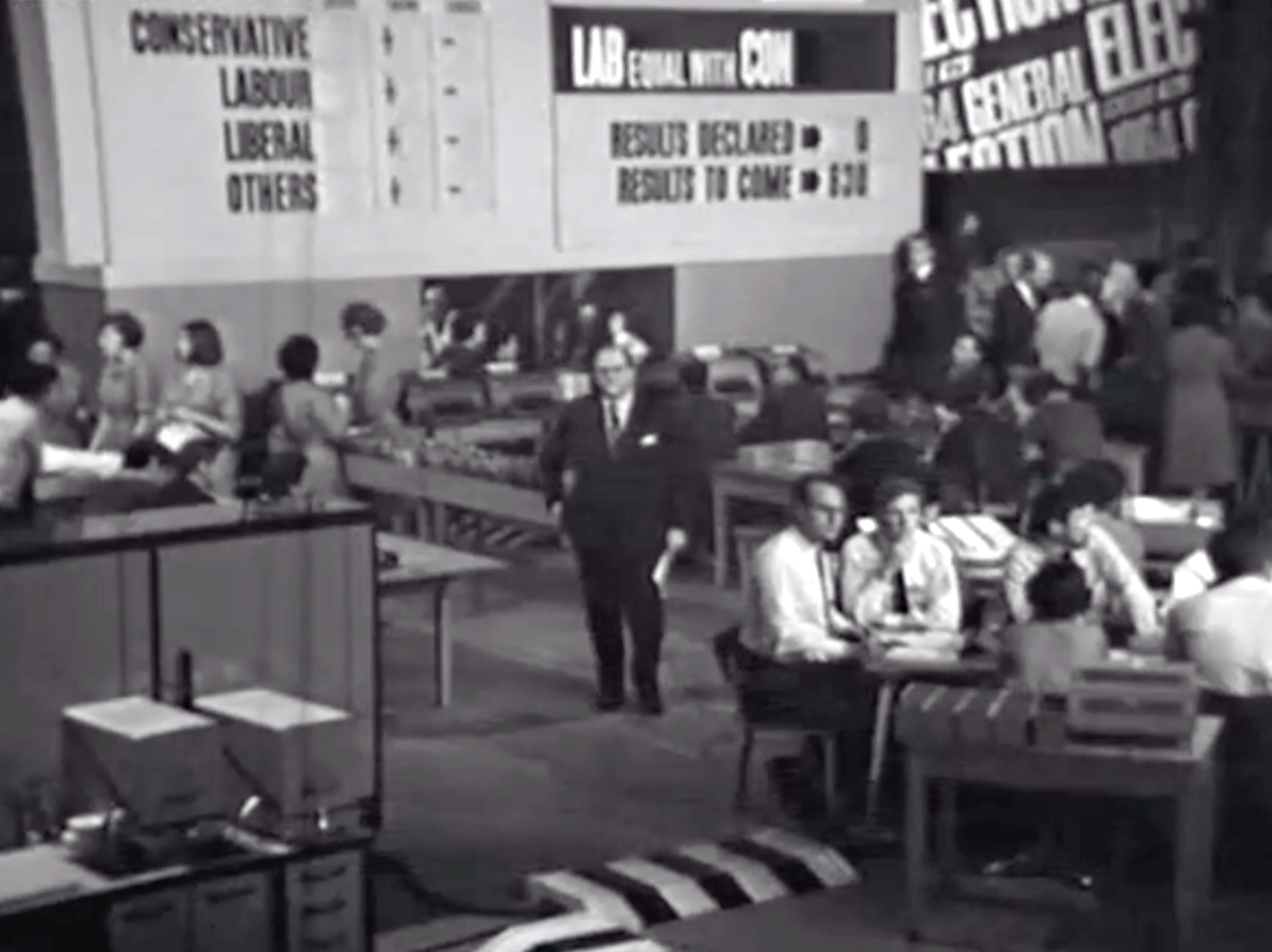
It’s nigh-on impossible to get tired of watching the BBC’s 1964 election programme and much of this is down to the studio, with its constant bustle, permanent air of excitement and relentlessly intriguing furnishings.
Richard Dimbleby didn’t live long enough to lead the March 1966 programme, which drew on all the most successful elements of 1964, refined them, then went a step further to produce something even more breathtaking.
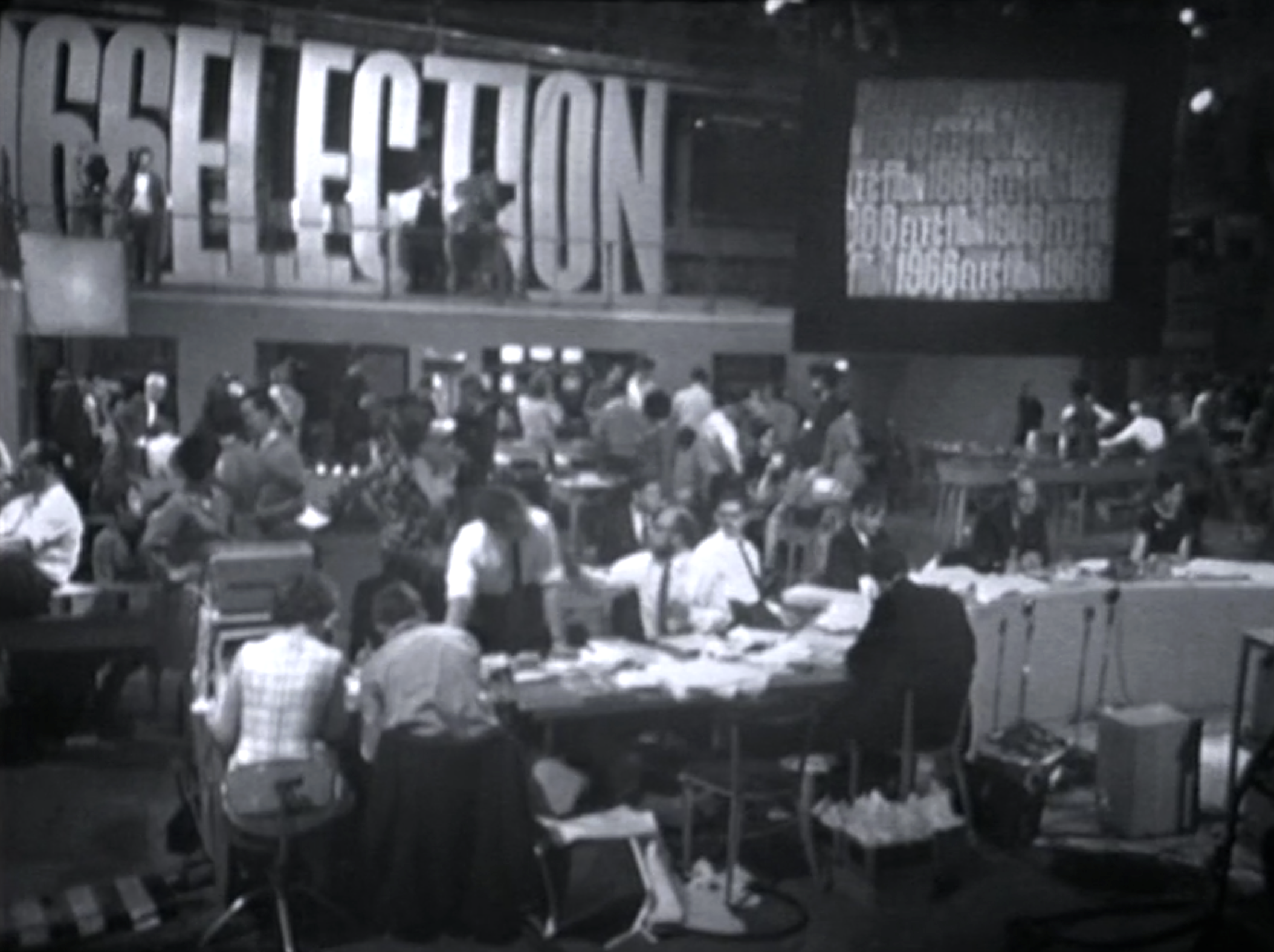
The mighty curved desk, the rows of monitors, the plentiful wooden tables, the multiple chairs and the multitudinous personnel are all back again, but the presentation is more ambitious and the studio has been furnished to a greater degree.
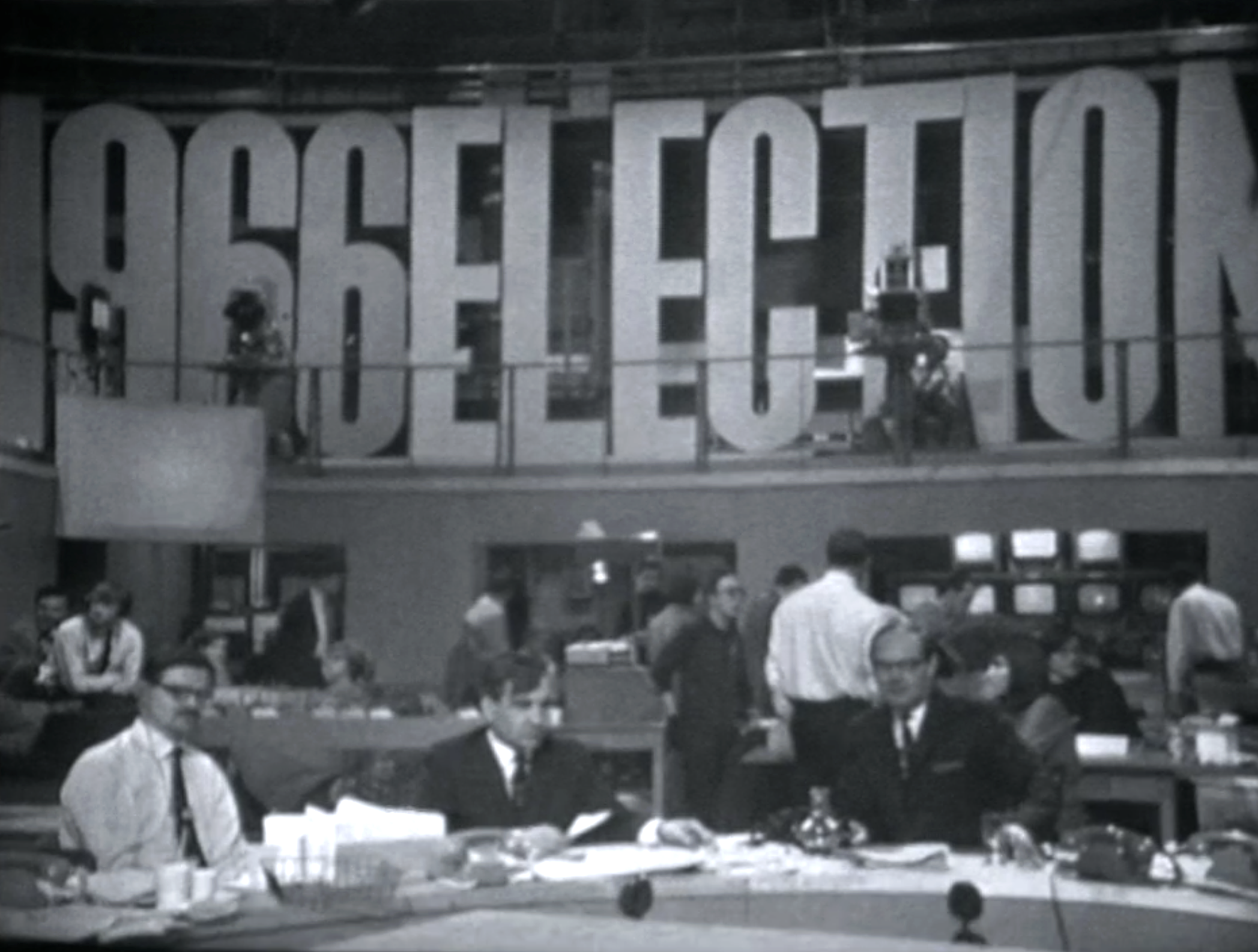
The most eye-catching addition is the elevated walkway running around part of the edge of the set, replete with vast cut-out letters spelling out 1966 ELECTION.
Cameras are mounted on the walkway, from which viewers get to peer down into the studio. It means that for the first time the presenters’ desk can be shot from both in front (at floor level) and behind (from the elevated level), leading to some fascinating shots where viewers get an over-the-shoulder glimpse, as it were, of what Cliff Michelmore (now the lead presenter) and co see when they are facing frontwards – including a clock mounted on a special stand, and a stack of eight monitors inside a custom-built unit, bearing labels like RESULTS 1 and OB 2.
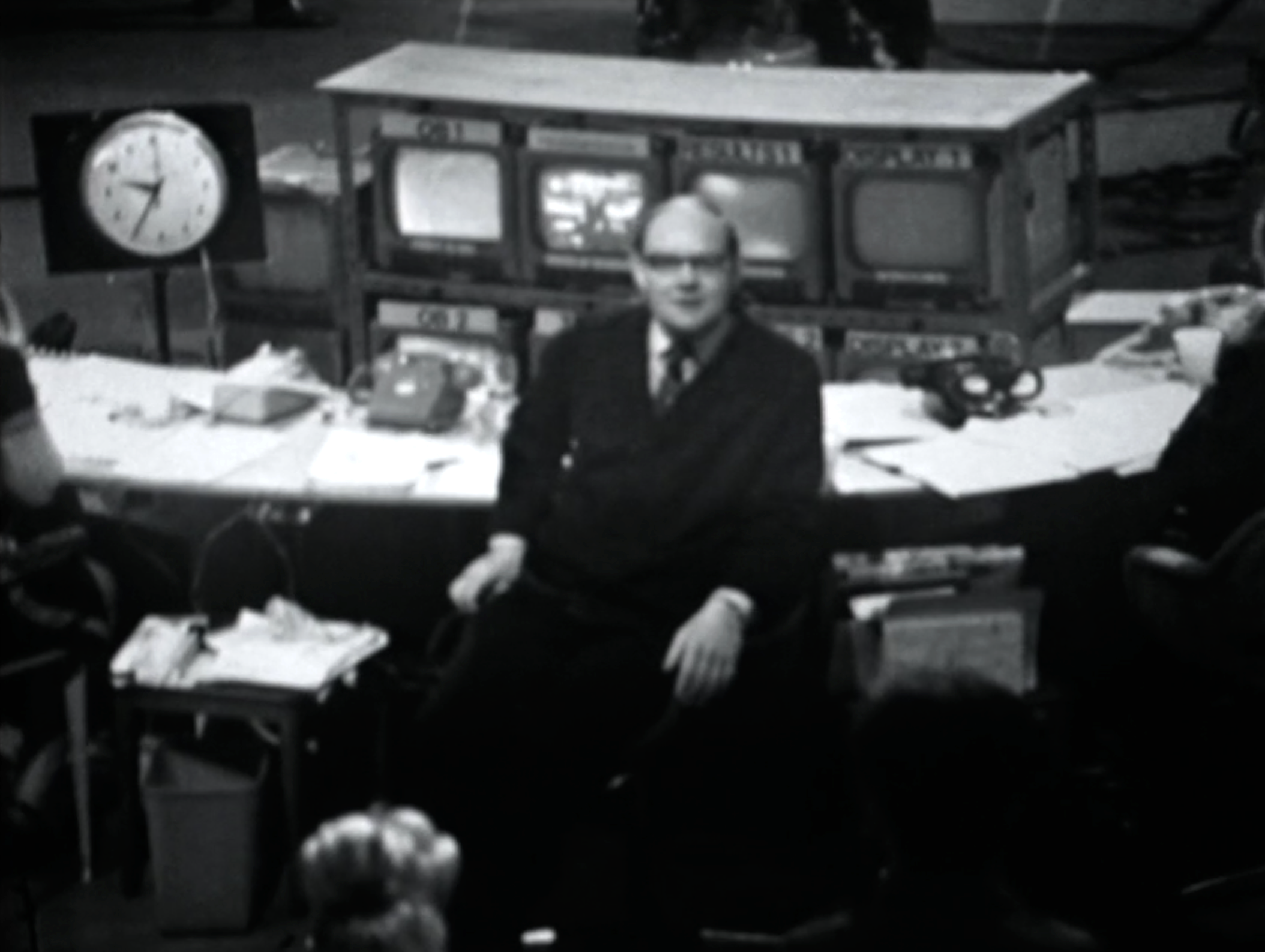
From time to time we see people on this walkway – mainly cameramen, but Michelmore drops by during his perambulation at the start of the programme, to explain that one of the cameras perched up here is actually in colour, specifically to record footage for transmission in the United States. It’s another reminder of how election programmes act both as a showcase for the best of current technology and an environment for nurturing the technology of the future.
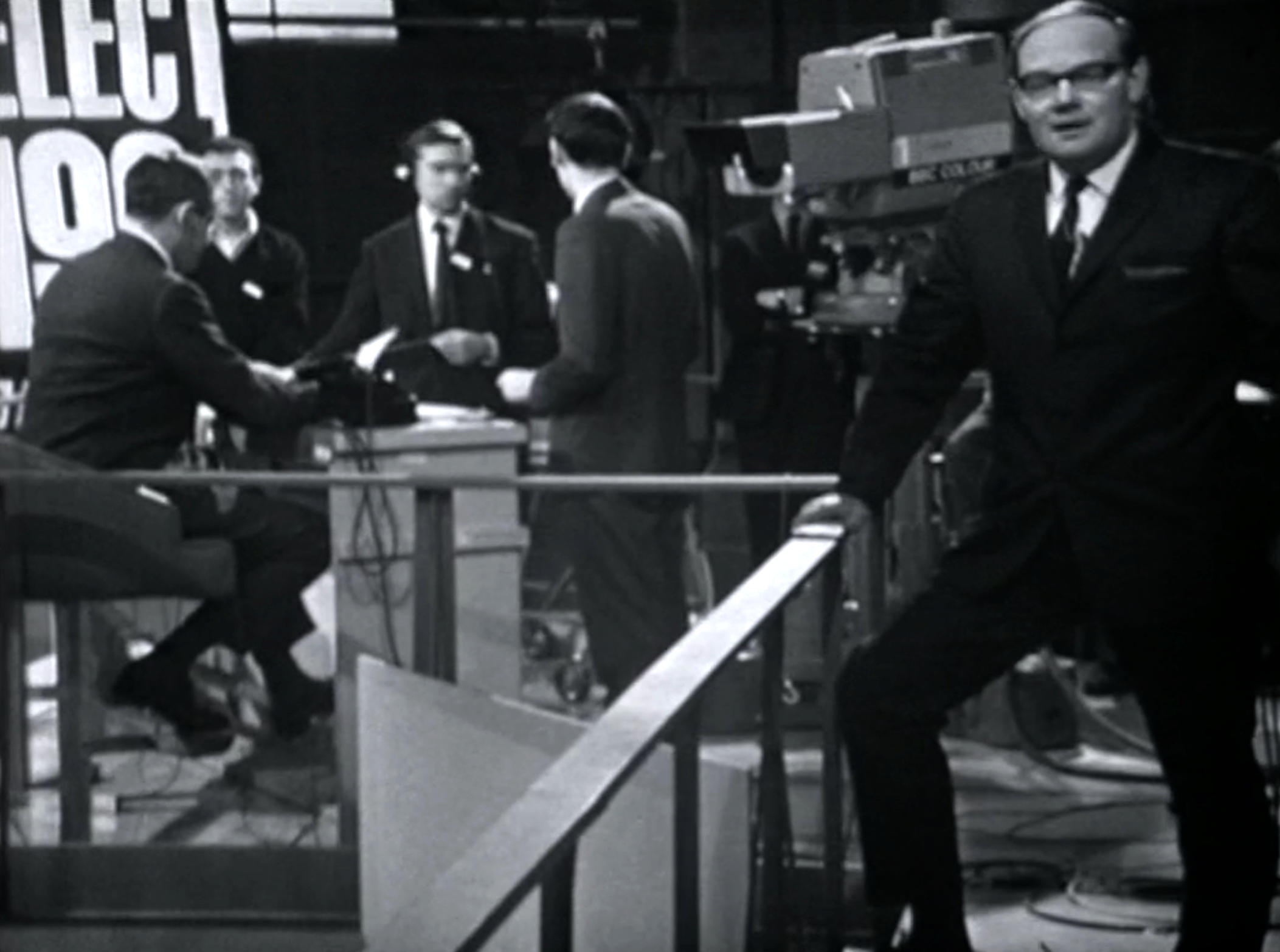
A wide shot from the walkway shows how all sides of Studio 1 have been utilised this time, including the wall that faces the presenters’ long desk. This has been filled with a row of additional smaller desks for various regional correspondents, all of which have maps behind them, above which are mounted the main results charts.
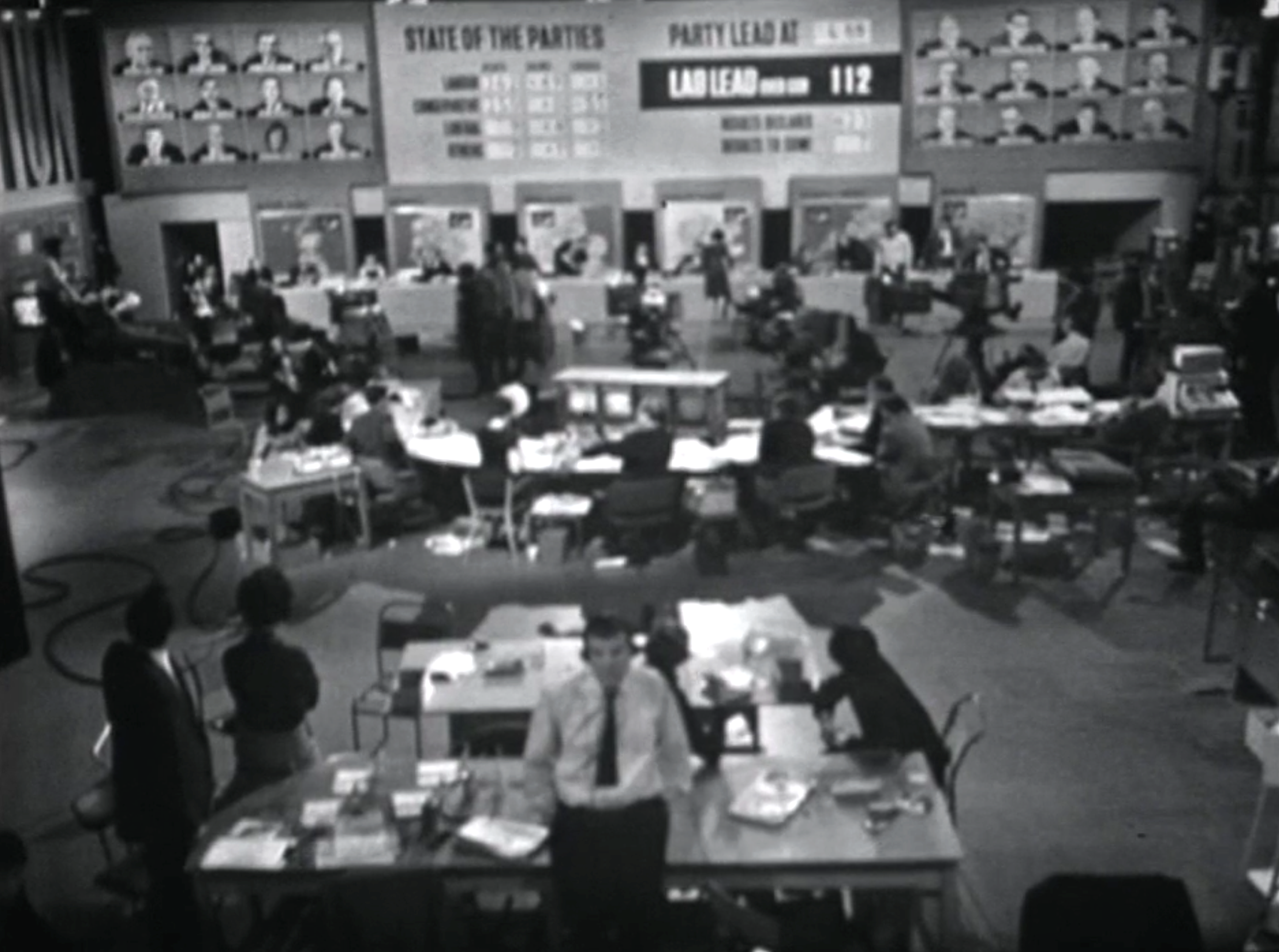
We have cameras pointing in multiple directions, with some cameramen having their backs to Michelmore, then flipping round to point at Michelmore with their backs to the correspondents. It’s a real feat of engineering, never mind floor planning.
More thought seems to have been given to what viewers see behind the heads of Michelmore and his companions. For as well as the now-familiar sight of people coming and going, there is also a wall of television screens, twinkling gently in the background.
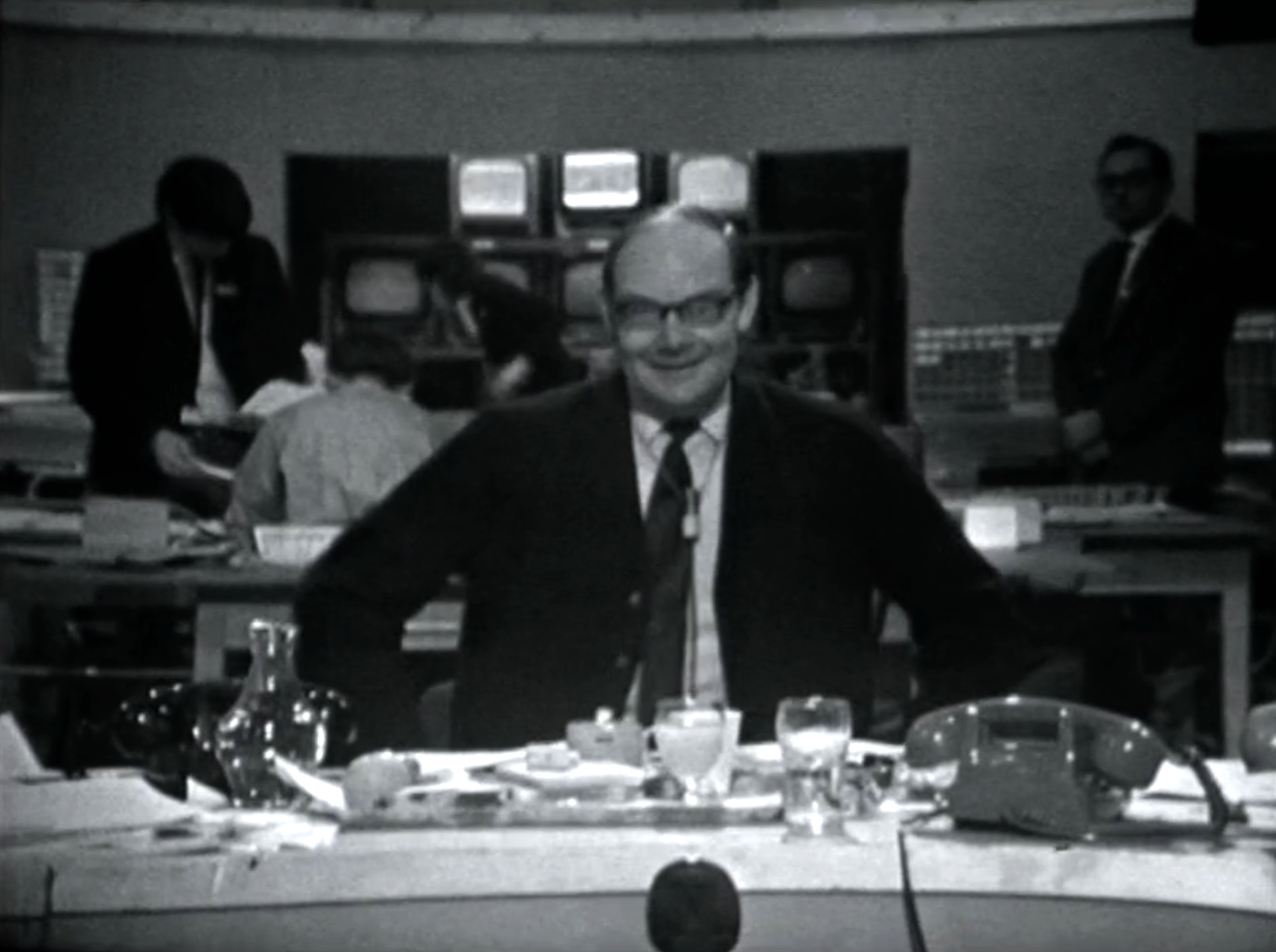
It’s an early instance of multiple television screens being used purposefully as an element of set design, rather than just as tools for presenters or staff. Here is a grid of screens treated almost as an object of beauty, of something that can make an aesthetic statement in its own right, not just a bundle of boxes to transmit pictures and information. It’s a bit of a landmark moment. Think of how ubiquitous walls of television screens would become in studios, not merely for news programmes but many kinds of broadcasting: sport, music, light entertainment, even panel games. Here is a wall of screens being deployed as a piece of studio furniture as long ago as 1966. It must have felt very new, perhaps even unsettling, for viewers at the time.
As if this wasn’t dazzling enough, there is also a single giant screen that appears to be suspended from the studio roof and which is positioned close enough to the main desk to allow Michelmore and co to swivel round on their chairs and watch footage from outside broadcasts.
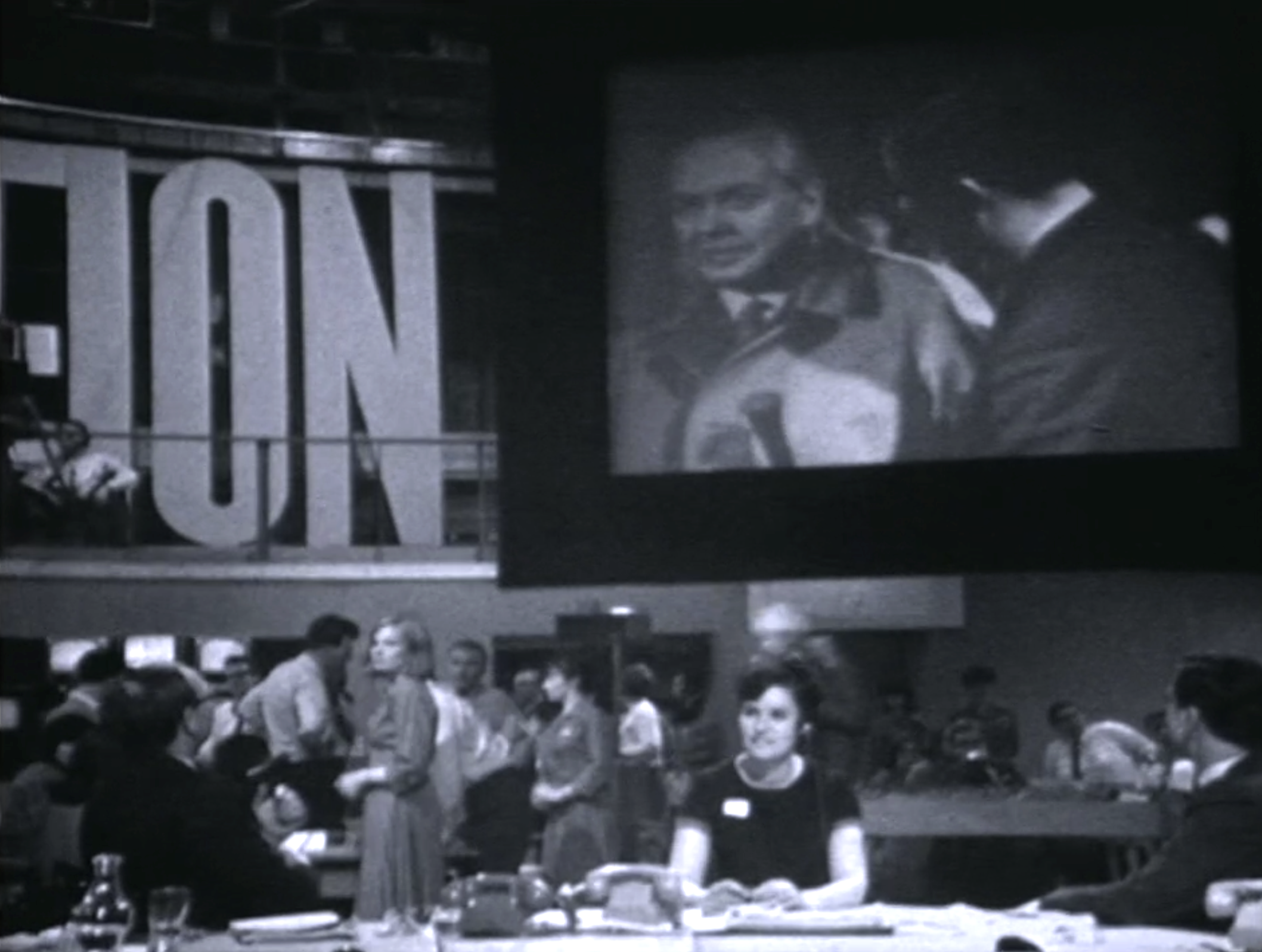
All of this multi-level furnishing means there’s no longer room for Robin Day and his election eyrie. He squats instead on the studio floor, but he does have his own desk, bank of telephones and water jug, along with a giant screen from which politicians gaze down on him menacingly.
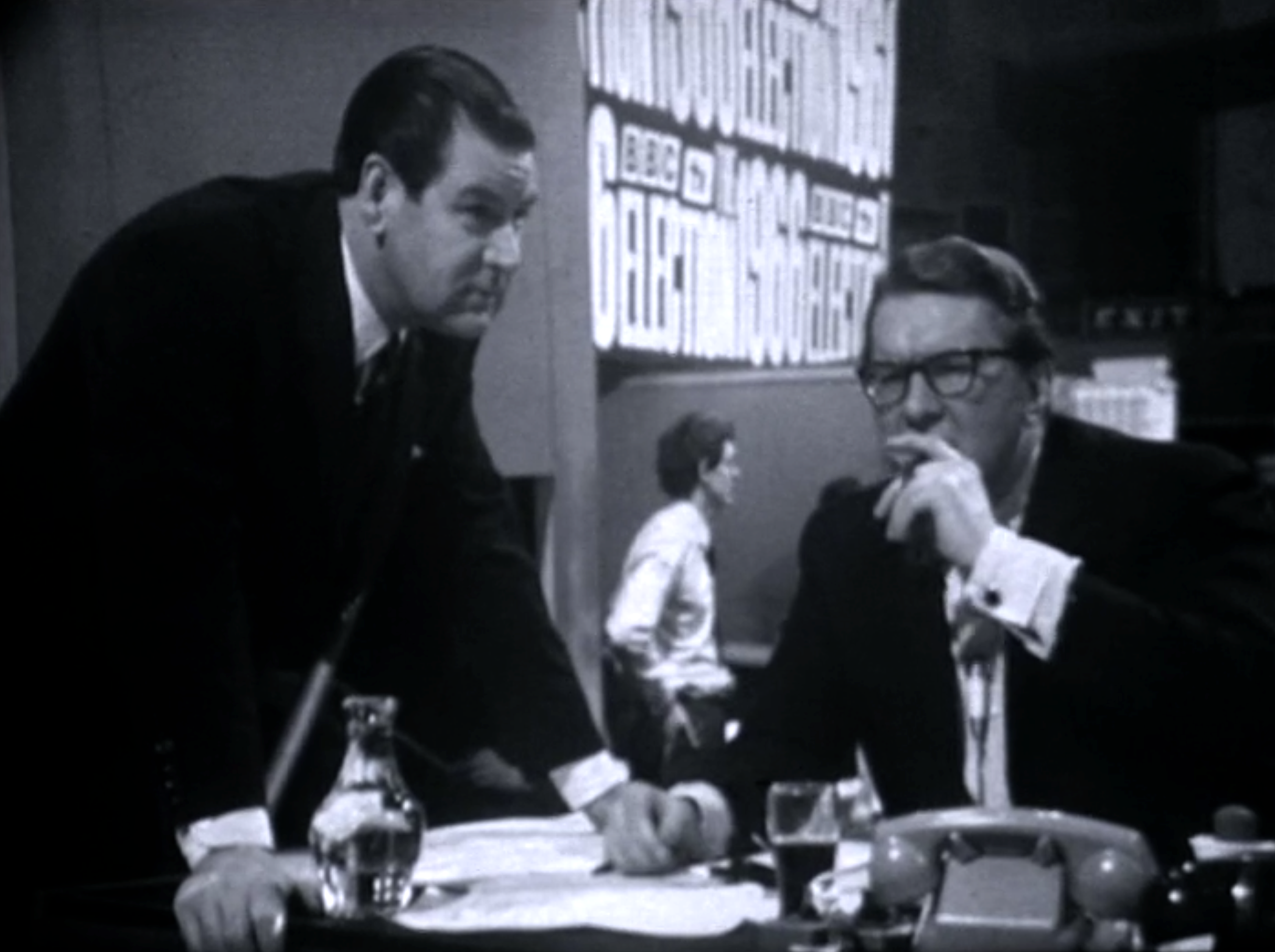
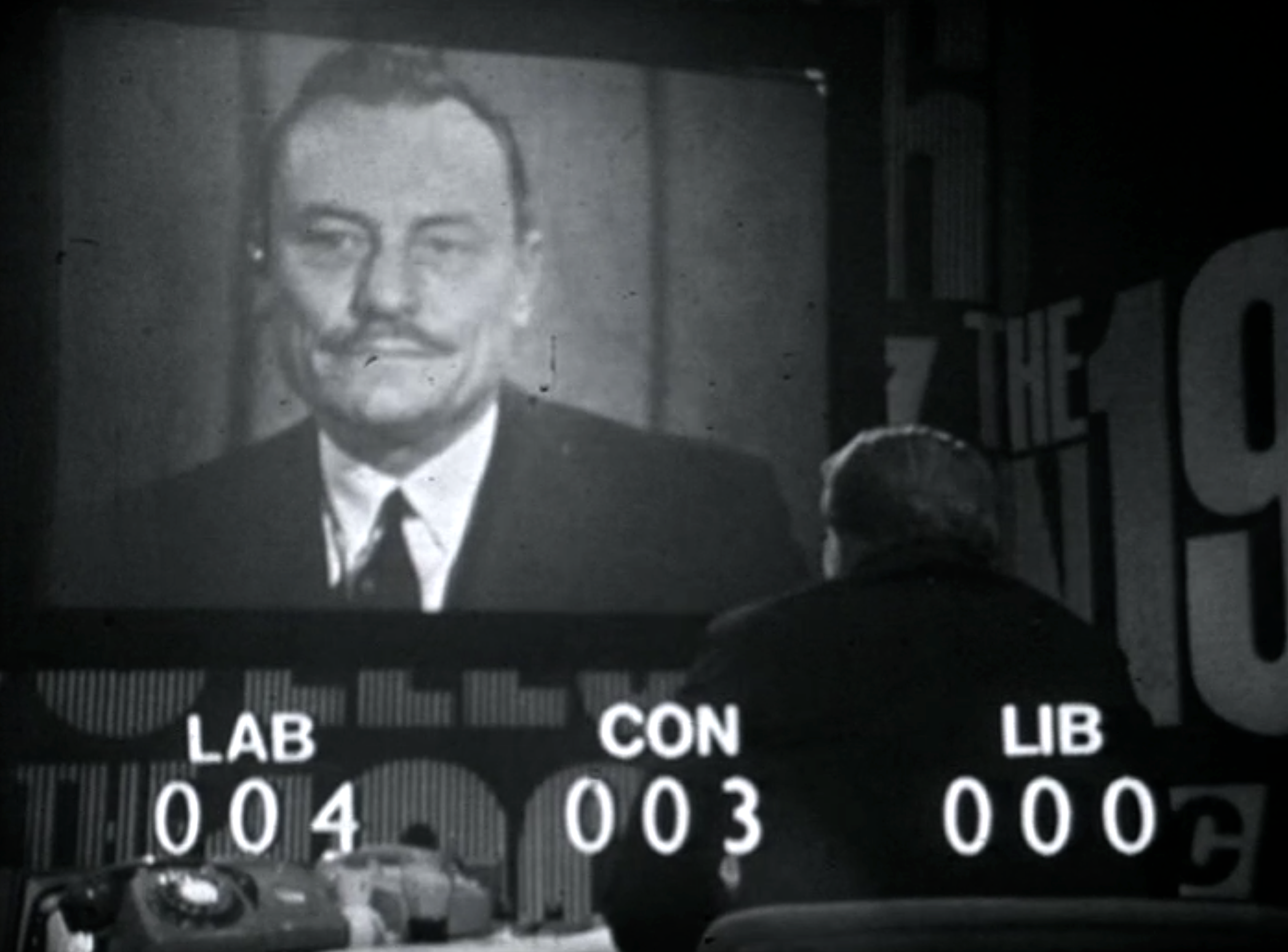
Big Enoch is watching you.
*
The June 1970 general election heralds both continuity and change.
Colour television has self-evidently arrived (no longer is it only viewers in the United States who get to enjoy it at elections). The concept of a semi-circular arrangement of personnel remains, but the execution is something entirely new – and rather courageous.
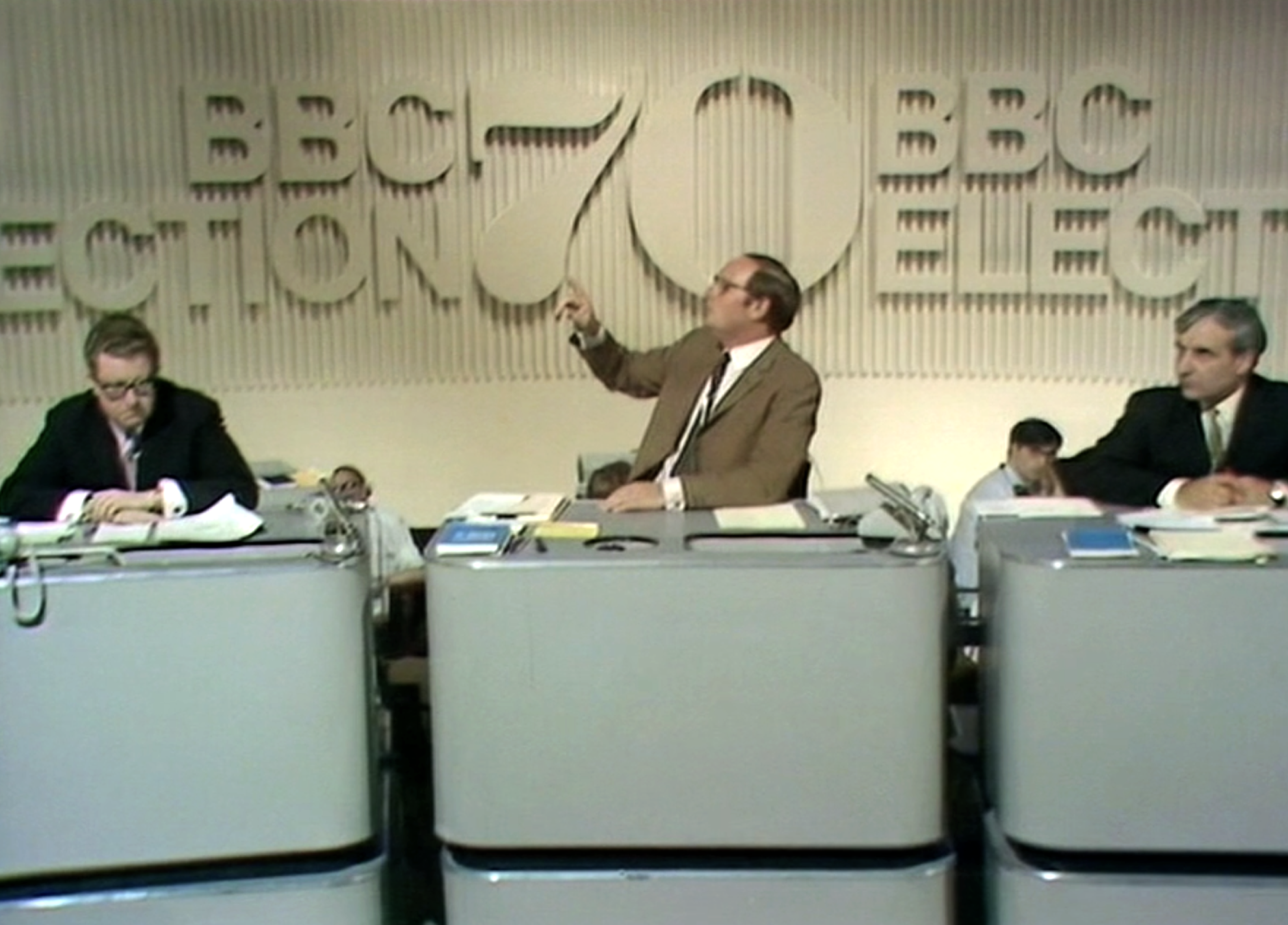
Instead of a single curved desk behind which everyone sits, viewers are greeted with a phalanx of glossy-looking pulpits, still in a semi-circle, but each separate from the other – and each positioned on top of its own equally glossy-looking podium, leaving the presenters marooned some way above the studio floor.
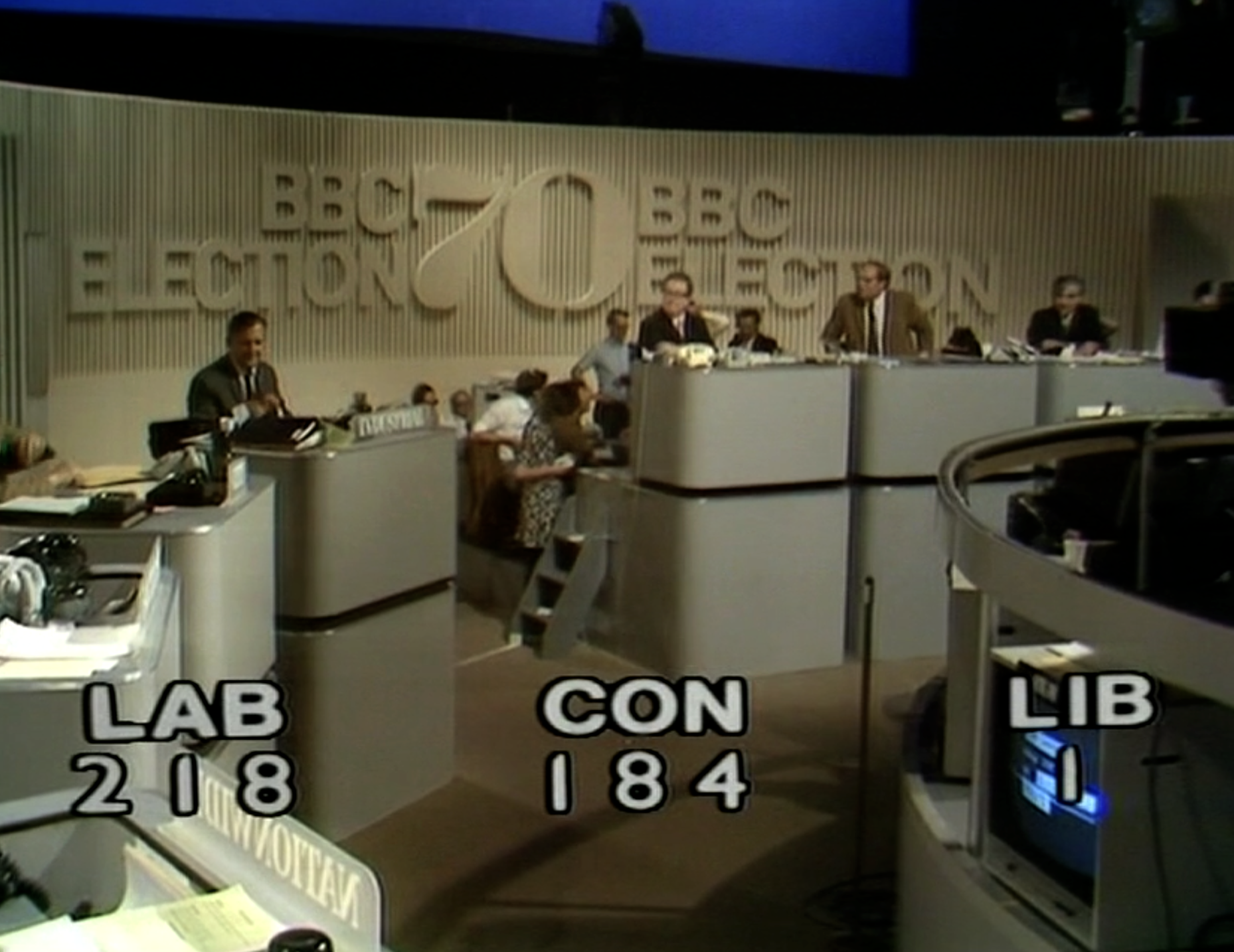
It’s certainly striking, if rather eccentric and more than a little precarious. To get to the pulpits, the presenters have to climb a small ladder – which sometimes appears in shot – and once they have reached their allotted cranny, there is very little room for them to squeeze into their chairs and fit behind their respective worktops.
Whenever we see a shot from one of the cameras mounted high up behind this cluster of pods, it’s clear just how little space there is for their occupants to sit comfortably, never mind move about or nip to the toilet. The rows of people sitting directly below must have been fearful of a Michelmore or a Butler tumbling on top of them.
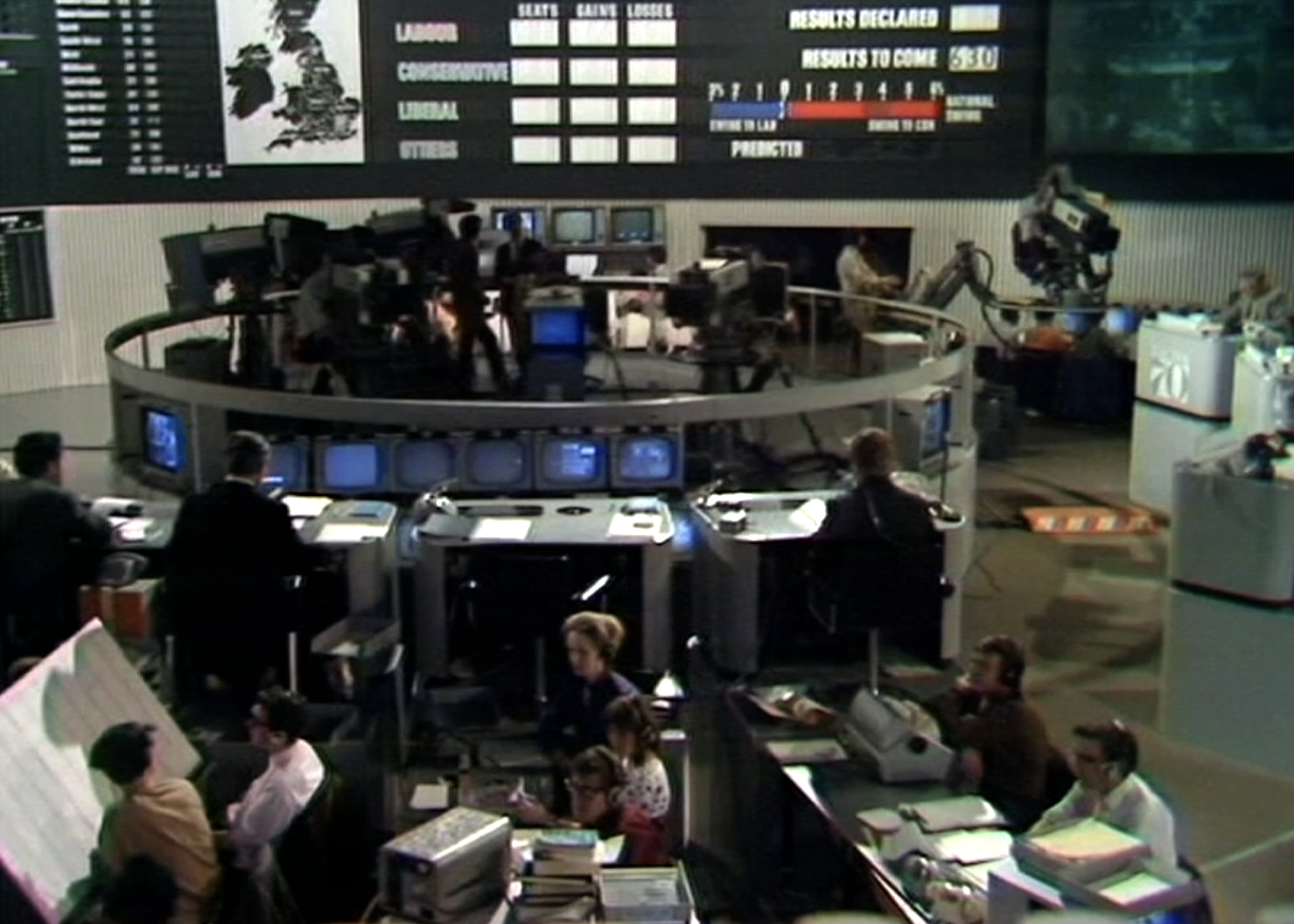
Wide shots of the studio reveal the only people at floor level are the massed ranks of the checkers, counters and button-pushers. All the presenters, even the correspondents, have their own pulpit-and-podium set-up.
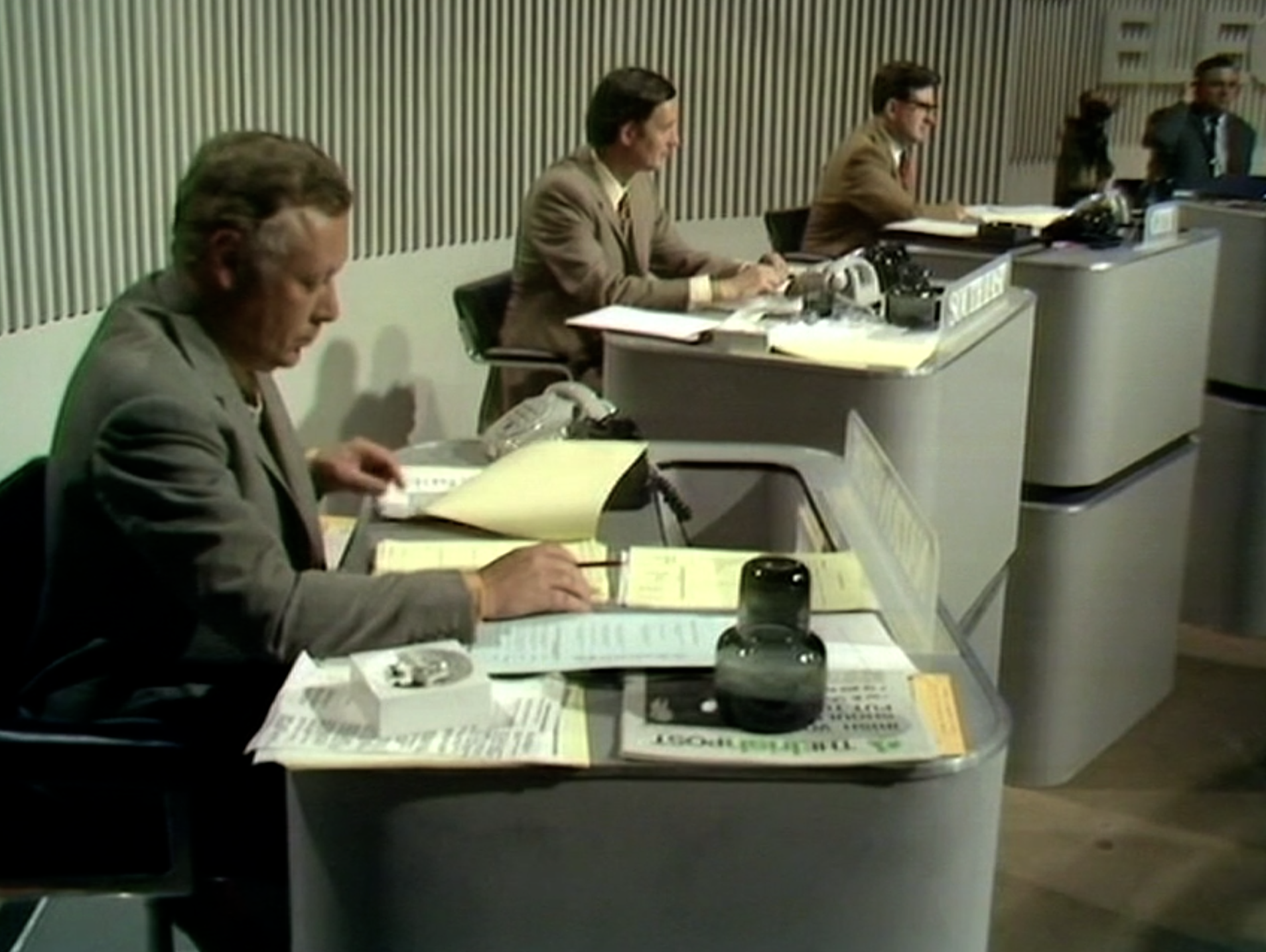
And because all of the presenters are roosting high above the floor, so the cameras are too, clustered in a circular playpen that has been erected in the middle of the studio, with some pointing at the team and others at the giant display boards that have been built on the opposite wall.
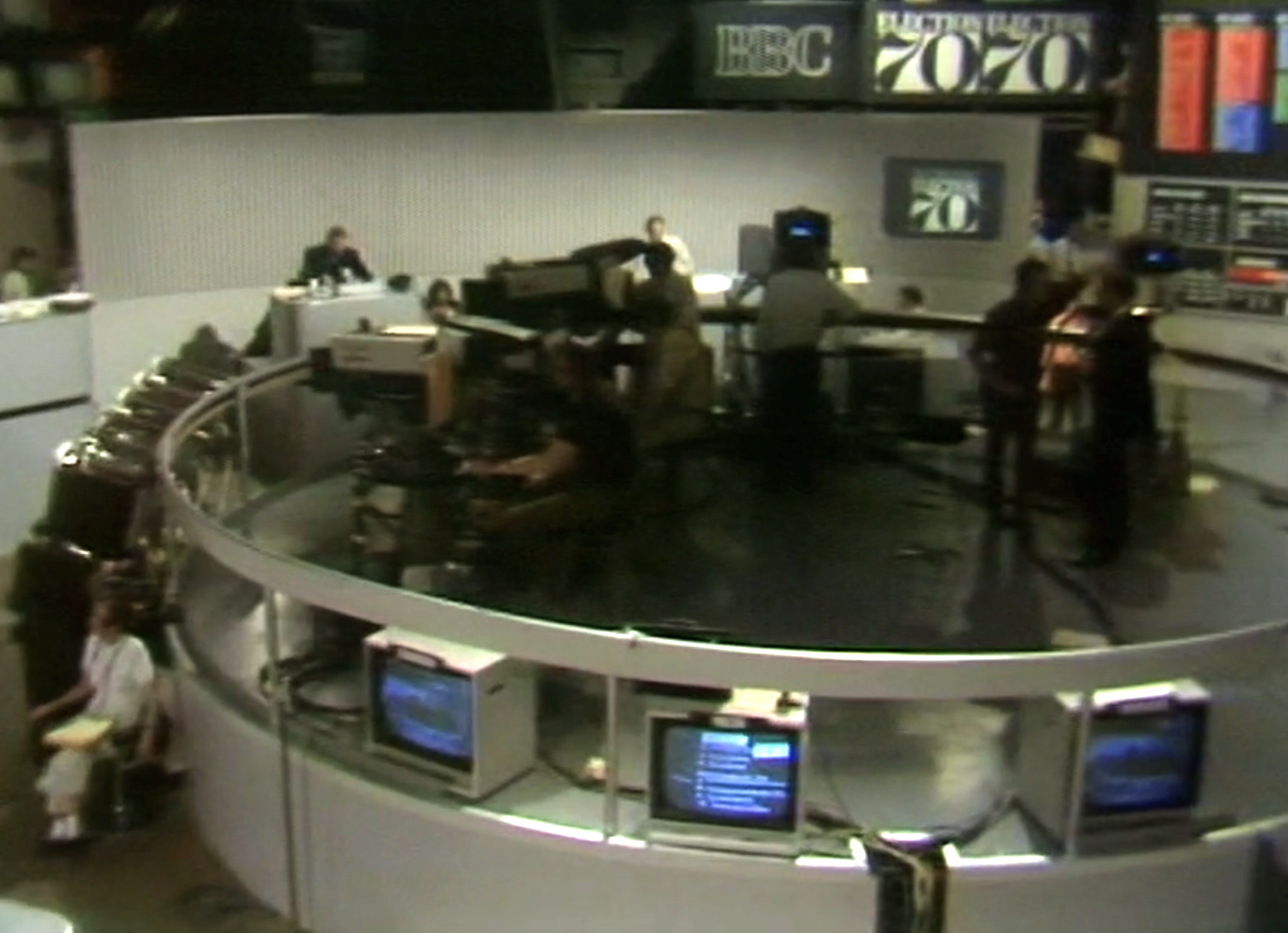
What was the thinking here? To put the top tier of BBC election talent literally above the lower tiers? To stop viewers seeing people wandering back and forth behind the heads of the presenters – something so redolent (too redolent?) of 1964 and 1966? To allow the business end of the election to unfold mostly out of sight of its on-screen presentation? All of these reasons, probably – together with a desire to try something different for the sake of it, and the urge to do something original and purposefully fanciful.
The new layout does mean the row of monitors that traditionally sits in front of the presenters can be partly incorporated into the design of the set, as an appendage to the circular camera pen, rather than housed inside a freestanding piece of furniture on the floor – although there are a few monitors out in the wild, one of which seems to have its label still attached.
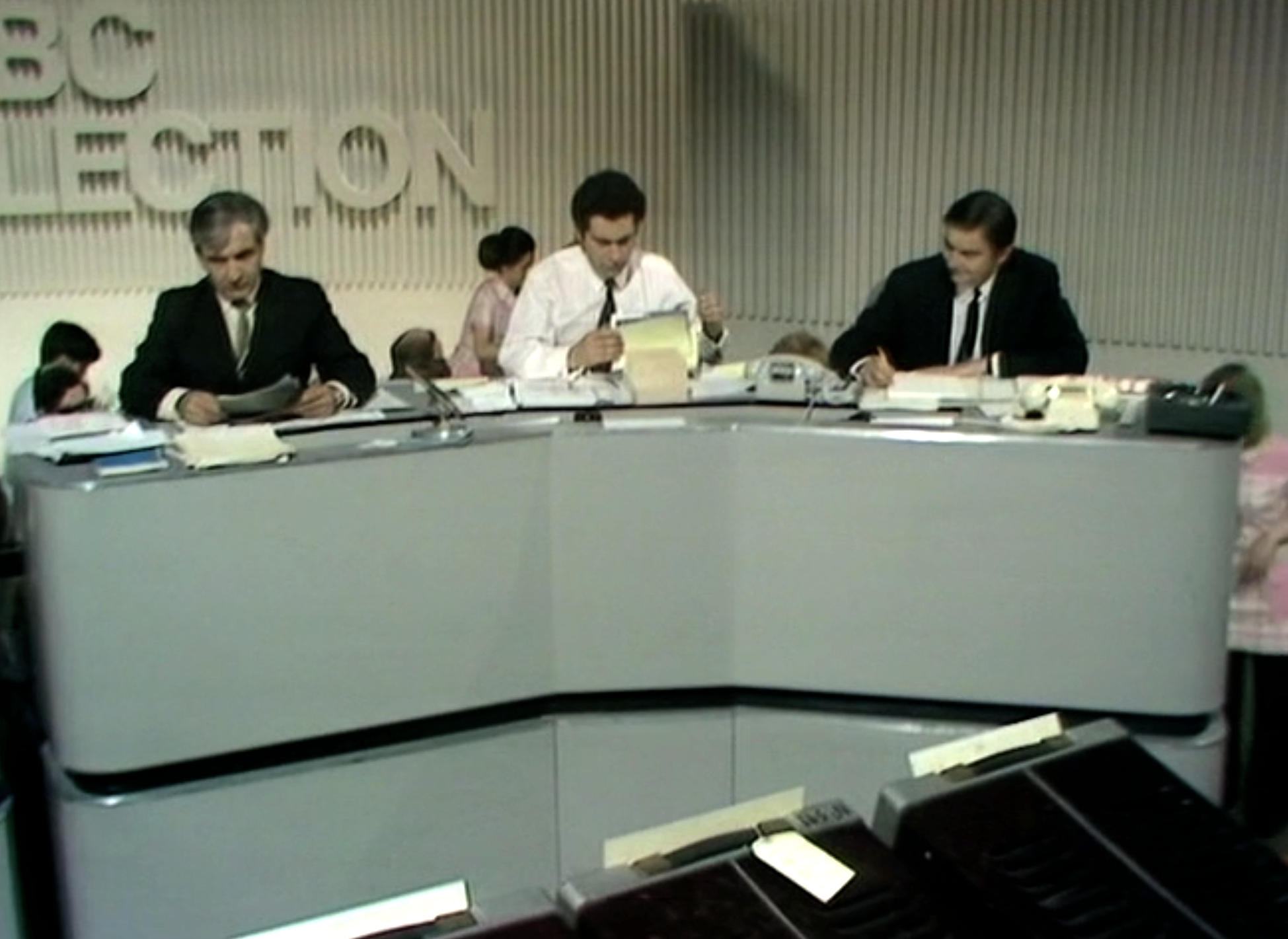
And thanks to the decision to retain the high walkway around the edge of the studio, we continue to get the occasional camera shot pointing downwards towards the pulpits, which confirms just how little room there is behind them (and how much clutter is stuffed underneath).
The colour scheme for this first election not to be broadcast in black-and-white has been chosen wisely.
The walls of the studio are a soft, unassuming beige – politically neutral – with a ribbed effect in places that works well behind the large cut-out letters BBC ELECTION 70. The exterior of the pods are coloured differently, but also in a soft tone: the sides are light grey, again politically neutral, with what looks like silver edging around the top. Everything is smooth, with curved corners. Right angles are right out.
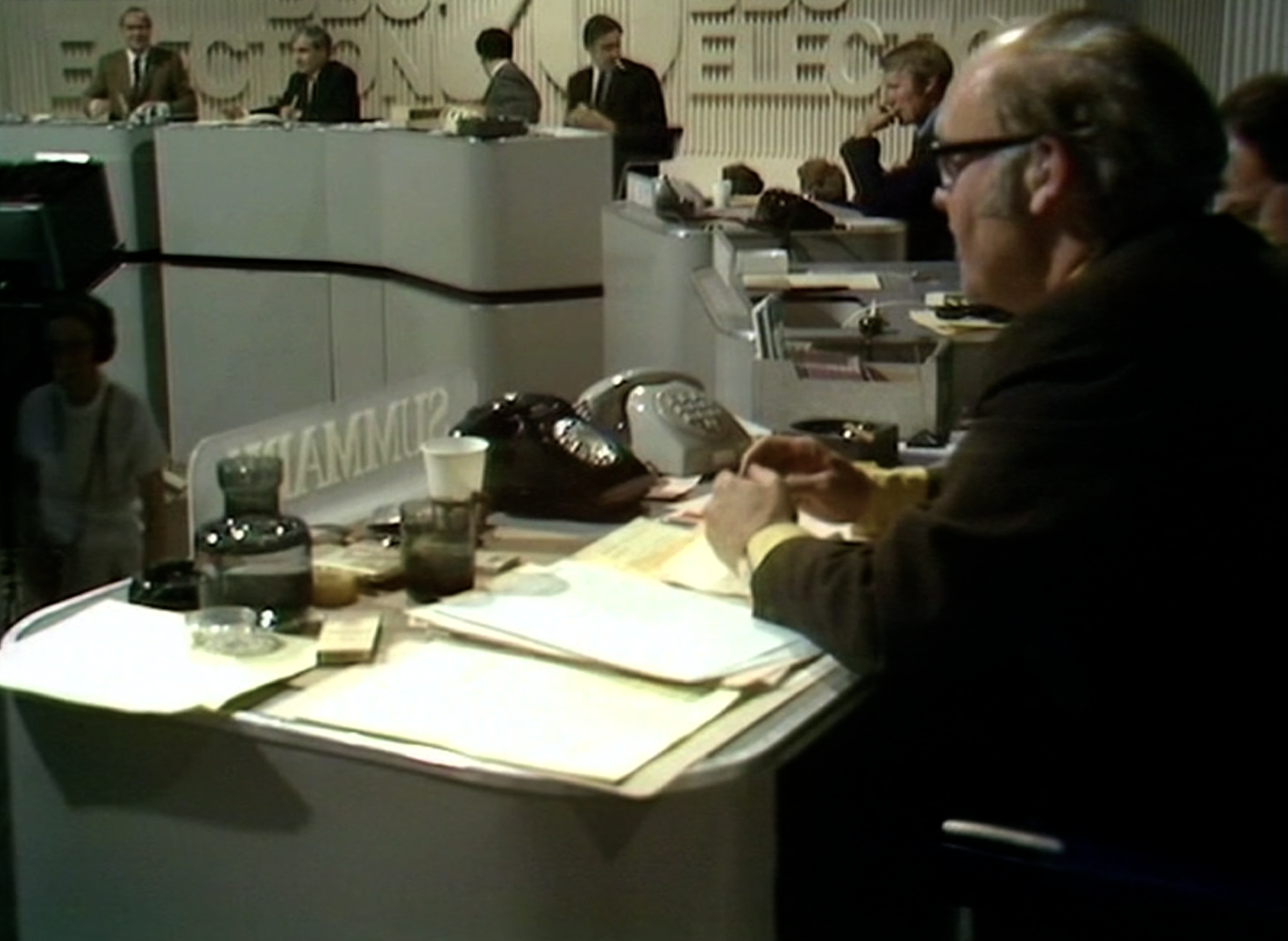
All of this makes for a sharp, effective contrast with the apparatus dotted around the studio: the darker hues of the monitors, the dull metal frames of the scaffolding, and the black background of the results charts.
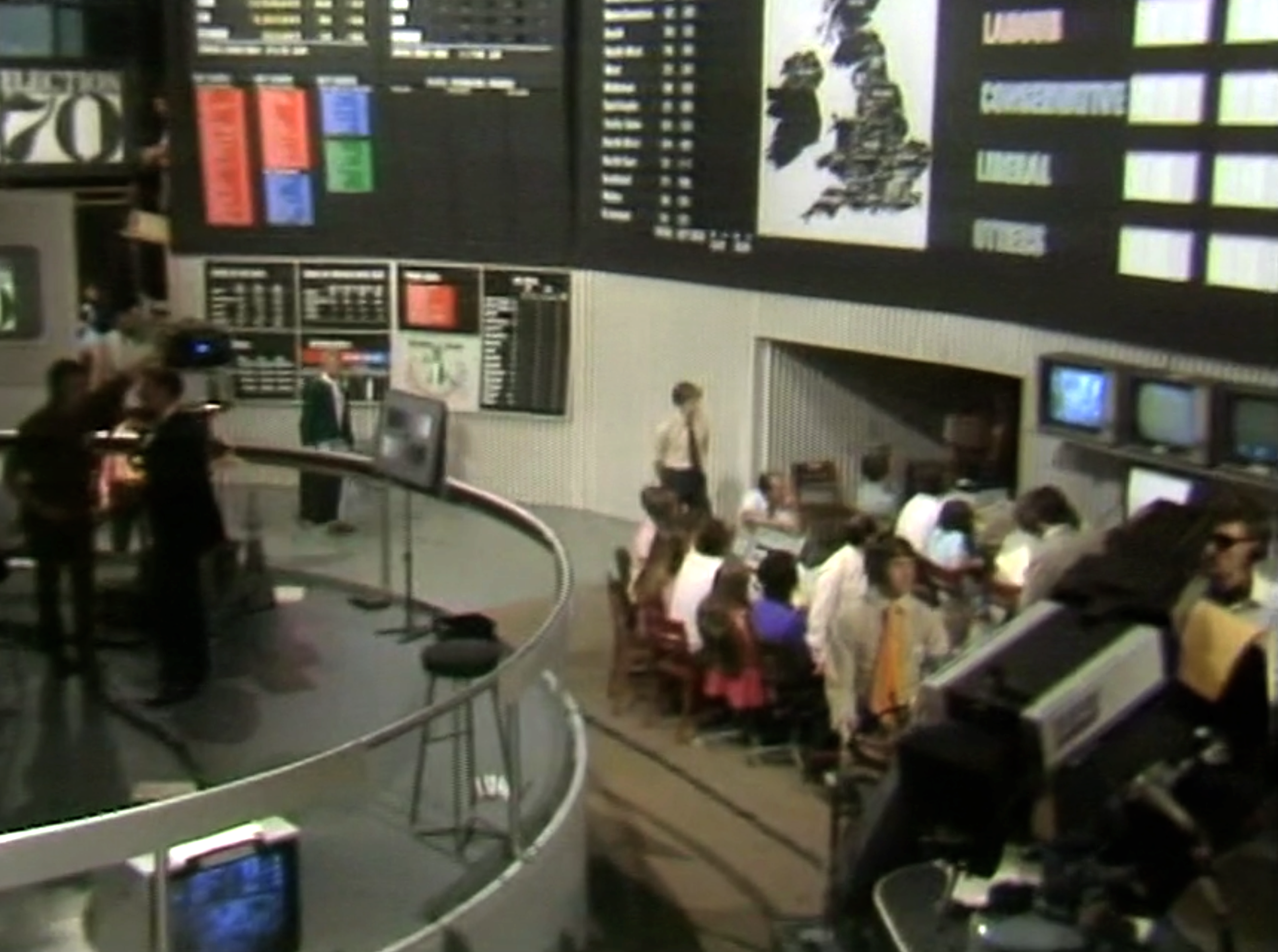
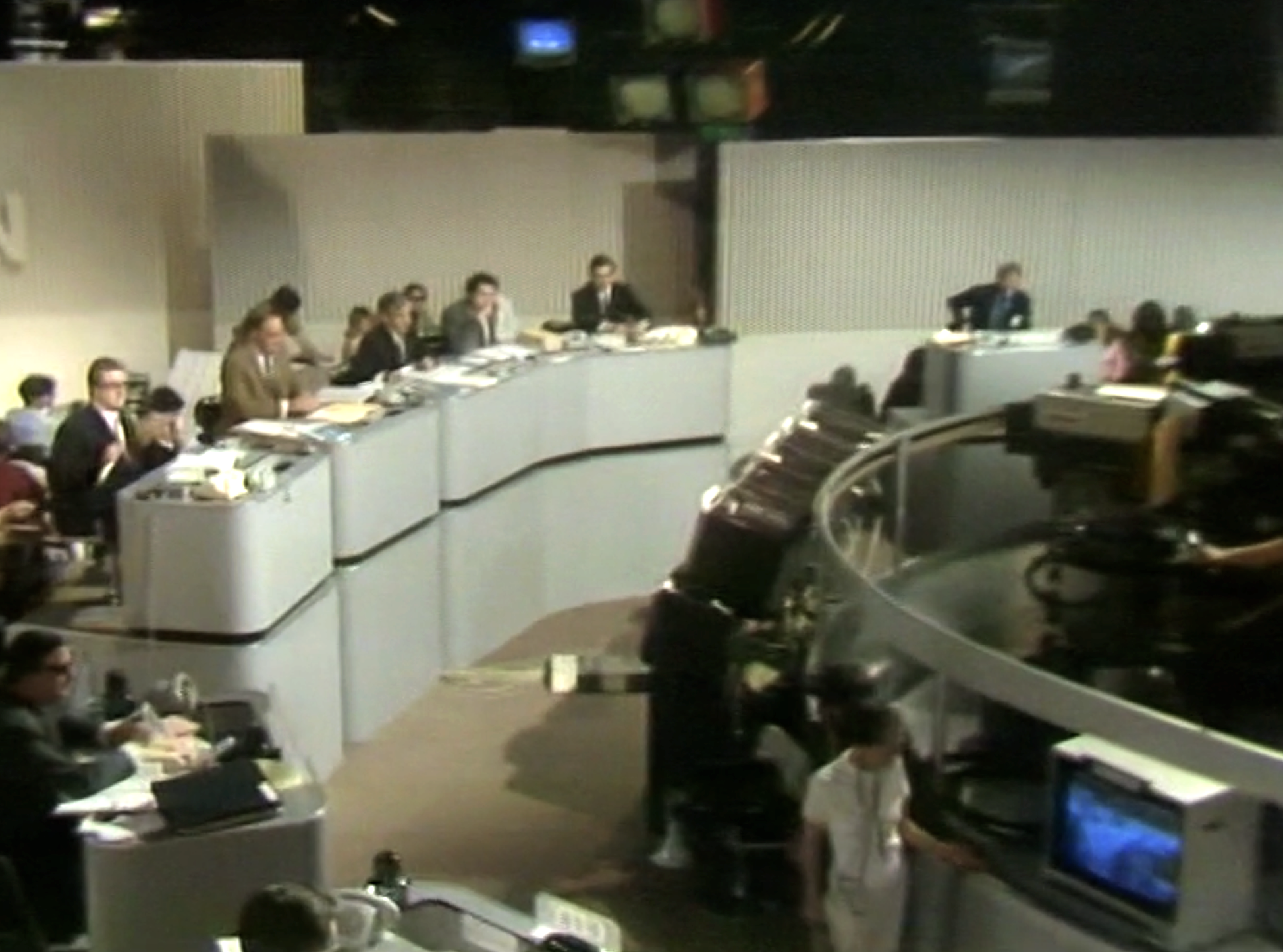
The circular walls are not continuous. Wide shots of the studio reveal they are actually built of freestanding panels, which themselves help to divide the studio into essentially two sections: the encircled on-screen arena, and a separate off-screen backstage area, where no effort has been made to tart things up and which consequently looks like a dingy warehouse.
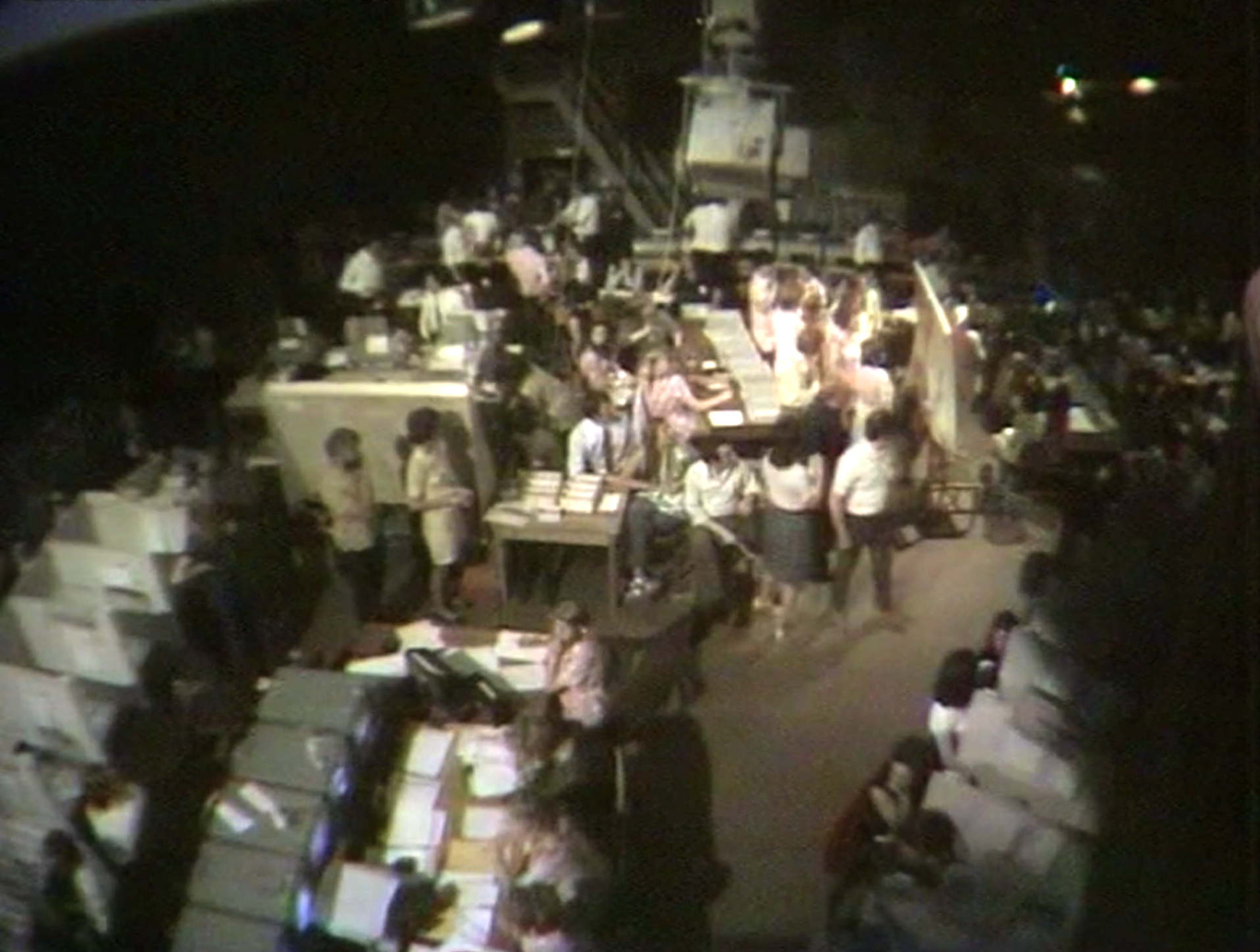
A camera mounted in the roof of the studio glides occasionally between one area and the other, reminding you this is an operation that still requires hundreds of people.
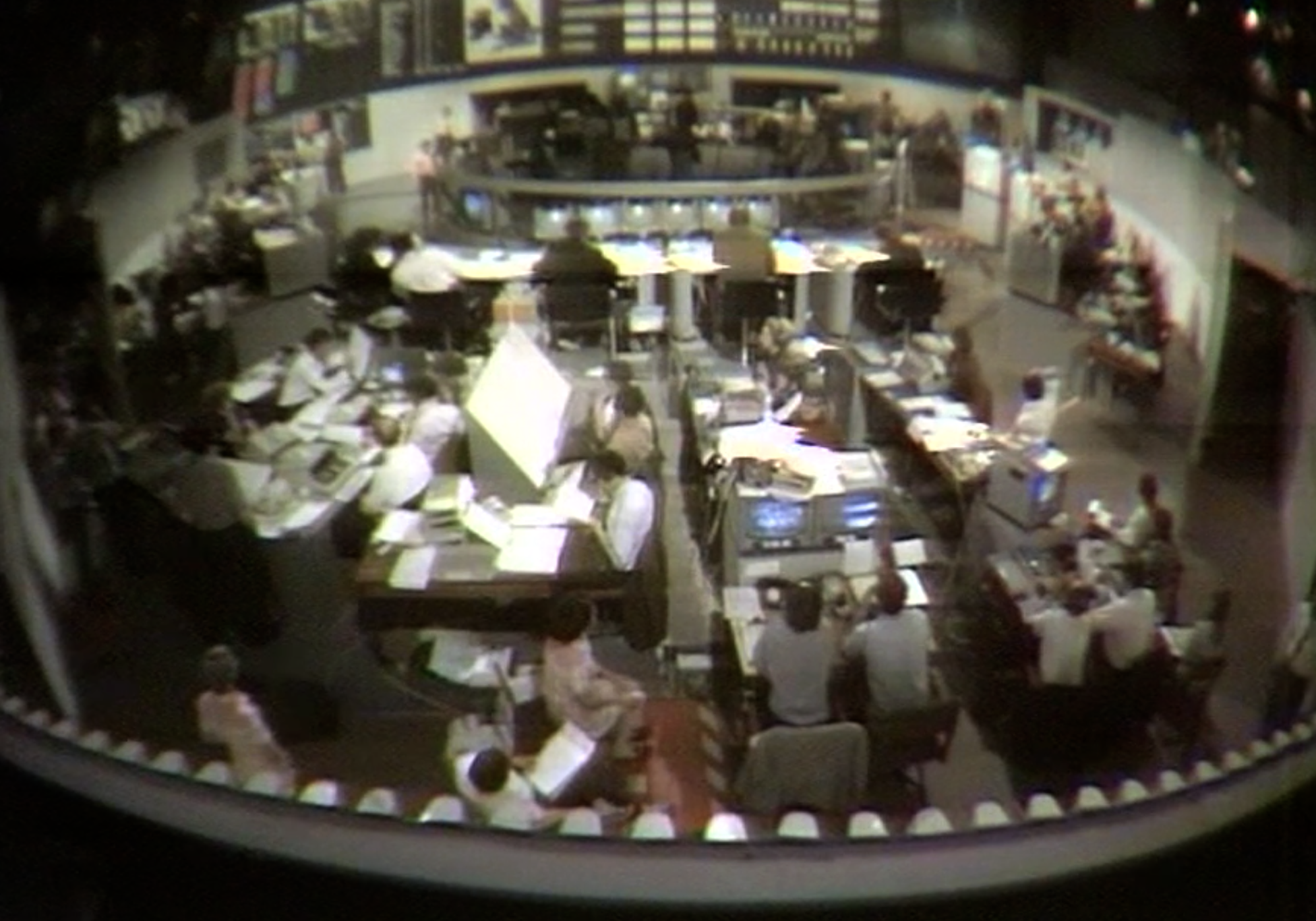
Such a multi-panel, multi-level edifice may have given the BBC’s election coverage a bold new look and solved a few problems that had persisted since the black-and-white days, but it also created a new problem: where to put Robin Day?
He couldn’t be on the studio floor, down among the equivalent of Shakespeare’s rude mechanicals. He had to be apart from the presenters, in his own conversation area – but there was no room for another pod on this level.
The solution? Shove him up towards the rafters in his own self-contained crow’s nest, sitting higher even than Michelmore and co: a position befitting his self-sustaining lofty view on matters and which, surely to Day’s delight, forces Michelmore to crane his head upwards, like a cowed courtier before a throne, whenever it is time to hand over.
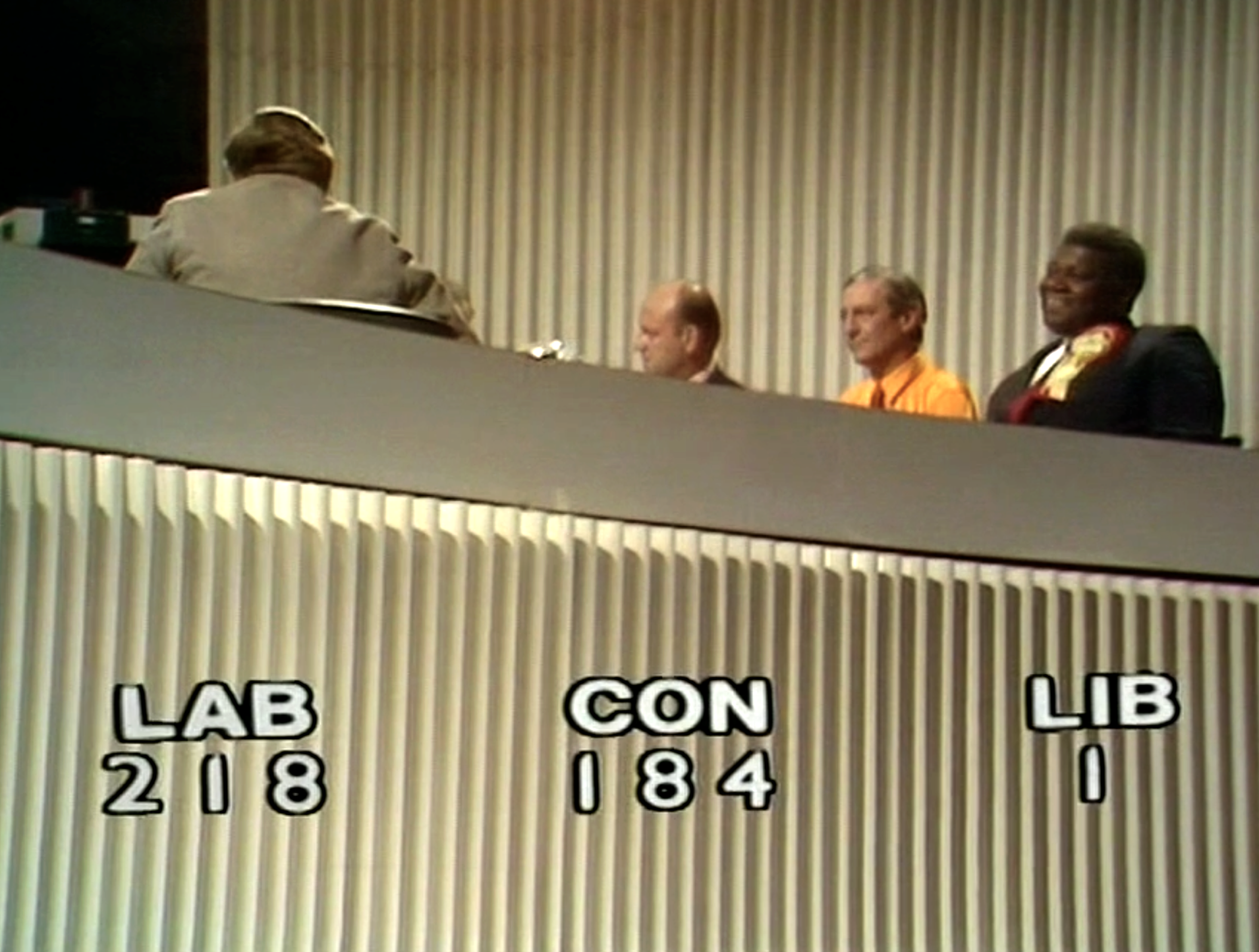
Michelmore hijacks Day’s perch at the very start of the programme to help introduce viewers to the layout of the studio, but he is quickly booted out to make room for Day and his guests, who presumably all have to clamber up a ladder to get there – or maybe Day insisted on some kind of crane or personalised cherry-picker to allow their smooth and dignified passage.
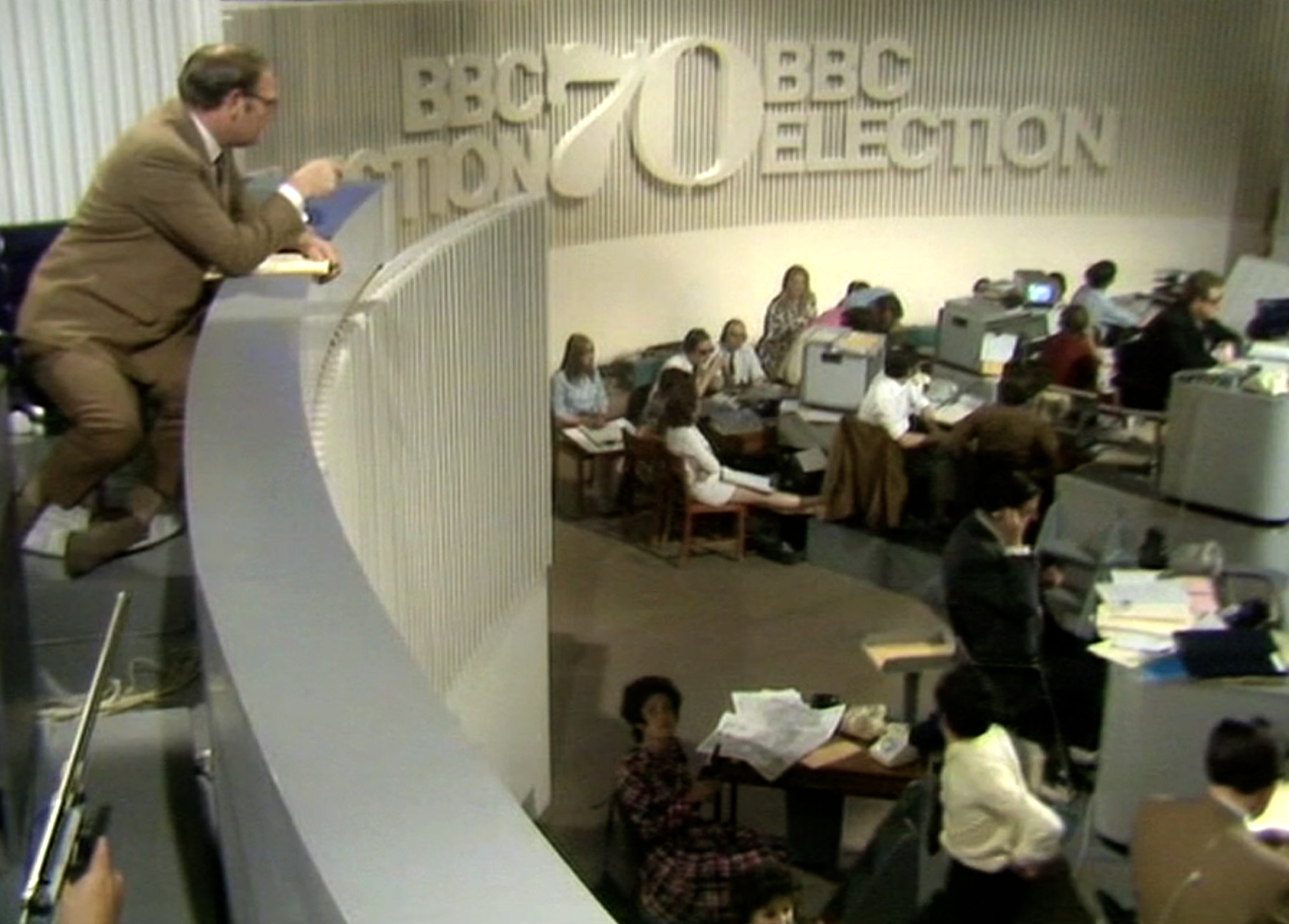
No tight squeeze for Day up in this sprawling attic, of course. He still has a big chunky desk for his big chunky ashtray and his piles of papers. But he has lost his giant monitor and instead has a normal-sized television set, meaning Enoch Powell no longer looks quite so menacing.
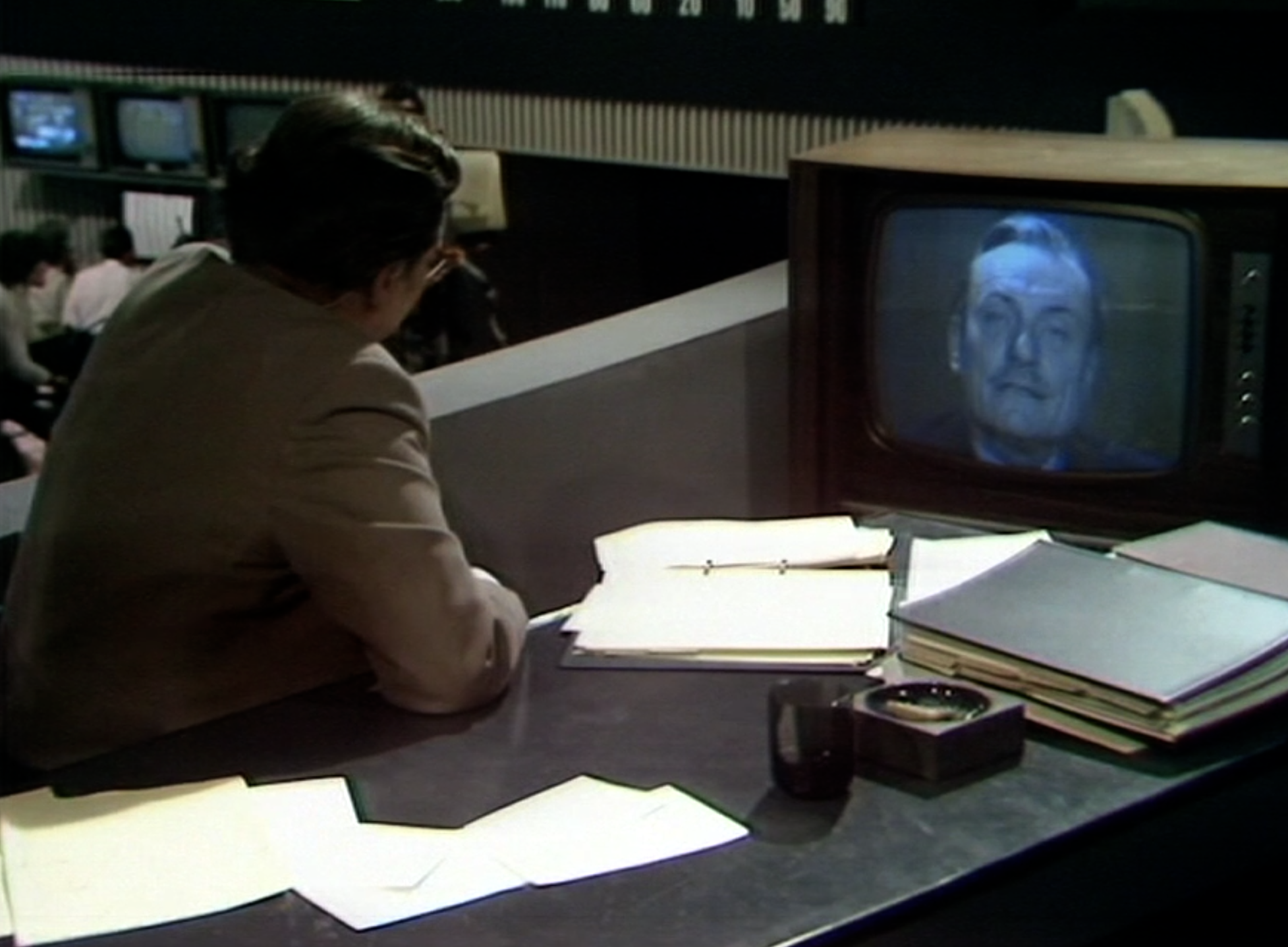
Despite its eccentricities, the 1970 set triumphs, both as an intelligent functioning television studio and a constantly engaging and surprising showpiece of design.
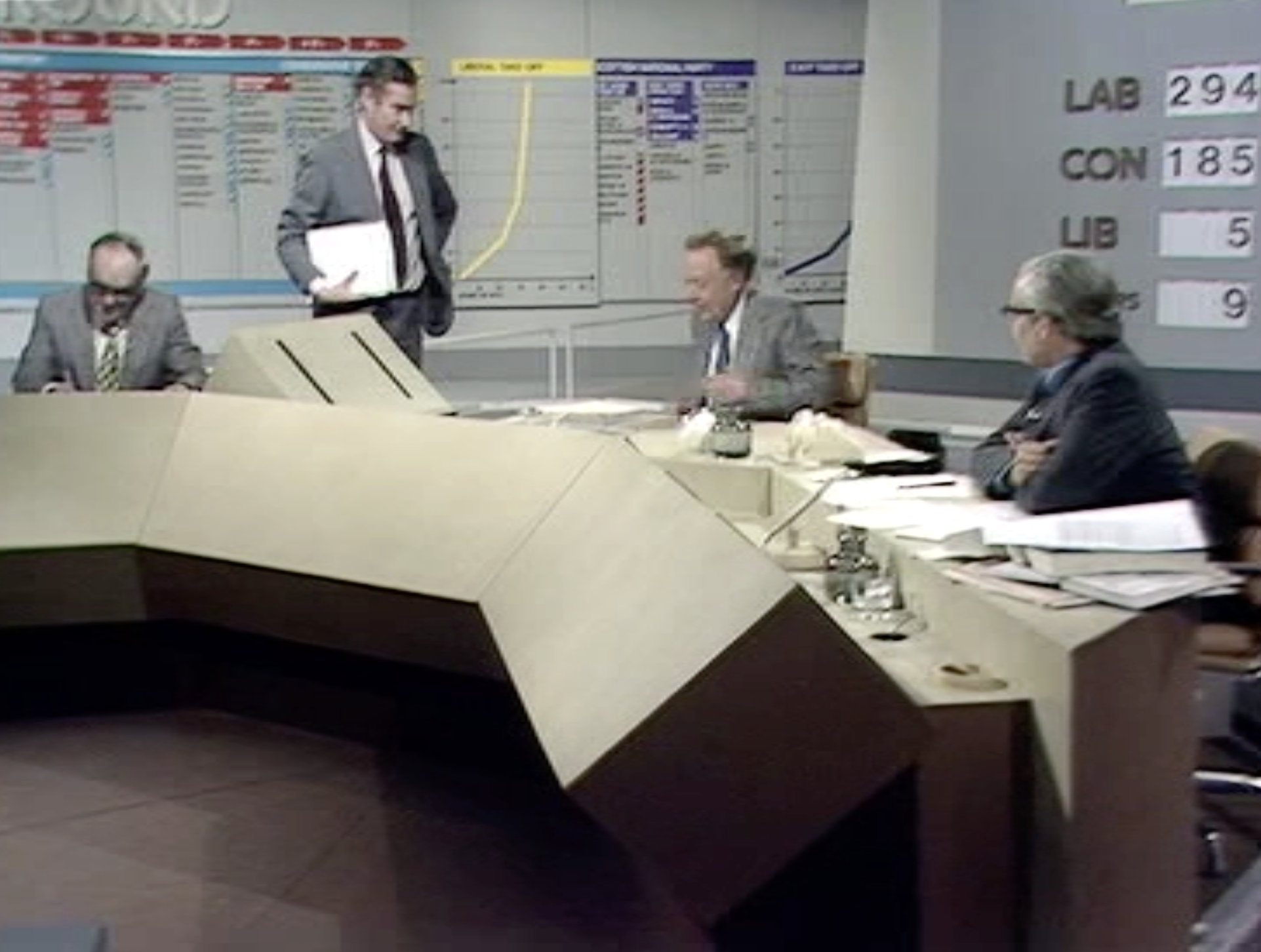
Enclosing the entire environment within a giant circular frame was evidently thought enough of a success – or perhaps an expedient – to warrant a second outing come the election in February 1974, though on a more modest scale. Some belt-tightening seems to have taken place here. Gone are the elevated pulpits, the gleaming podiums and the vertiginous rookery for Robin Day. Gone too are the enormous charts and jumbo-maps. Only a handful of result-checkers are glimpsed and those we do see are consigned to the equivalent of the studio basement.
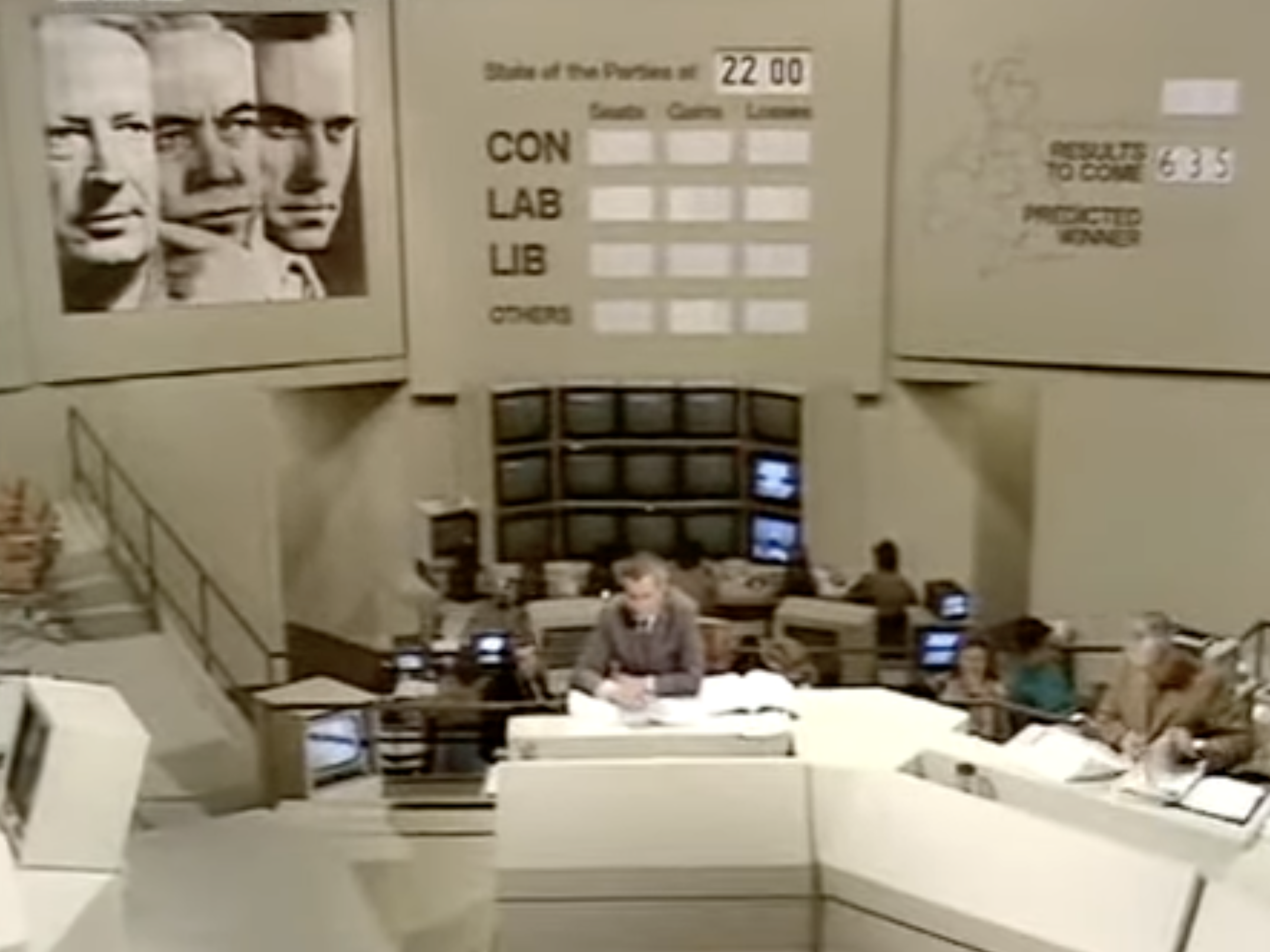
It’s tempting to see this as a response to the mood of the times, specifically the feeling of perma-crisis kindled by the government’s imposition of a three-day working week at the end of December 1973, and the subsequent miners’ strike that began in January 1974. The slimmed-down presentation suggests someone at the BBC is wanting to save some money, or at least to be seen to be wanting to save some money.
The downbeat atmosphere is compounded by the absence of Cliff Michelmore, kicked indecently out of the big chair by the BBC’s short-term signing Alastair Burnet, with Michelmore’s warmth and affability replaced with Burnet’s gruff and surly demeanour.
Even the smooth contours and handsome finish of the desks have been junked, replaced with furniture that looks like it has been fused together crudely from a jumble of geometric shapes, rather than assembled with an eye for clean lines and a continuous semi-circle.
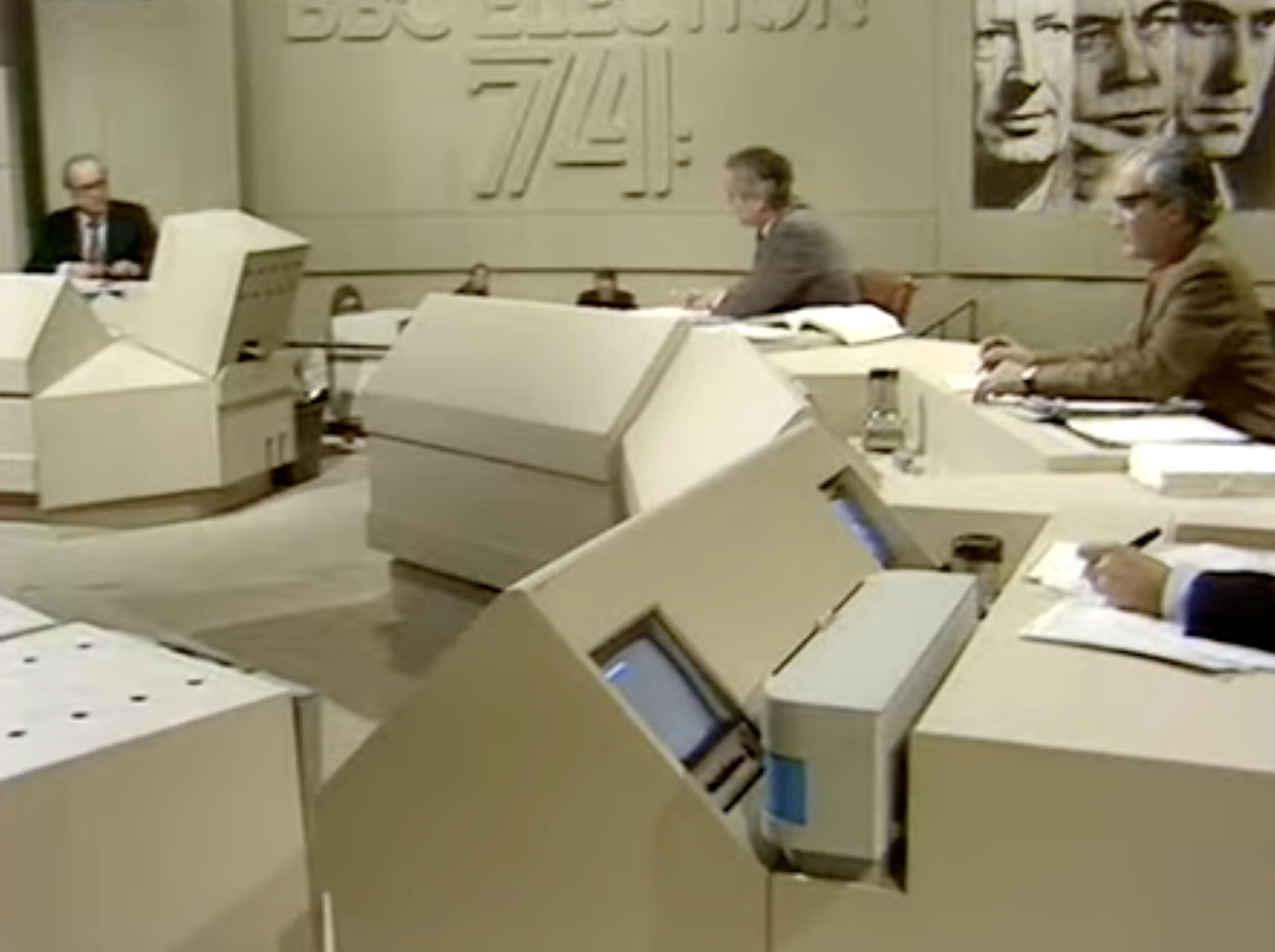
The presenters’ monitors are now incorporated fully within the desks – the end point of a process that began in 1959 – but this hasn’t been done with much elegance. Bob McKenzie in particular has been saddled with a machine that sulks at the end of his desk, emitting waves of lumpen electronic malevolence.
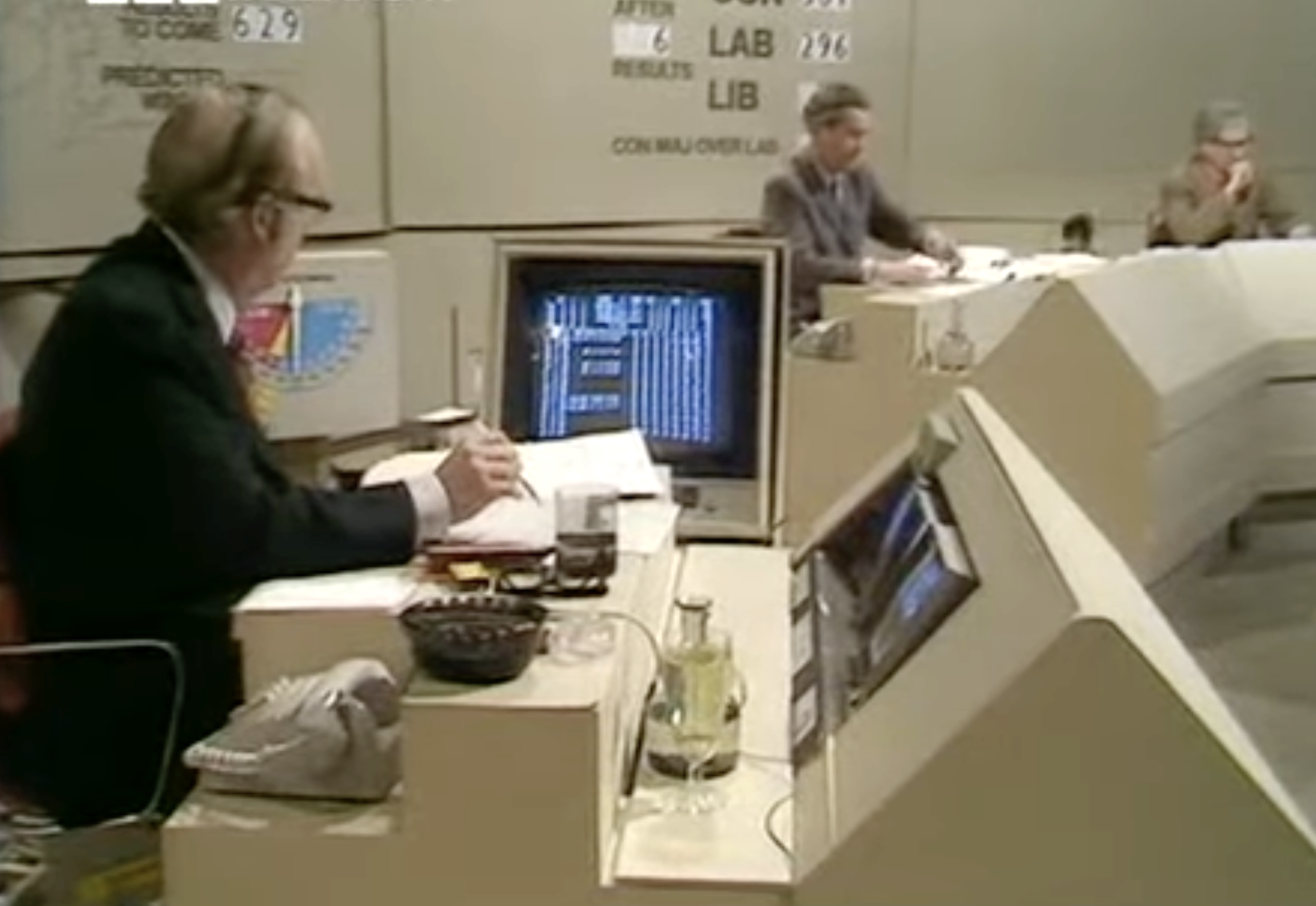
It looks like a memo went round telling the team to place secondary apparatus – glasses, water jugs, ashtrays – in the trough that runs between the monitors and the raised outer edge of the desks, though McKenzie gives this short shrift and keeps an enormous ashtray in full view. The special ledge that has been cut into the end of his desk for a telephone to sit discreetly is a nice touch, though.
Beige is once again the official colour, applied this time not only to the walls but also the desks, the floor and pretty much everything.
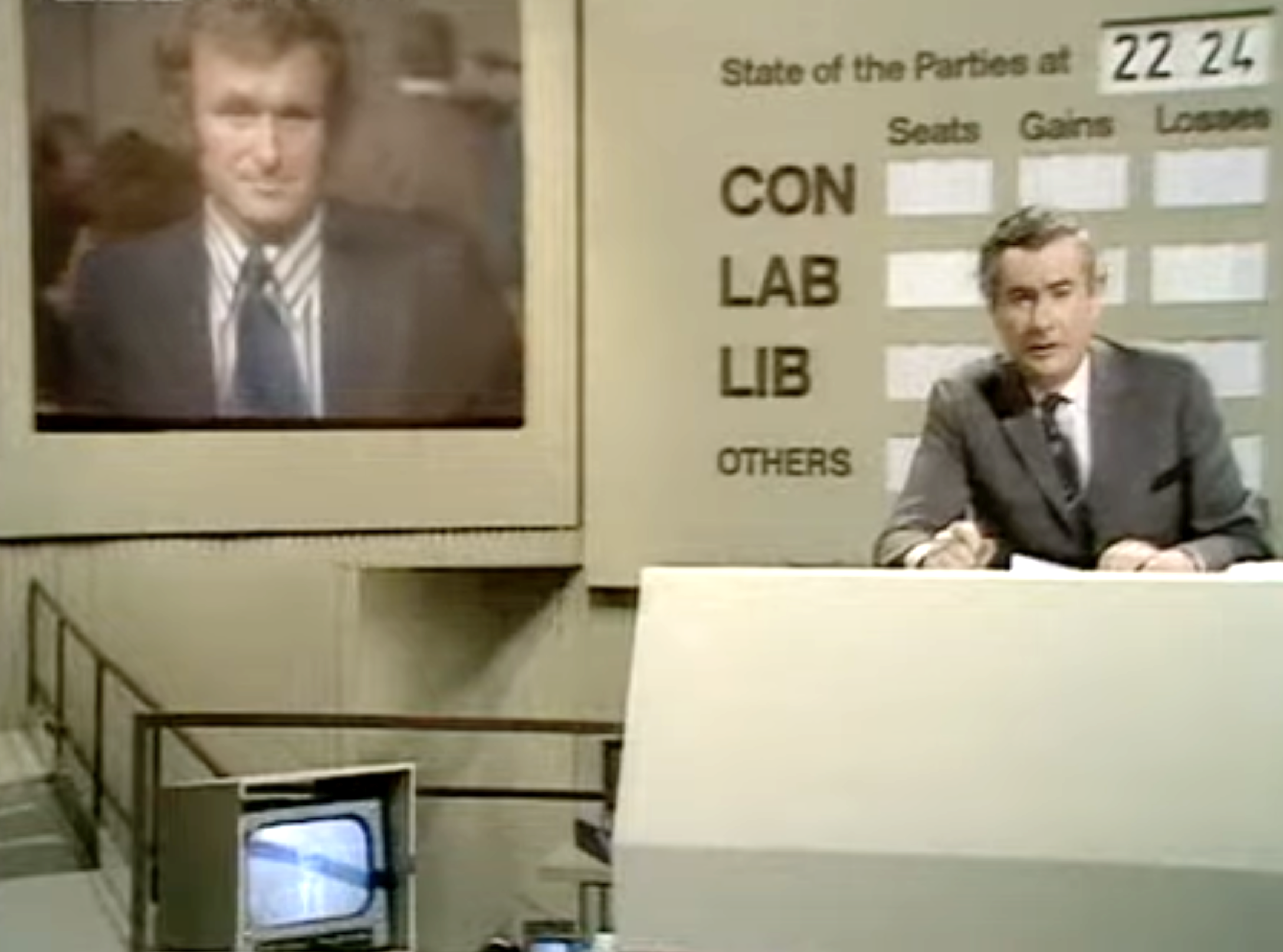
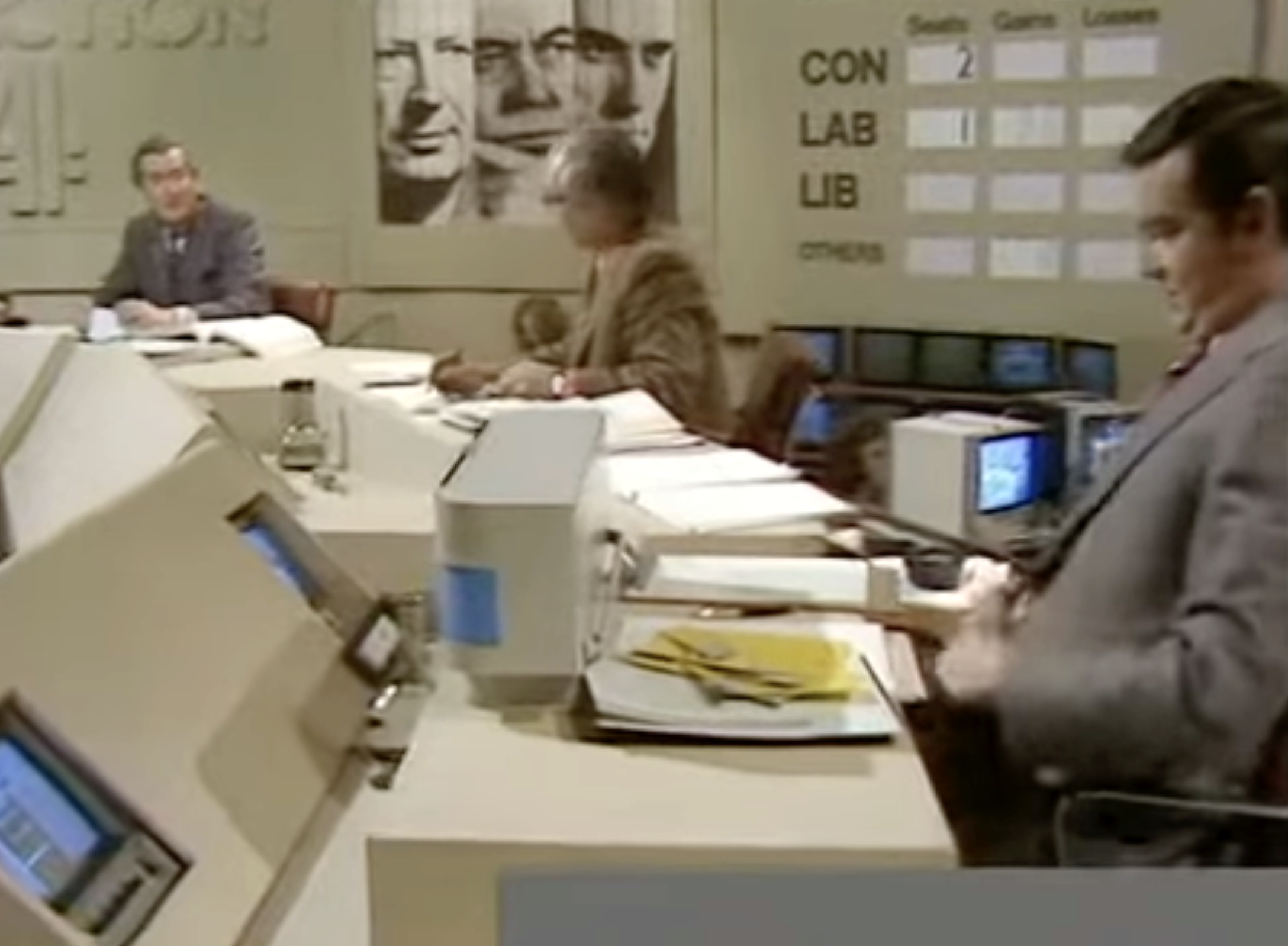
There is a bank of television screens, but it’s positioned to one side of Burnet and we don’t see it except in medium shots or when the camera points down into the studio.
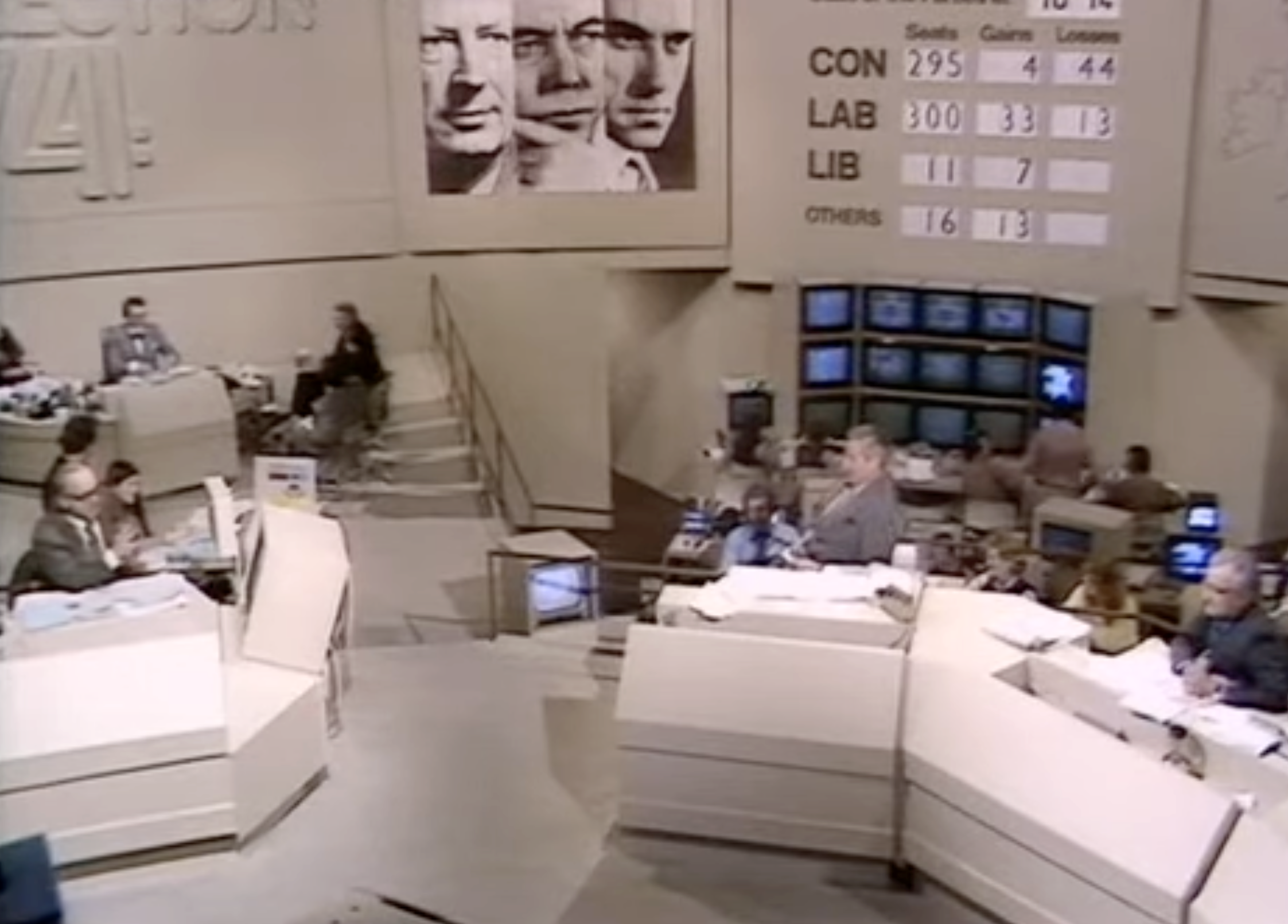
Maybe Robin Day incurred the wrath of some of the high-ups, for this time his conversation nook is not above everyone else but slightly below, as if in an orchestra pit.
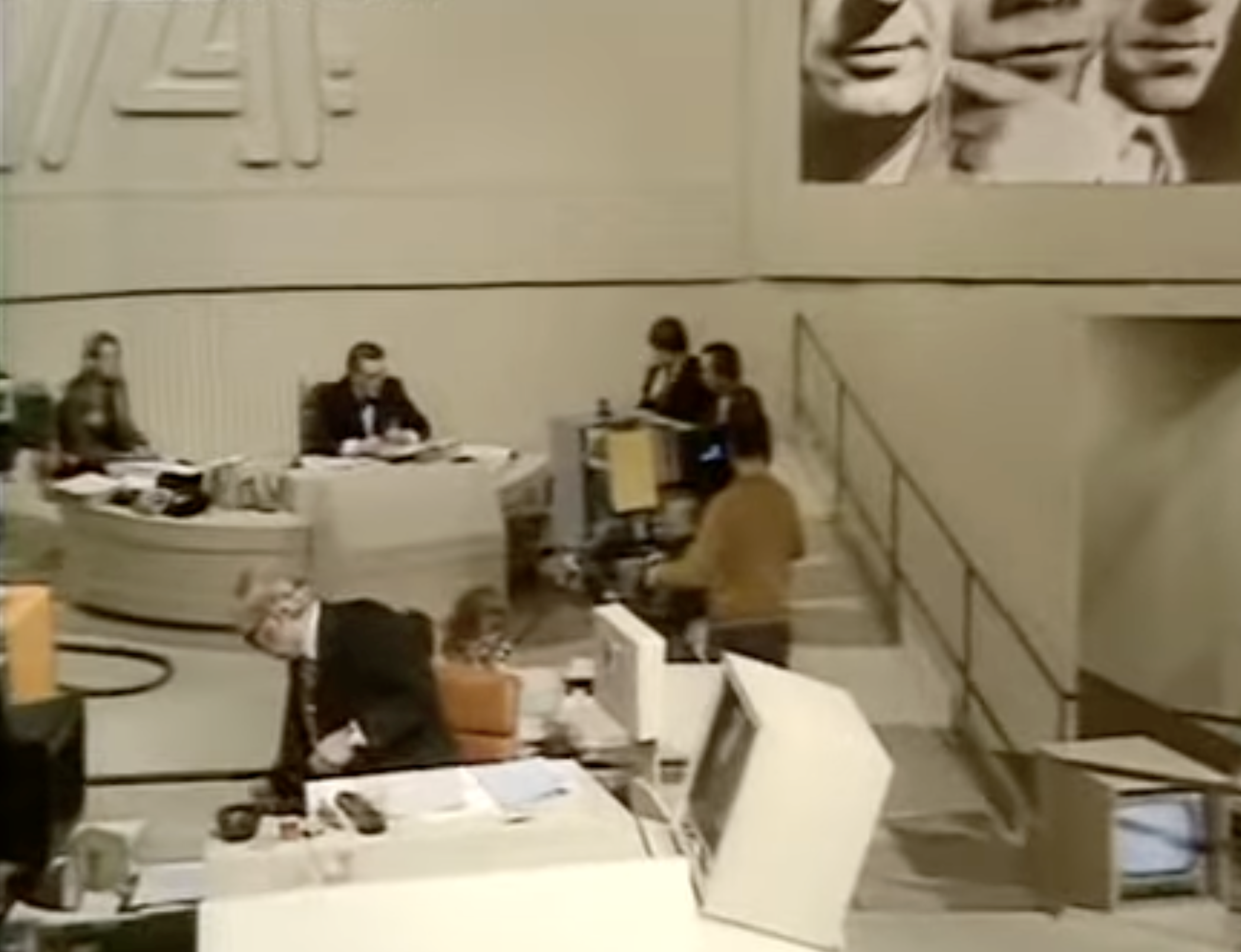
Perhaps to offset this arrangement and to remind viewers of his status, Day has decided to augment his desk with a sort of a mini-library, as if he might pluck out a reference book at any moment (this never happens).
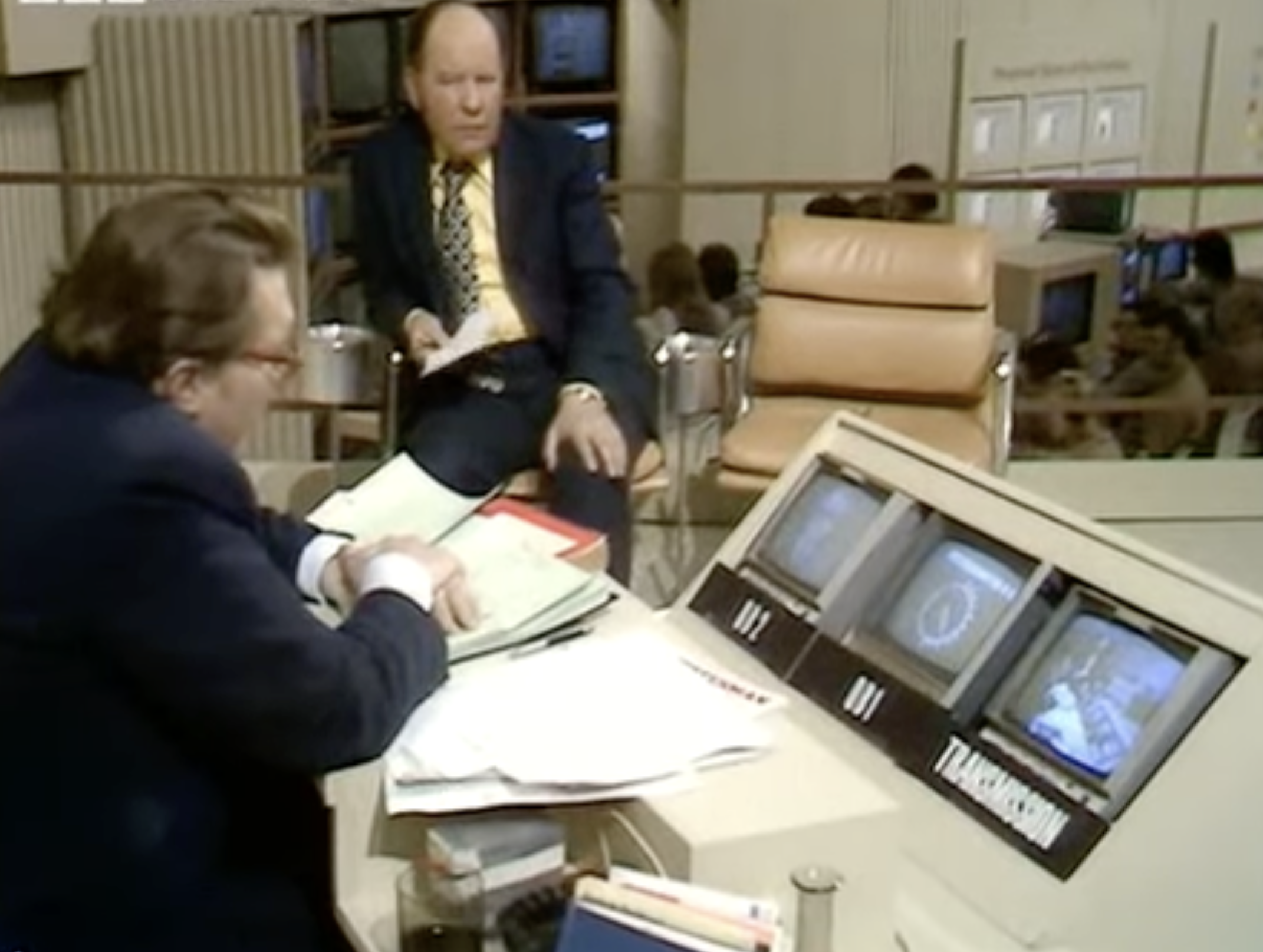
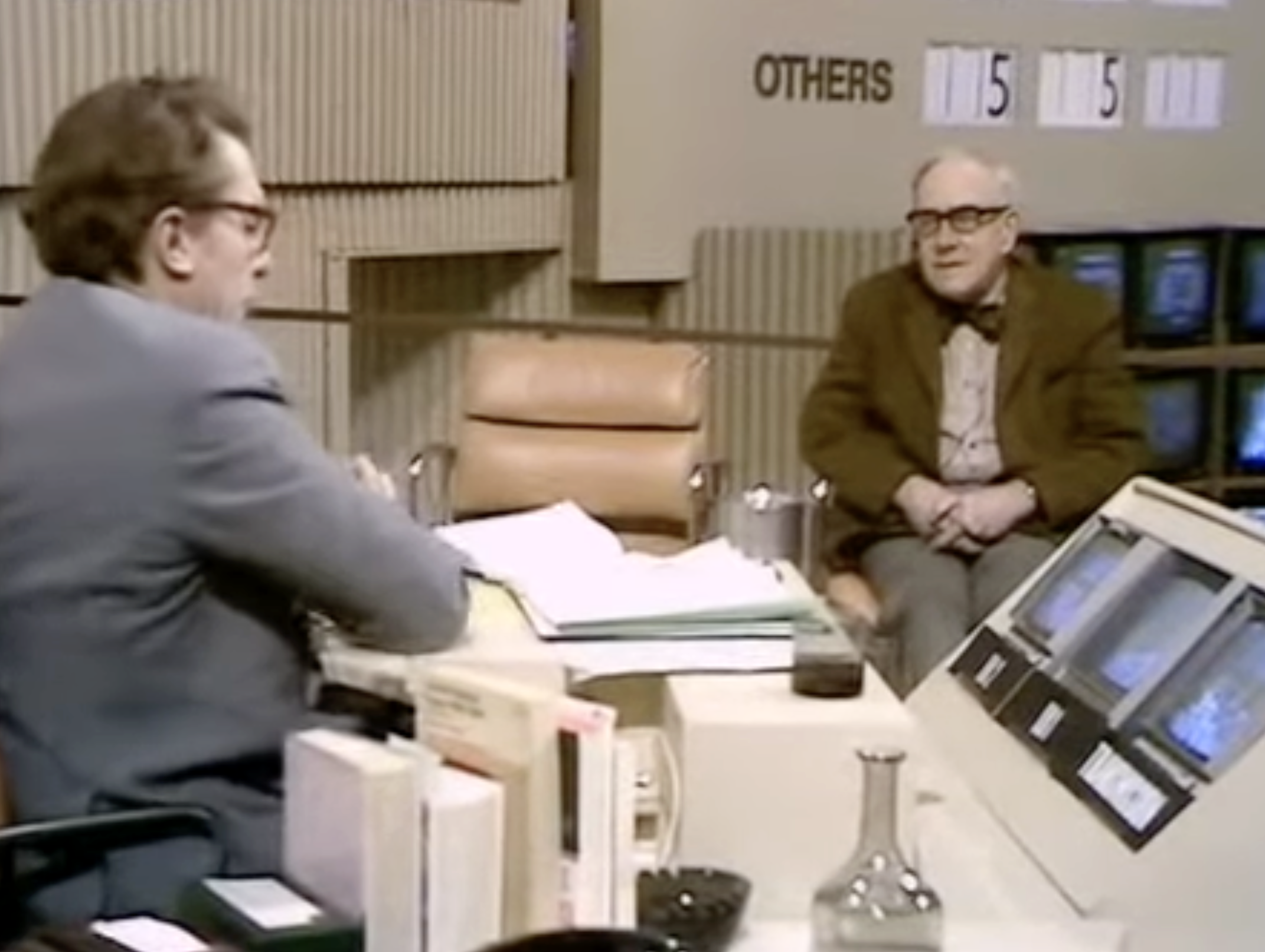
He has managed to lay his hands on some padded chairs, however. Indeed, the chairs throughout the studio are the most comfortable yet seen. The country may be about to run out of coal, but at least it’s still possible to have a nice sit down.
The failure of any party to win a majority at this election or subsequently to form a stable government implied another poll would have to happen fairly sharpish – Burnet himself refers to it as being “the first” general election of 1974 – and it looks like the BBC kept much of the trappings of the set in storage, ready for a second outing later in the year.
You can’t really blame them; the cost of producing a new set from scratch might have gobbled up what precious money they still had. Besides, seeing elements of the February set return in October, albeit with small tweaks and modifications, fits neatly with the sense of it being the second half of a two-act spectacle – something reinforced by Burnet’s return for the second, and thankfully final, time as anchorman.
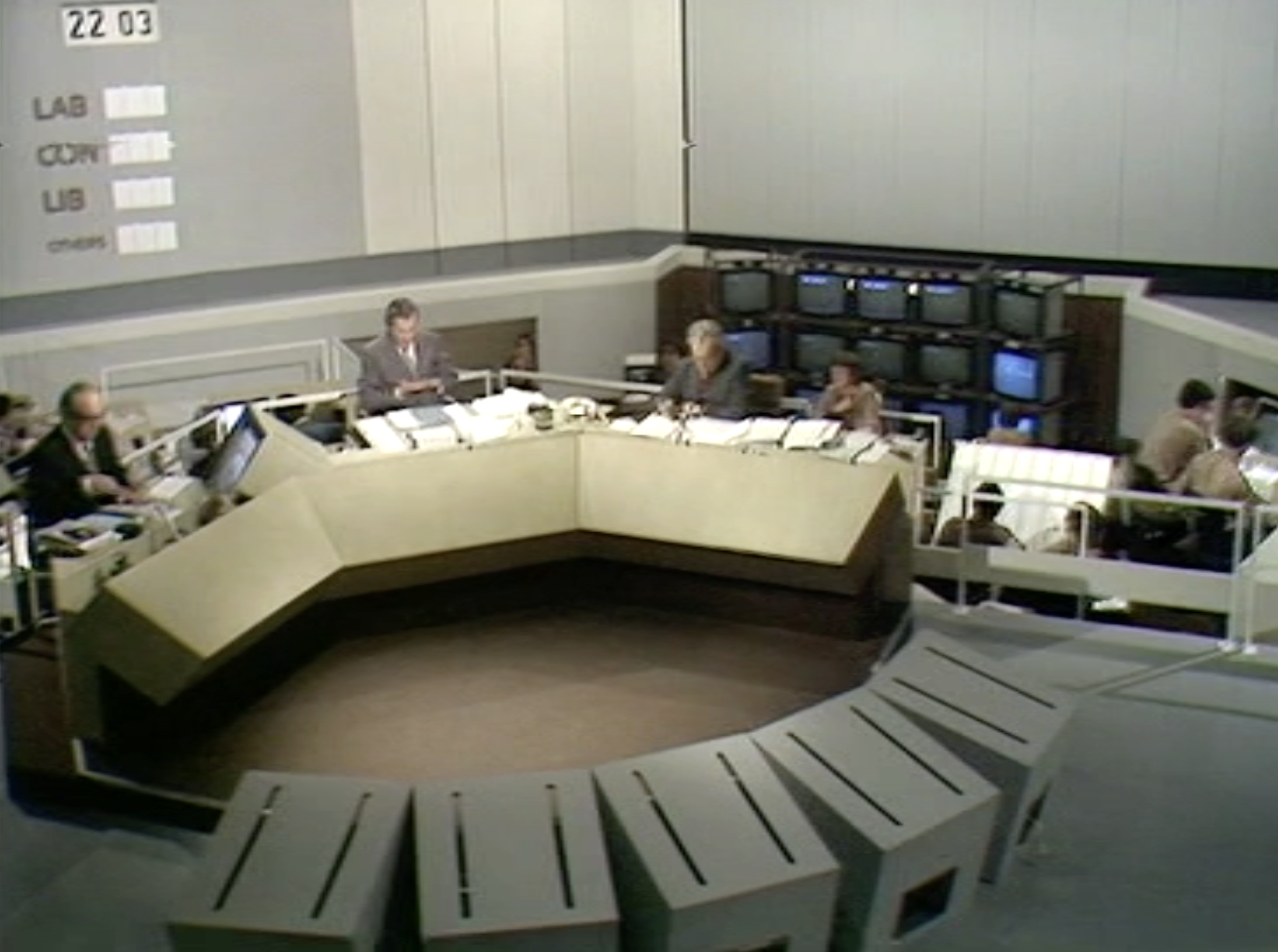
Bob McKenzie’s desk has now been pushed up to meet the others, so there is no longer a gap between him and Burnet across which they have to shout. But McKenzie’s hulk of a monitor is still there, as are the telephone perches, the trough for the drinking vessels and the recessed monitors. A second row of standalone monitors is much more in evidence this time round, plonked ostentatiously in front of the presenting team and nestled inside some dull cladding.
Grey has definitely won the battle with beige this time round: there’s far more of the former in evidence in October than in February, including on the wall panels and the floor. Some attractive rotating slats have replaced one section of the wall, which at the touch of a button reveal a giant screen, to which Burnet offers surly remarks.
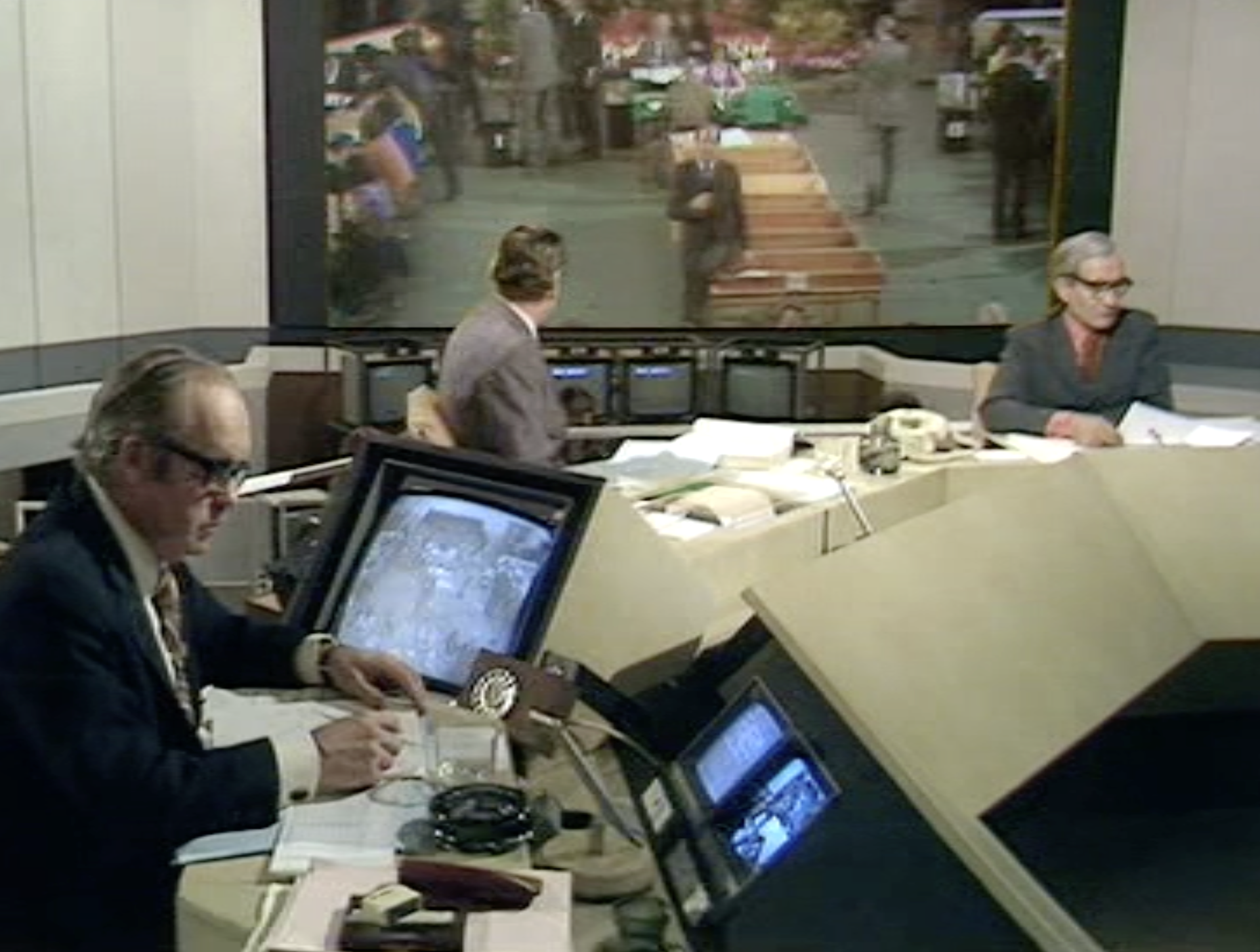
This is certainly the tidiest studio set we’ve seen so far; there are even small holes in the desks through which cables can pass, and the floor is noticeably free from untethered wires, rubbish bins and debris.
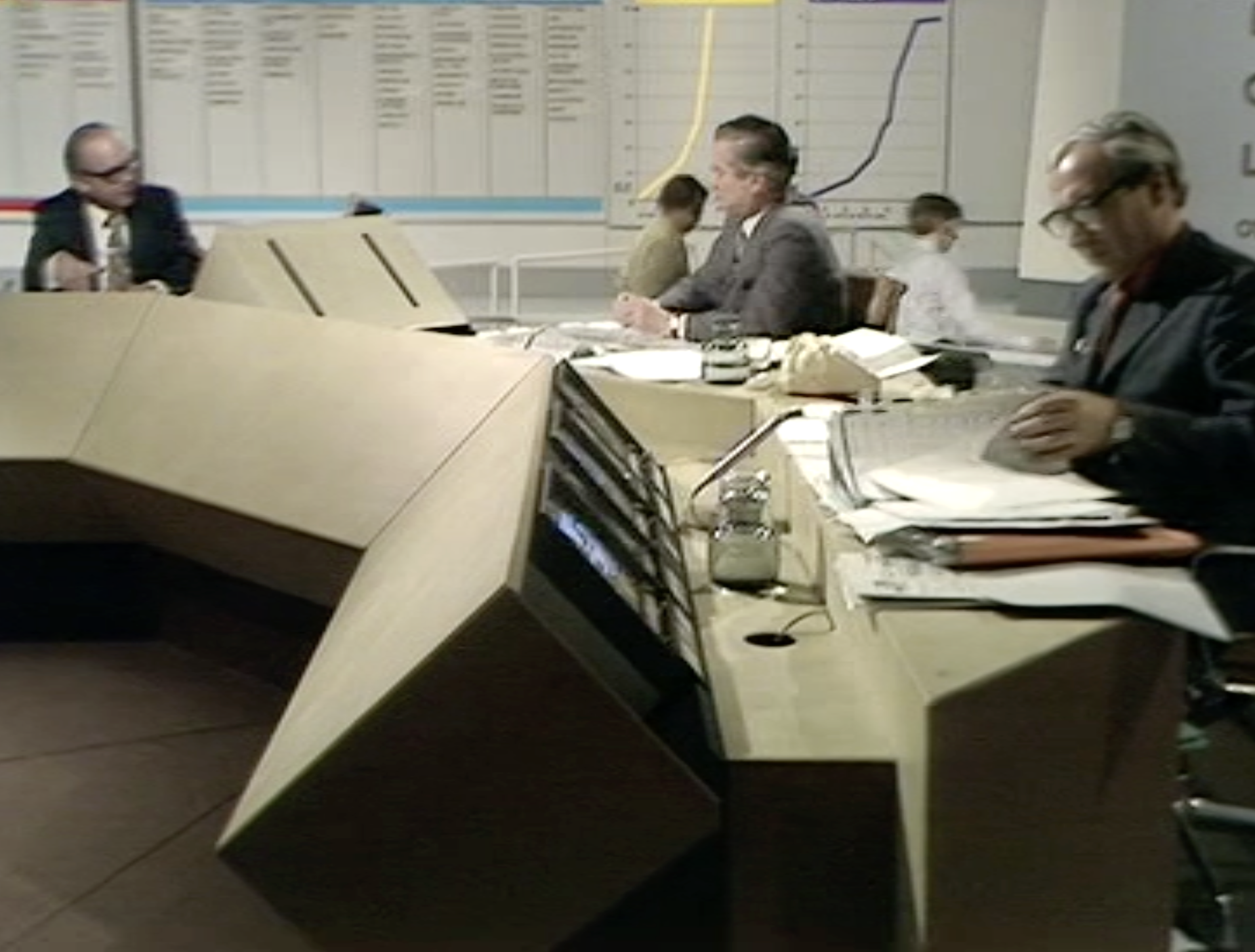
There is one exception to the rule, however: the lid of Richard Stilgoe’s grand piano, which is unceremoniously shoved in a corner during the man’s brief appearance the following morning.
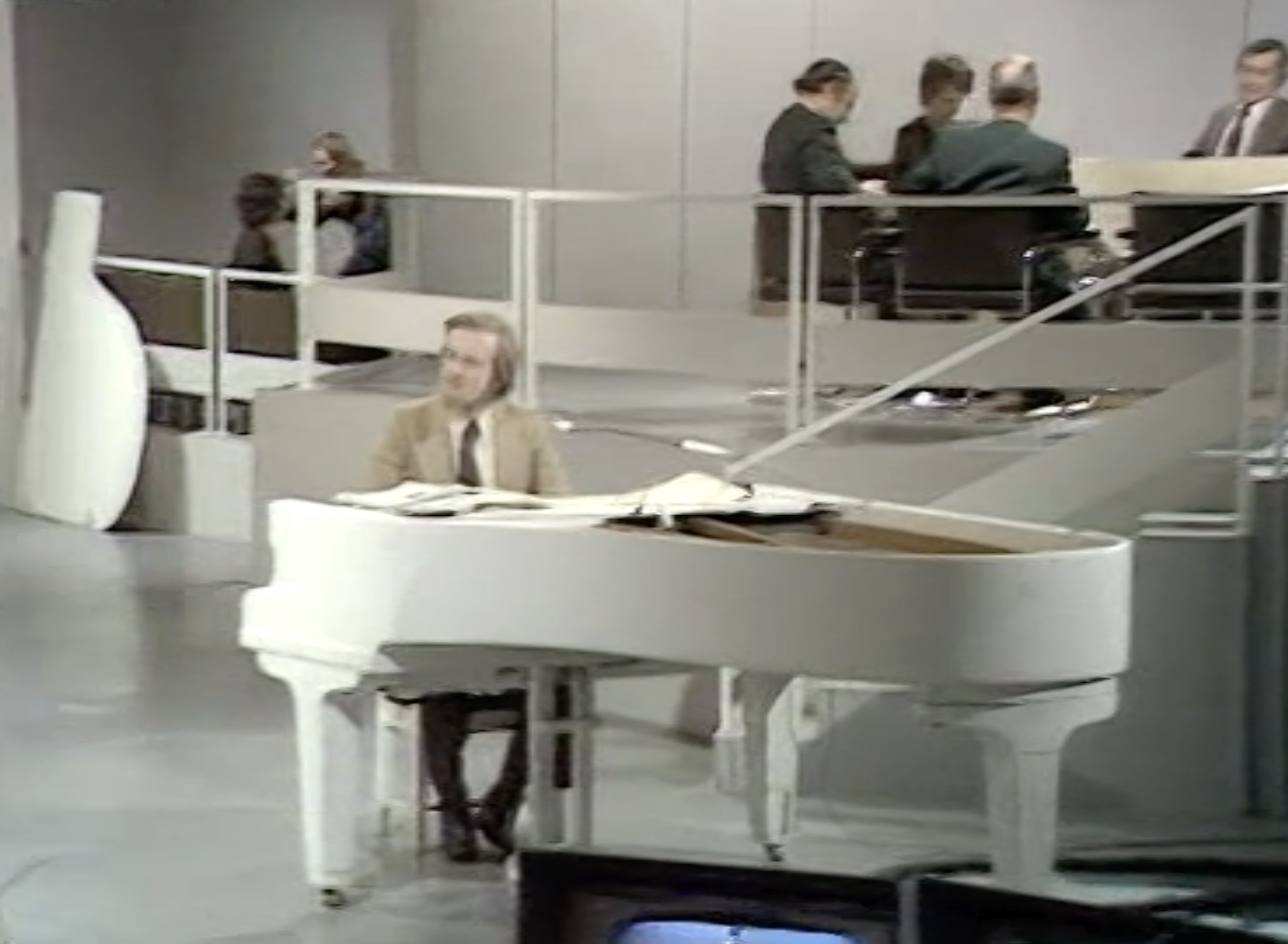
Here is one reason there is so much empty floor space this time round. The vast proportions of Maestro Stilgoe’s instrument need to be accommodated somewhere, on screen and off.
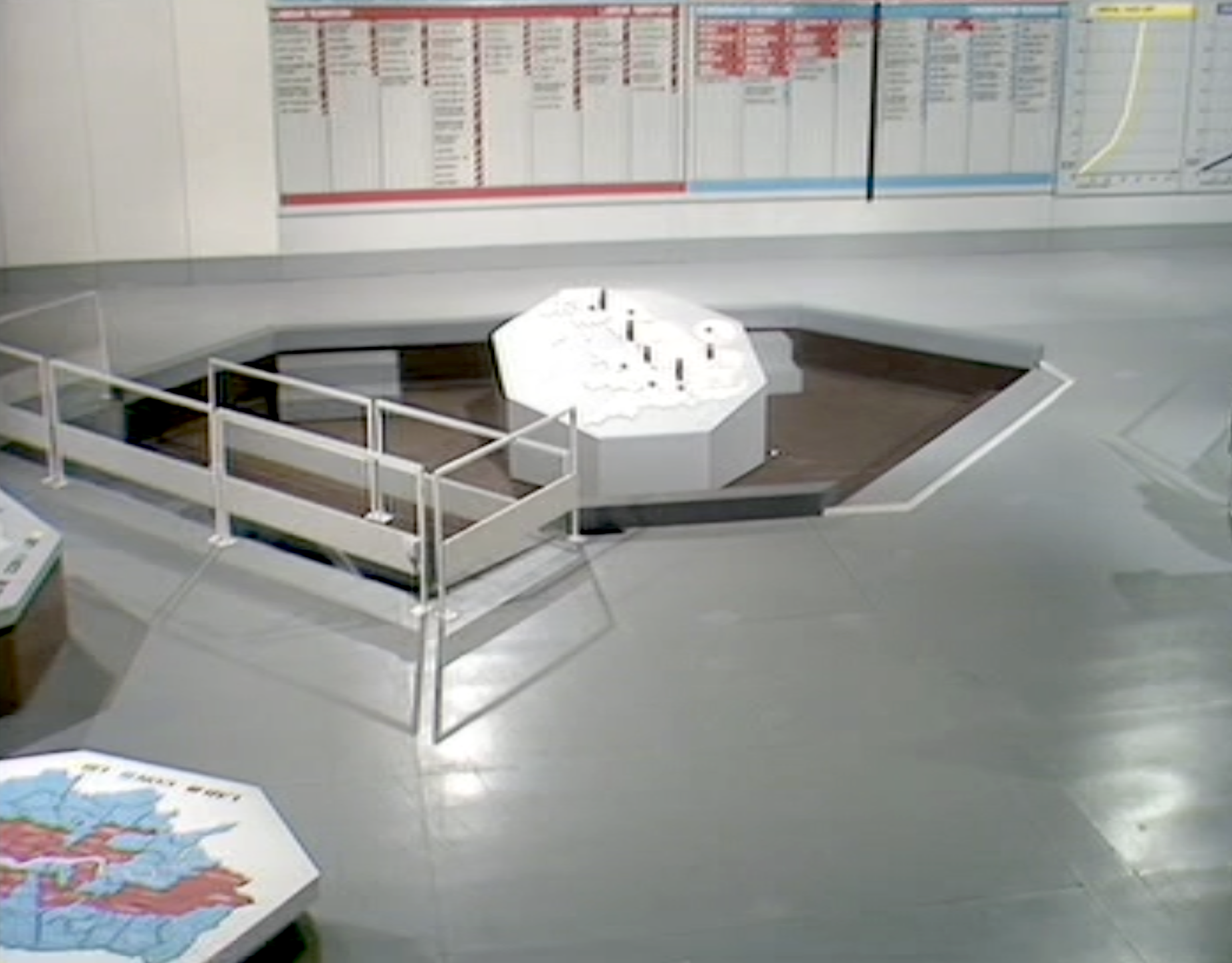
The grey base of the set has been built on top of the main studio floor, allowing certain areas to be slightly lower than others, calling to mind the gaudy sunken beds and settees briefly in vogue in taste-deficient well-to-do circles around this time.
A map of the UK has been placed in one of these pits; the result-checkers have been placed in others, meaning we are treated periodically to rows of the backs of heads.
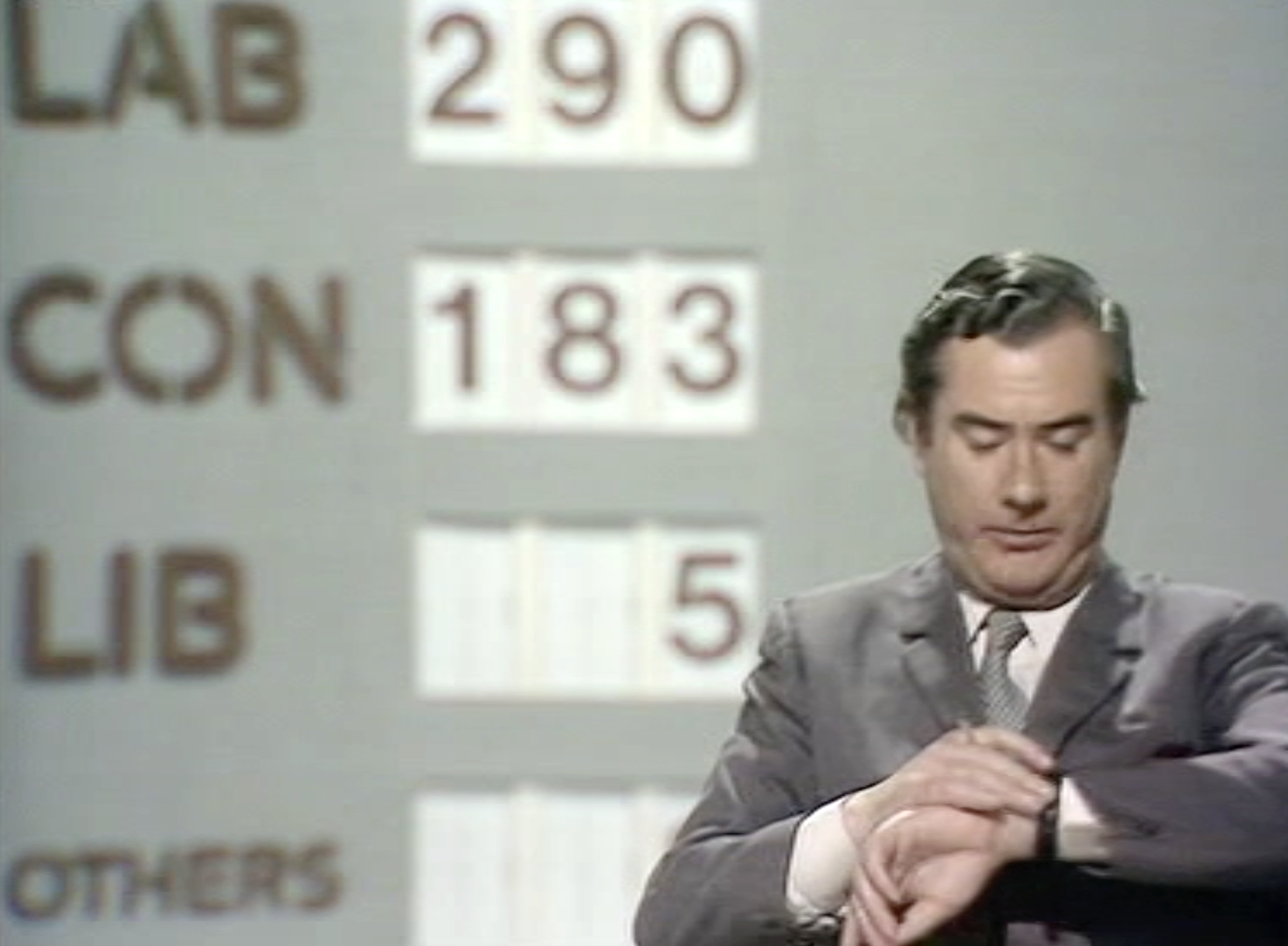
There is an elegant simplicity to the way the state of the parties is displayed on the wall of the set. By contrast, there is a profound inelegance to the way Burnet spends much of the proceedings checking his watch, as if he can’t wait to pop off for dinner. Michael Barratt anchors the early shift the following morning and does it so well that Burnet gets visibly agitated, striding back on to set and looming over Barratt for several minutes before kicking him out – only to start checking his watch again. This man should never have been hired.
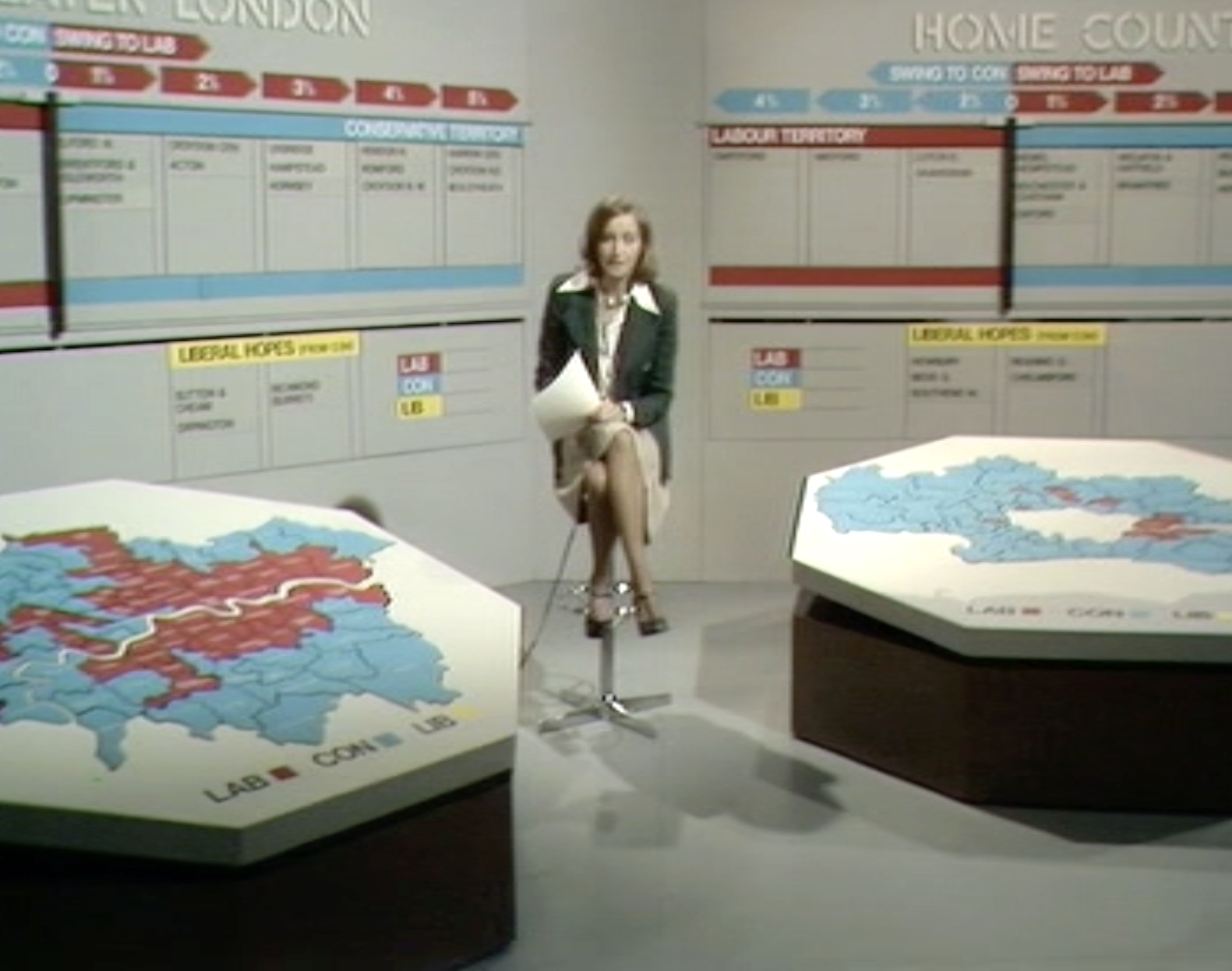
Elsewhere, we have the first appearance on an election night of a high chair. Sue Lawley perches atop it during the regional opt-outs, telling viewers in the capital what has happened in London and the Home Counties with the help of some giant maps, each mounted on an octagonal elevated dais, which look very swish.
The same cannot be said of Robin Day’s nook. He’s been parked in the most sparsely-furnished area of the studio, with only the most essential props to hand.
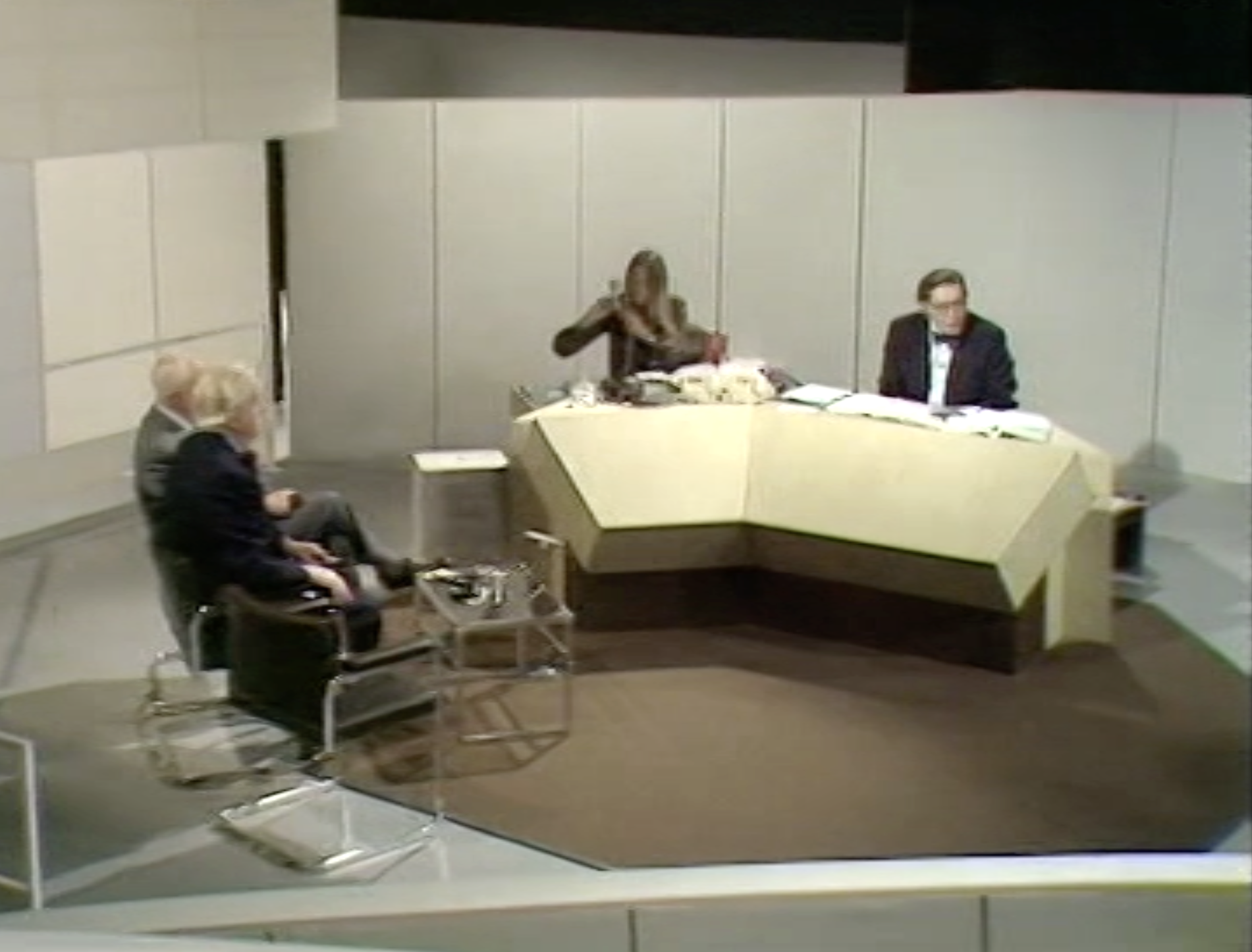
He’s lost his freestanding television set completely, having to peer down into the monitors built into his desk. His guests are too far away, perched on bland chrome-framed chairs and a far cry from the snug light-coloured seats of February. Even his desk is too small, with books and papers piled on top of each other.
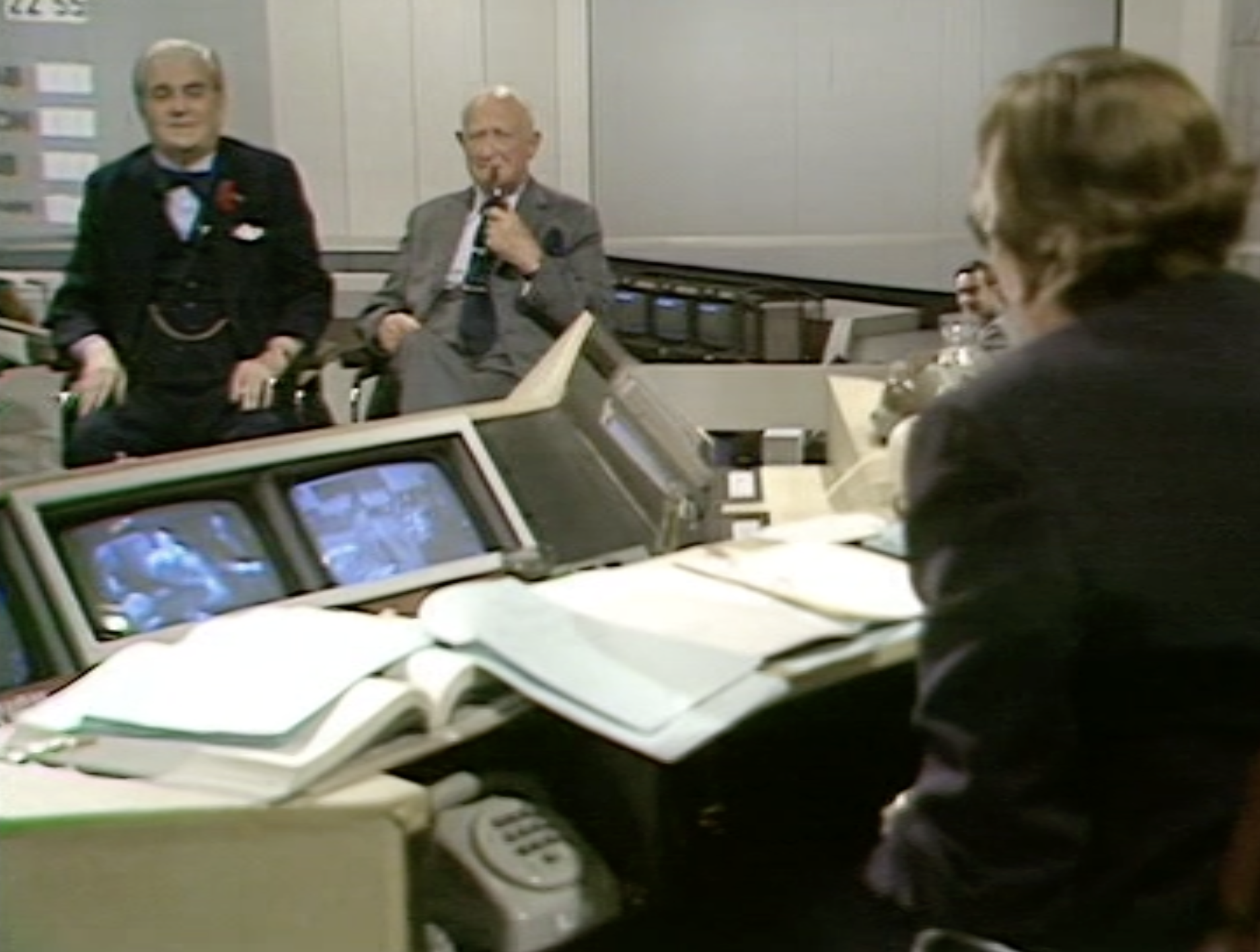
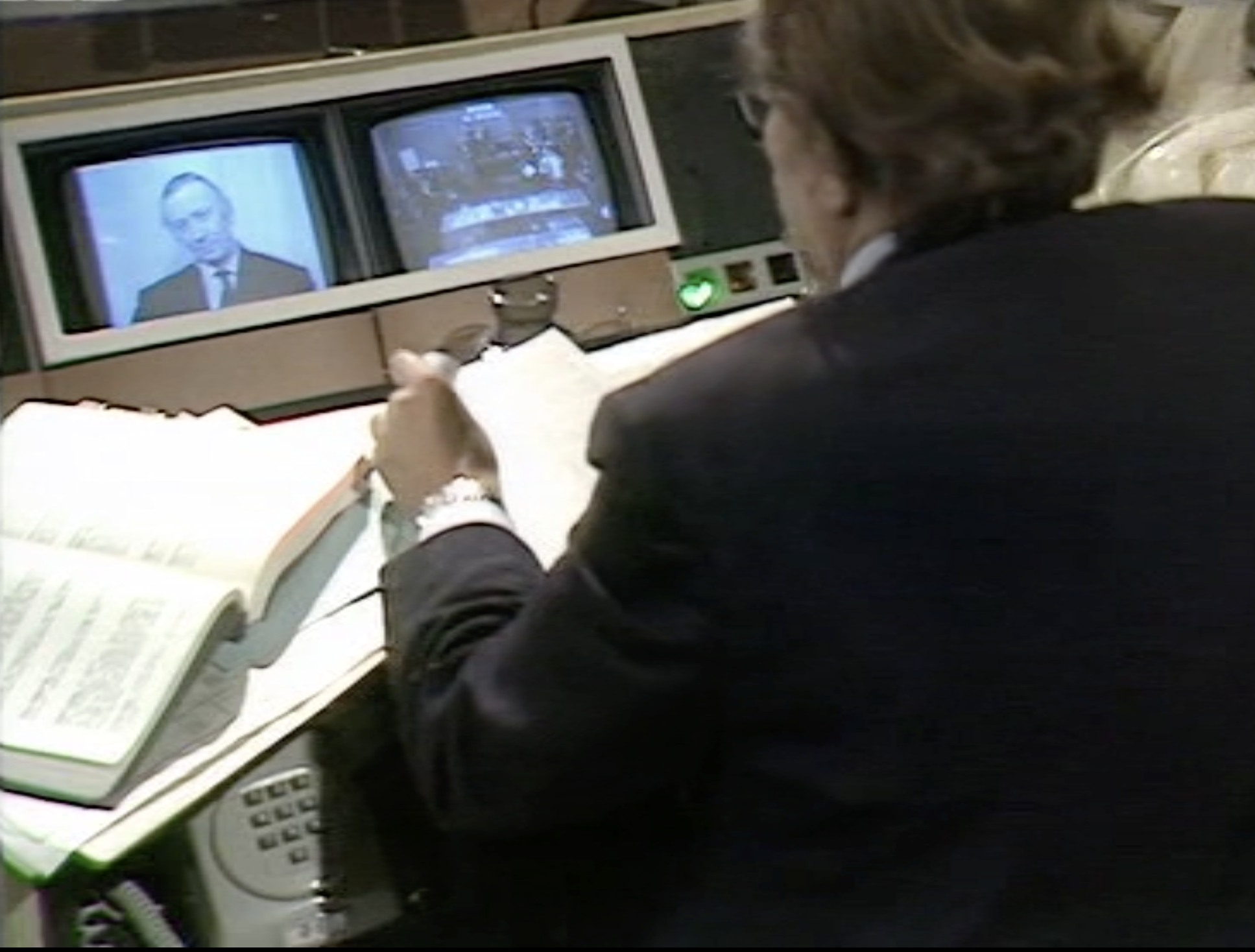
An election telephone deserves to be seen and heard, not tucked away as if an object of shame.
*
October 1974 was the last time for nearly two decades that a giant studio set was used by the BBC for its election coverage.
The next three general elections see sequentially smaller sets, dwindling amounts of furniture and fewer and fewer people, culminating in the entire squadron of result-checkers banished out of sight, referred to but never seen. Each programme appears more diminished than the last. The endpoint is something with the visual ambition of a company boardroom rather than the hall of mountain king.
The diminishing is gradual, though. The May 1979 programme still boasts a sprinkling of support staff who occasionally bob into view from behind three V-shaped desks: one for Robin Day and guests, one for David Butler and new host David Dimbleby, and one for newsreader Angela Rippon and Bob McKenzie.
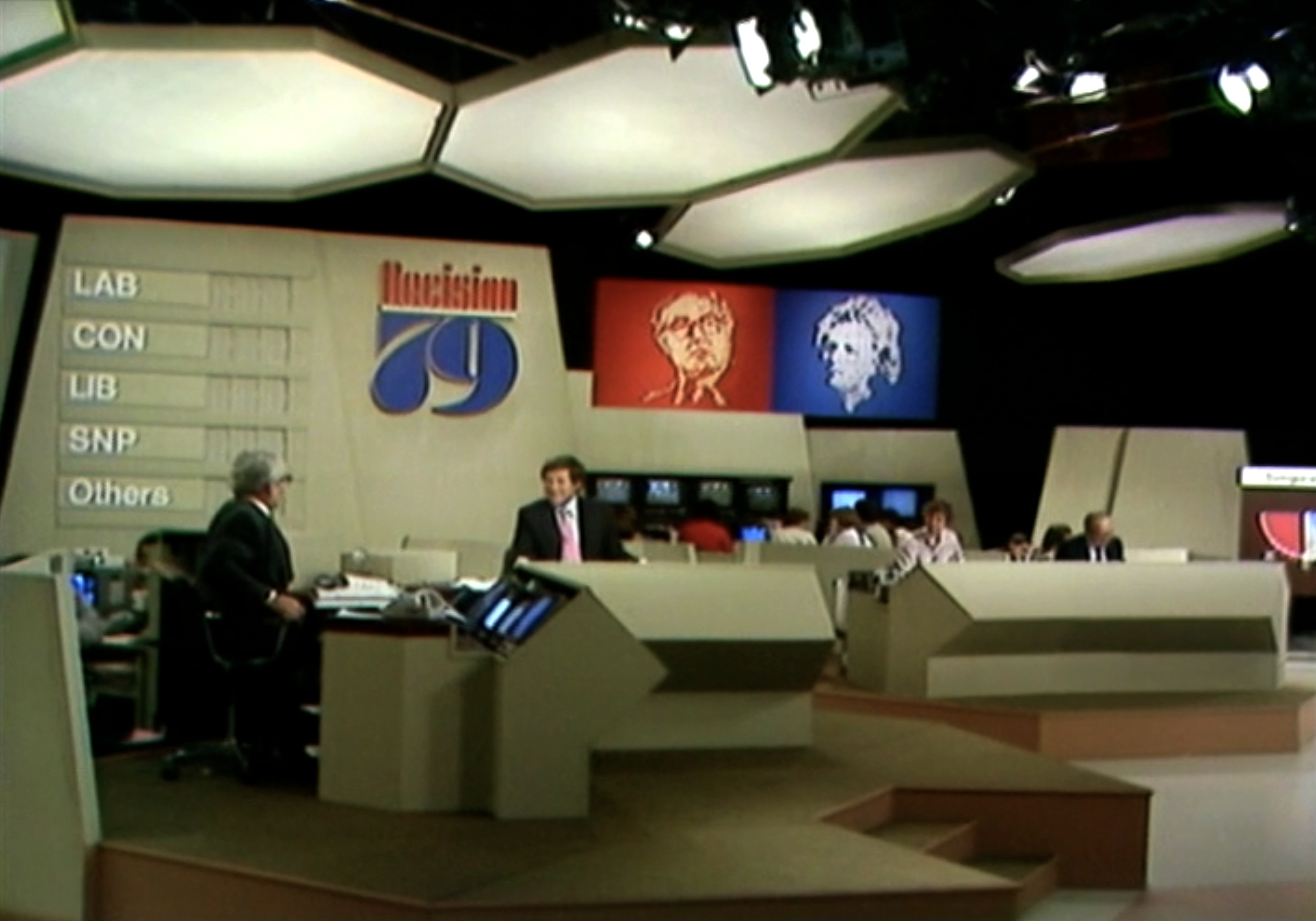
The desks are arranged in a forward-facing line with gaps between each one, helping to suggest a sense of scale and grandeur in lieu of much practical evidence of either.
Each desk is on a podium, which raises the presenters above the result-checkers and creates vertical perspective as well as horizontal: a strategy deployed at all four elections in the 1970s, but ditched in the next decade.
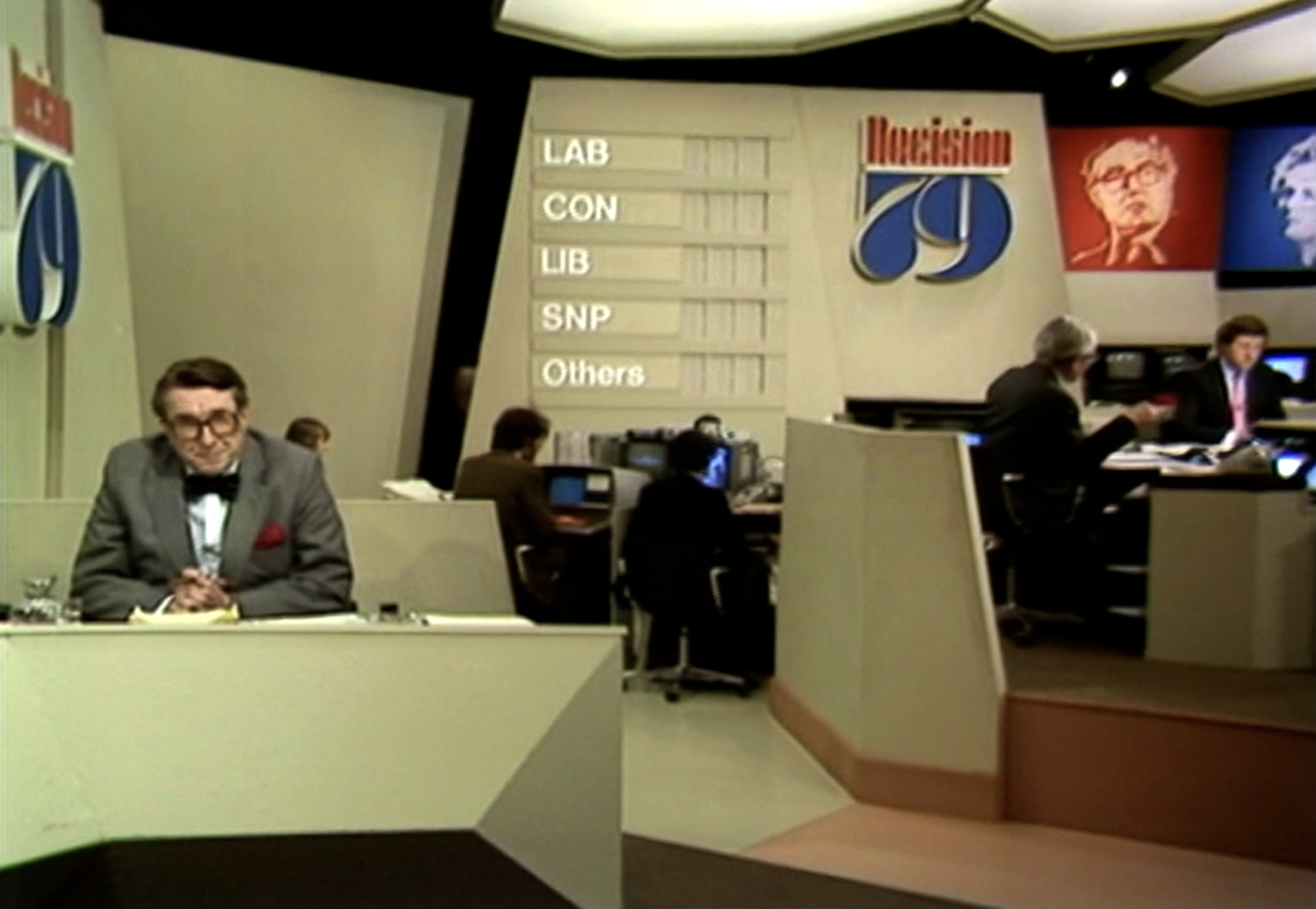
The same fate awaits the beige colour scheme, which came in with the 1970s and will go out with it as well.
Here the beige is almost everywhere: on the floor, round the desks and up the walls. Only the tops of the desks have been fashioned from a darker material, which at least provides a nice two-tone effect – when you can see the top of the desks, that is.
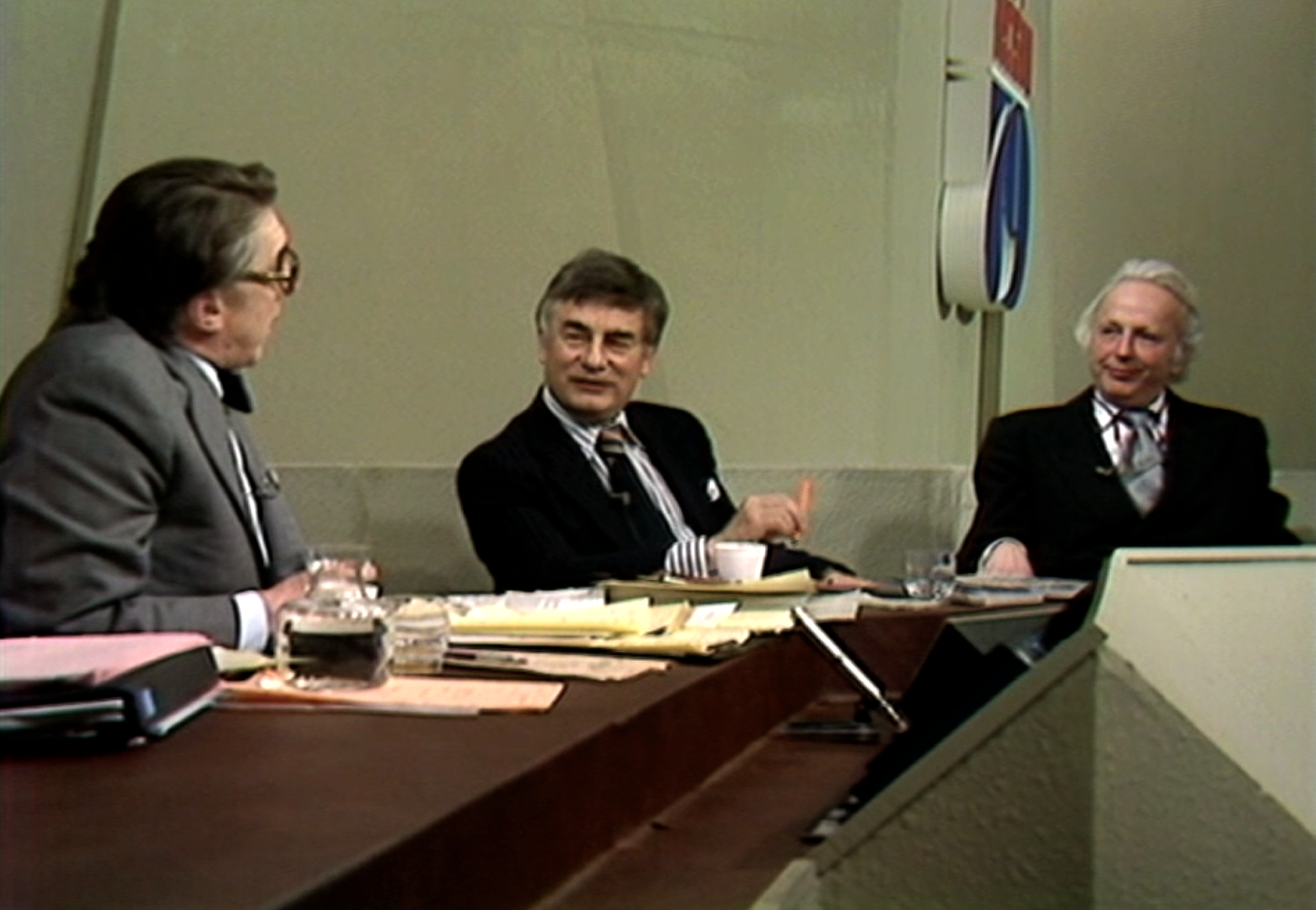
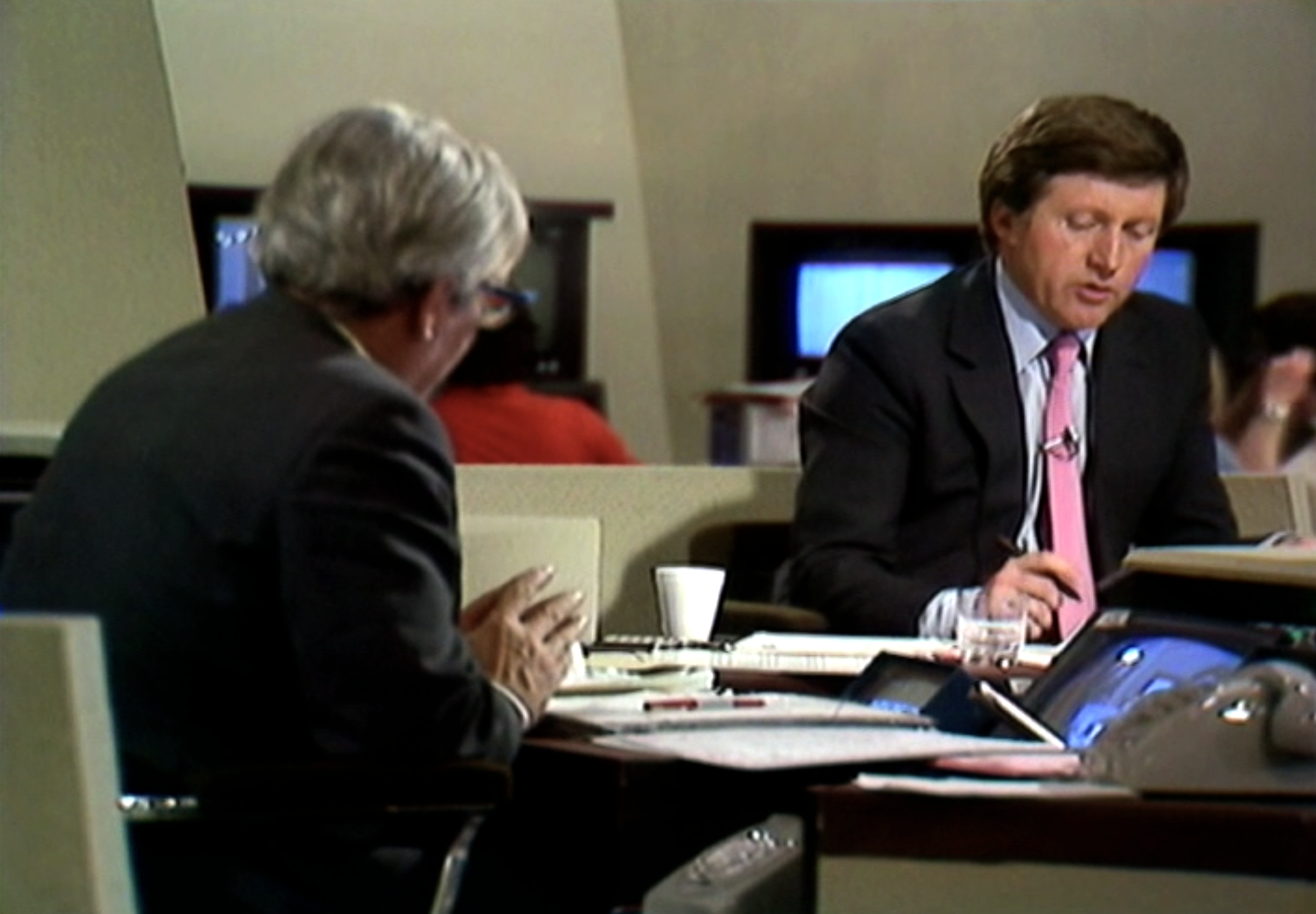
We’ve now travelled a long way from the days of studio monitors being shackled inside metal cases or simply plonked on the floor with cables trailing around people’s feet. In 1979 they are entirely enclosed within the desk units, angled at 45 degrees towards the presenting team, shimmering gently like a console on an elegant starliner.
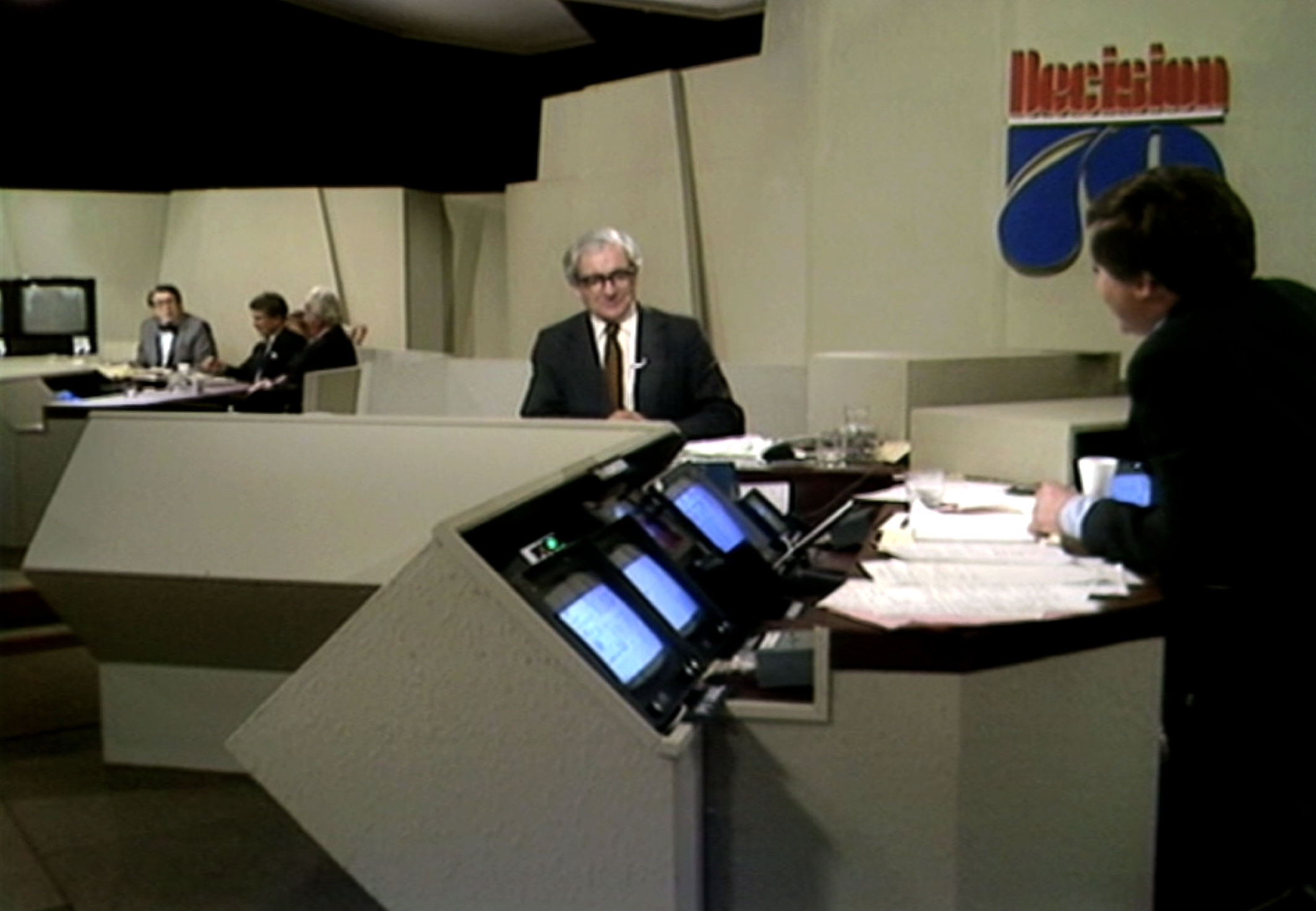
The overall dimensions of the studio are smaller than any during the 1970s and this is reflected in the size of David Dimbleby’s outside broadcast monitor, which is now a hole in the wall rather than a giant suspended screen or a projection behind revolving slats.
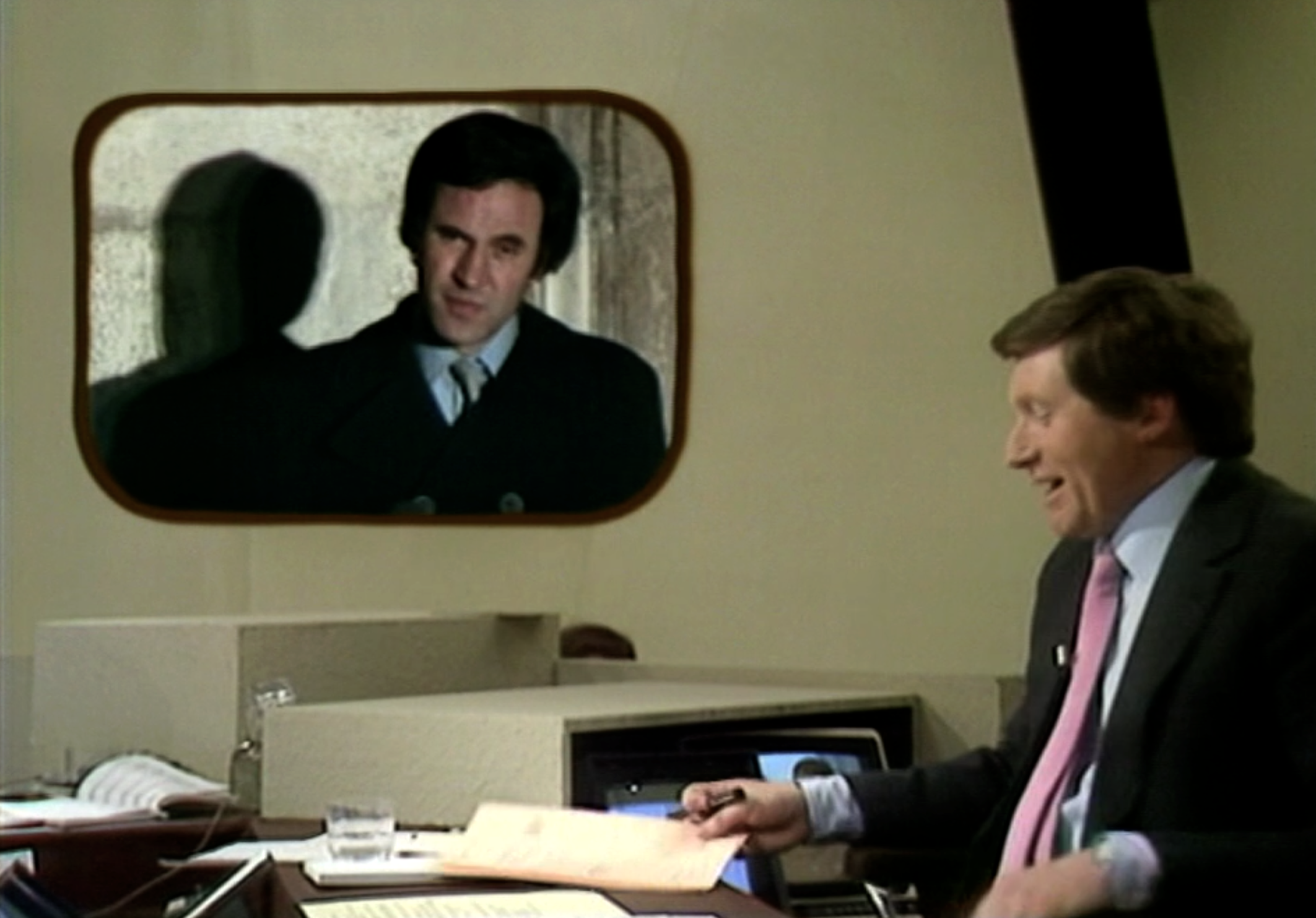
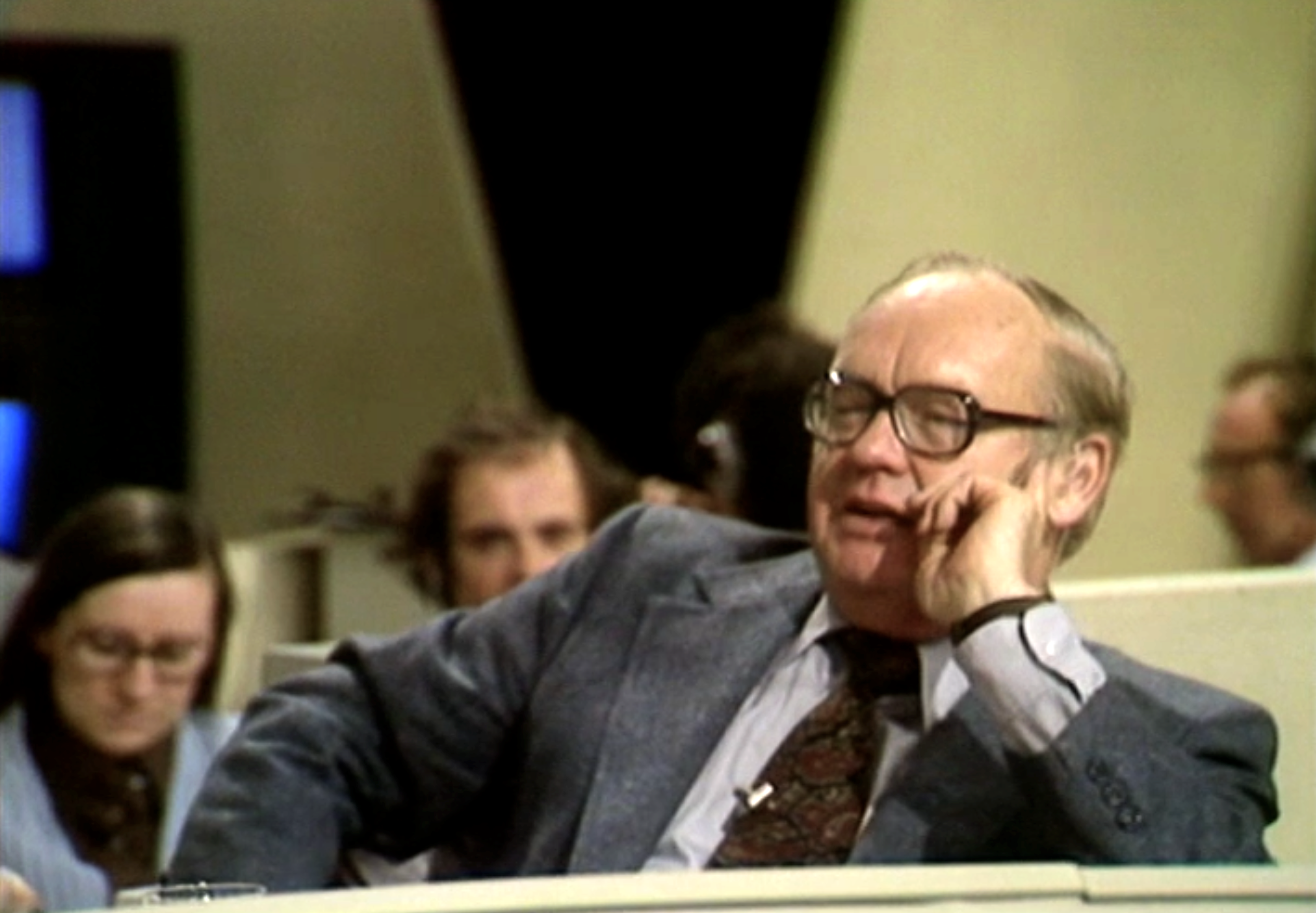
We must bid farewell after 1979, at least for the time being, to the wall of TV screens: a piece of election furniture that never dulls the pulse or tires the eye. We must also bid a permanent farewell both to David Butler (demoted to radio after 1979 and then kicked off the BBC entirely) and Bob McKenzie (who passed away in 1981). At least both saw out their final TV general election as much an integral part of proceedings as in 1955, together with their own well-furnished desks, fully incorporated into the studio layout. McKenzie’s tilting chair allows him simultaneously to lean back and hold forth.
It’s goodbye after 1979 to geometric shapes, though not before one last hurrah in the guise of a grid of huge octagonal ceiling lights. They are so striking, not to say ostentatious, as to be as much a feature of the set as the rest of the furniture. They jostle for your attention with the results board and those enormous colour-tinted depictions of Jim Callaghan and Margaret Thatcher.
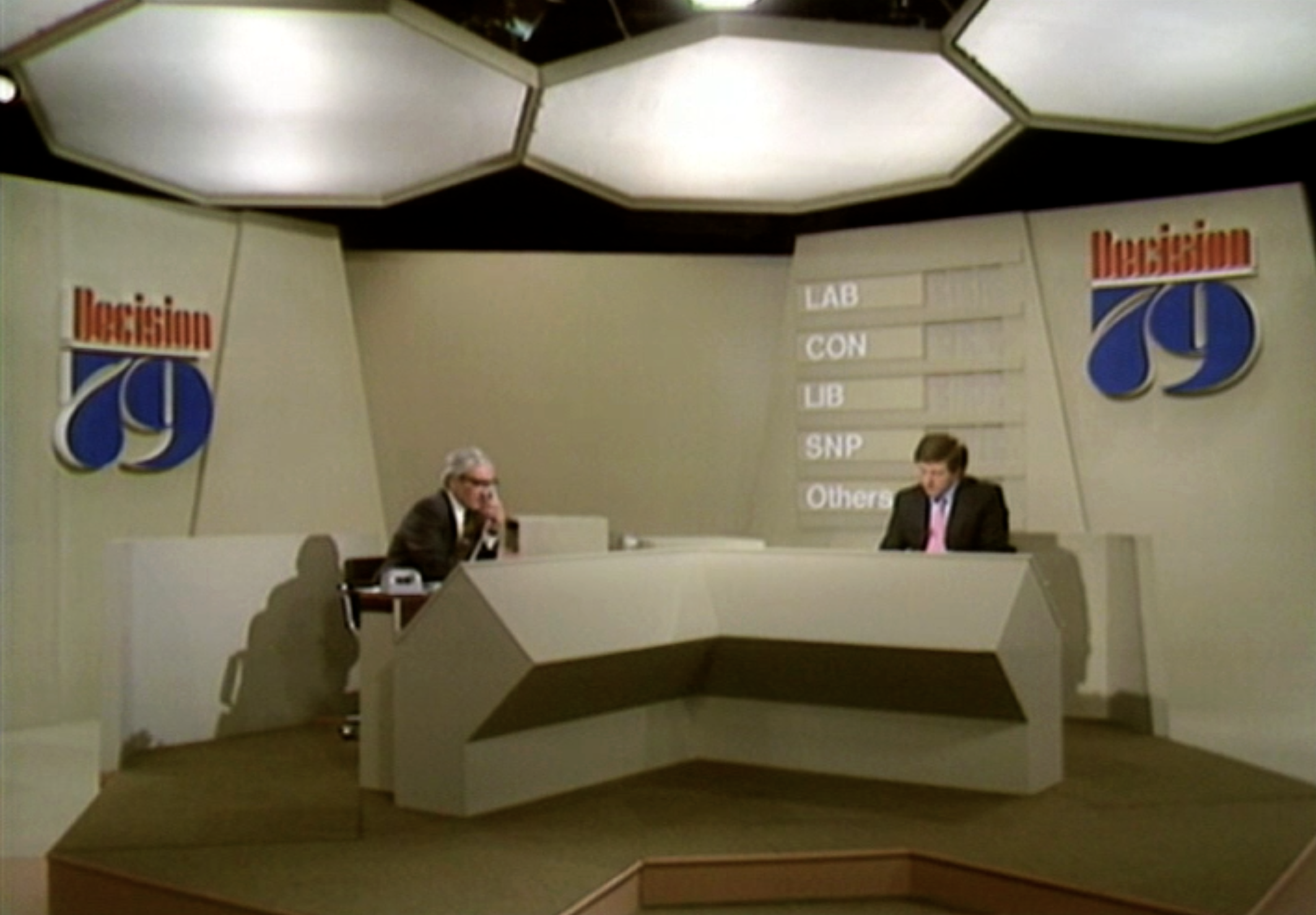
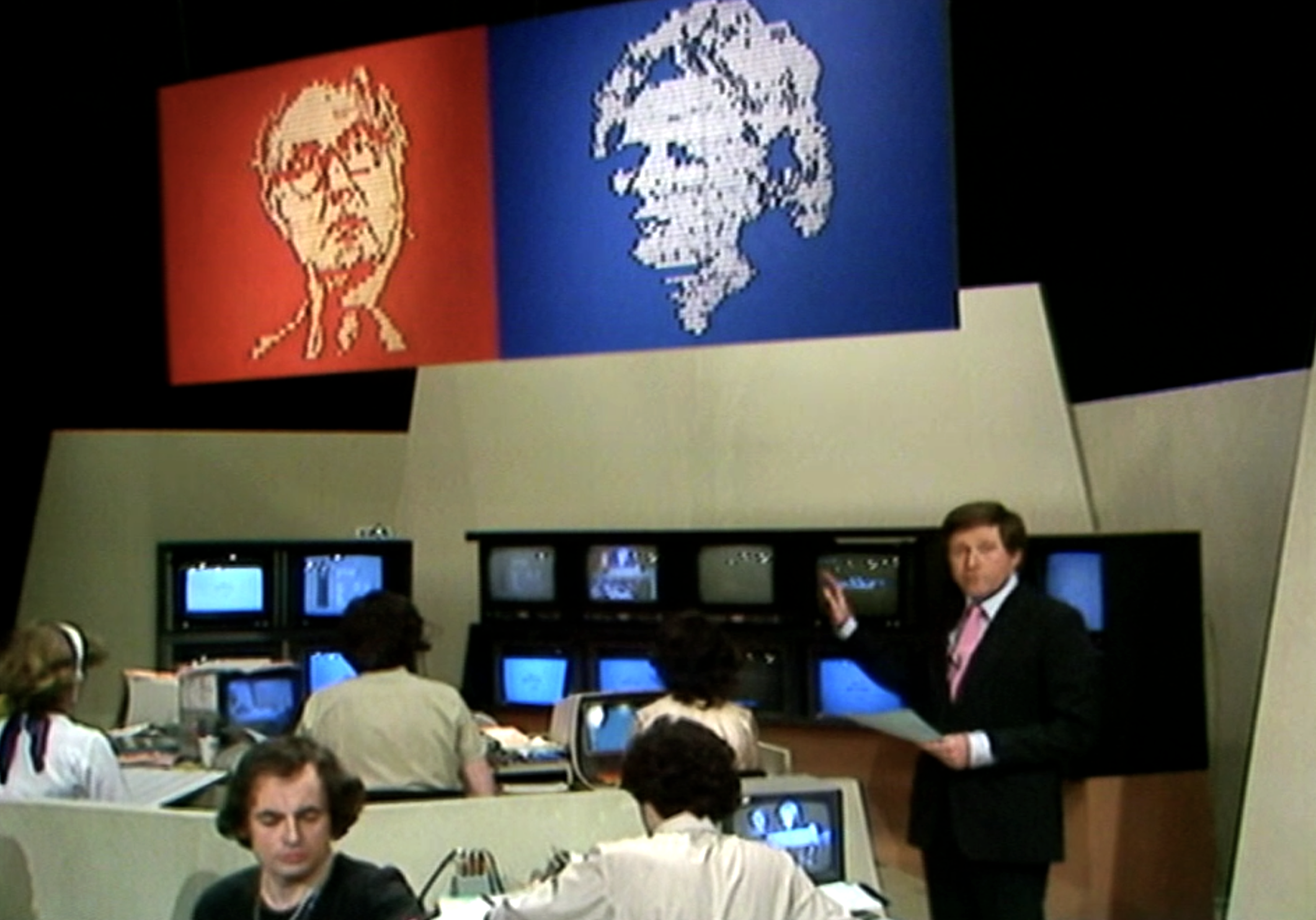
The Decision 79 logo is very gauche. The curves on the 7 and 9 are almost indecent. Note we are no longer dealing with an Election; we are apparently contemplating a Decision – a Decision, moreover, that merits its own Breakfast Special, replete with Richard Stilgoe and piano, for whom floor space once again has to be found.
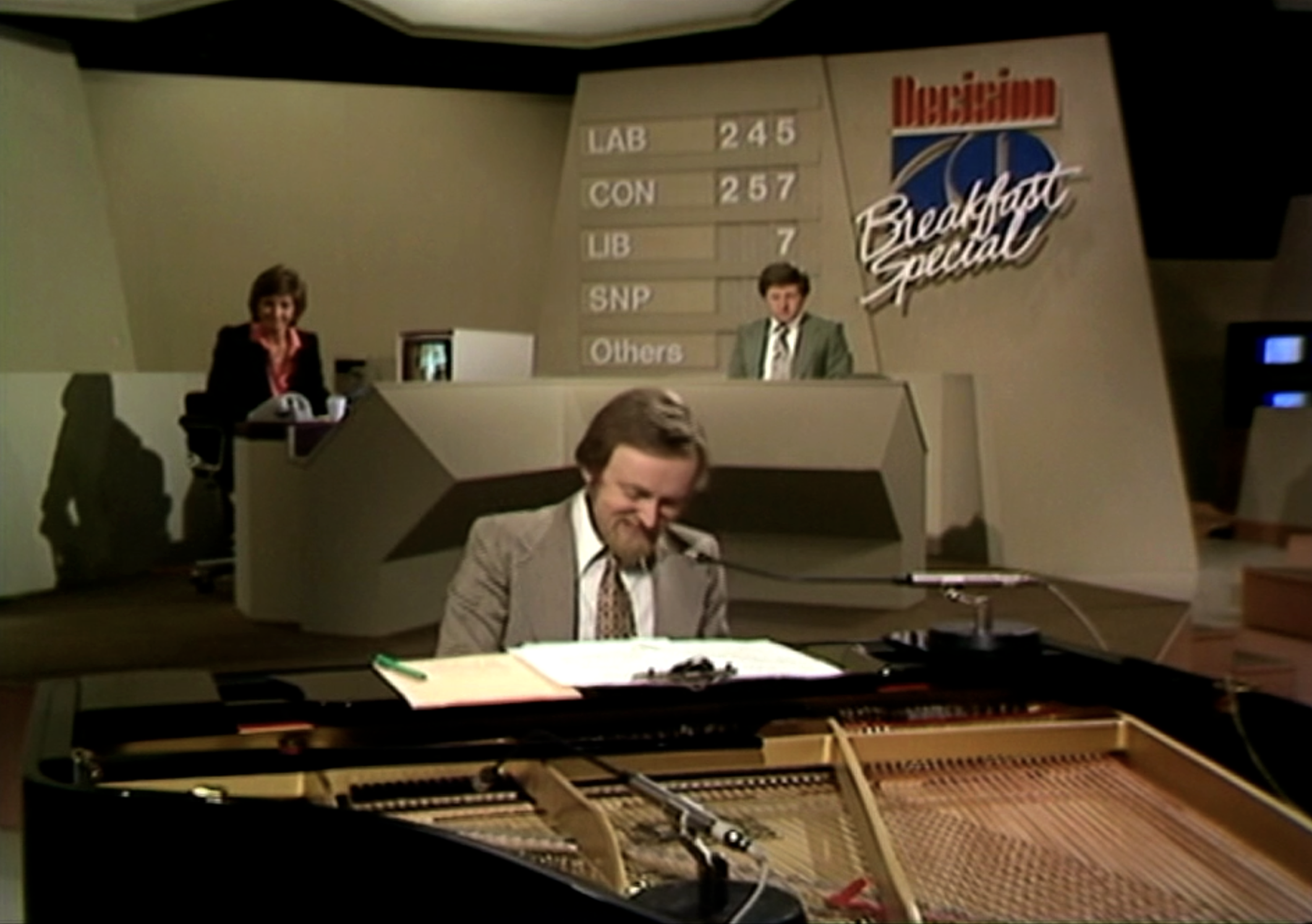
Here is the first instance of election branding becoming furniture in its own right. The logo is not there simply to inform, it is there to augment the look and personality of the studio. It augments it with something all right. Aggressive gaudiness? Jocular nausea?
Four years later, the election of June 1983 delivers a landslide. A landslide of brown, to be precise, which looks and feels all the more overwhelming by virtue of happening inside the smallest election studio since the 1950s.
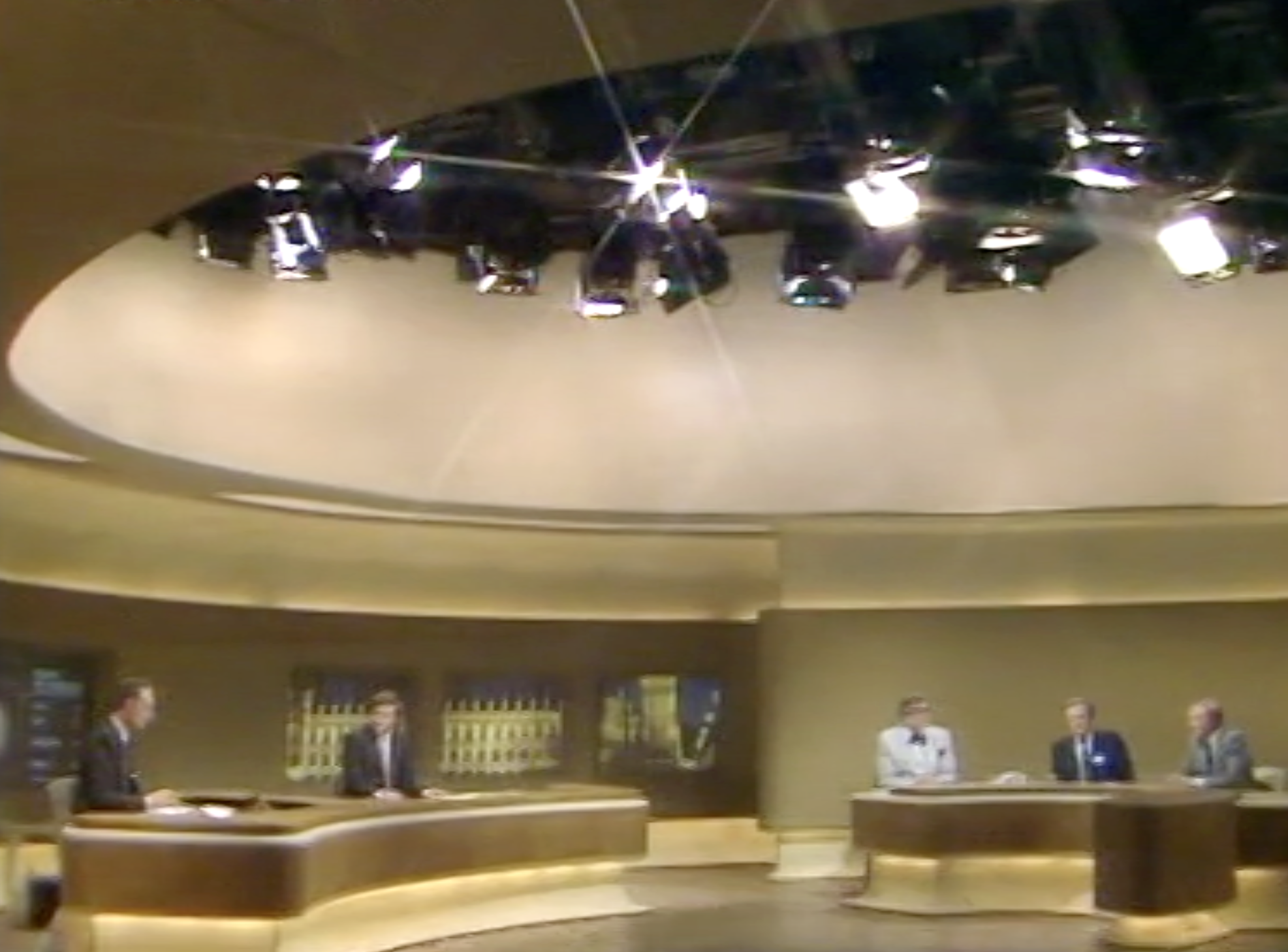
Little expense appears to have been spent visibly on what is the most underwhelming set so far. Even the rudimentary efforts of 1955 and 1959 had elements of charm and an endearing personality. The 1983 set has no charm and an arid personality.
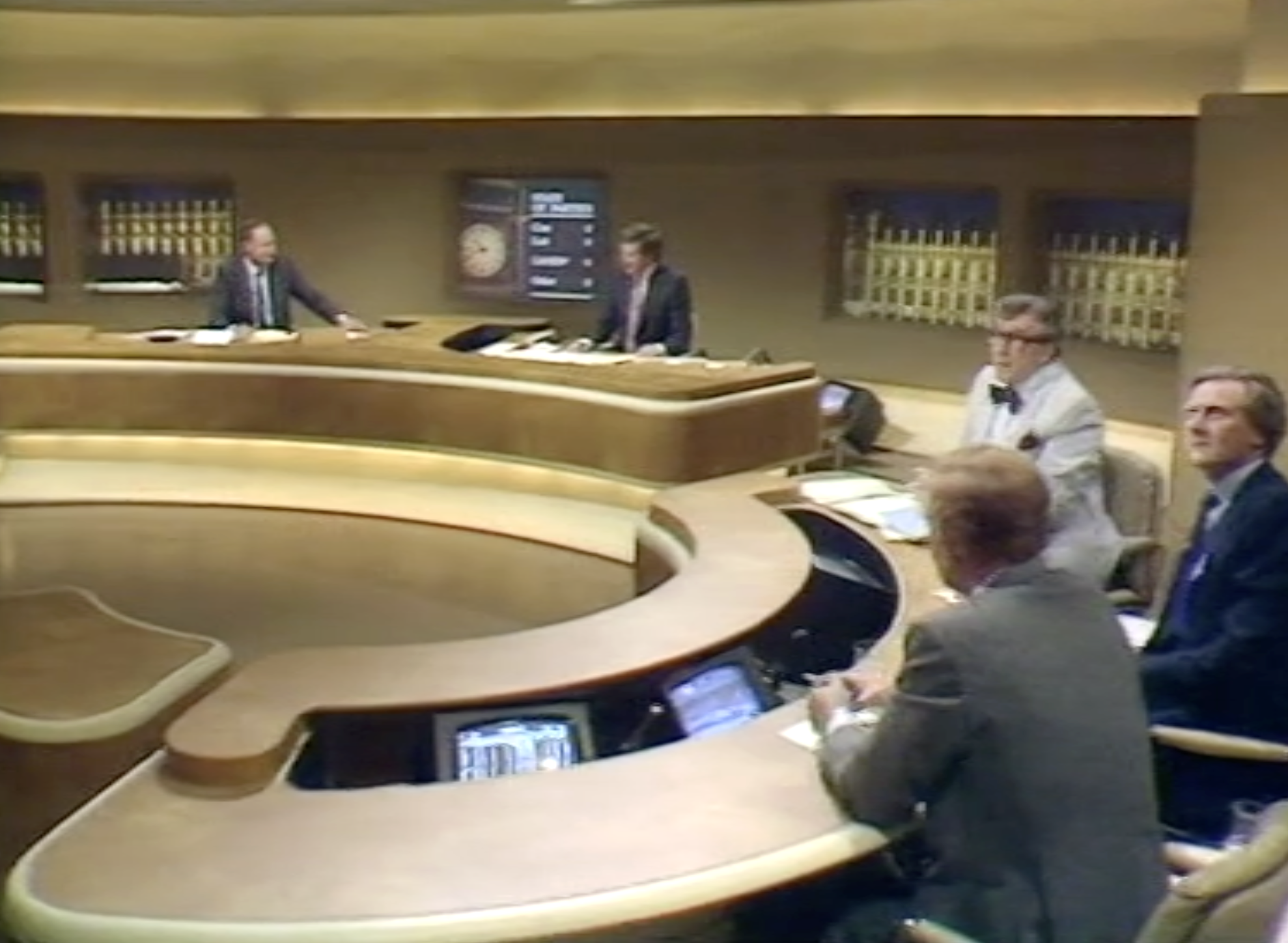
Yes, the continuous curved desk has returned after its exile during the 1970s, with one deployed for David Dimbleby and debutant Peter Snow, the other for Robin Day and guests. But the design is stern, even sullen. There is no warmth to the furnishings, and the curved lines and restrained shades of colour evoke a soullessness rather than elegance.
There is a sense of not wanting to make a fuss or suggest any kind of spectacle. There is also a lot of concealment. Lights are hidden behind panels, monitors are tucked away inside the desks, and absolutely everyone save the presenters and guests are out of sight.
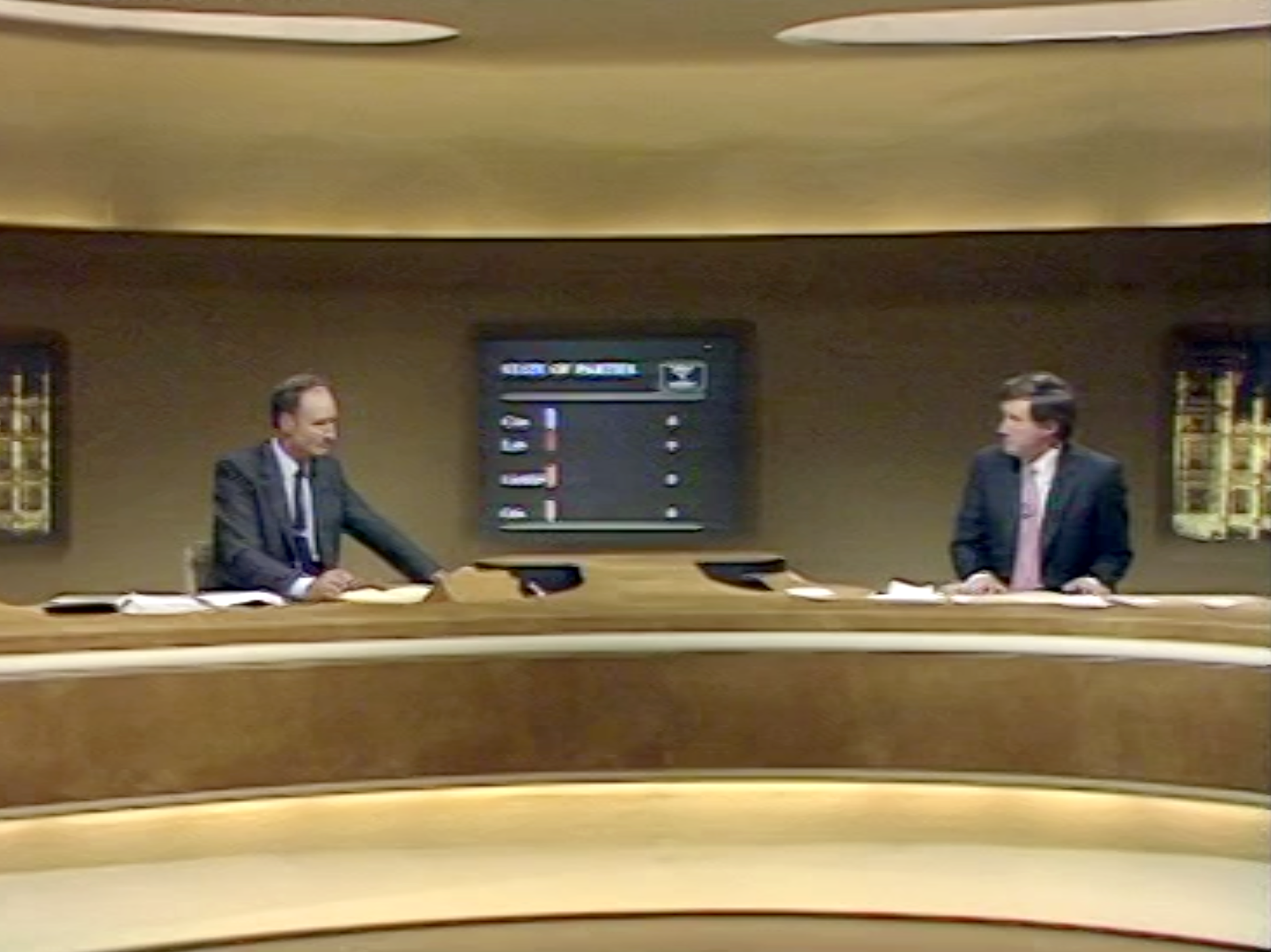
There is no room for any kind of freestanding psephological artefact. David Dimbleby’s screens are compact and seem to blend into the wall rather than stand out from it. The lighting accentuates the worst elements of the set rather than the best. The whole studio has the ambience of an executive suite or function room, not the cockpit of the nation.
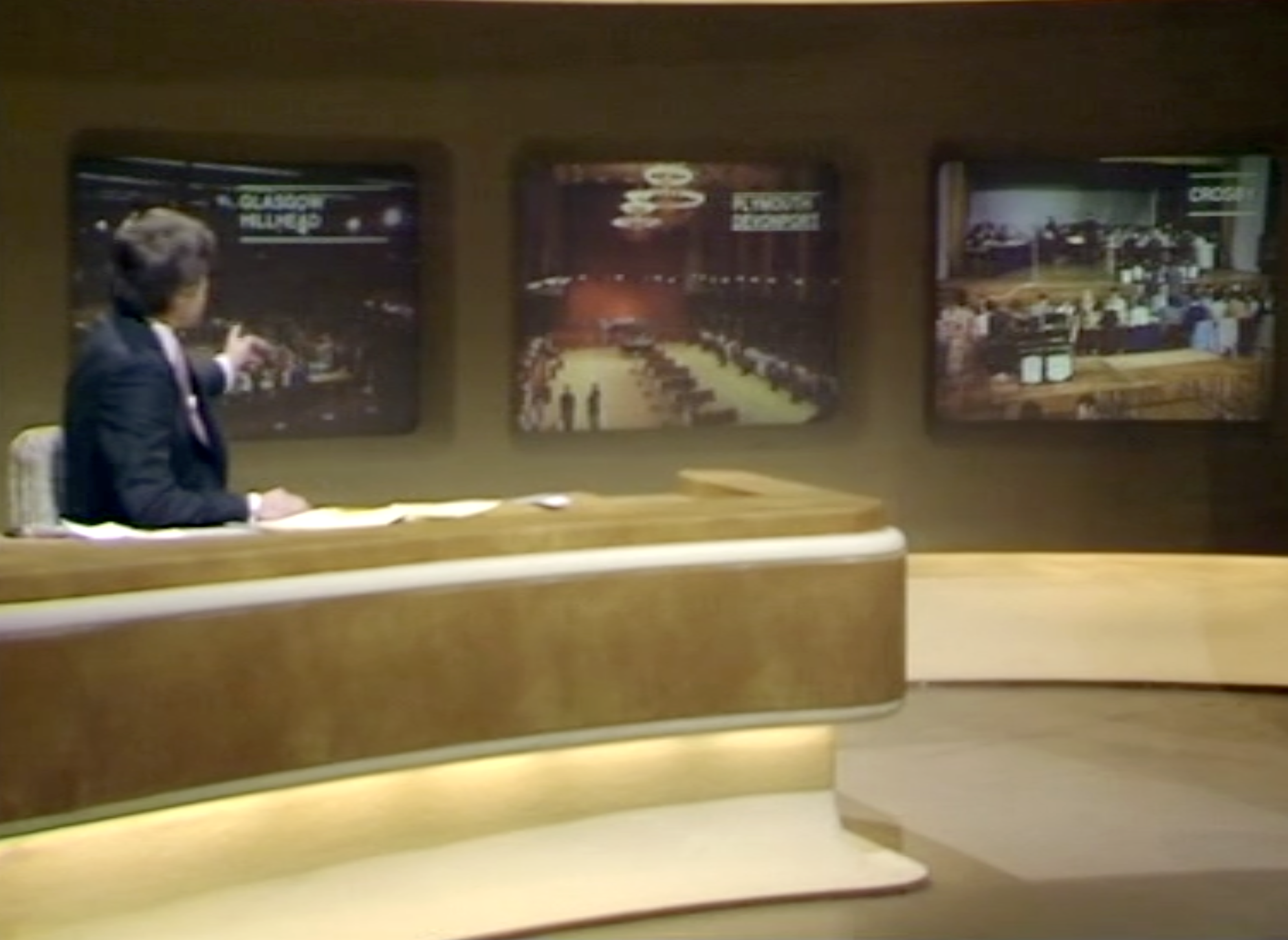
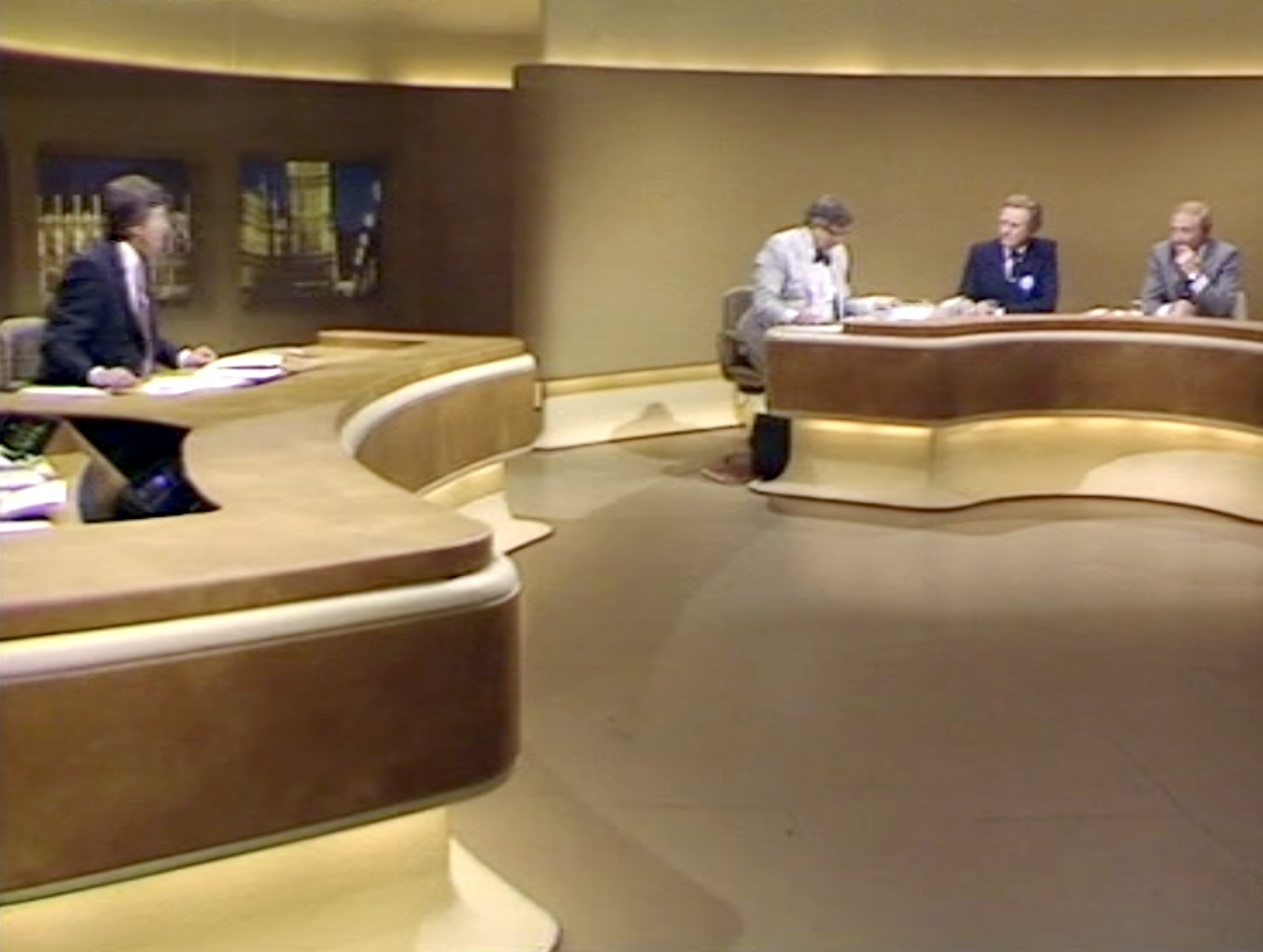
Perhaps most puzzling of all, however, is the curiously-shaped over-sized pouffe that has been dumped at the end of Robin Day’s desk. It stays there right through the programme and is never moved or used.
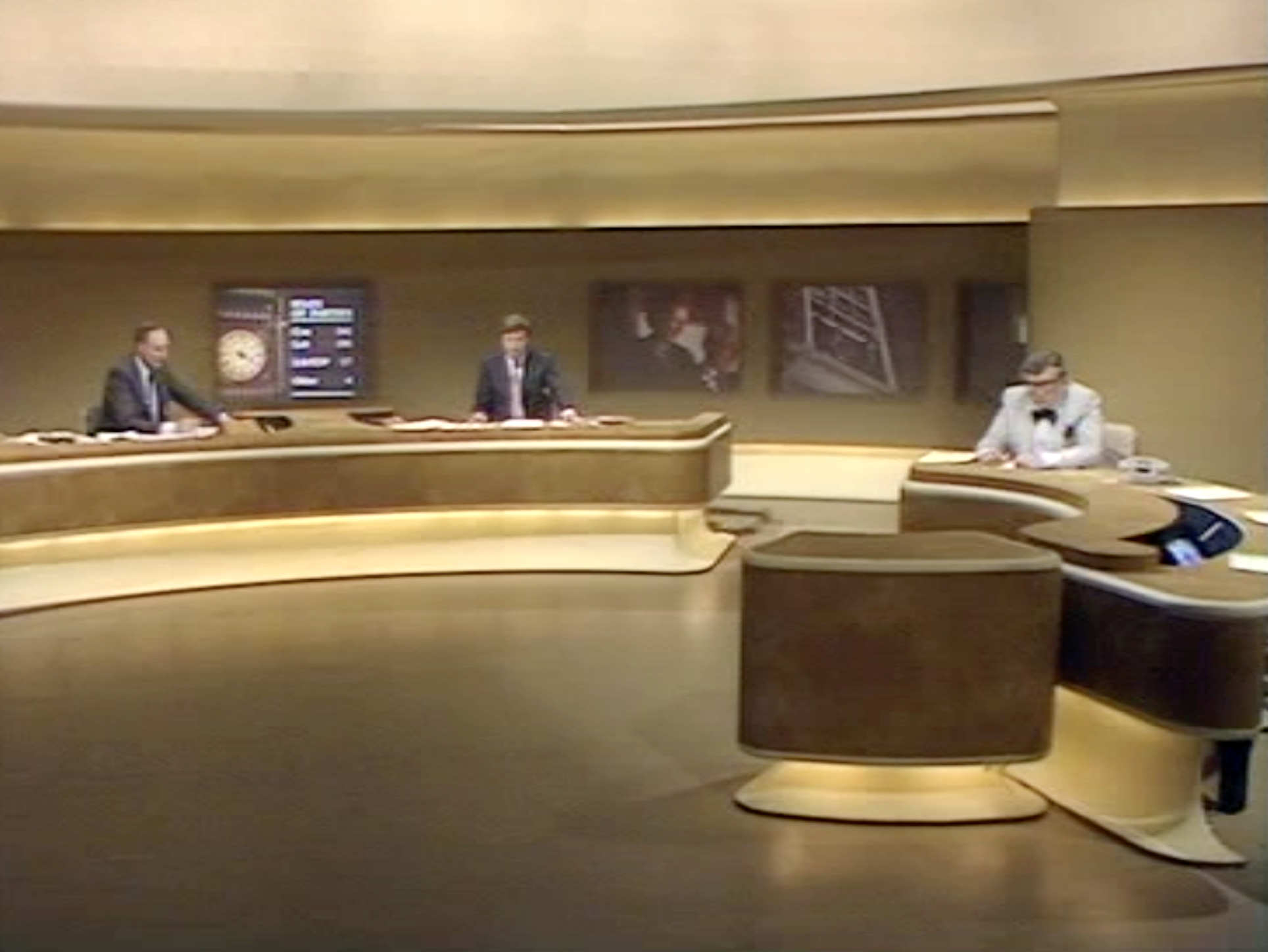
Is it a footrest intended for Robin Day that came back from the props department three sizes too big by mistake? Is it meant to double as a desk extension, ready to be deployed if Day has a superfluity of guests? Or has it been plonked there to hid a spillage on the studio floor? We are never told. Let’s not be too hard on the pouffe, though. It’s not to blame for inviting so much speculation. The real blame lies with everything else in the studio, which so fails to engage your attention as the hours go by that you can’t help becoming increasingly obsessed by the pouffe’s enigmatic presence.
Blue replaced brown in June 1987, creating an even more murky and unsettling environment. What is this dimly-lit, after-hours establishment into which have stumbled?
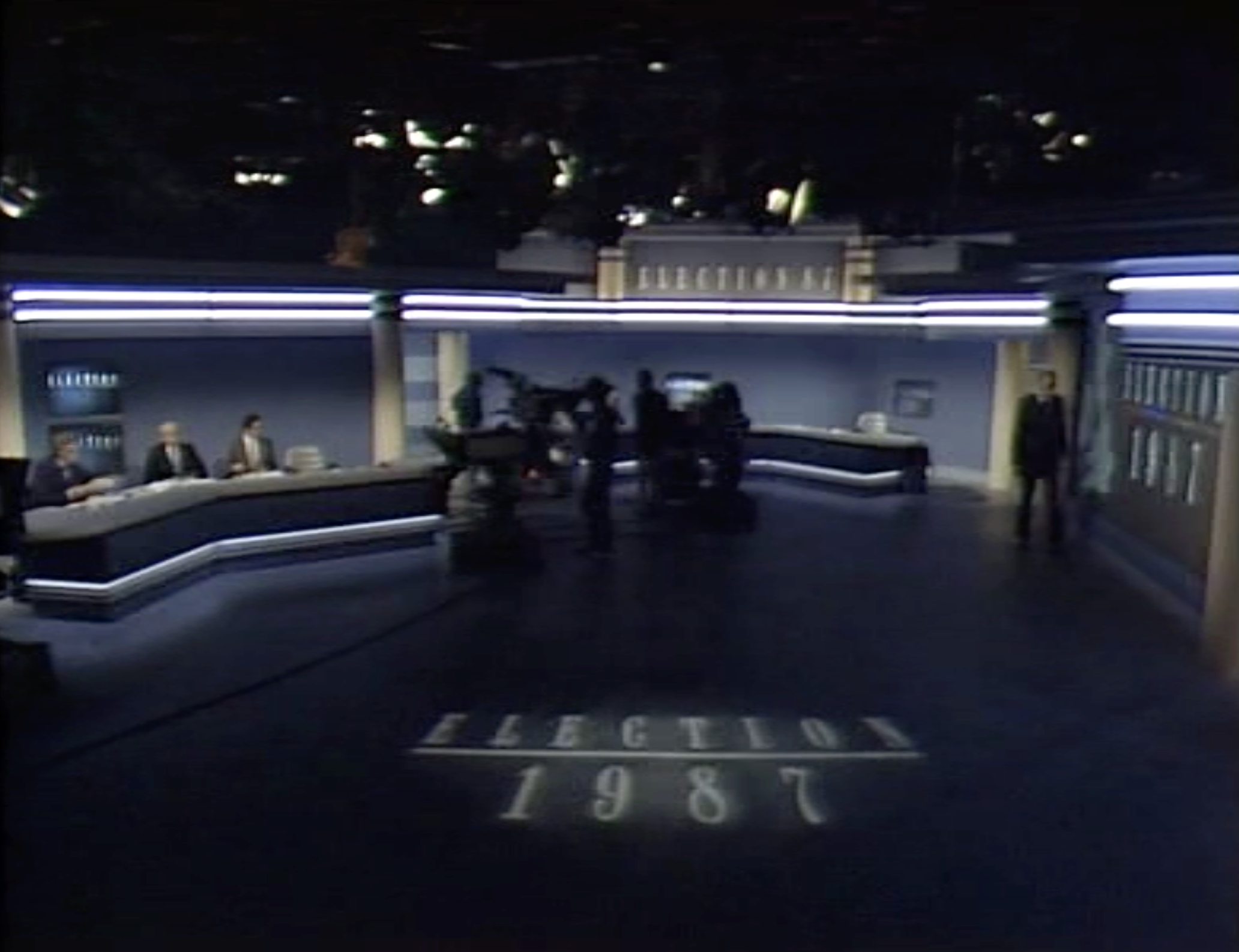
The decor implies exclusivity and discretion: a private members’ club to which we have been granted rare but limited access for one night only. Guests sidle silently in and out of Robin Day’s conversation nook. When Peter Snow gets up to walk to his results screen, his feet make no sound. Not one whisper of background noise can be heard.
The result-checkers look like they have been imprisoned in a below-stairs dungeon that is full of scaffolding and metal shelves and unforgiving lights. We see this modern-day workhouse for a few seconds early in proceedings but never again.
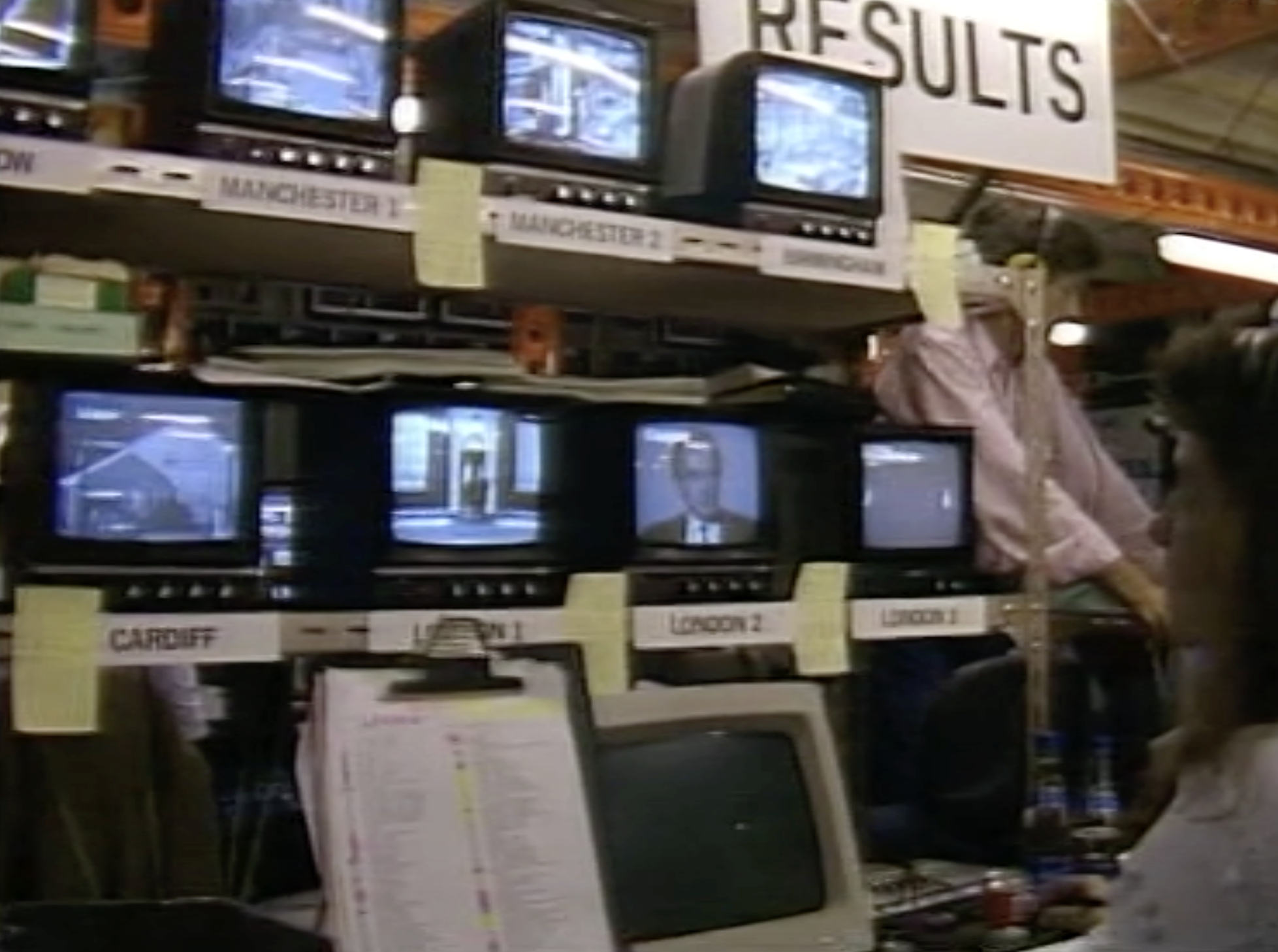
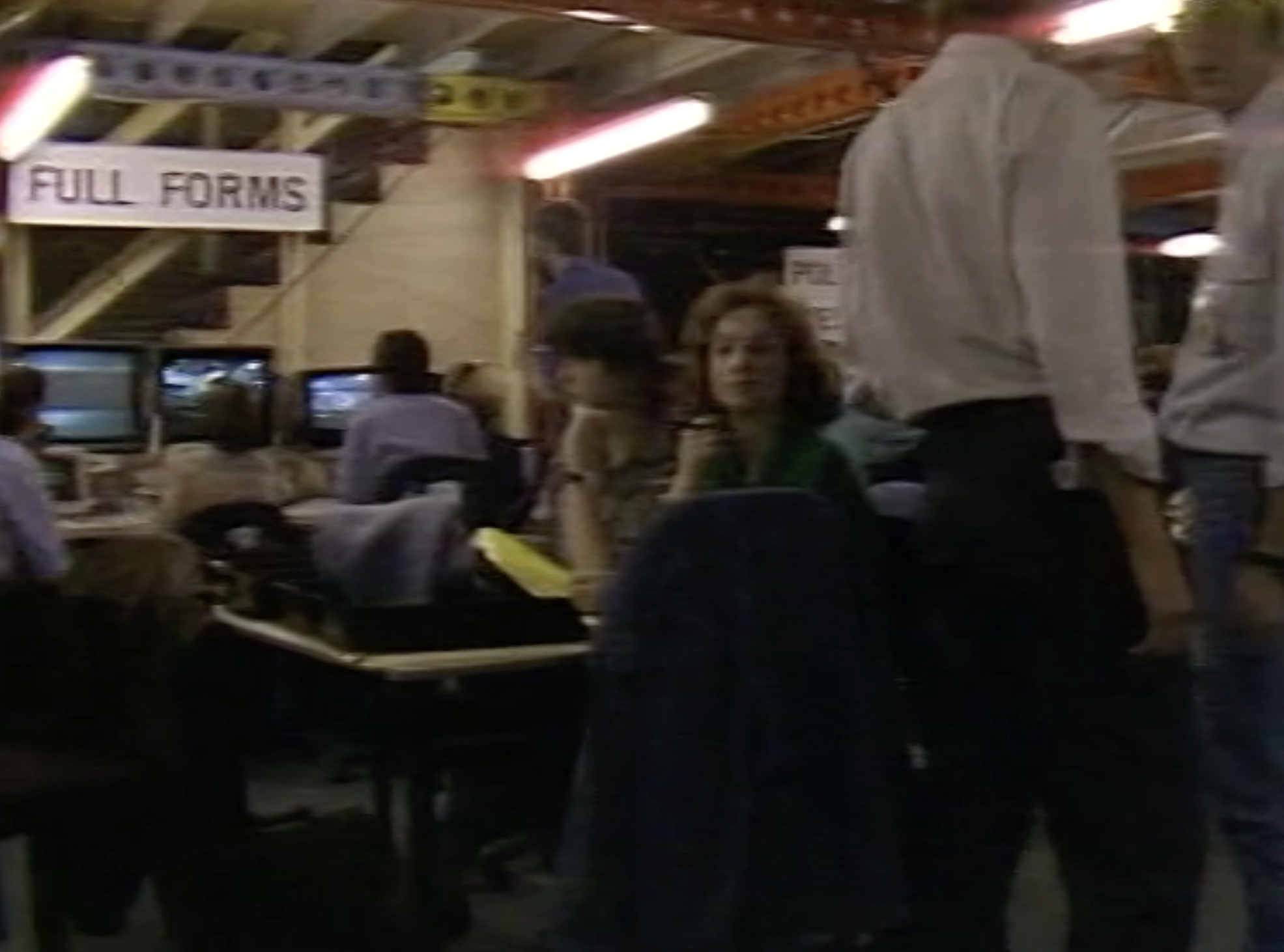
The set – Studio 3 in Television Centre – is even more soulless than in 1983. We’ve moved still further away from functional chic and are now dealing with a mindset where plush equals prestige. The grey desktops are perhaps the embodiment of this: overstated slabs that don’t convince either practically (being much too large) or aesthetically (too ugly).
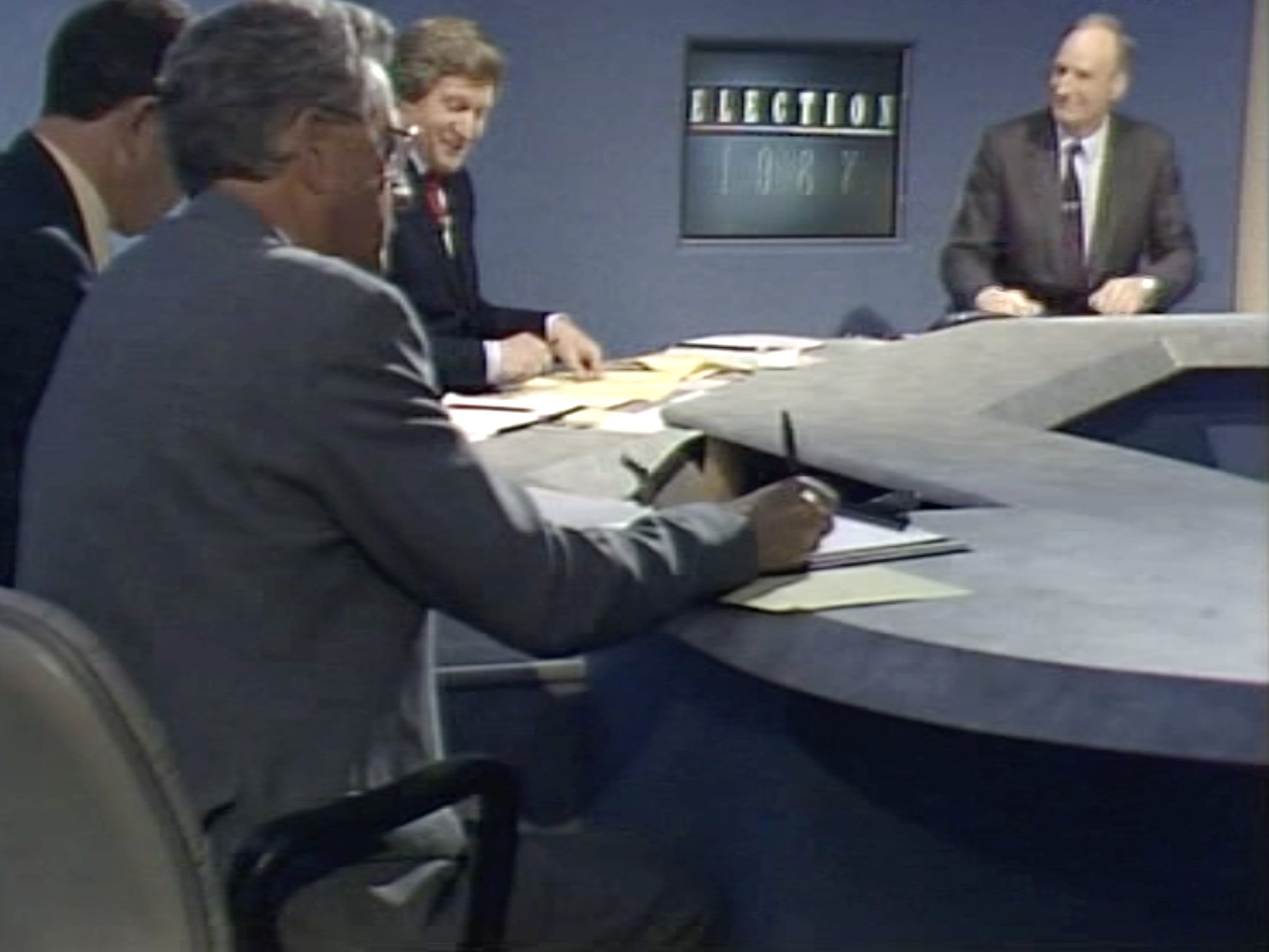
The telephones on the desks now have button keypads rather than dials. There are even handsets for the guests to use, perhaps to check the latest Nikkei prices or order a champagne breakfast.
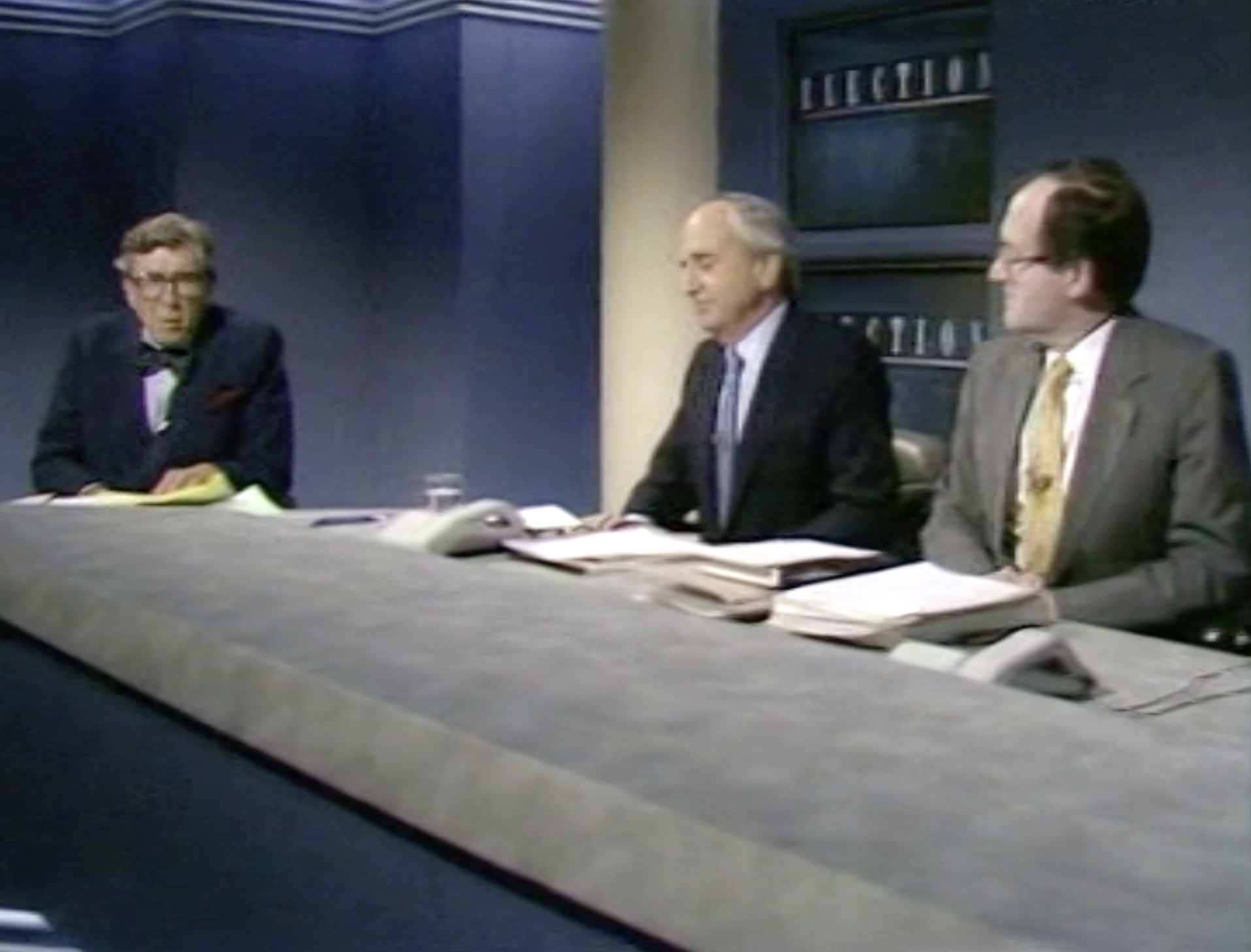
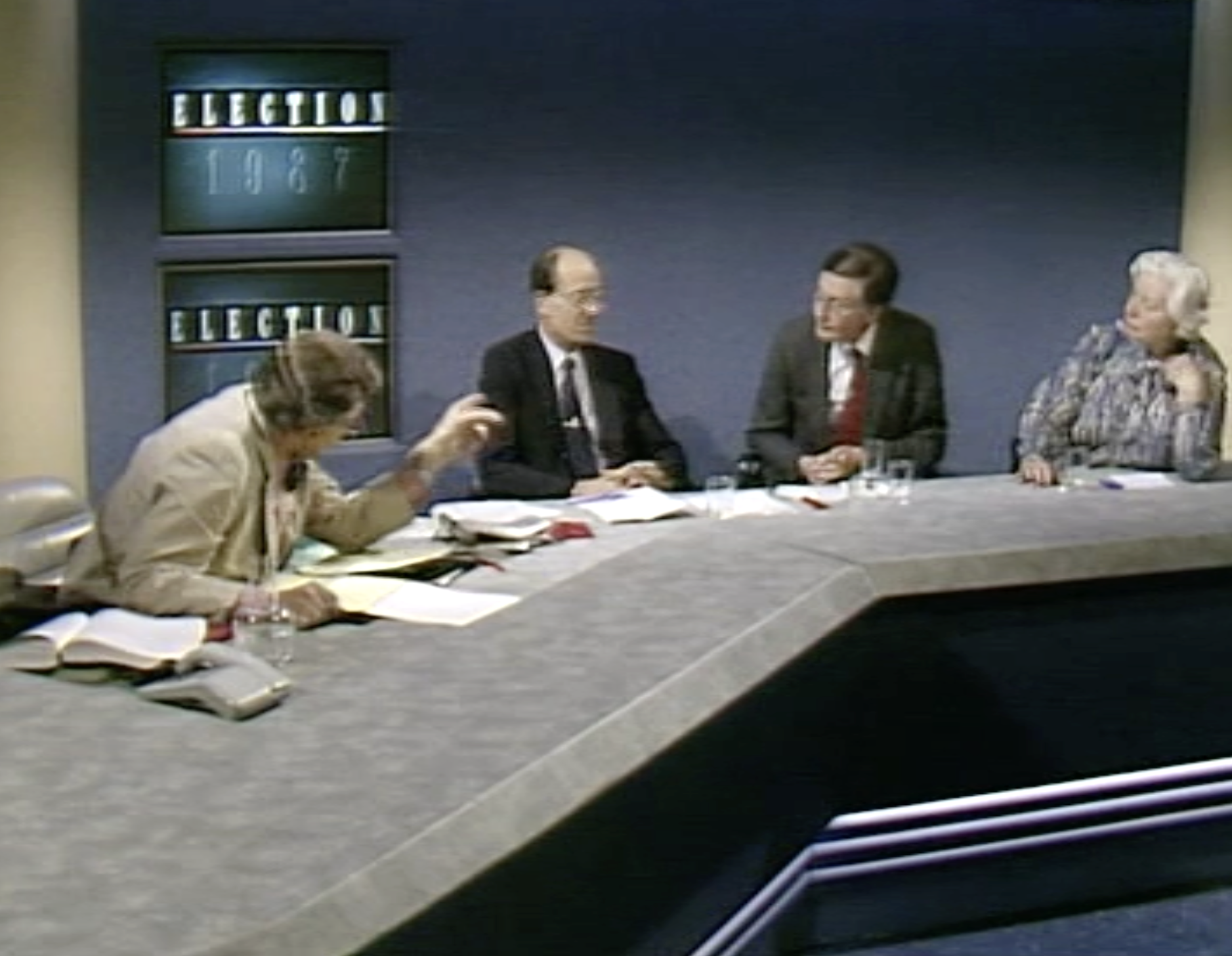
There is one thing to commend this set, however: the way the presenters’ monitors have been integrated within the desks. Dimbleby has no fewer than seven of them in front of him, in what is the most discreet if tightly-packed arrangement to date.
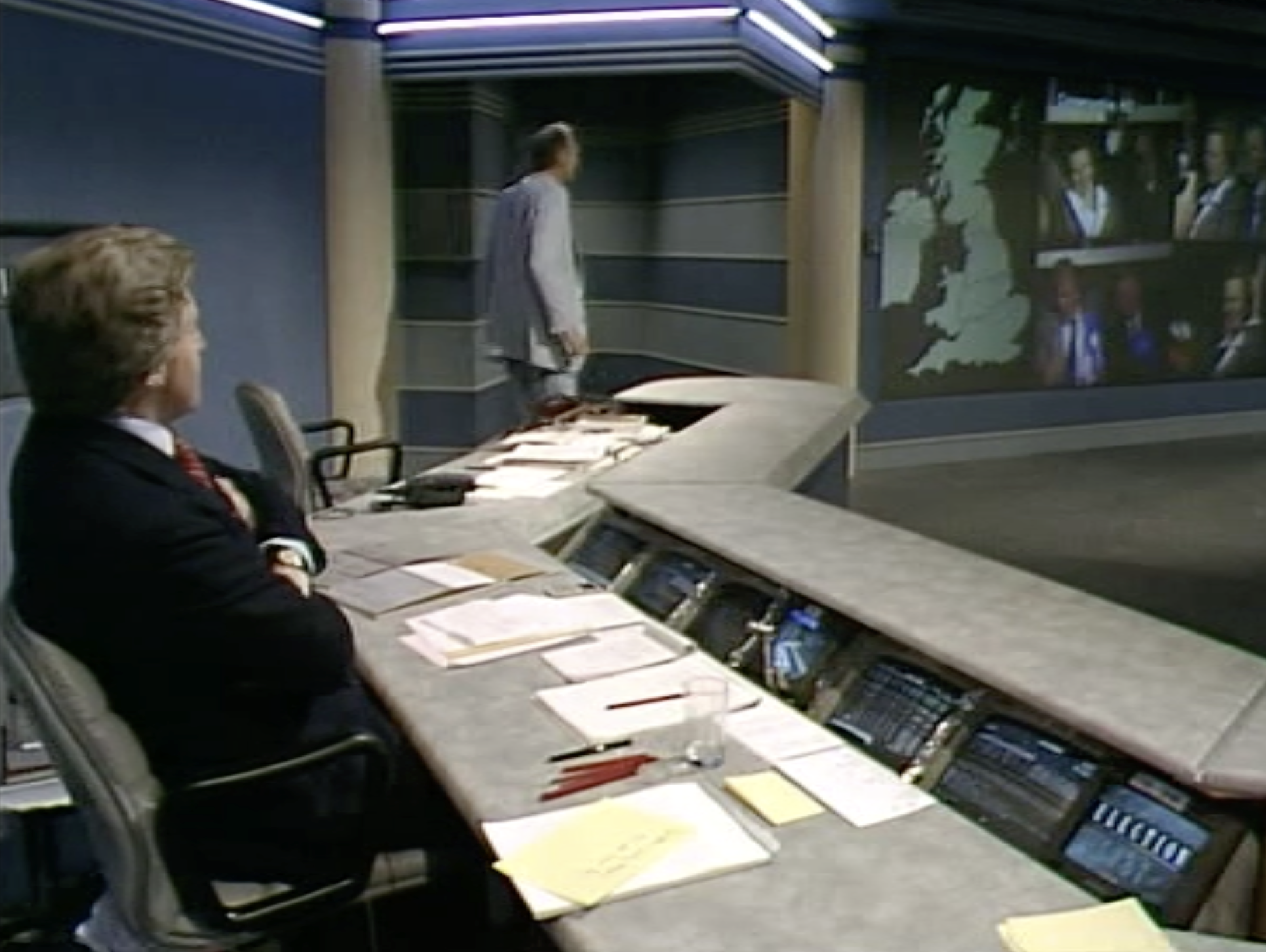
Where would all this end? An ever-diminishing election set, culminating in David Dimbleby sitting alone in a room the size of the Children’s BBC broom cupboard, with everybody else – experts, guests, Peter Snow – beamed in from locations elsewhere?
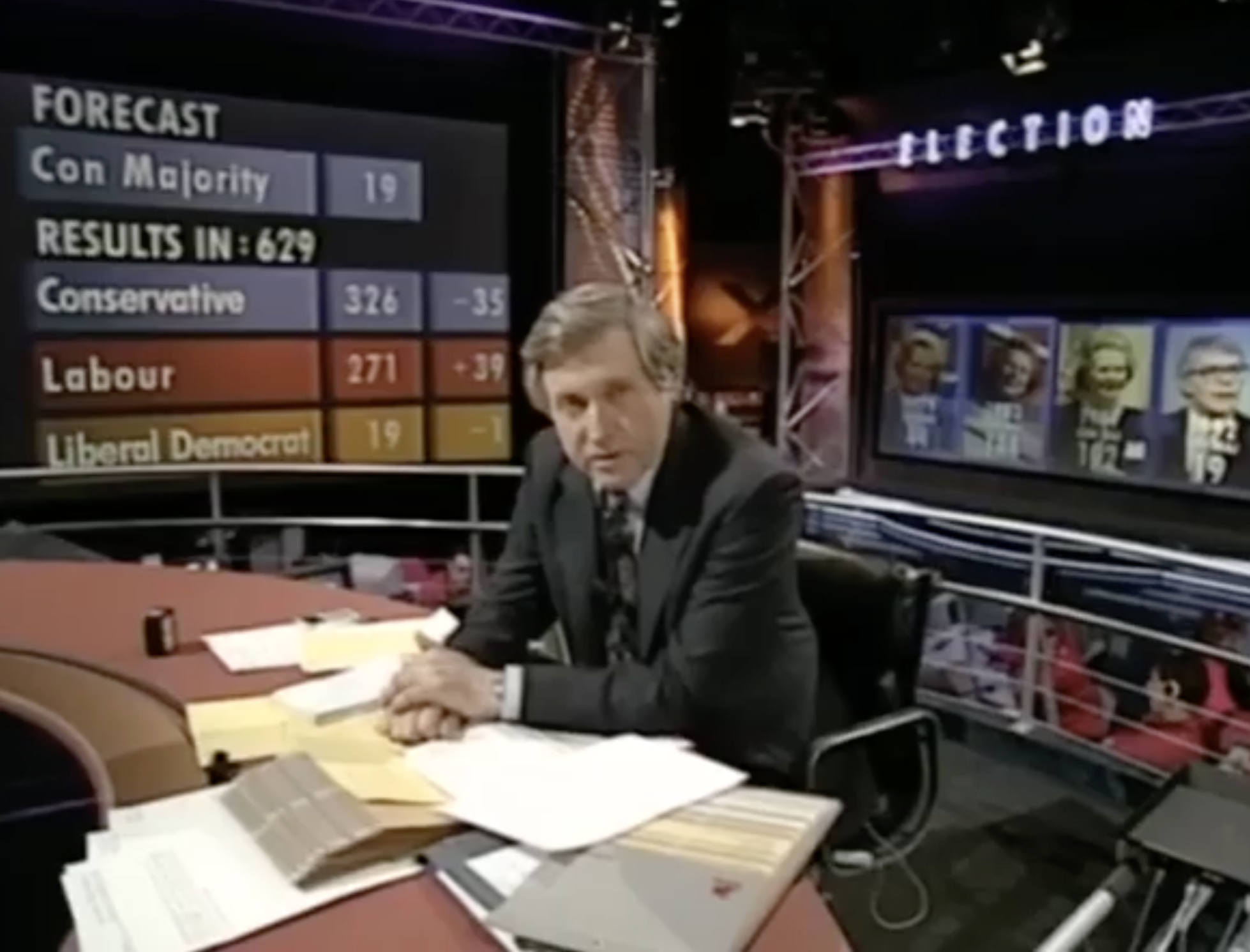
Fortunately – mercifully – both he and us were spared this indignity. Someone called a halt on the miniaturisation; bigger was deemed to be better once again. A motivating factor might have been the return of the swingometer, considered unnecessary in 1983 and 1987 thanks to those contests being three-way fights between the Conservatives, Labour and the SDP-Liberal Alliance. In April 1992 the election was a clear Tory-Labour battle and hence the giant pendulum could be unpacked – and a giant pendulum needs a giant space in which to swing.
The 1992 studio might have come as a surprise to viewers who’d forgotten about the the cavernous sets of the 1960s and 1970s, or who weren’t old enough to have seen them first time round. Not only is the generous floor space restored, but also the people to fill it and the machines they need to do their job.
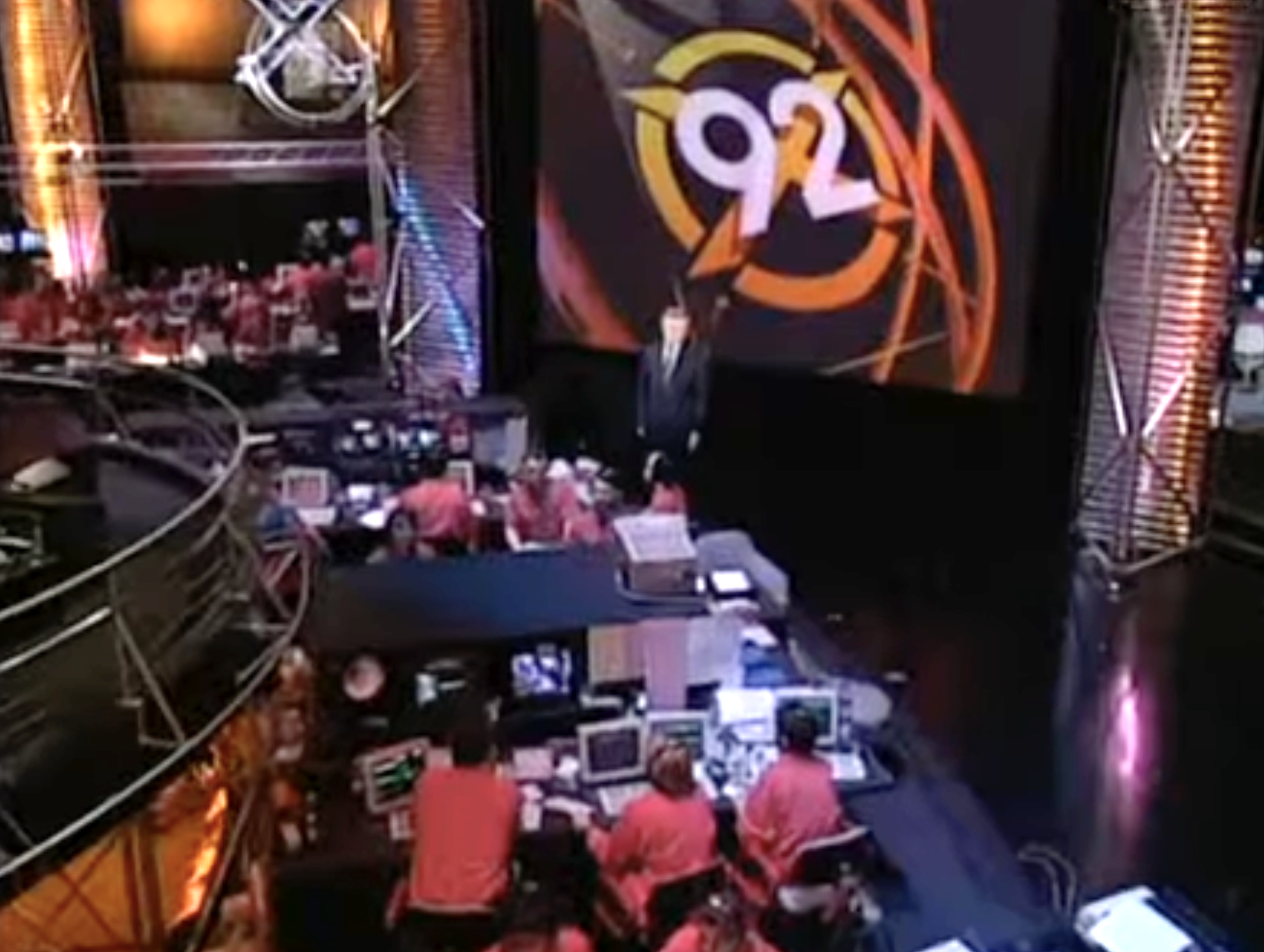
Might the pendulum have swung too far, though? This studio is certainly big – but is it too big? Or more particularly, the wrong kind of big? The black panels or drapes that enclose the set give an impression of the studio receding into infinite darkness. Better to have a precise sense of a vast scale, with a tangible perimeter, rather than no sense at all.
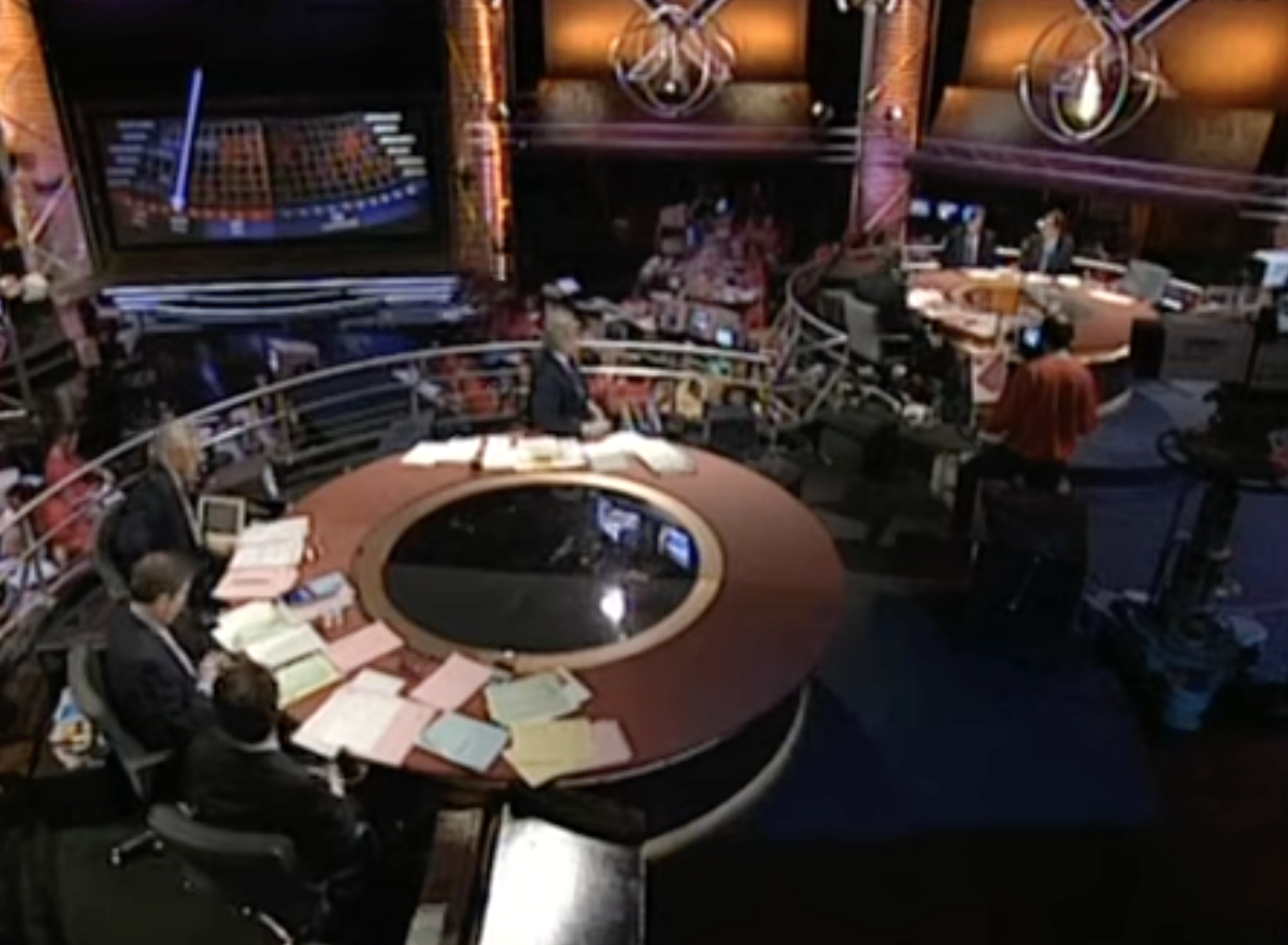
The furniture in the foreground of the set has no spatial relationship with the scenery placed in the background, because there is no defined background. Consequently the furniture looks as if it has been scattered in a haphazard fashion around the studio, with no logic or order to its position. Its character is diminished thanks to the characterless aspect of the environment. Someone hasn’t thought enough about how all of this appears on screen – or maybe too many people thought too many different things, and the outcome you see is the compromise.
Circles appear to have been the original concept. David Dimbleby anchors proceedings from an elevated circular podium roughly in the middle of the studio; the result-checkers are arranged in a larger part-circle on the floor beneath him; to one side, as if in a precarious orbit around Dimbleby’s planet, is a satellite desk for Peter Sissons (Robin Day now retired); even further adrift is Peter Snow’s smaller desk.
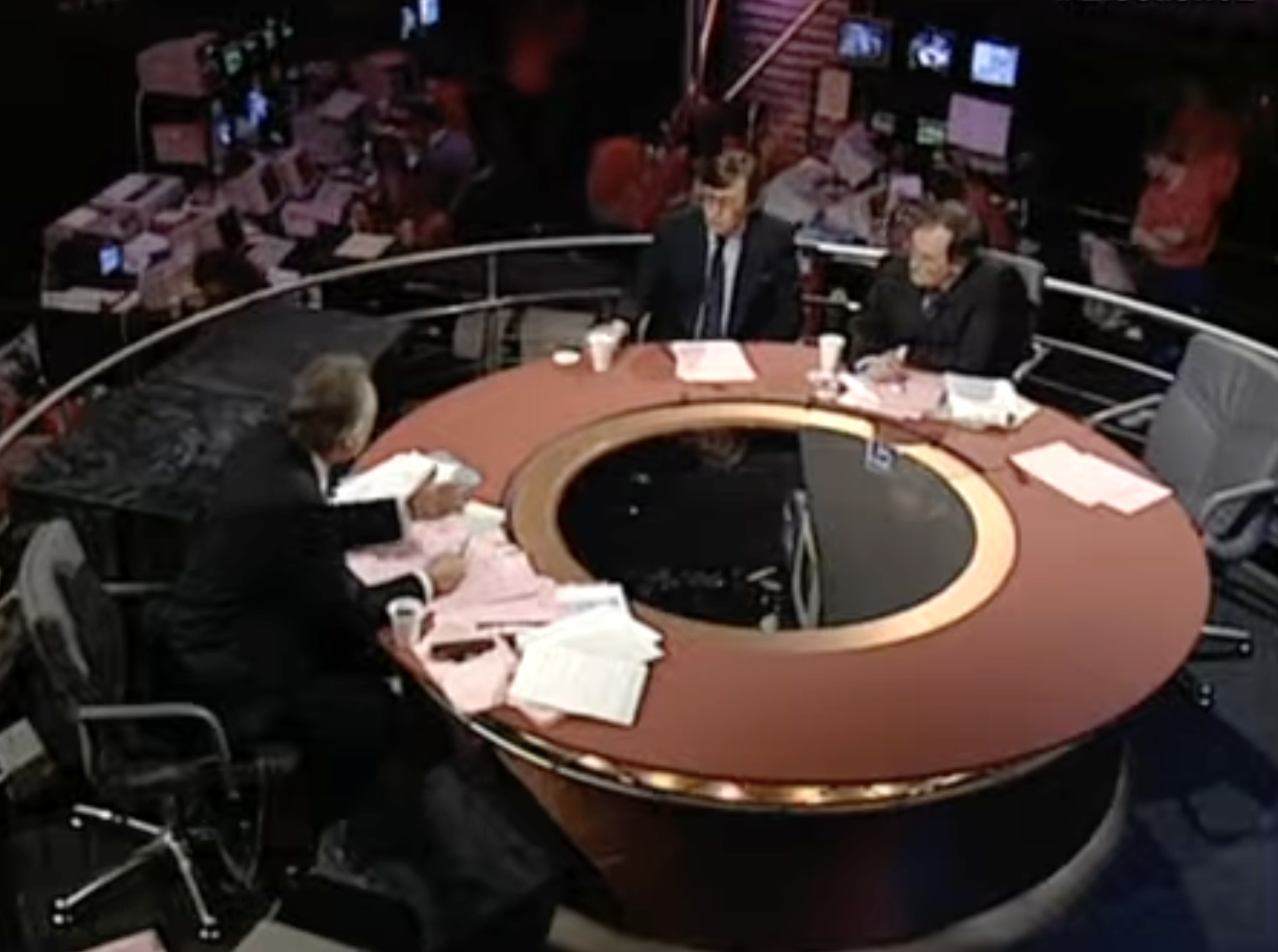
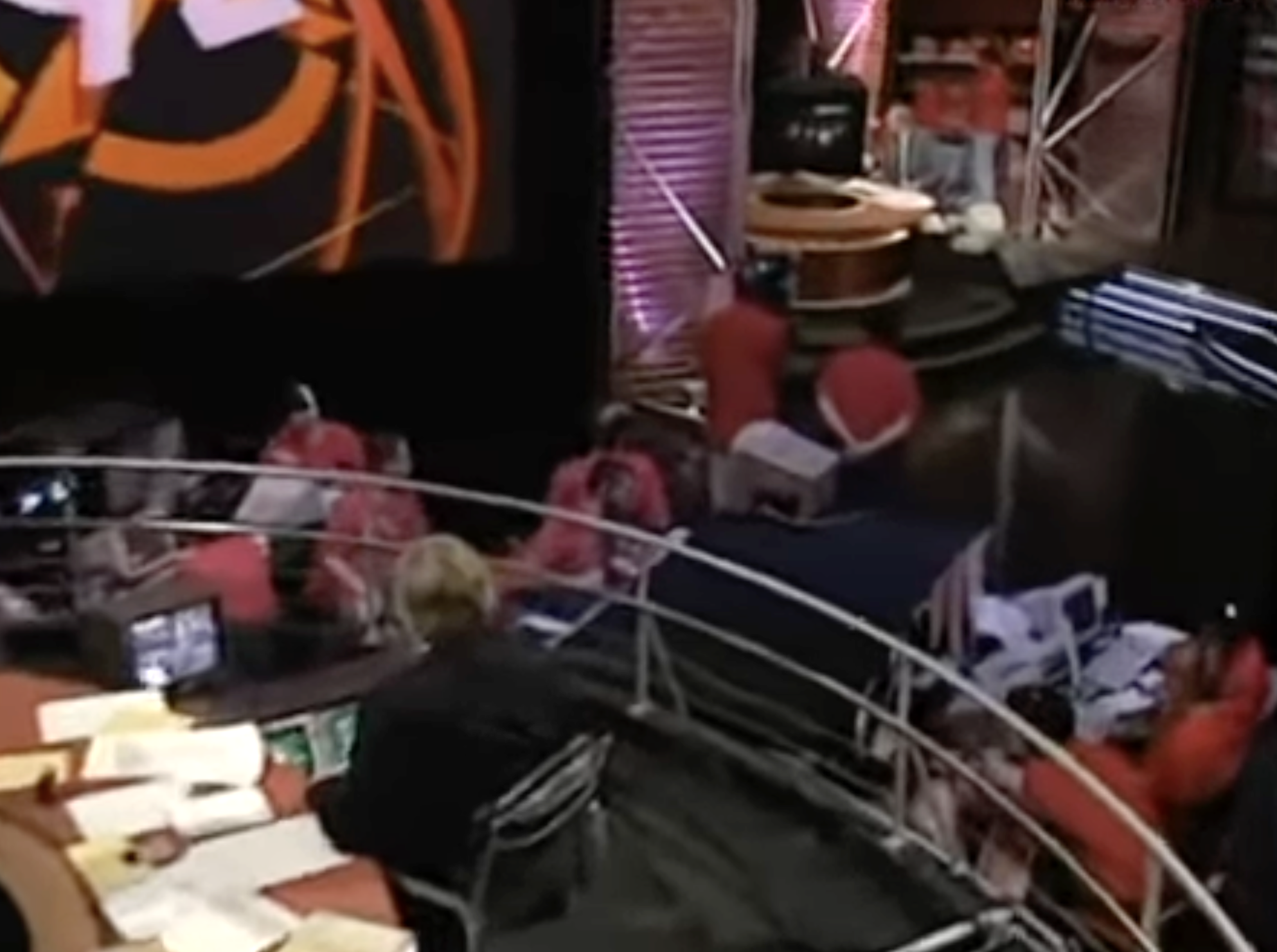
It’s the first time an unbroken circle has been used for the design of the main presenter’s desk. We’ve had plenty of curves and semi-circular arrangements, but not the full thing – until now. The design allows Dimbleby to project authority by sitting not just apart but also across from his guests. He has one side of the circle all to himself; the others are bunched opposite.
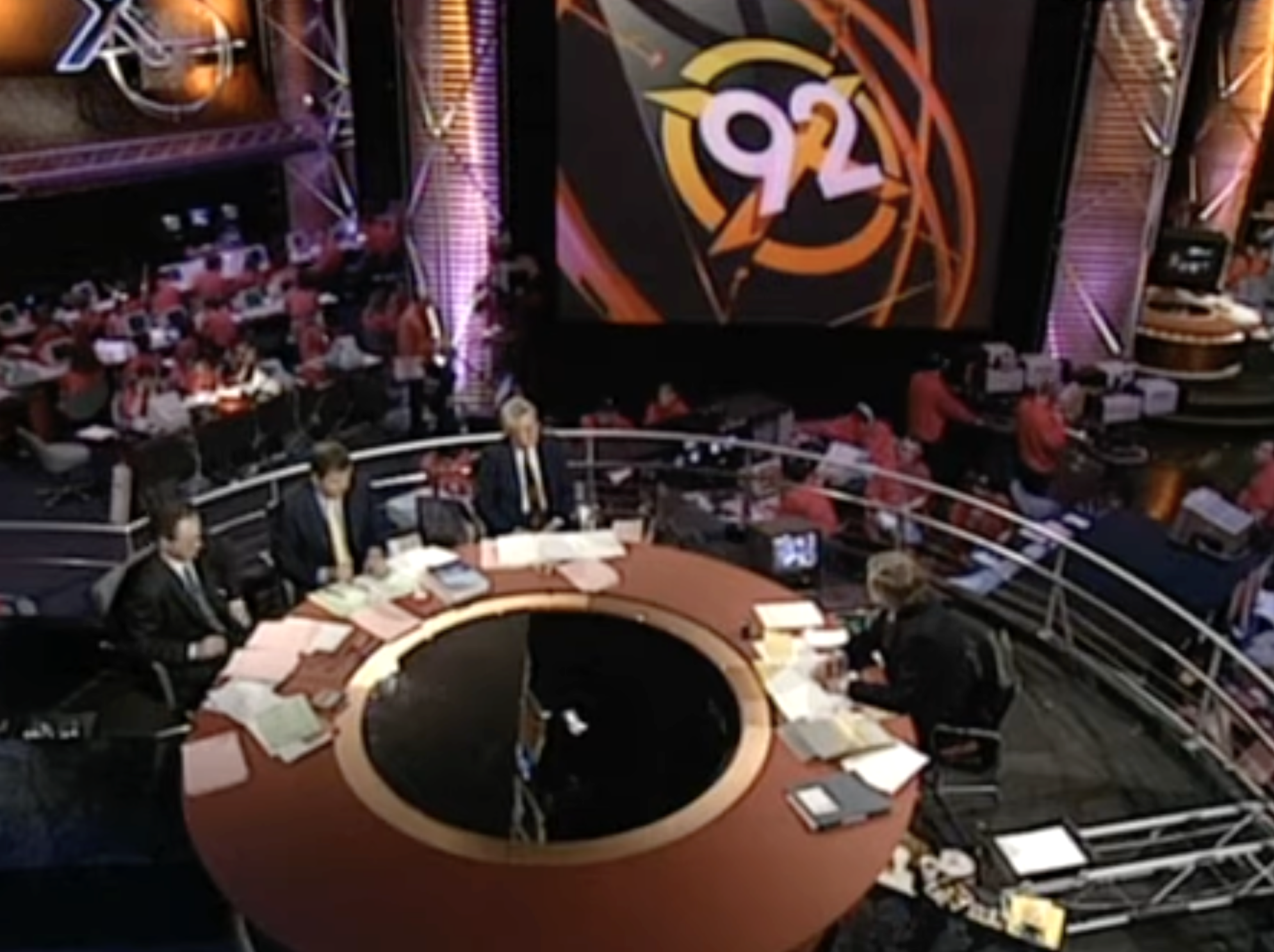
The desk is not a completely solid construction. It has a hole in the middle, into which some of Dimbleby’s monitors have been placed, which has then been covered with a glass lid. A few additional monitors have been installed to one side of Dimbleby’s chair, but this is the first time most of these screens have been fully hidden from the viewer. The same approach is applied to the desks of Peters Sissons and Snow, though Snow also has an enormous computer perched rather hazardously to one side of his impressive swivel chair.
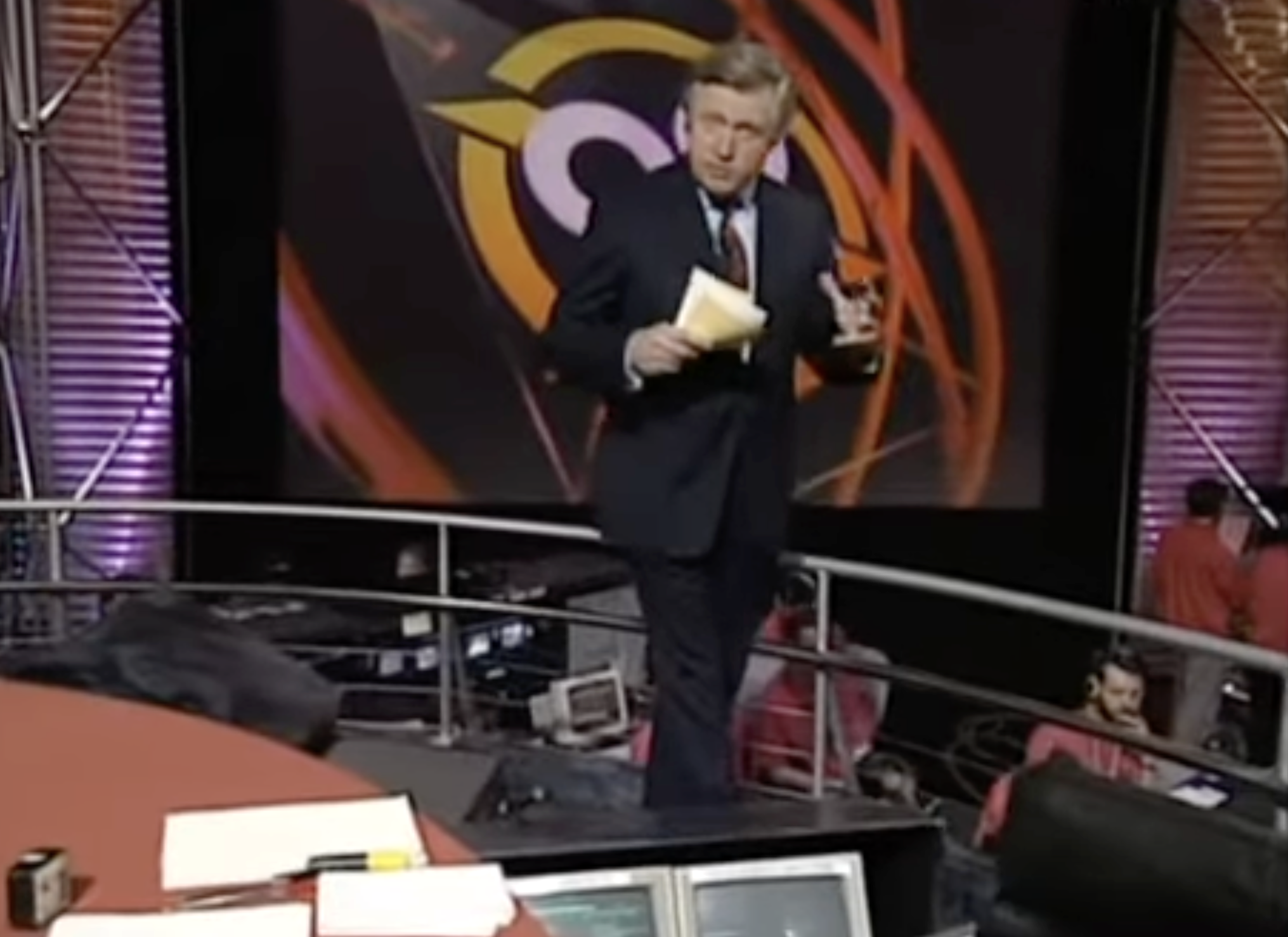
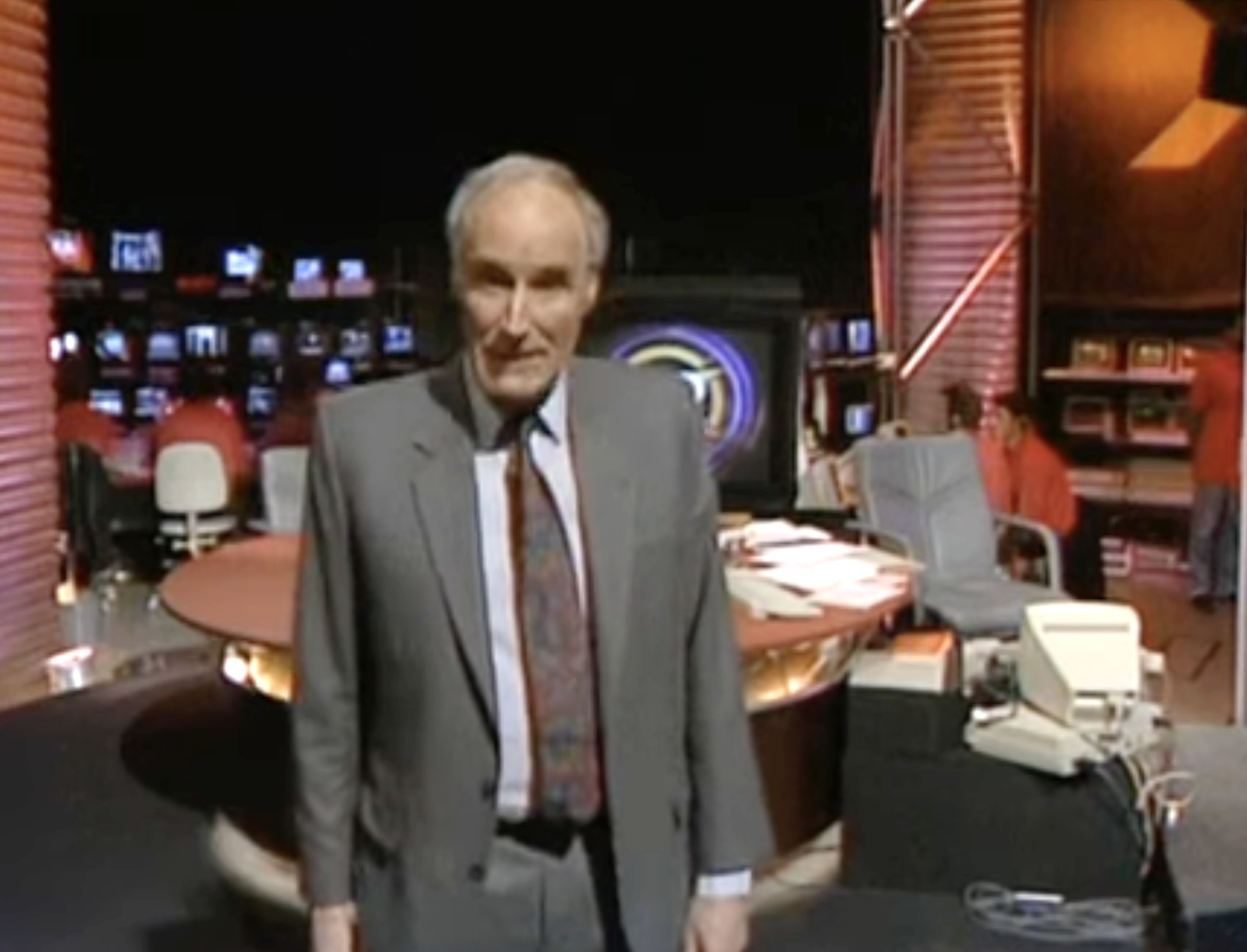
There are points to commend about these desks, but also to criticise. Their main fault is the degree to which they reflect whatever is immediately above them, be it heads, brightly-lit logos, coloured ties or other bits of furniture.
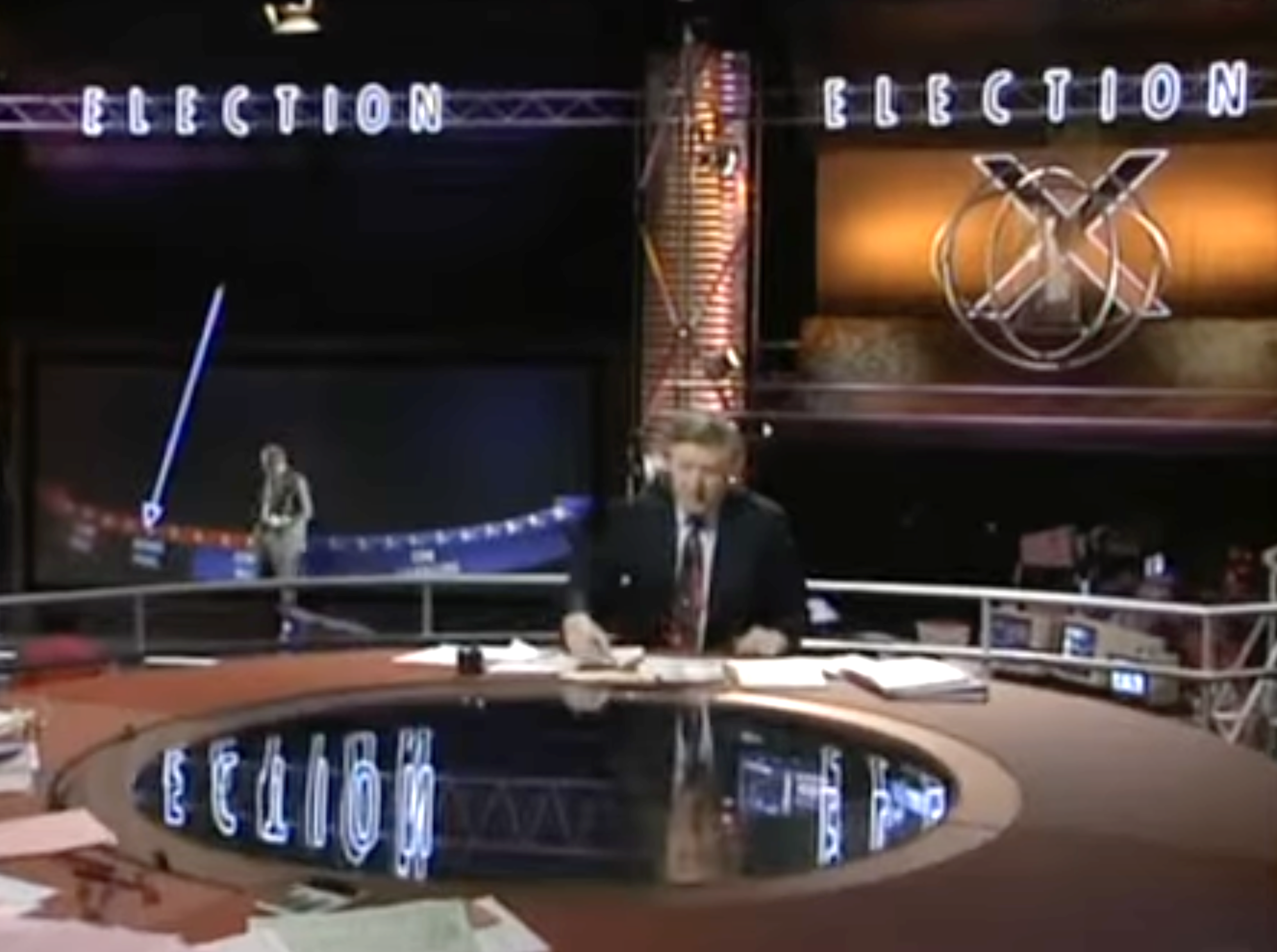
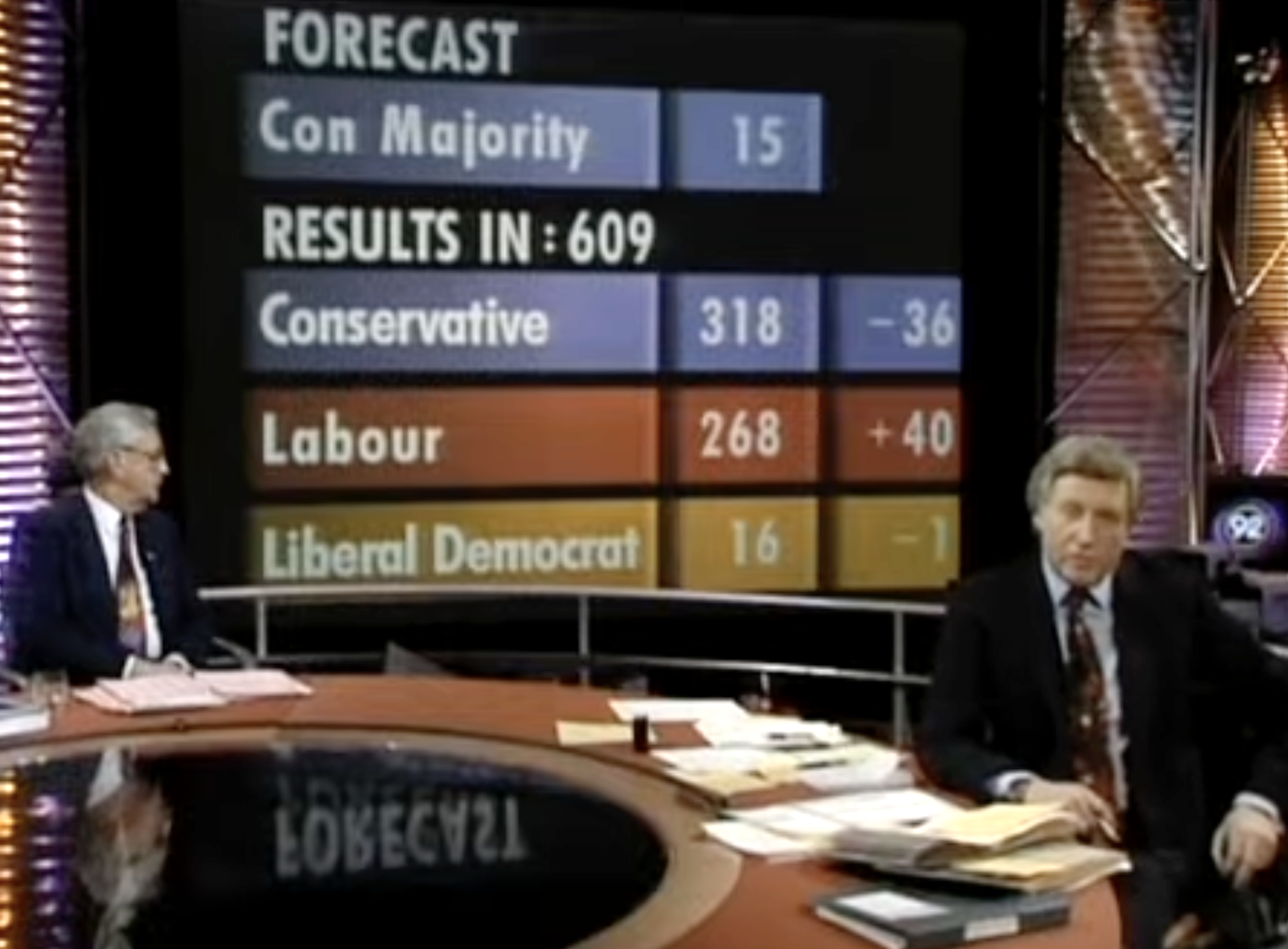
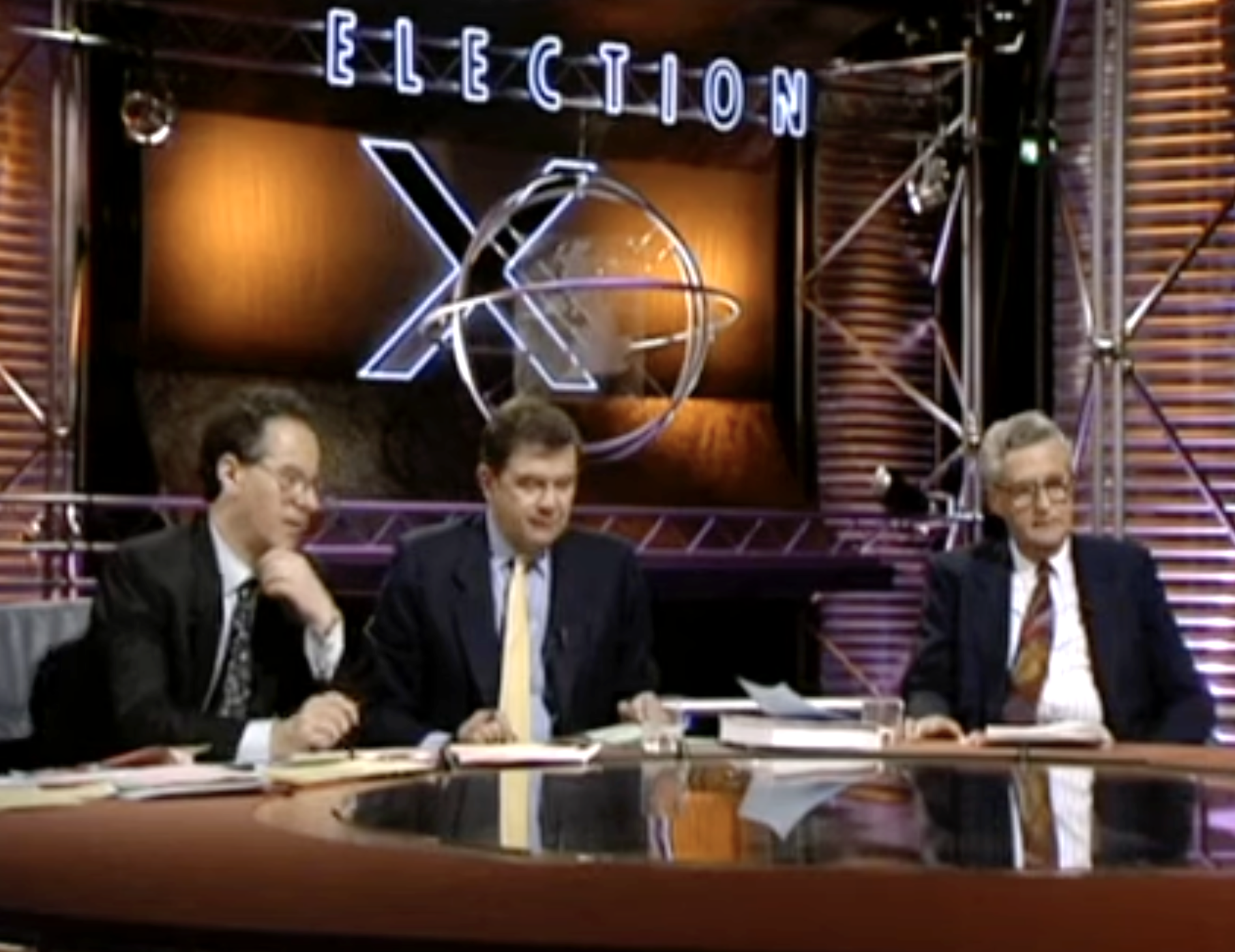
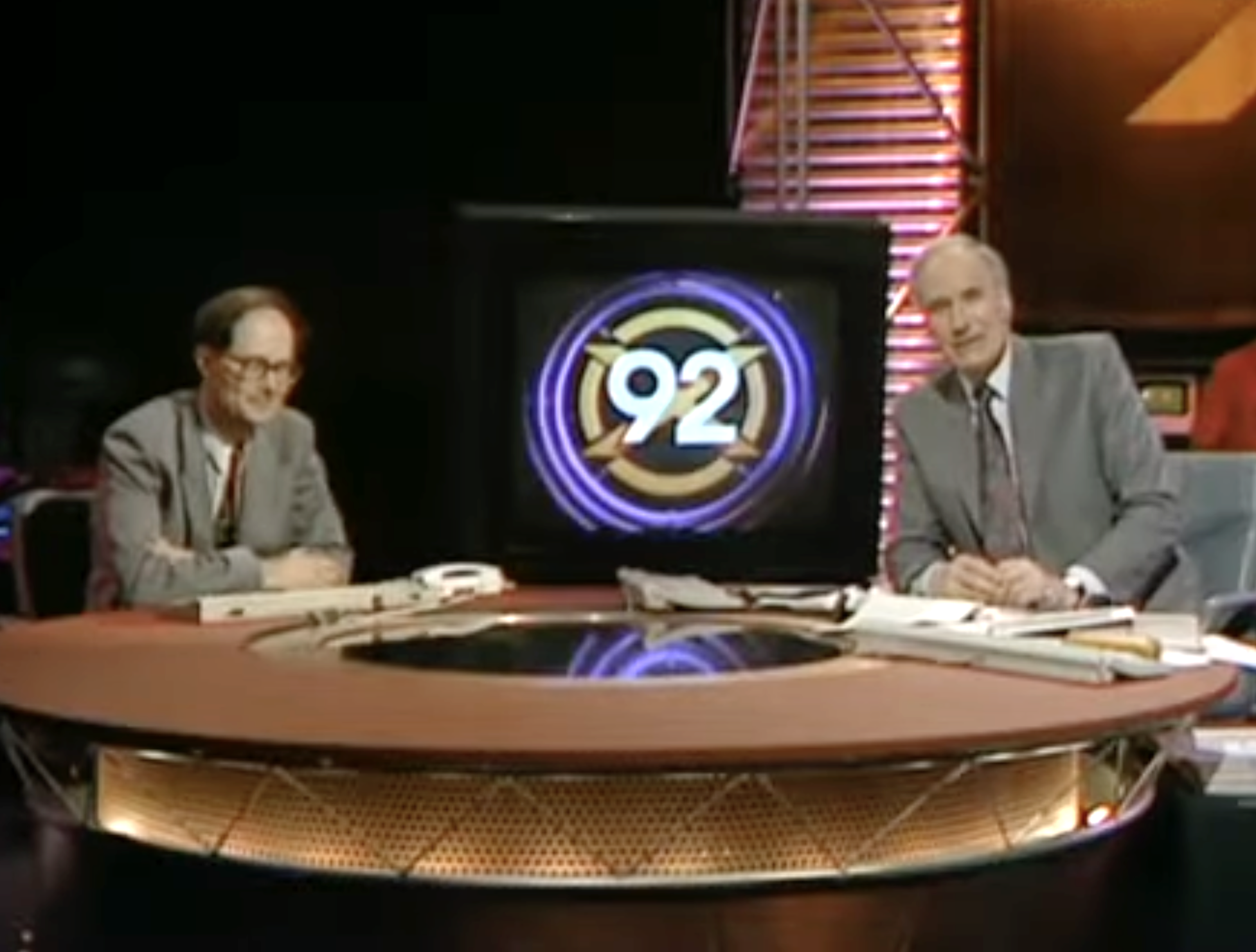
After a while this becomes distracting and highlights (literally) the extent to which the set has been stocked with so many bright primary colours and shiny surfaces.
On the plus side, there is a stylish band of small lights that runs underneath the edge of each of the desks which, together with the ostentatious mixture of materials used to add texture and ornamentation to the circumferences, signals we are now in the era of postmodern interior design, or maybe even postmodern science fiction console design. Indeed, the tops of the desks bear a passing resemblance to transporters, as if guests have beamed down from some sort of election-sphere.
There’s a strong whiff of postmodern design to other aspects of the studio: the way so many objects and features have been built to call attention to their structure; the deliberate clash of colours and textures; the aggressive absence of stylistic uniformity. It’s there on the walkways, the freestanding wall panels, the gangways, even the lighting rigs. Everywhere is fussy. Even the logo is fussy.
The uncontrolled and very human jumble of papers and desktop items – including Dimbleby’s index file – are a welcome contrast to so much controlled and mechanised dishevelment elsewhere. In fact, the dishevelled narrative of the coverage itself, including the bungled exit poll and surprise election result, helps enormously to offset the overall feeling of the studio being a giant playpen for top-down meticulously-planned corporate sprawl.
Come May 1997 and while the circular concept has been retained, improvements have been made.
The set is no longer wrapped in a cloak of darkness. Walls can be seen and they have been lit with soft colours, punctuated with the Election 97 logo and broken periodically with entries and exits for the result-checkers, which help give the studio depth and perspective.
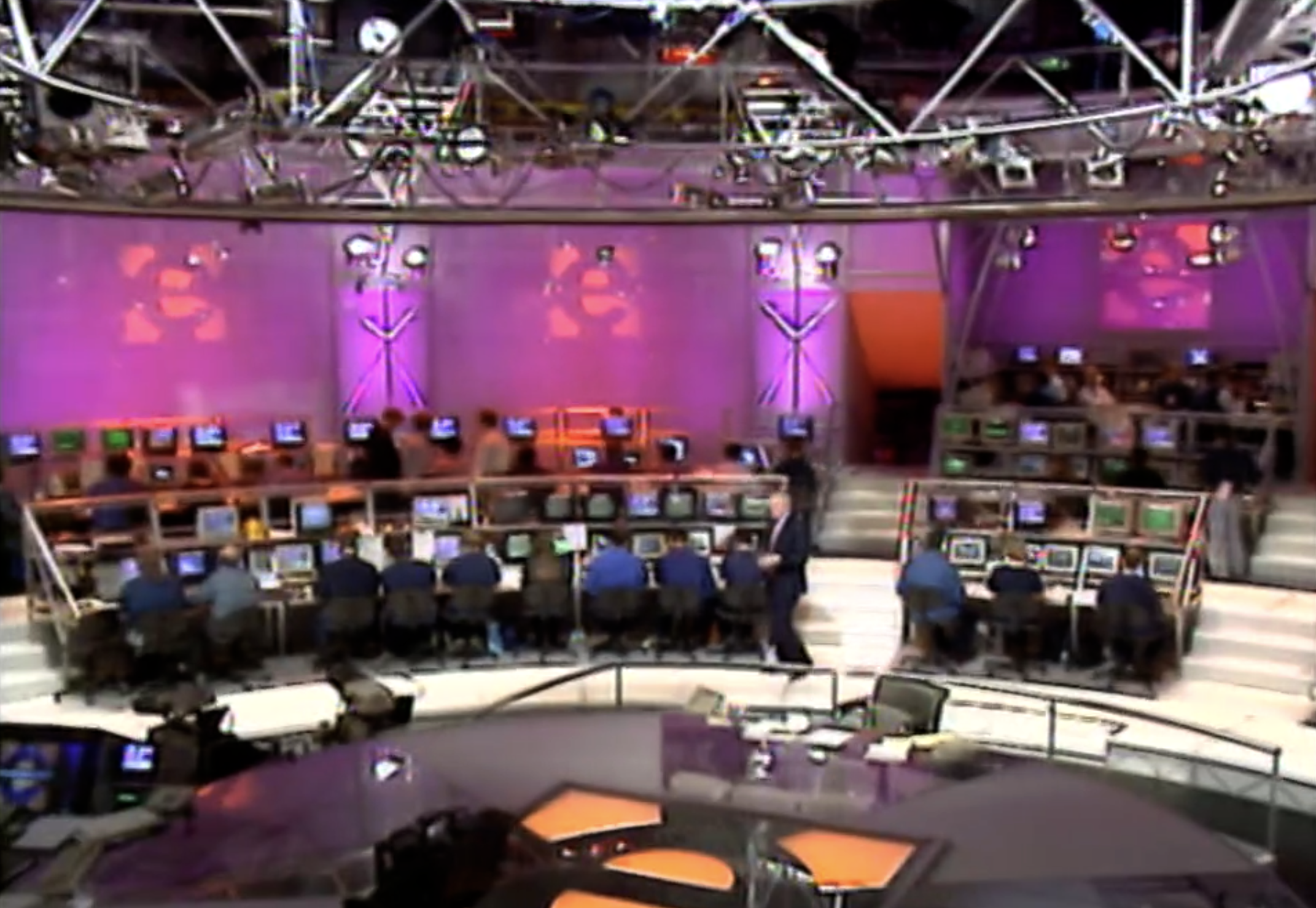
Everything feels more tangible and character-full. The walkways still have a preponderance of metal struts and angular fixtures, but they don’t seem quite so garish. It helps that cameras have been mounted high in the ceiling, higher than in 1992, which give a much-needed sense of proportioned space. One camera is on a motorised track that is able to shuttle around the entire circumference of the set.
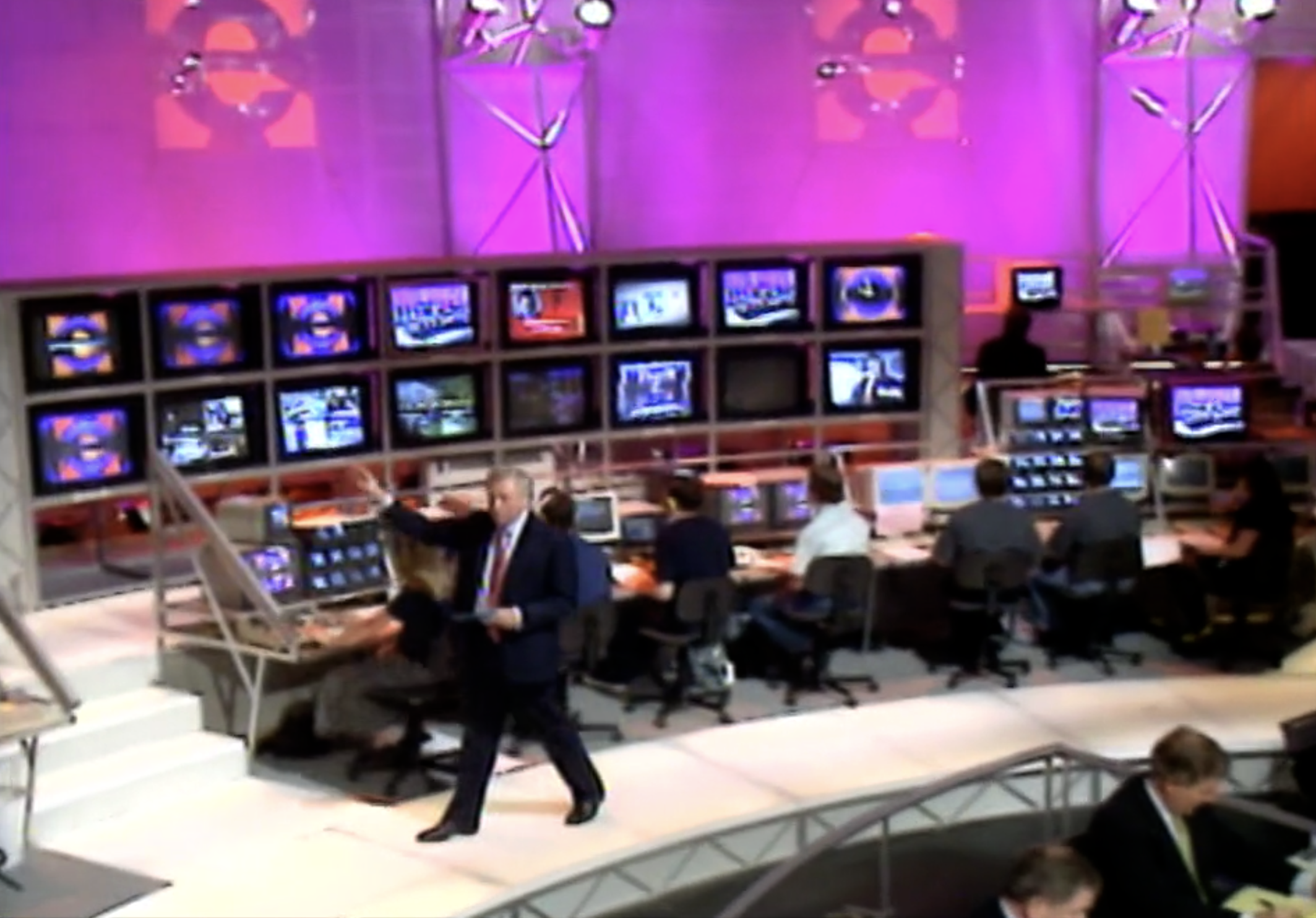
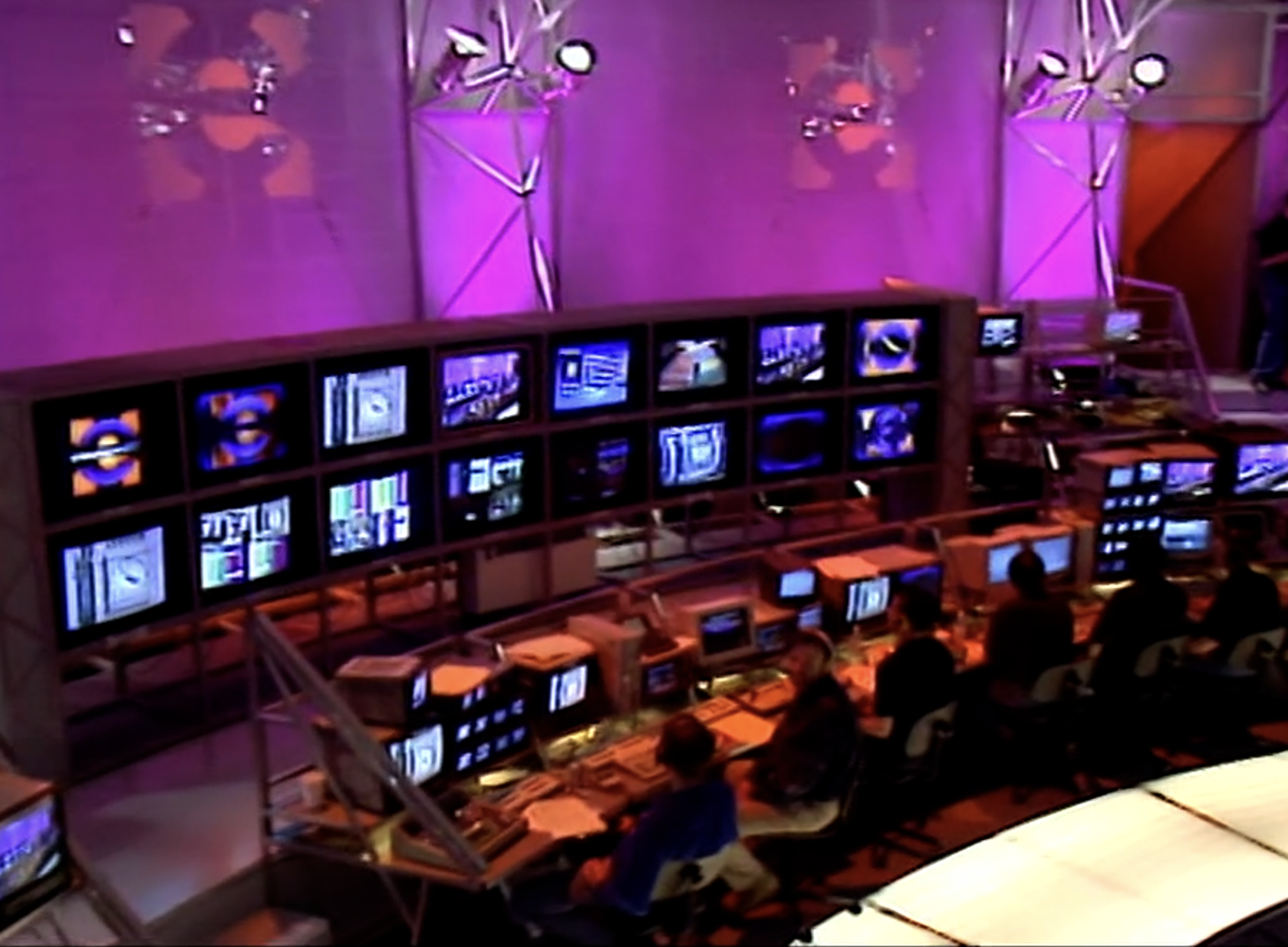
The walls of screens are once again treated as items of furniture, to be displayed and admired, rather than tucked in corners. They are deployed almost everywhere you look – this must be the highest number of monitors ever seen on an election programme – though this means their operators almost all sit with their backs to the camera, creating rows of shoulders and necks and shirts. The entire set feels even more like the control room of a starliner, with Dimbleby’s desk at the very centre of operations – completely circular as in 1992, but larger and grander.
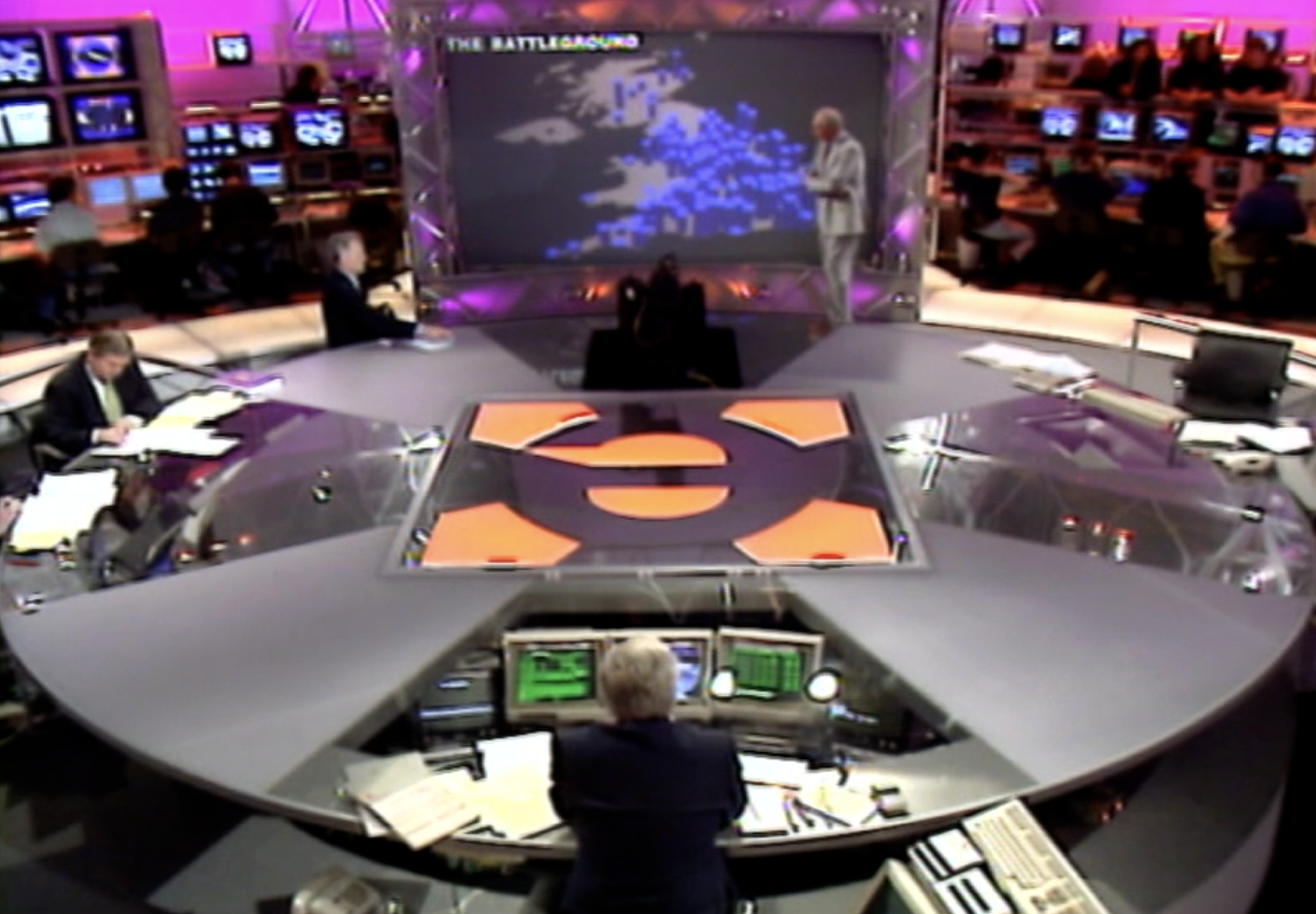
Lessons have been learned here as well. There aren’t so many reflective surfaces as in 1992, helped by the way the top of Dimbleby’s desk incorporates the enormous Election 97 logo, which interpolates transparent glass with opaque shapes.
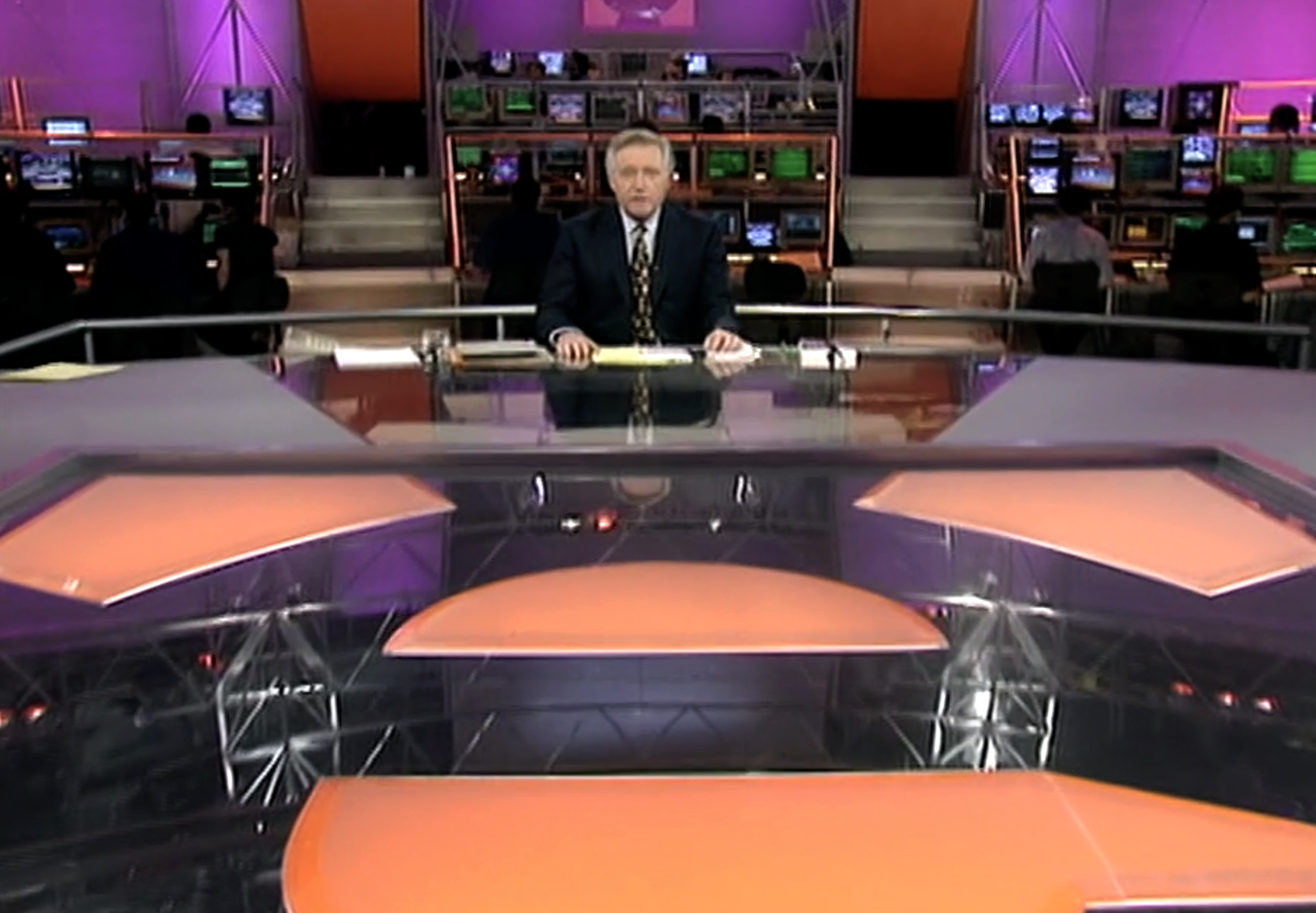
The conversation area for Jeremy Paxman (now filling the Robin Day role) is built on a slightly higher level than Dimbleby’s podium and – in a major departure from precedent – has no desk. Instead there is a low-level coffee table, which is still a little too shiny but which makes a huge difference to the look and feel of this part of the studio. It recalls Cliff Michelmore’s conversation banquette of 1964: an environment intended to be more conducive to informed chat than aggressive interrogation.
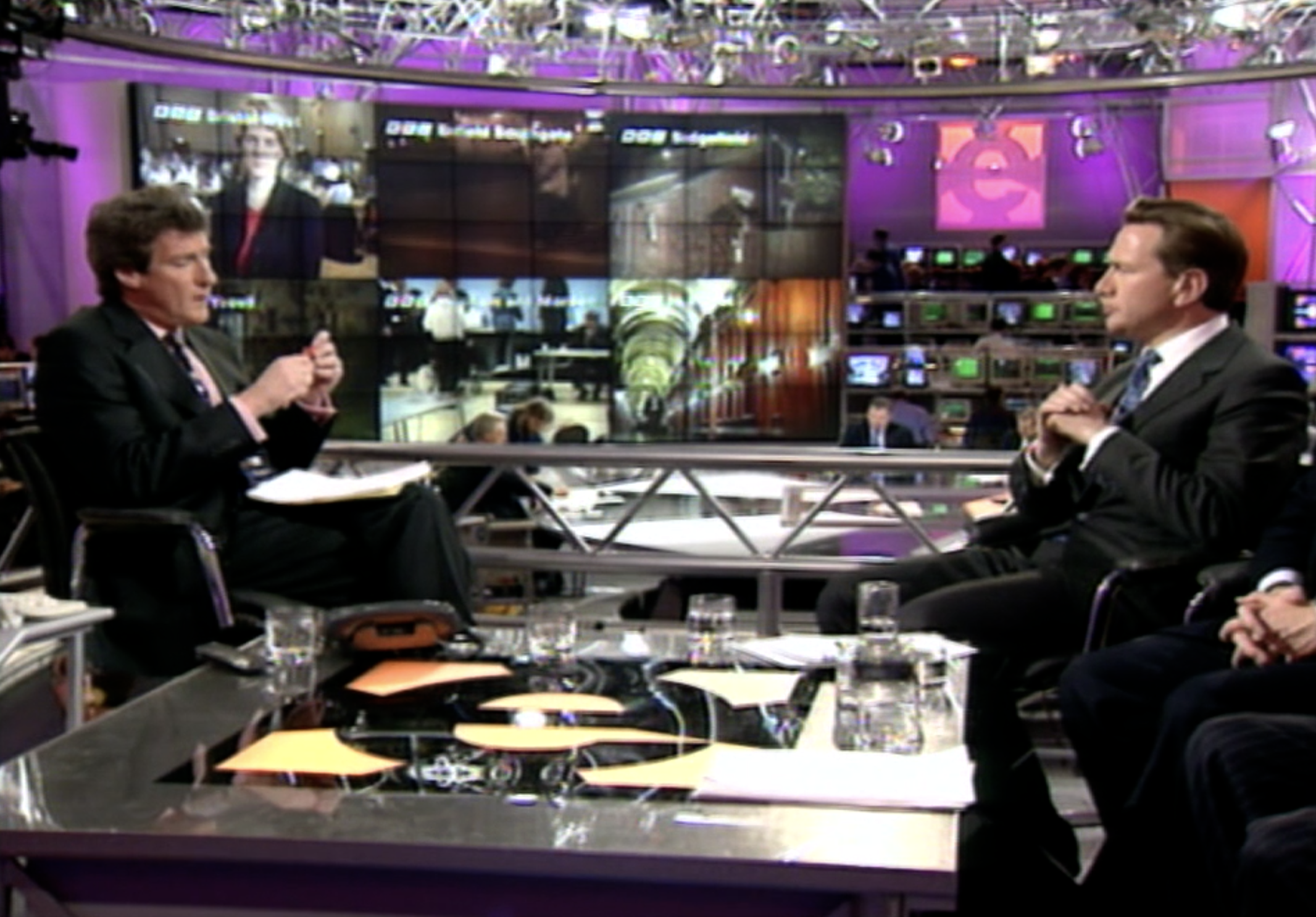
Back to Dimbleby’s desk, though. It’s not without problems. The size is almost preposterous: he has to shout across to guests on the other side and has to bawl at Peter Snow, who is parked at a small booth that has been built below the main podium, together with an enormous Sony HDVS monitor.
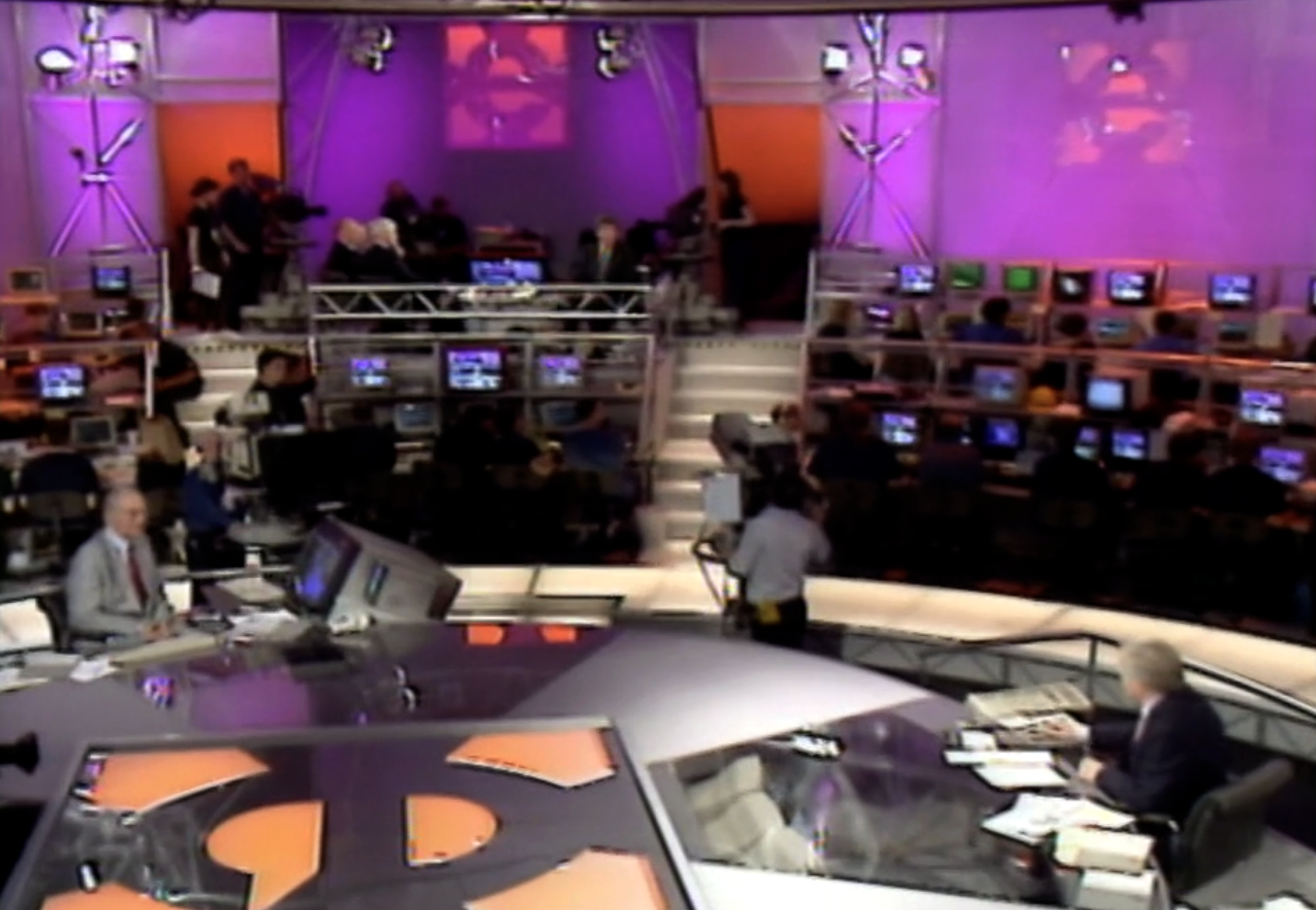
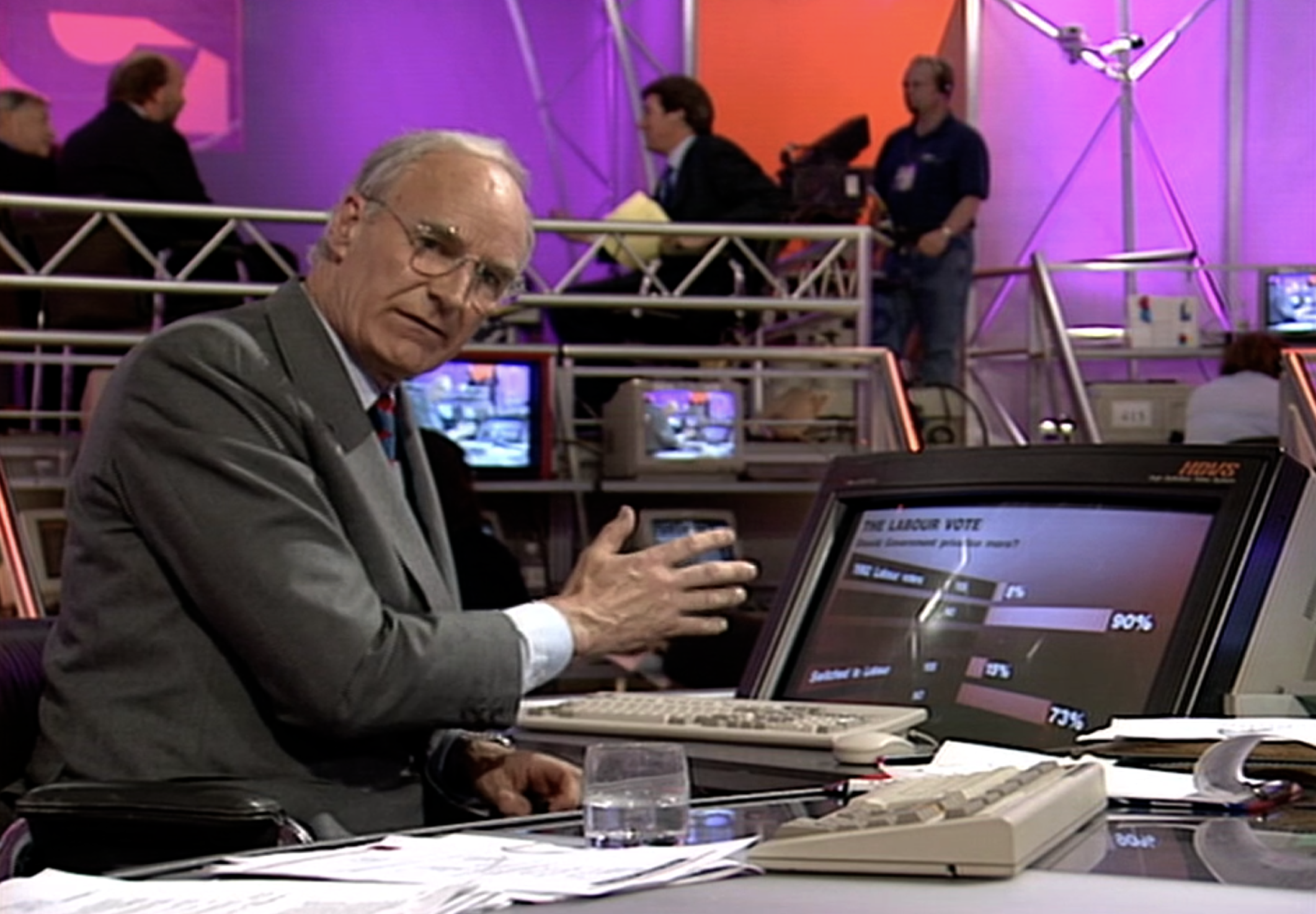
Dimbleby’s chair has been placed in such a way as to frame him in front of a very impressive wall of TV screens, most of which show rows of important-looking data.
Something has gone wrong with the layout of this part of the studio, however, or hasn’t been properly checked in rehearsal. Stationed behind Dimbleby, but out of sight of the camera, is an electric fan or some kind of ventilation unit. All the way through the programme – night and day – this piece of equipment sends wafts of air towards him and his desk, causing his notebooks and papers to flap about.
It quickly becomes a distraction, then an annoyance, both to viewers and clearly for him, as he is forever interrupting his train of thought to flatten down the notebooks or put objects on them. You’d think someone would have sorted this between Thursday night and Friday morning, but no: the papers flap about all the way through to Friday afternoon.
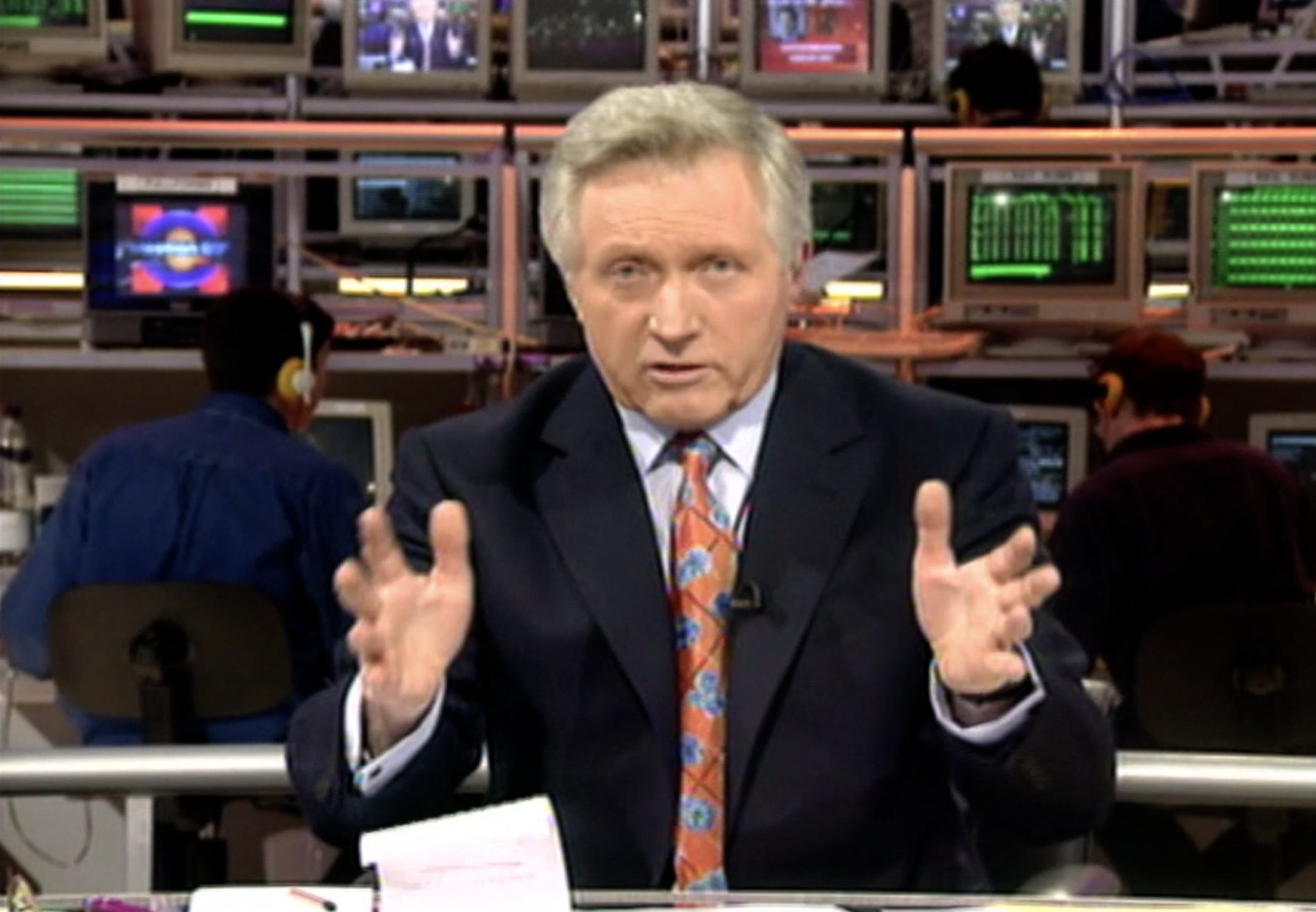
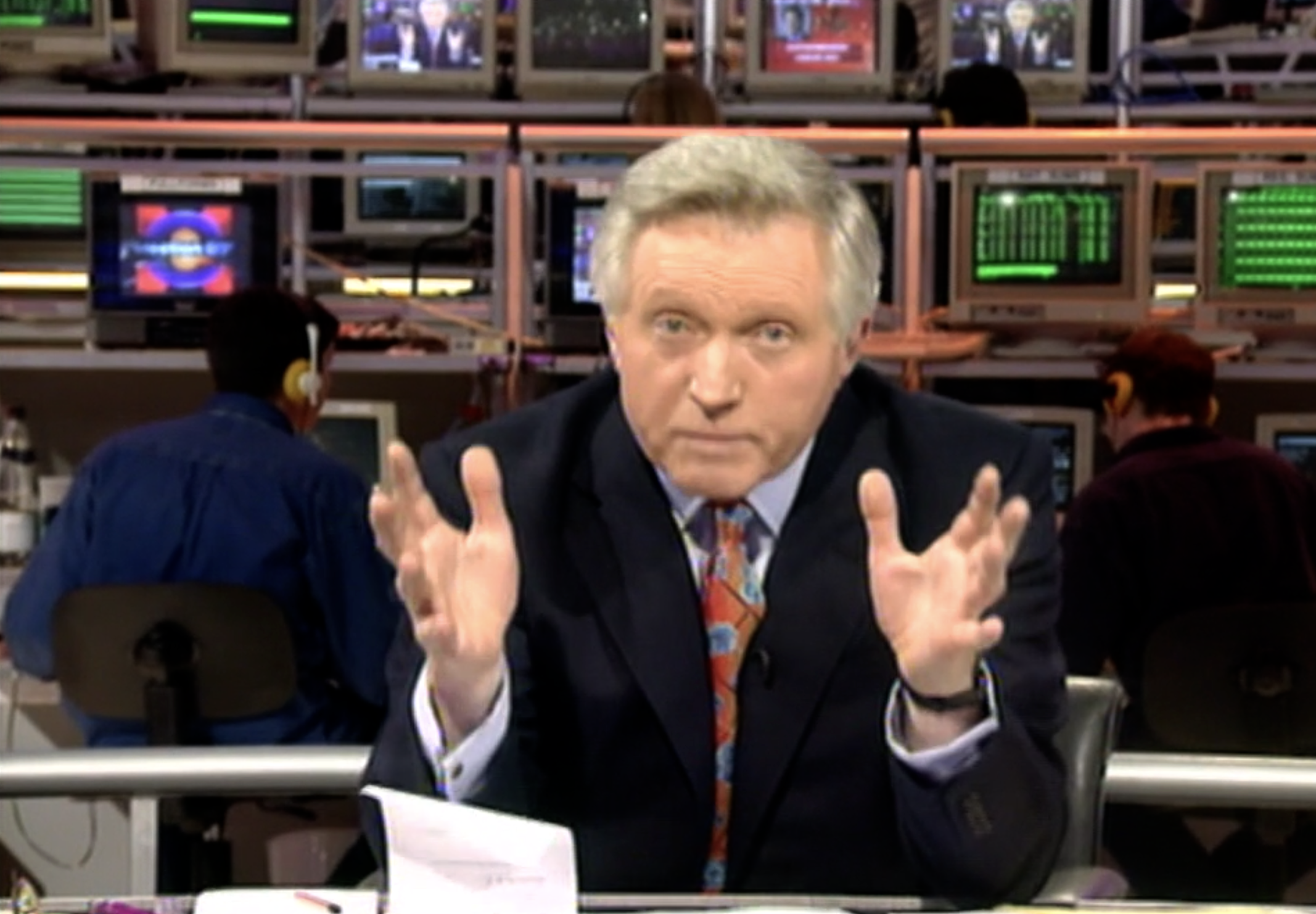
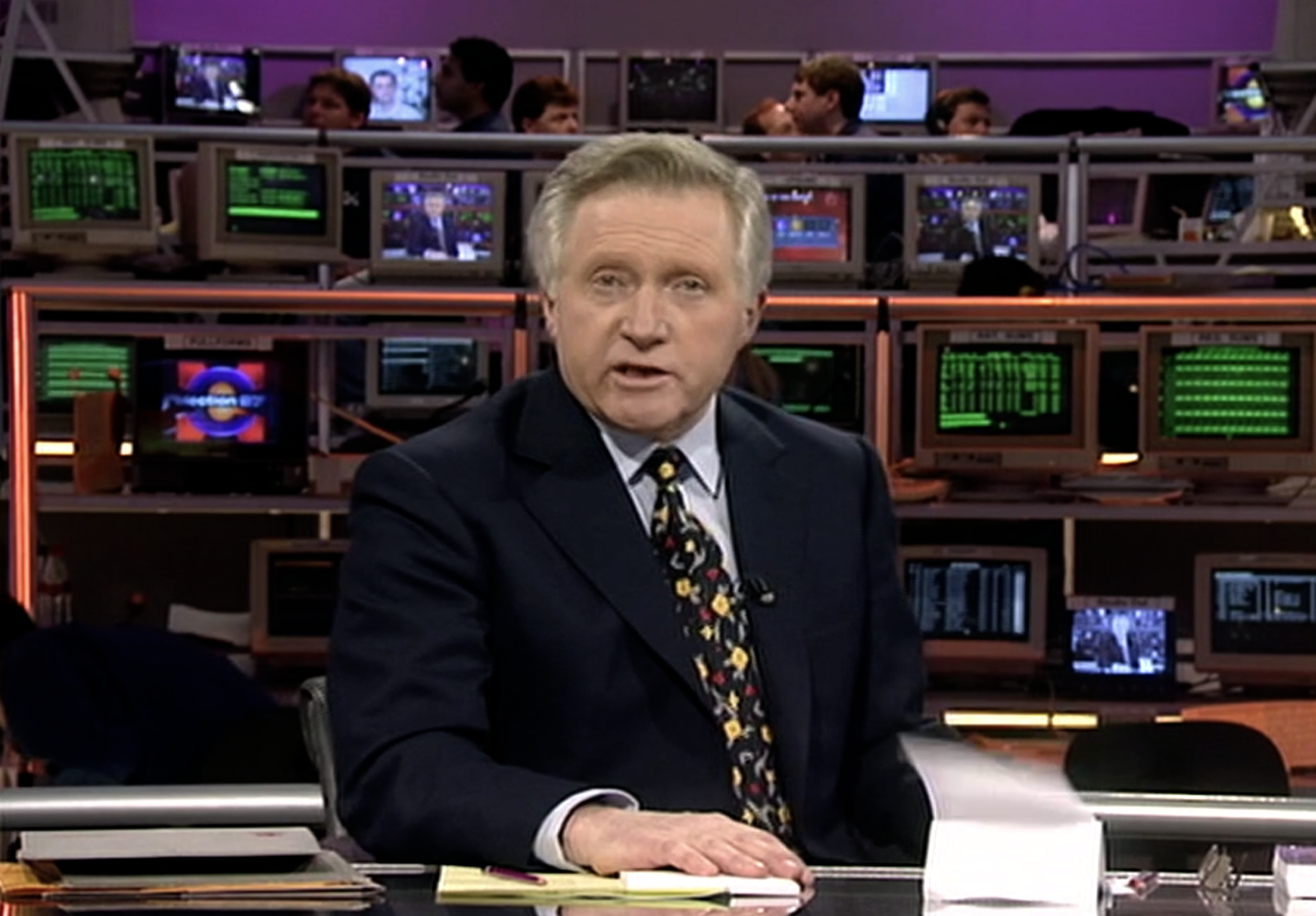
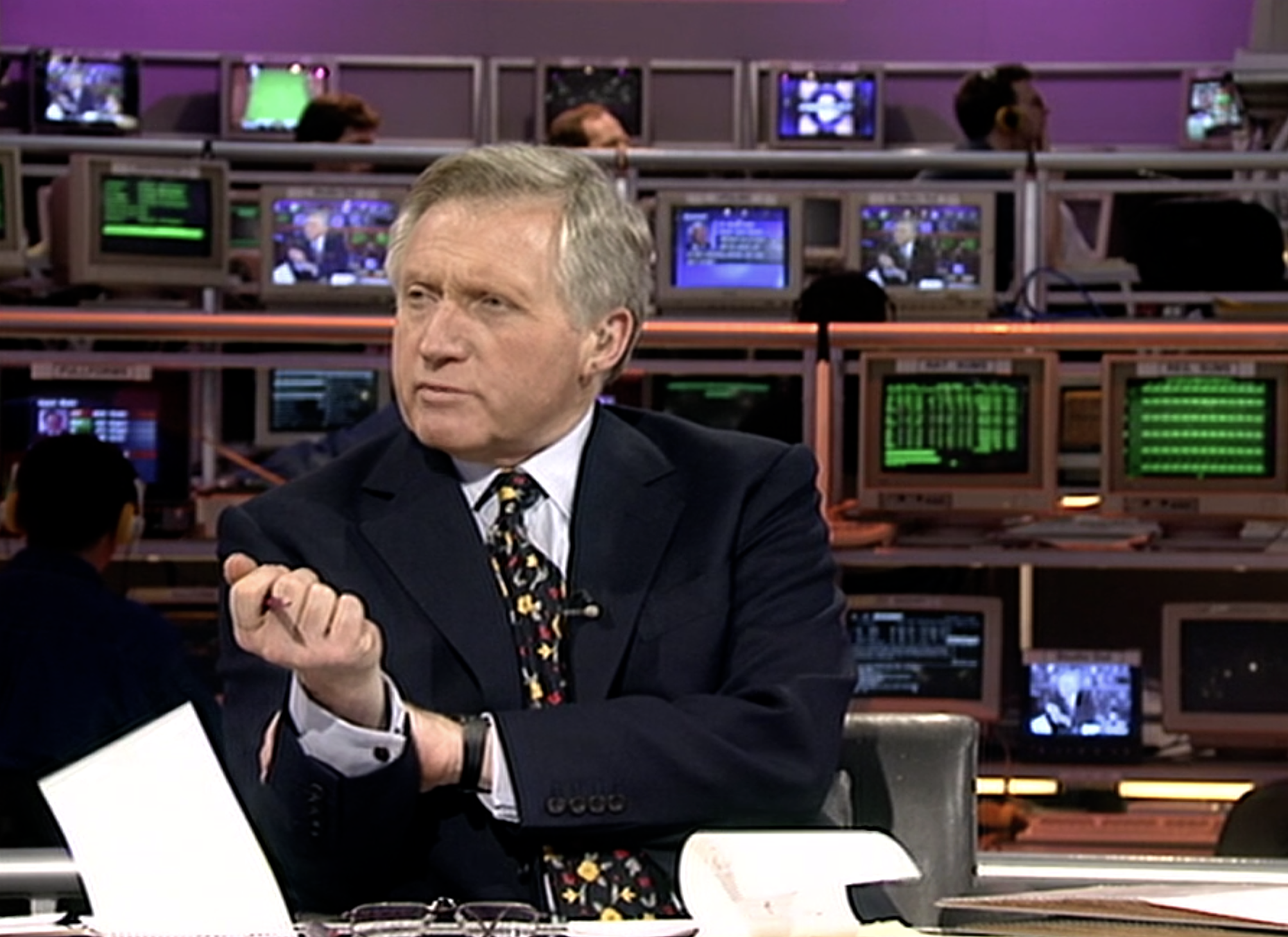
The star piece of furniture, beating even Paxman’s coffee table and the tiers of monitors around the circumference of the studio, is the mega-wall of screens that has been built just to one side of Dimbleby. It is able to act as one giant screen showing a single image; split into two or three different shots from outside broadcasts; or show a different image on all 42 screens – albeit with mixed results.
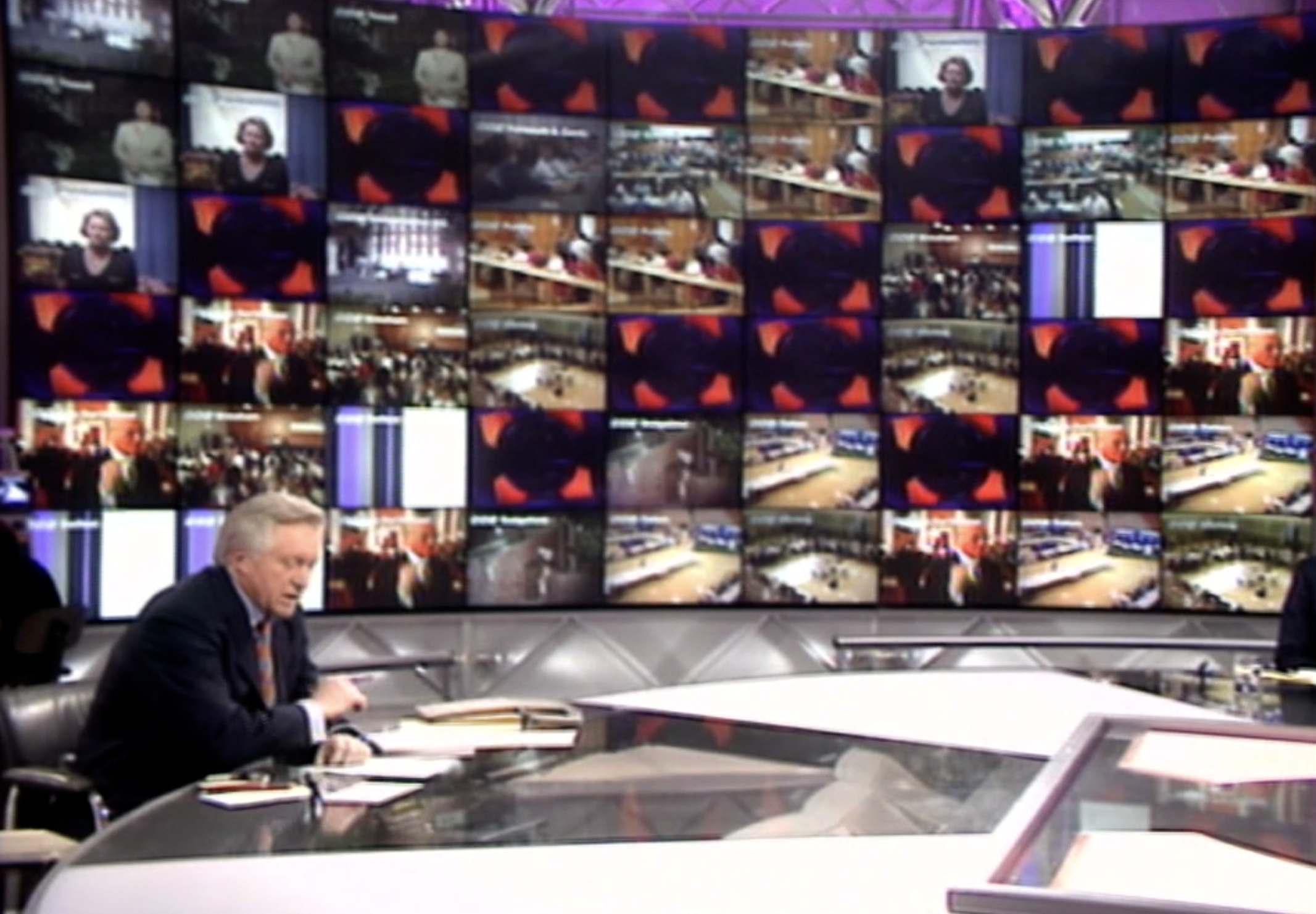
What’s the collective noun for a group of Kate Adies?
*
At the time of writing, the 21st century has yet to deliver an election results programme on the BBC where the studio furniture has come close to matching anything seen in the 20th, either in style or spectacle.
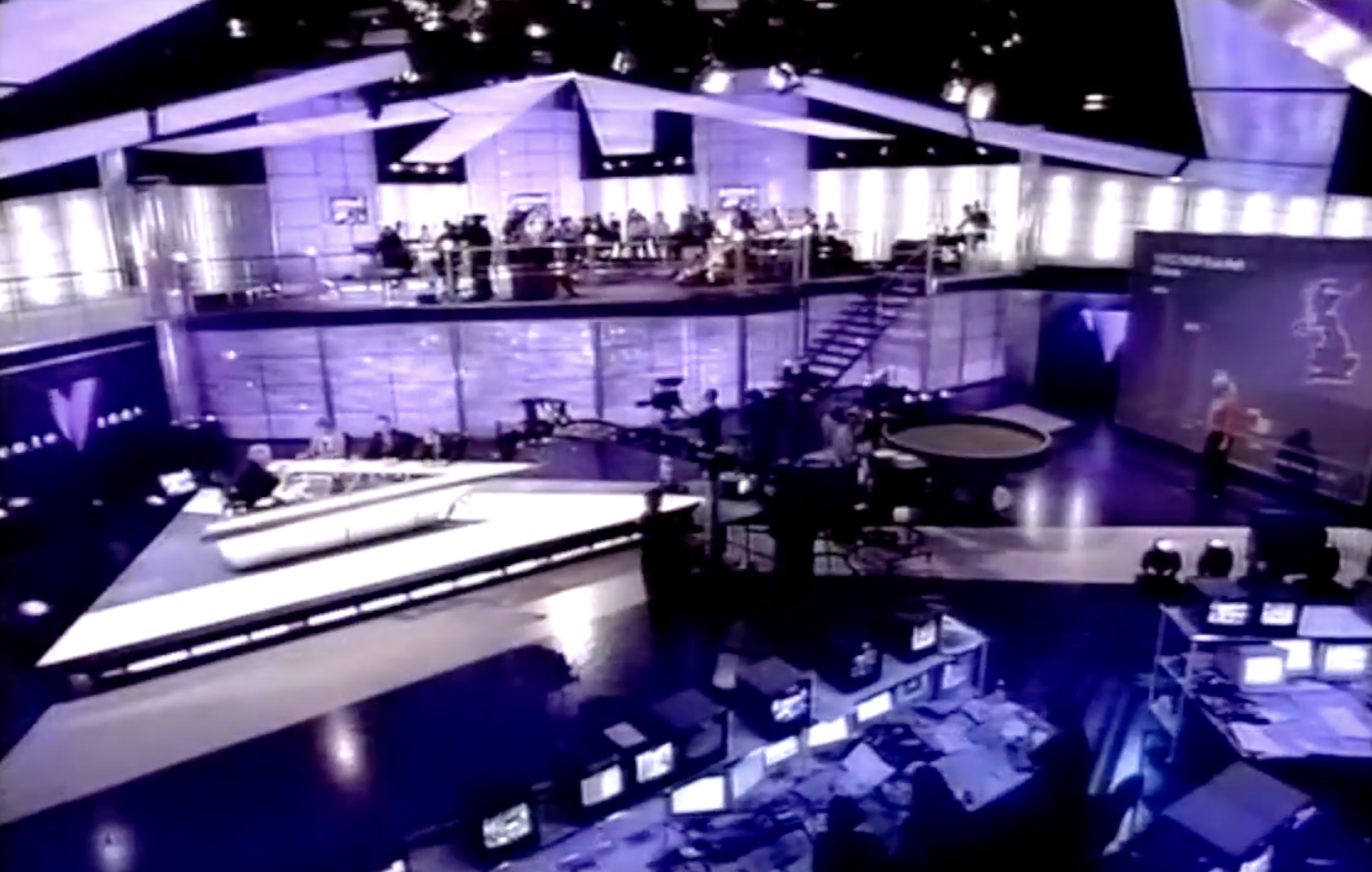
The coverage of the June 2001 election tried to marry the single-colour approach of the 1980s with the giganticism of the 1990s, but failed to pull off either successfully. The colour scheme is quite nauseating. How to describe it – fuchsia lilac? Bubblegum lavender?
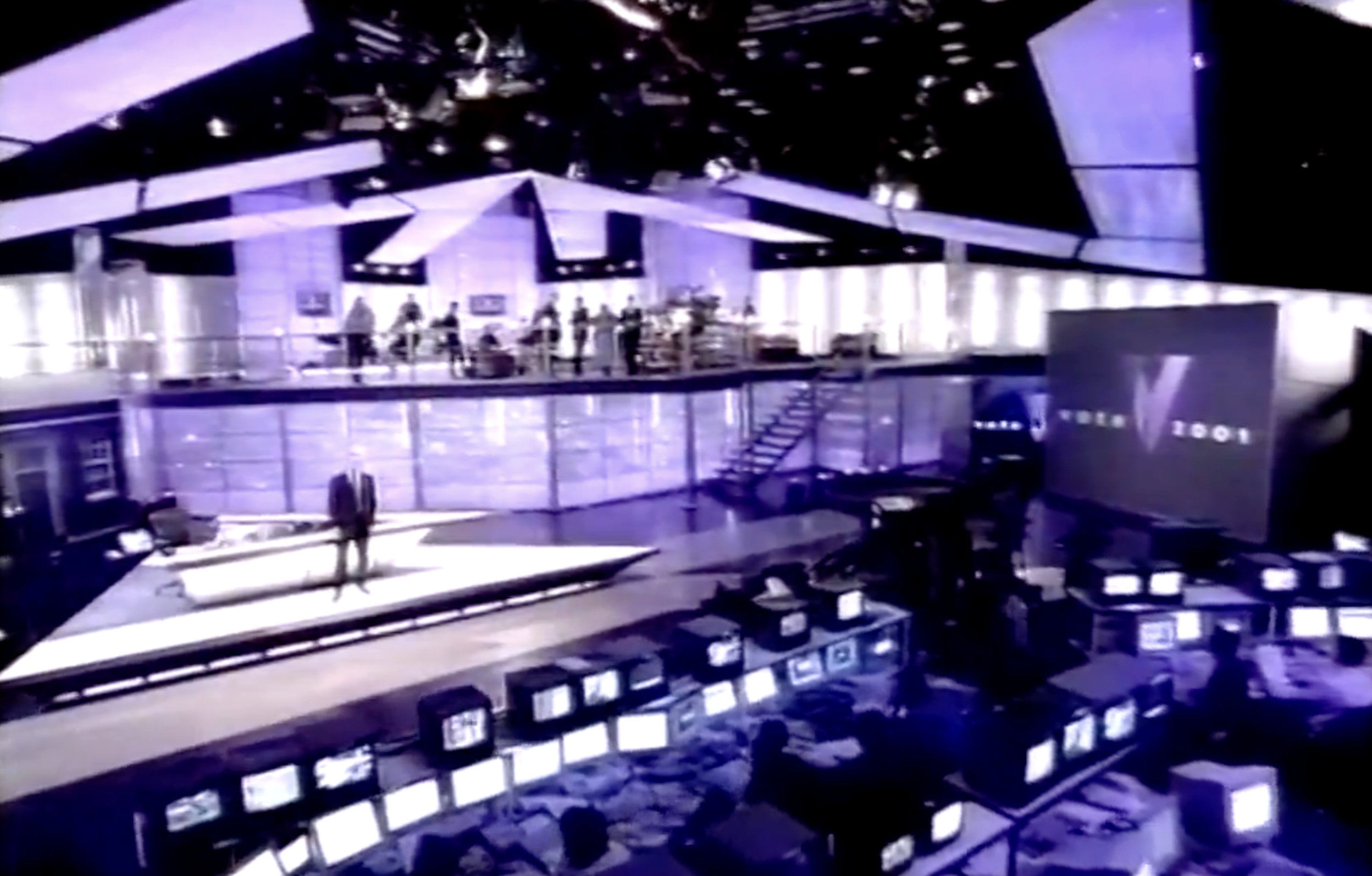
The result-checkers are bathed in this lurid glow, while the coarse jagged lighting panels in the ceiling project it and the bare studio floor radiates it. And as for the semi-transparent screens – what was the inspiration here? A guess-the-silhouette panel game? Either put some of the backroom staff fully on camera or don’t bother at all. Trying to do a bit of both just looks indecisive.
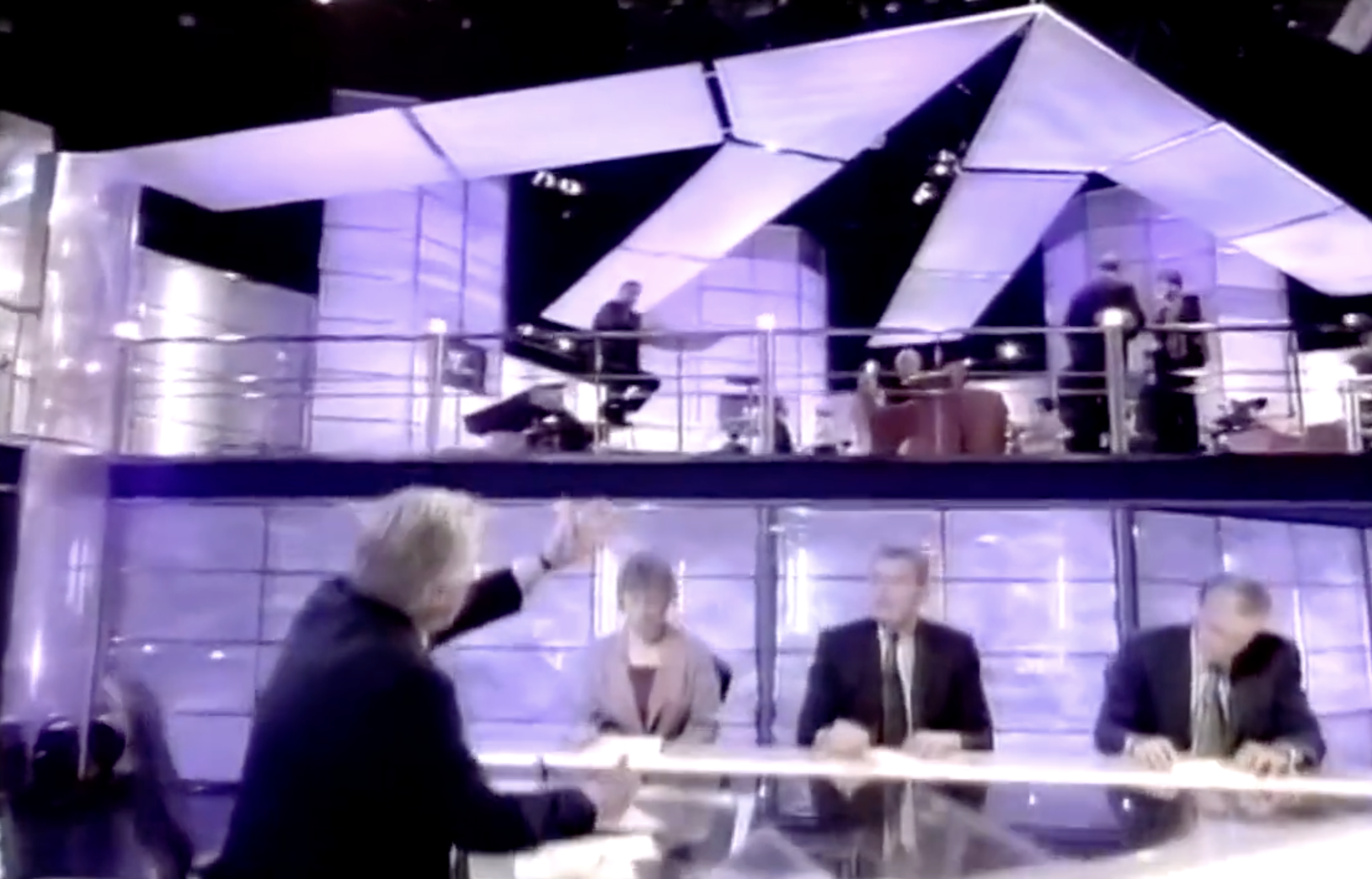
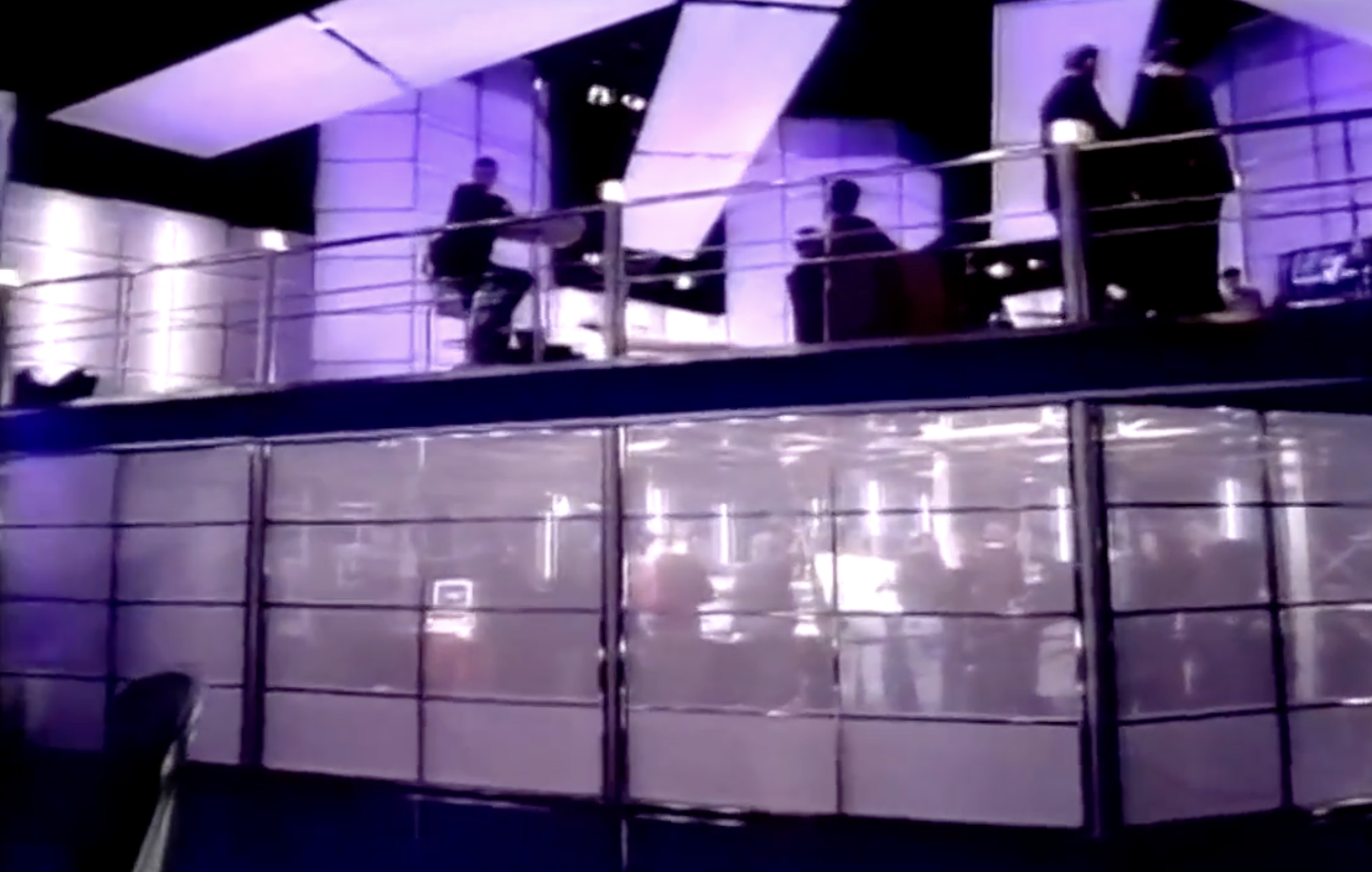
Sitting above the semi-transparent screens is Jeremy Paxman, squeezed behind a tiny desk with his guests, all of whom are sitting on an equally tiny banquette.
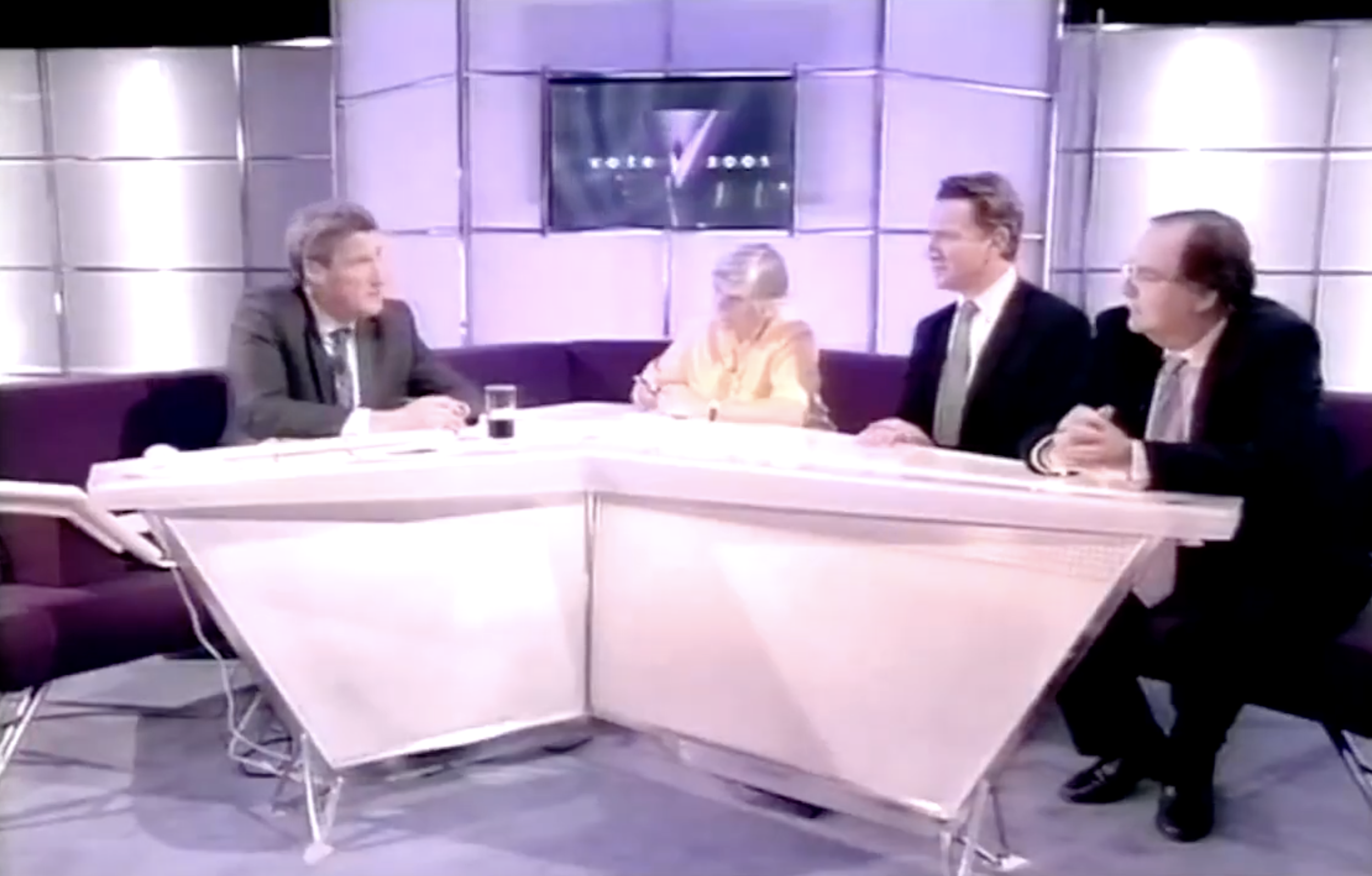
The enlightened coffee table of 1997 has been ditched, sadly. This desk is definitely a step backwards. A step into bafflement, meanwhile, is the decision to exile Fiona Bruce to a balcony with a roving microphone, where she is required to mingle with an ever-changing cast of non-politicos, who recline awkwardly in easy chairs or perch gingerly alongside what looks like the bar of a formerly-upmarket-but-now-on-the-skids drinking establishment.
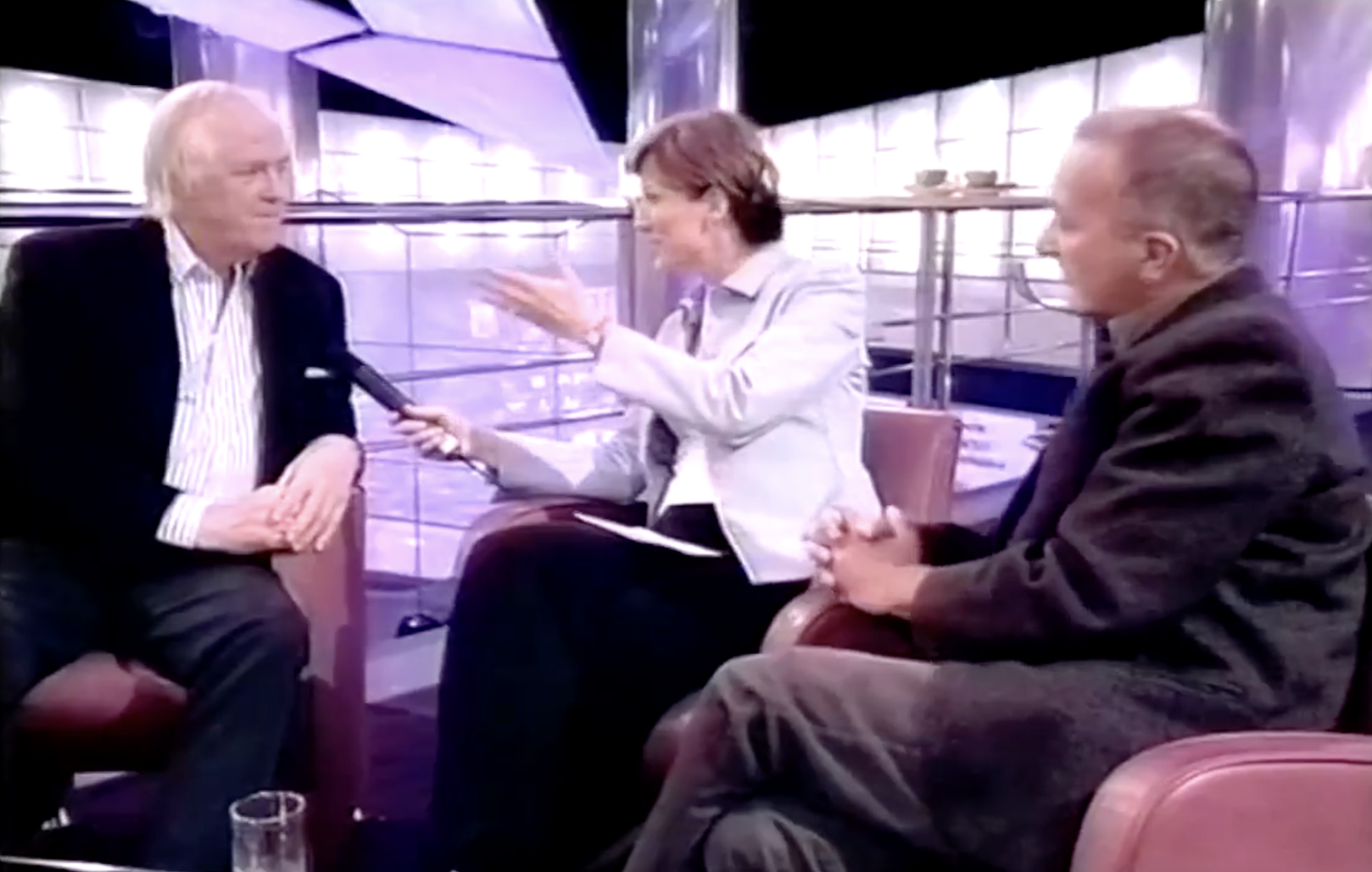
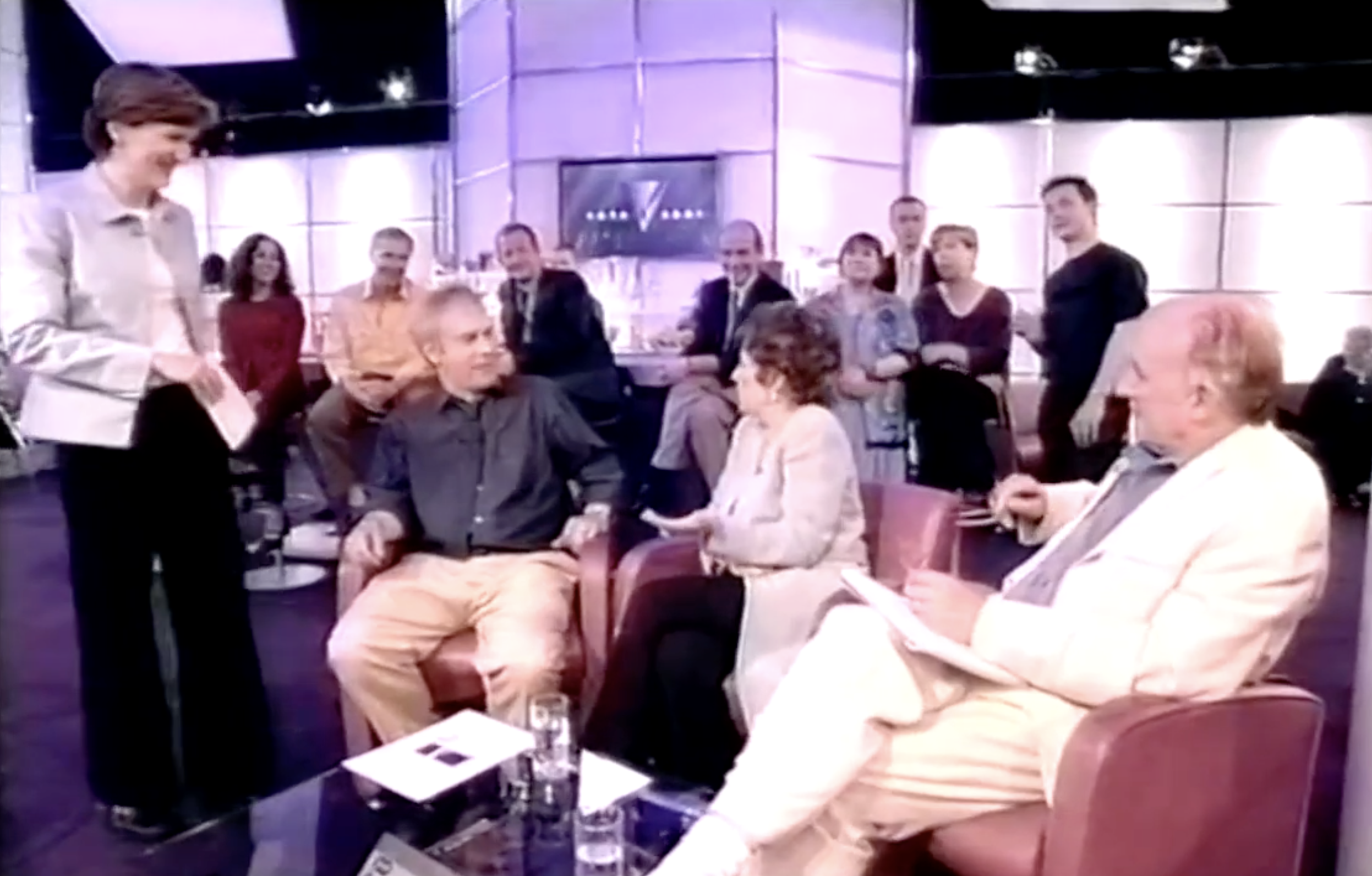
The guests are picked to offer one view and then the precise opposite – for example, Tim Rice praises the Conservatives, then Tony Robinson praises Labour. Nothing is proved. Like the furniture, the views exist purely to fill the air and take up space. There also appear to be some extras milling around, perhaps even some actual members of the public, enlisted presumably to foster an air of authentic hubbub, though all – including Bruce – are upstaged by an enormous bowl of fruit.
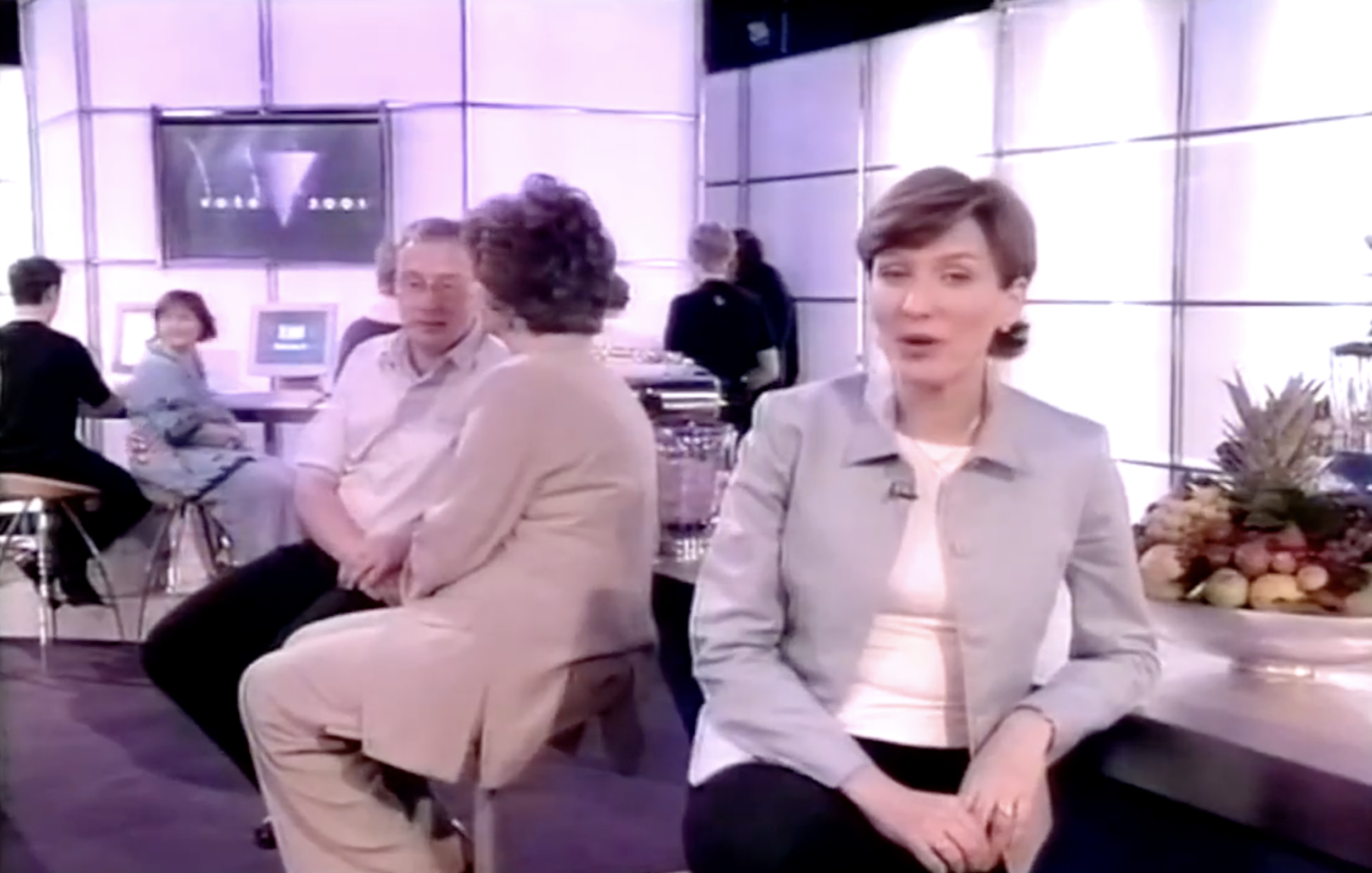
Also new, and also binned after just one outing, is the main desk. This is the first time David Dimbleby has been berthed behind an isosceles triangle, with him on the shortest side, the guests bunched together on one of the longer sides, and the other side left empty.
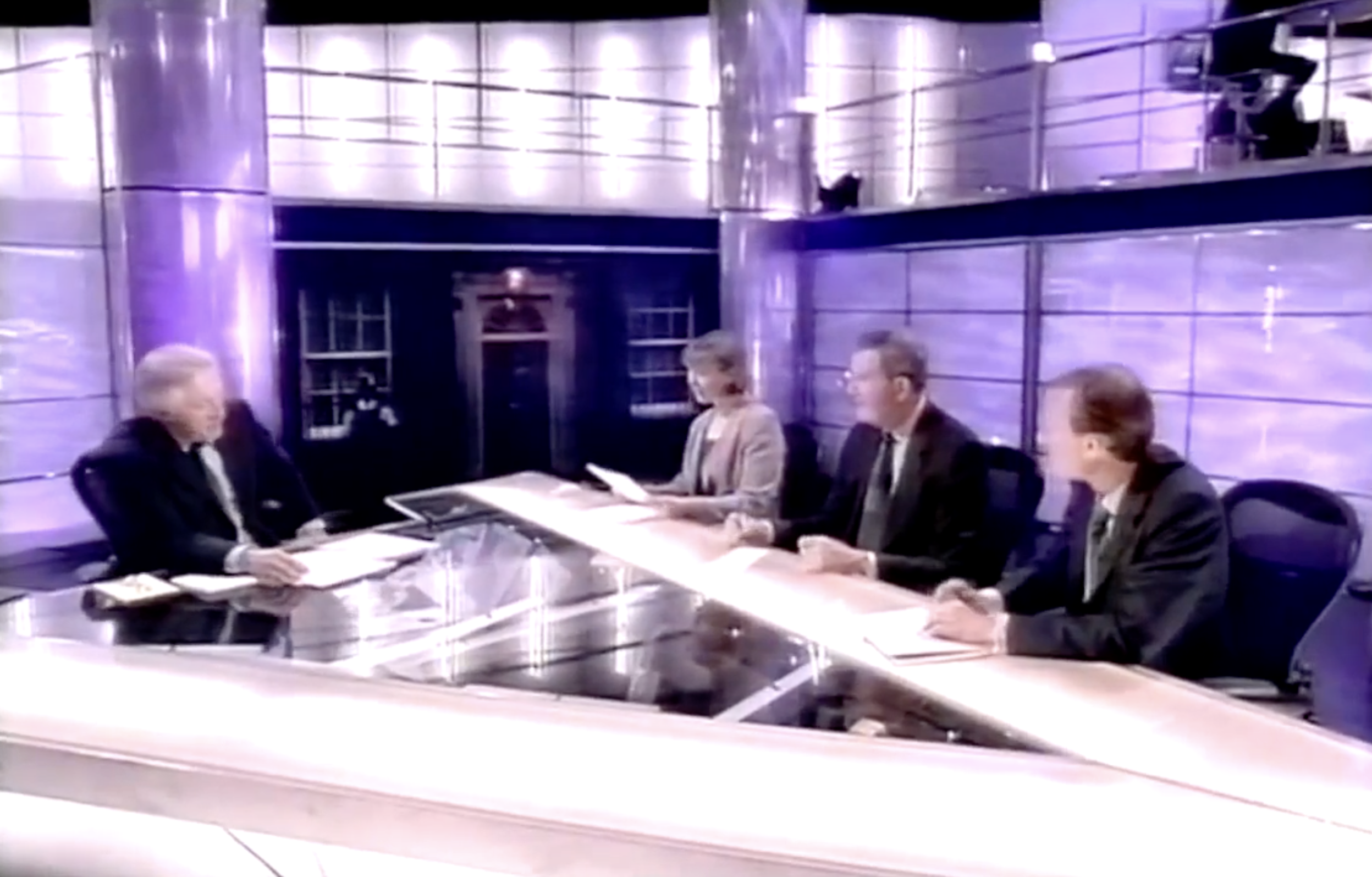
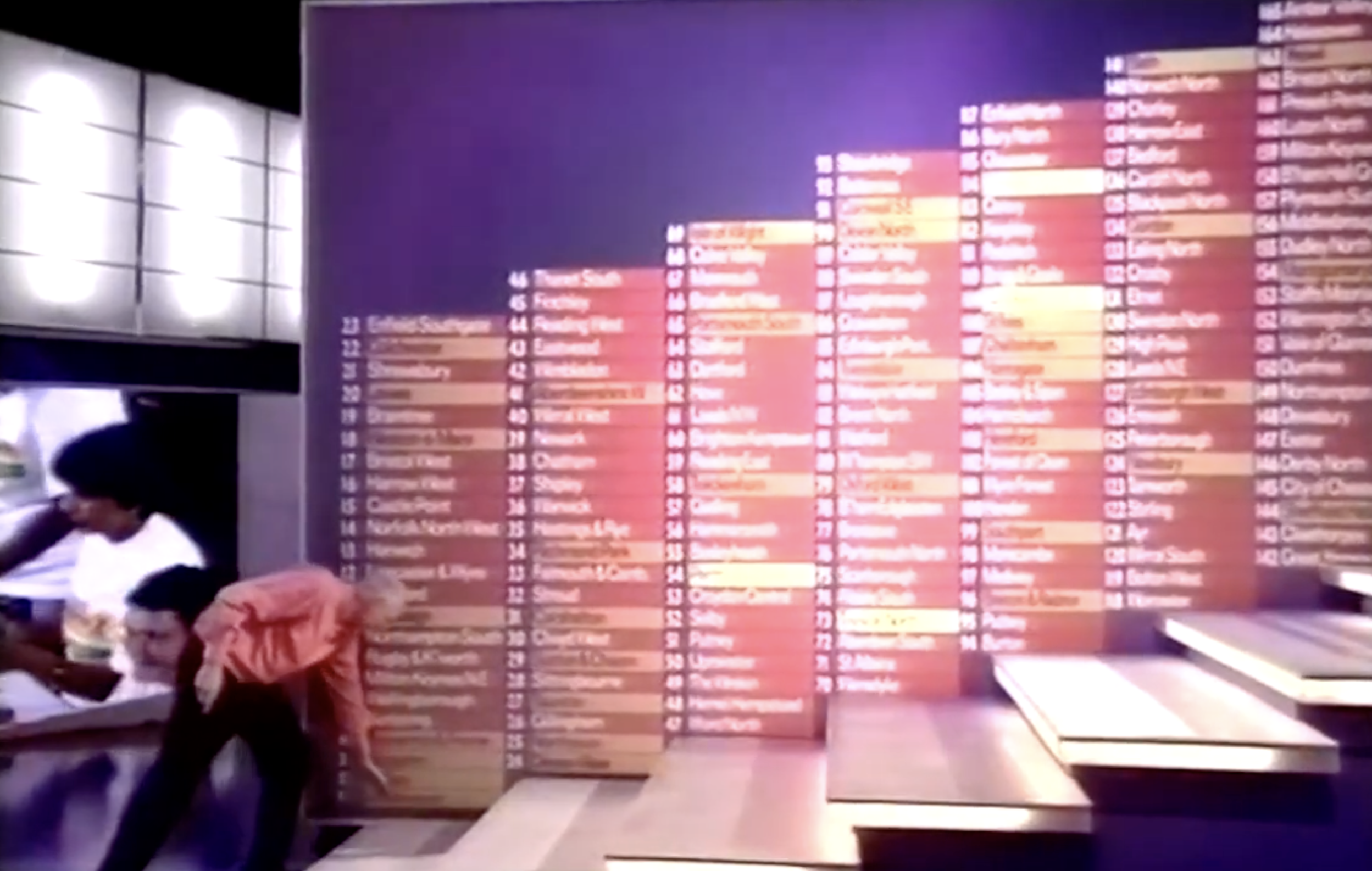
While the surface area of desk is smaller and not quite so reflective as in 1992 and 1997, the design doesn’t really work. Nobody looks comfortable, the structure is too ostentatious and brightly-lit, and the whole arrangement is too performative, with the triangle pointing in a rather intimidating way across the studio floor to where Peter Snow dwells, without his own desk, but with a giant retractable staircase.
Things improved by the time of the May 2005 election. Firstly, someone remembered the value of sensitive lighting. Secondly, some of this light is provided naturally, in the form of giant windows that show large clumps of foliage quivering in the open air – though it’s never entirely clear if these are actual windows, or screens relaying live pictures of the outside world.
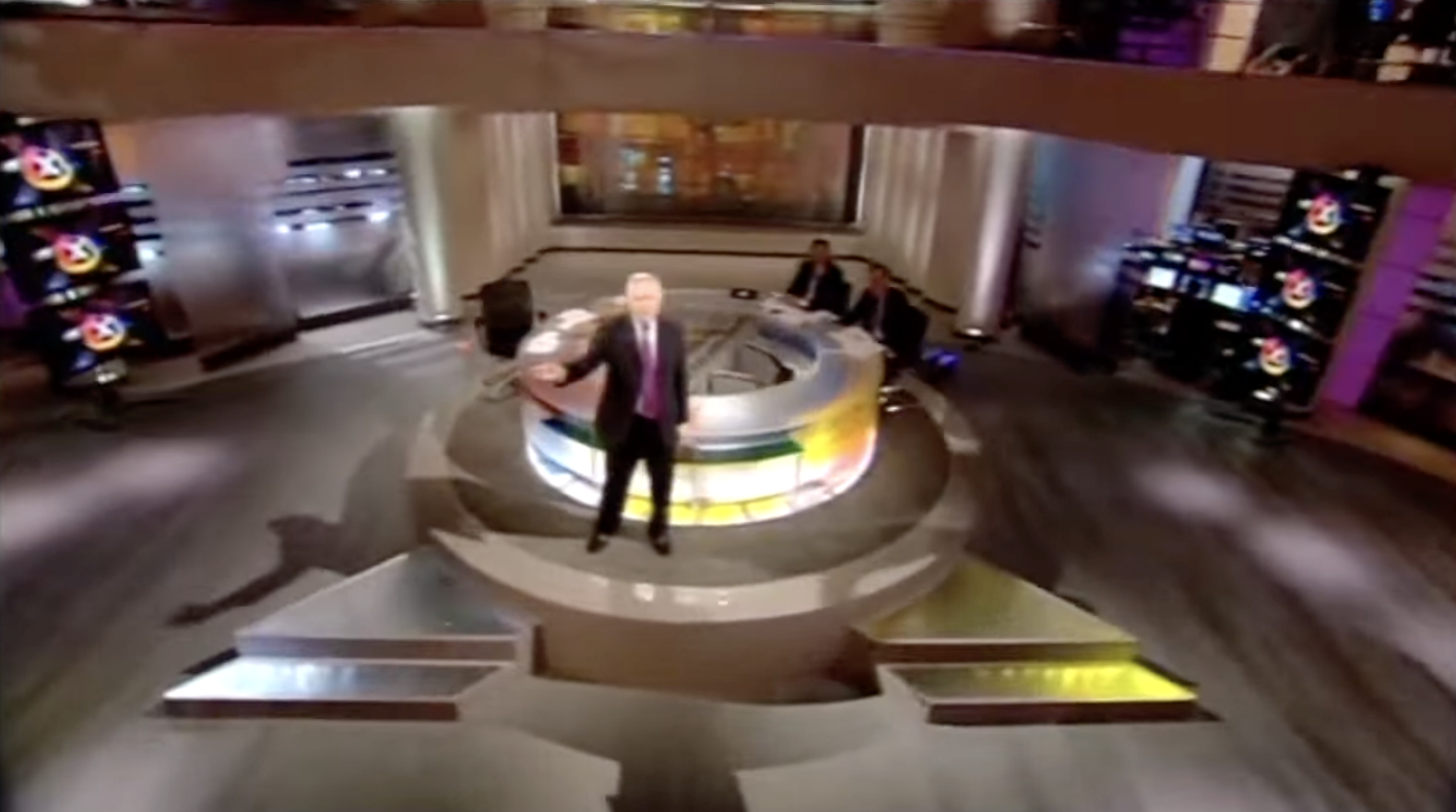
Either way, this simple idea has a profound impact, as it means the whole look and feel of the studio changes, from part one (overnight) to part two (the day after). In part two the set is flooded with natural light, and everything and everyone seems to become a bit more relaxed.
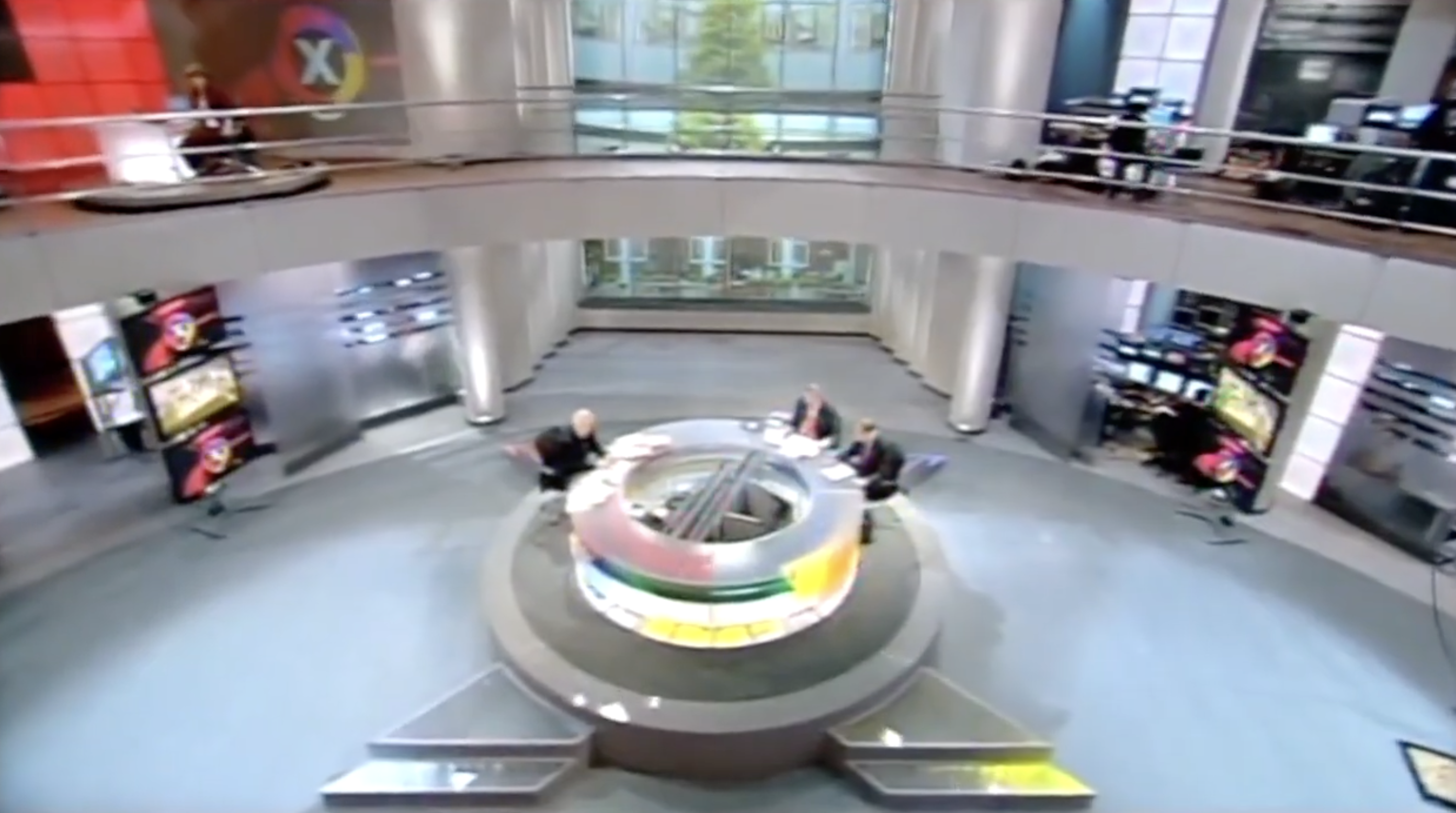
The convivial mood is augmented by the ordered layout of the furniture and the amount of open space. Rarely has an election studio been so free of clutter and dark corners. Even the colour of the floor plays a role, changing from a dark brown overnight to a light grey in the daytime.
David Dimbleby’s desk is restrored to a circle and is furnished simply, with bands of coloured perspex running around the outside, accentuated with soft lighting. The size of the desk is just right: not too small but not too capacious. Its occupants can chat with each other without needing to bawl across an expanse of air.
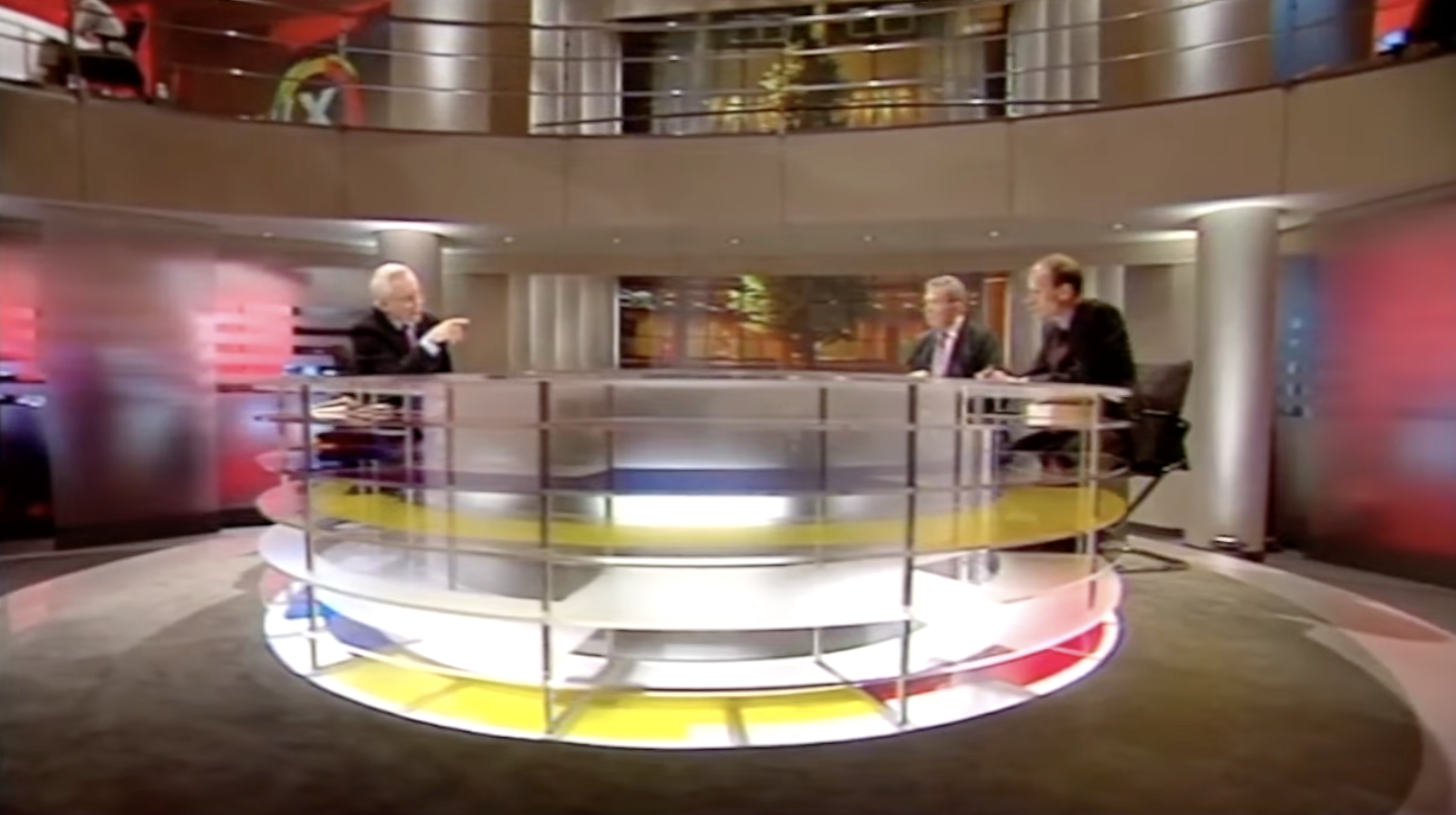
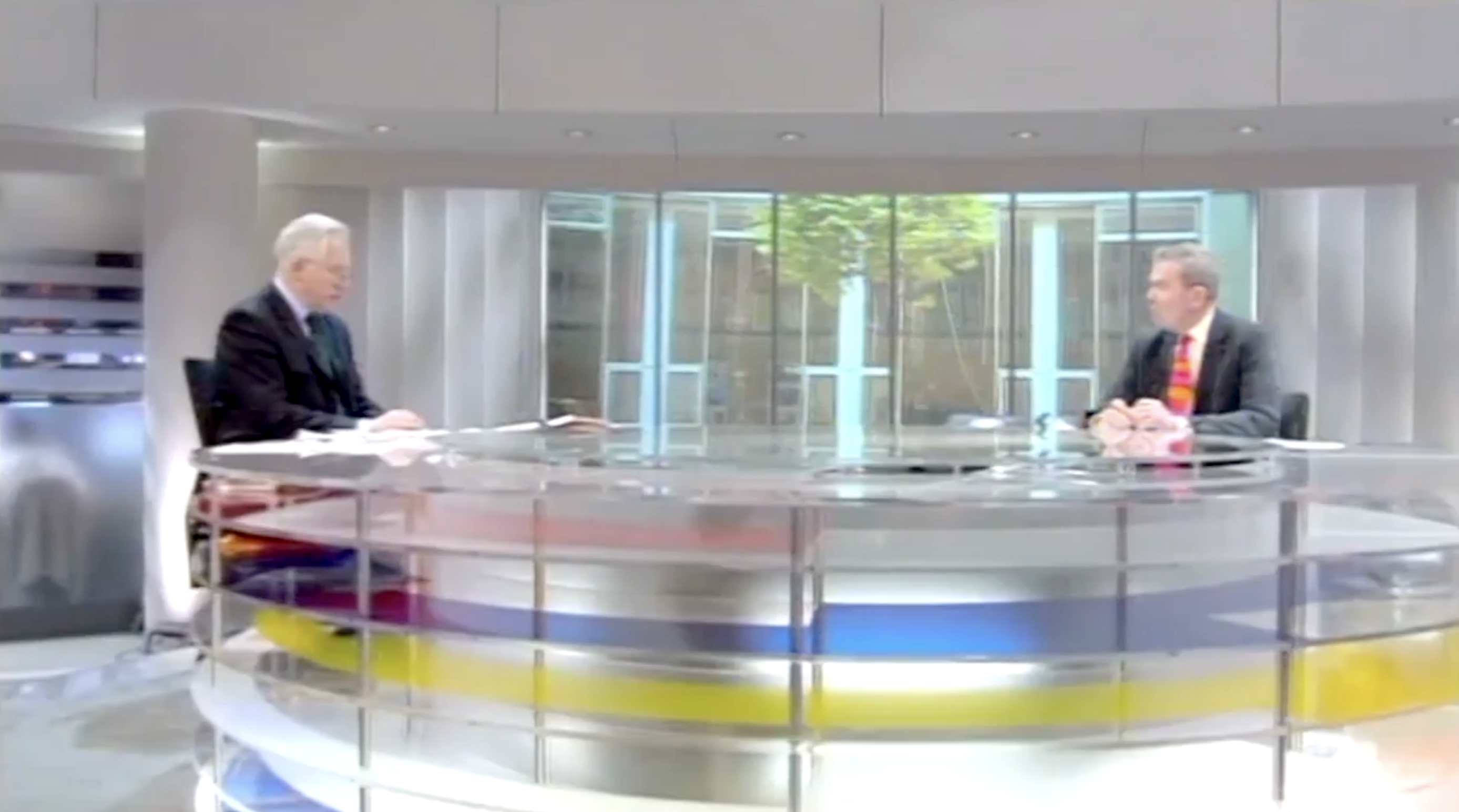
Buried inside the desk are what look like eight or nine angled monitors, permanently in Dimbleby’s eye-line, but visible to viewers only when the camera cuts to a very high angle.
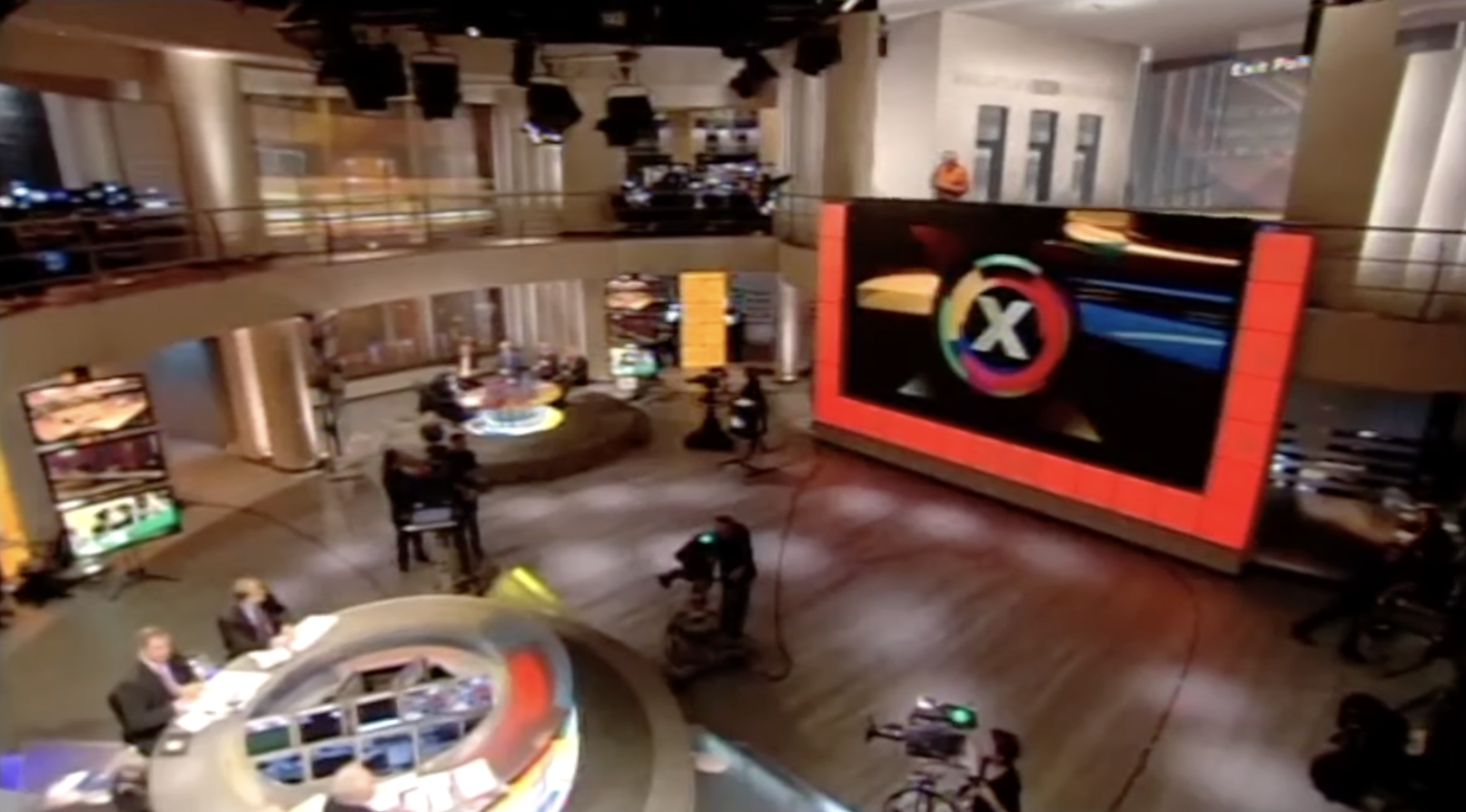
Jeremy Paxman’s coffee table makes a welcome return, while Fiona Bruce has been spared another stint in the faux-wine bar and instead reads news summaries from a simple table up on the balcony.
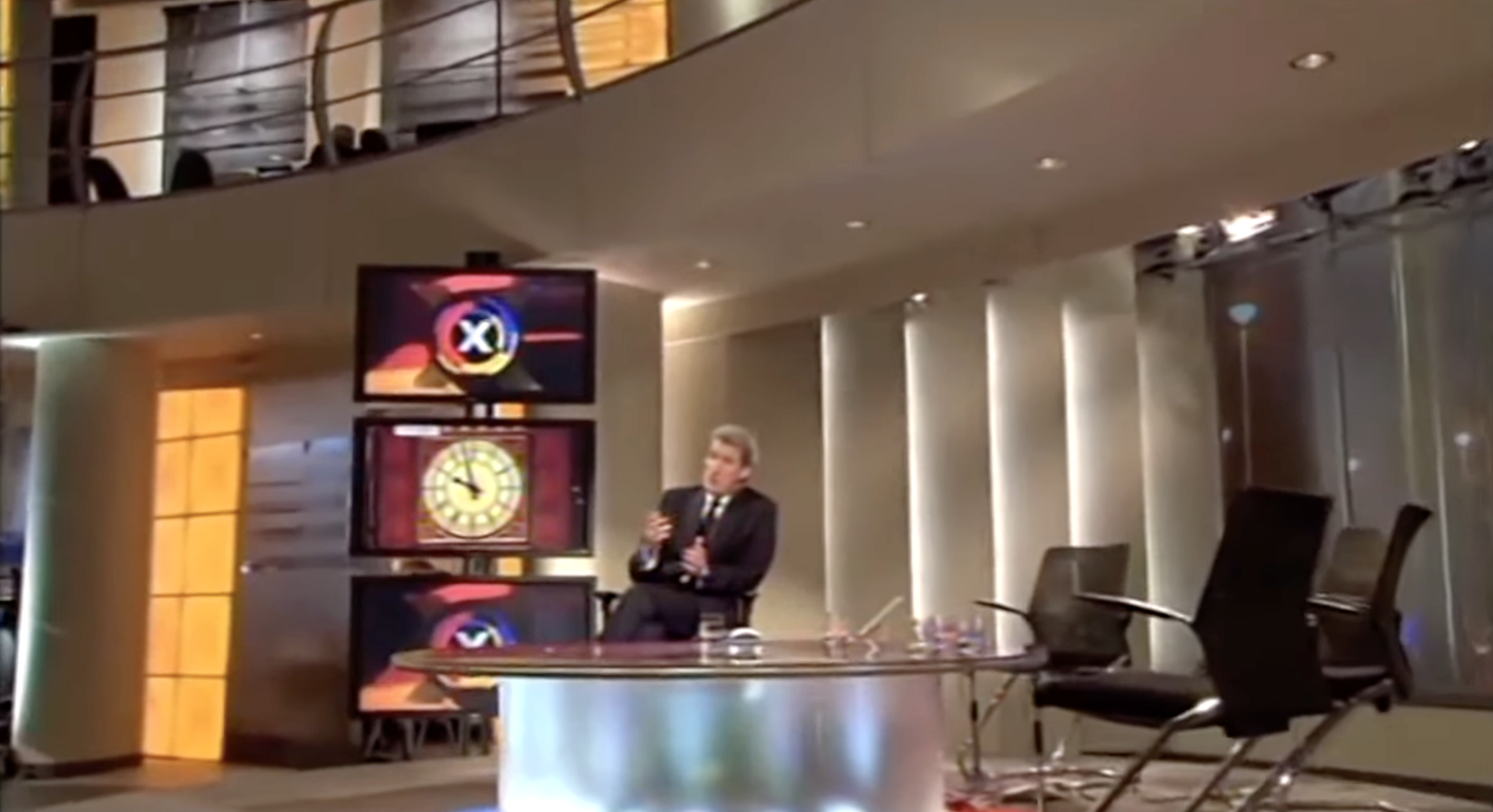
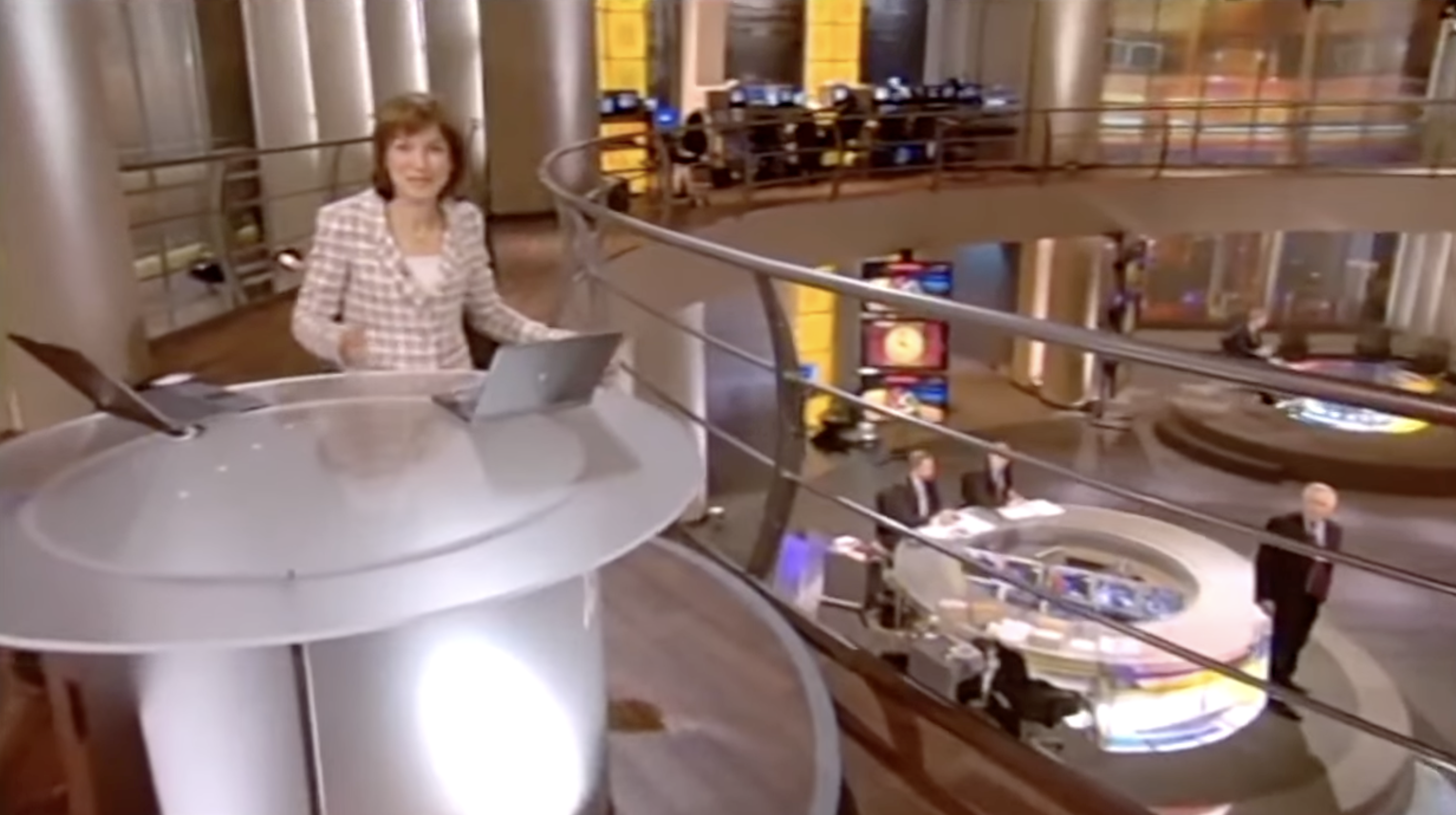
The amount of robustly-built, permanent-looking features, in particular the staircases and walkway, together with those windows showing the world outside, makes this election programme unique in BBC history. It is the only one to use the existing interior features of a building – part of the BBC news block on the Television Centre estate – rather than a set built from scratch in a studio.
Having served up so many visual treats – and curiosities – over more than four decades, it’s a shame Television Centre’s last general election in May 2010 was more of an agitated splutter than a confident clear-throated farewell.
Yes, we’re back inside Studio 1, where Richard Dimbleby and his cast of hundreds first shuffled across the floor in 1964, and yes, everything is big and bustling. But there’s been another change in approach. Intricacy and nuance are out. We’re now in an era where live television – of any kind, be it news, sport or entertainment – prioritises brash contrasts of colour and texture. Surfaces and hues must accordingly react aggressively with one another, rather than blend or co-exist quietly. Details and decoration are not as important as the combined visual impact; fixtures and fittings no longer need, and perhaps must no longer have, individual character or aesthetic distinction.
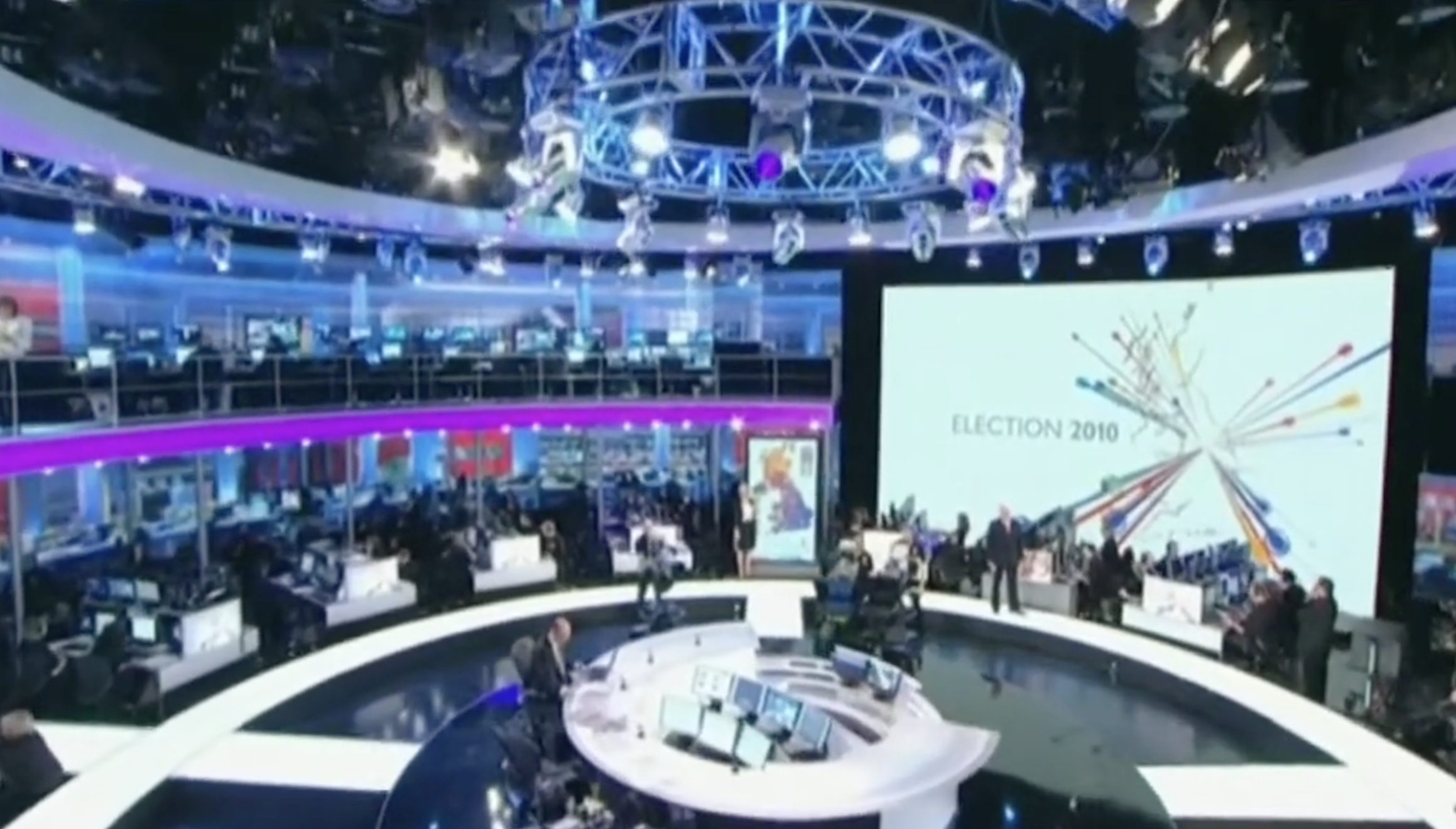
Here is a studio that feels like it has been conceived to make an assault on the senses and go on doing so, minute after minute, hour after hour. The designs and its execution seem intent on maximising a sort of inescapable digital sheen, or a suffocating blur of lustre. The presenters often look on screen as if they are overwhelmed by their environment, depersonalised among the dazzle and the polish. This is true even when the camera moves in closer, subjecting the viewer to the full glare of David Dimbleby’s unsightly heap of a desk.
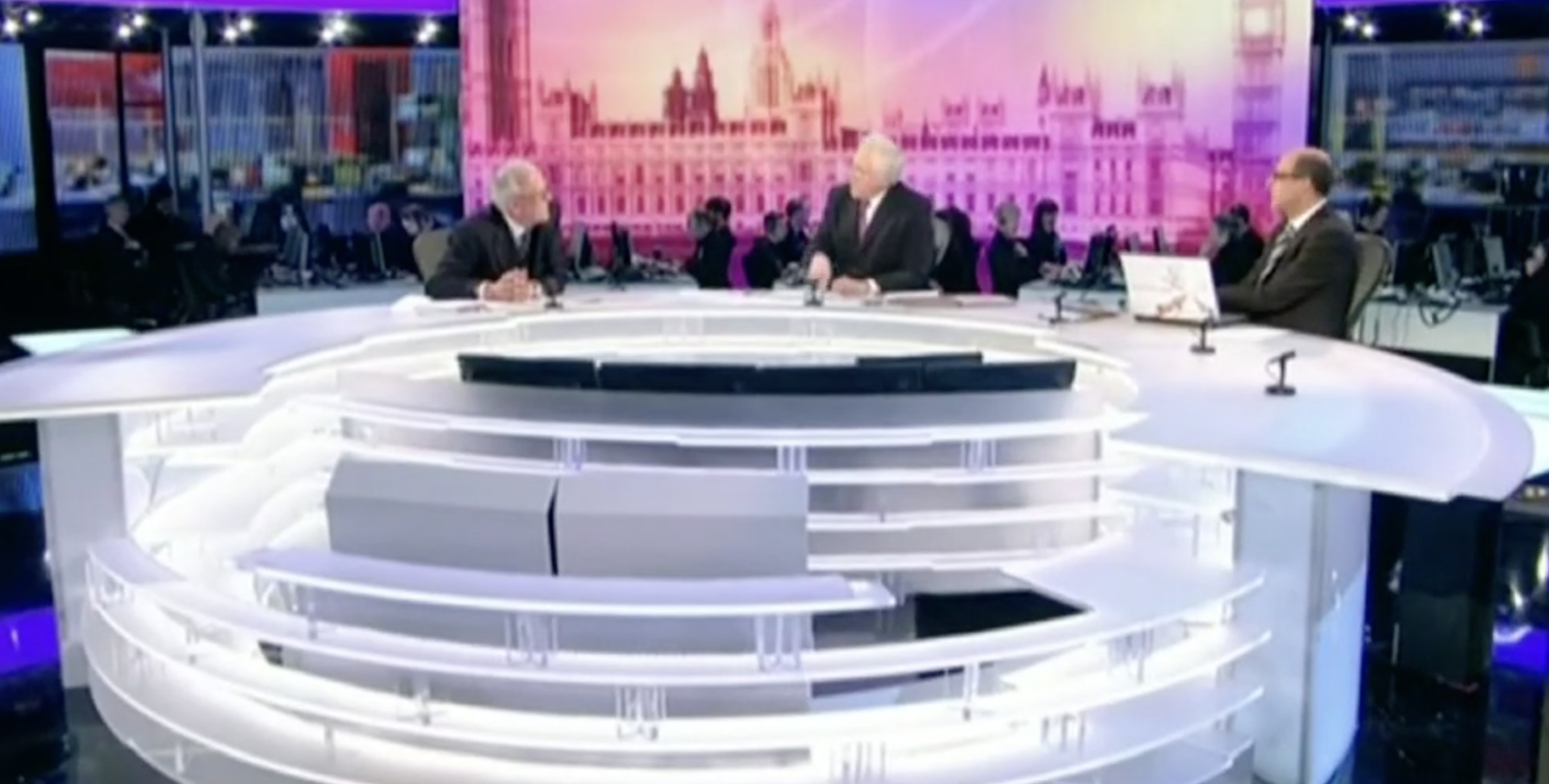
It all looks pin sharp in high-definition, which was perhaps part of the point. But it’s not a world in which you particularly want to spend much time.
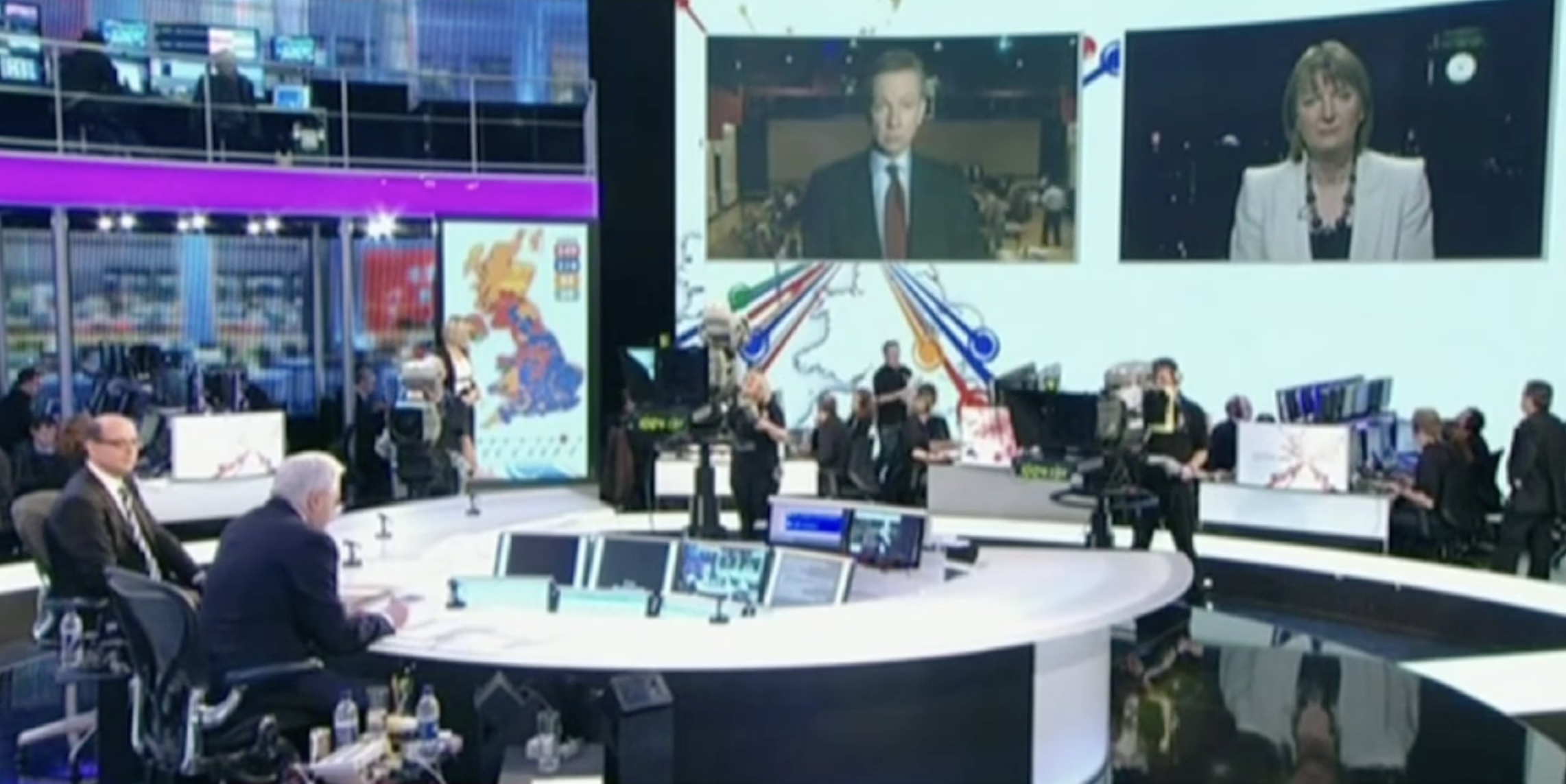
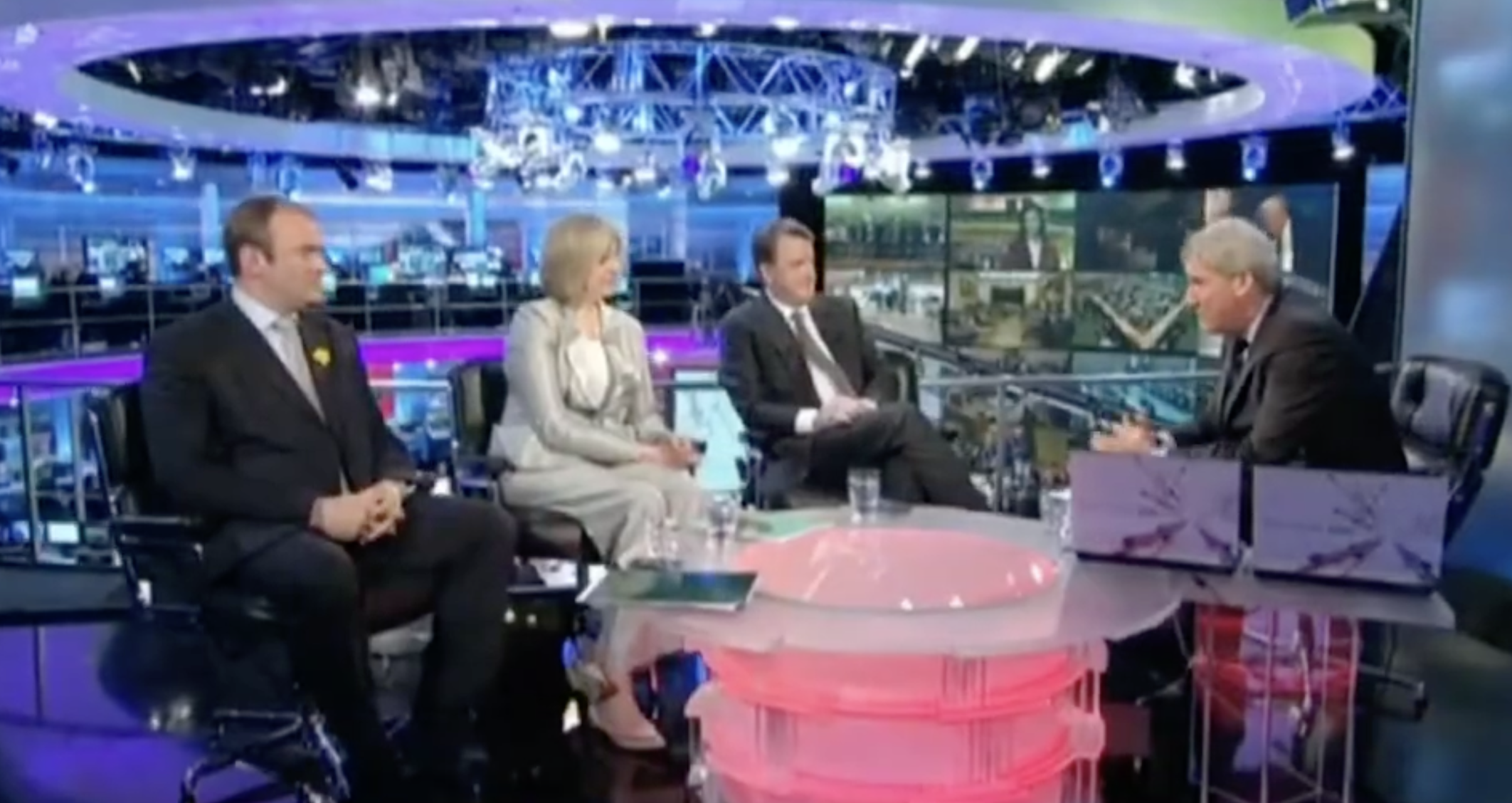
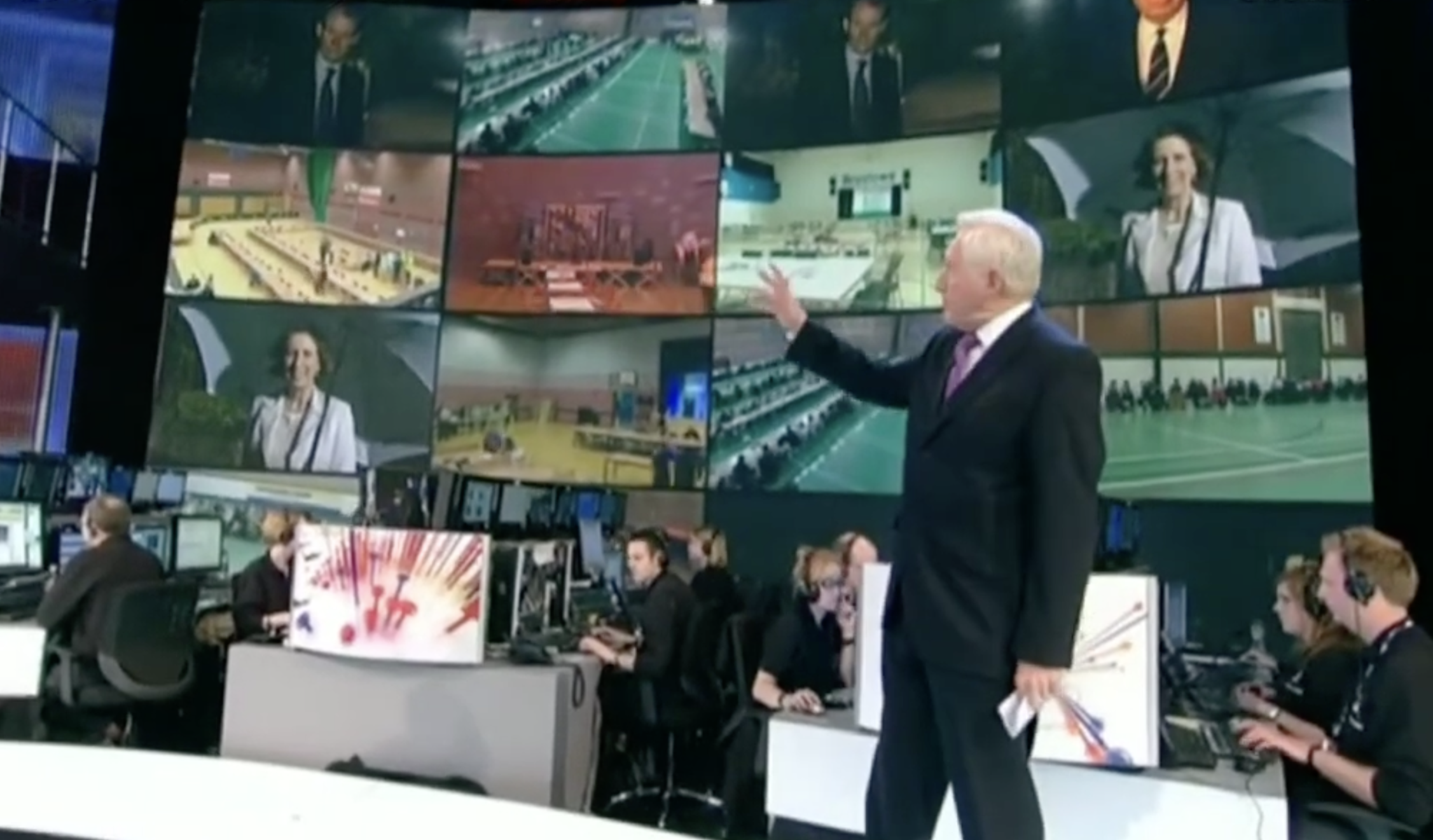
The same aesthetic and approach was carried forwards into the May 2015 and June 2017 election programmes, both of which came from the BBC’s Elstree studios, and which saw the 2015 set reused almost entirely in 2017, down to the same desk, lighting rigs, branding and chairs.
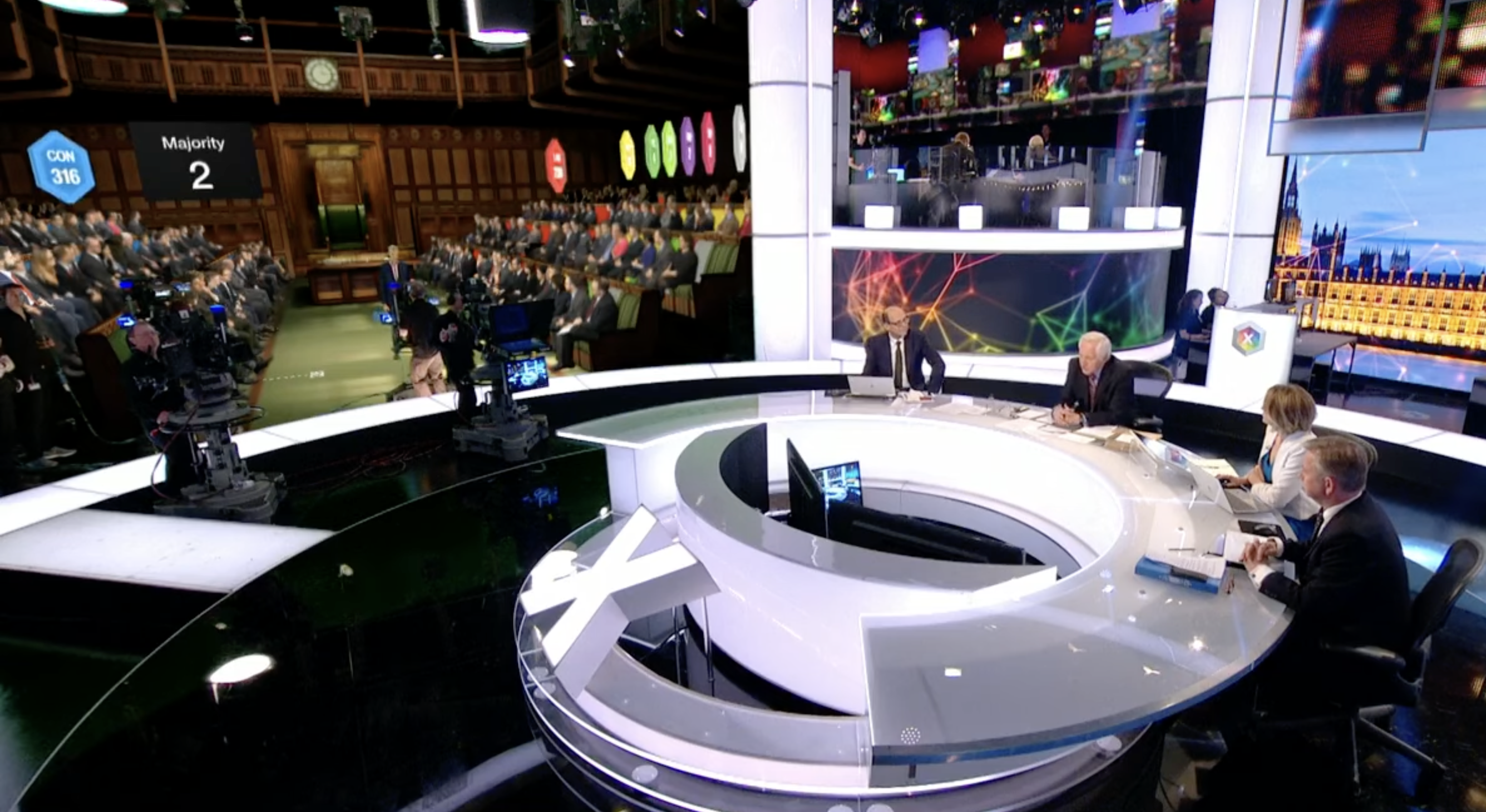
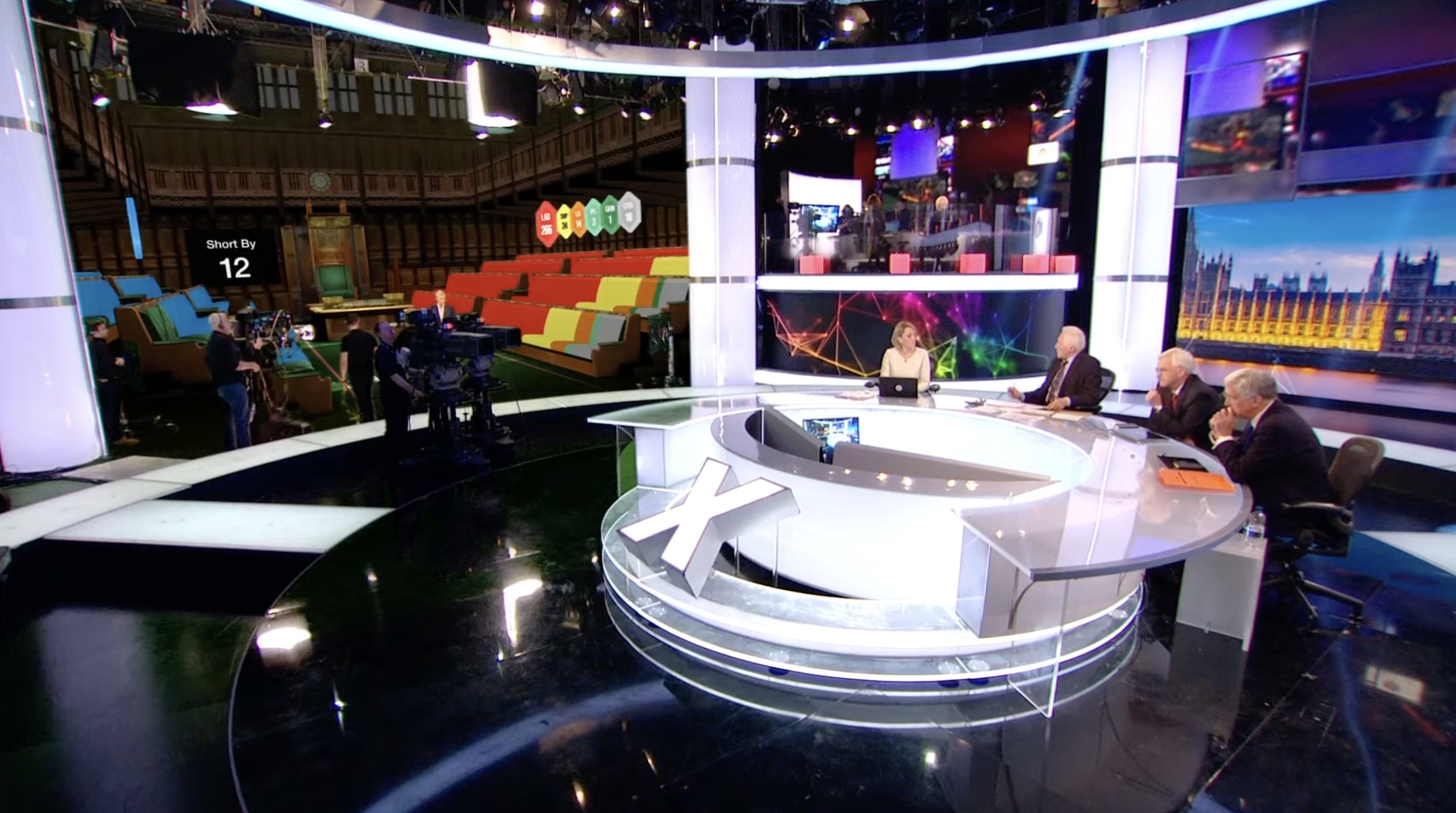
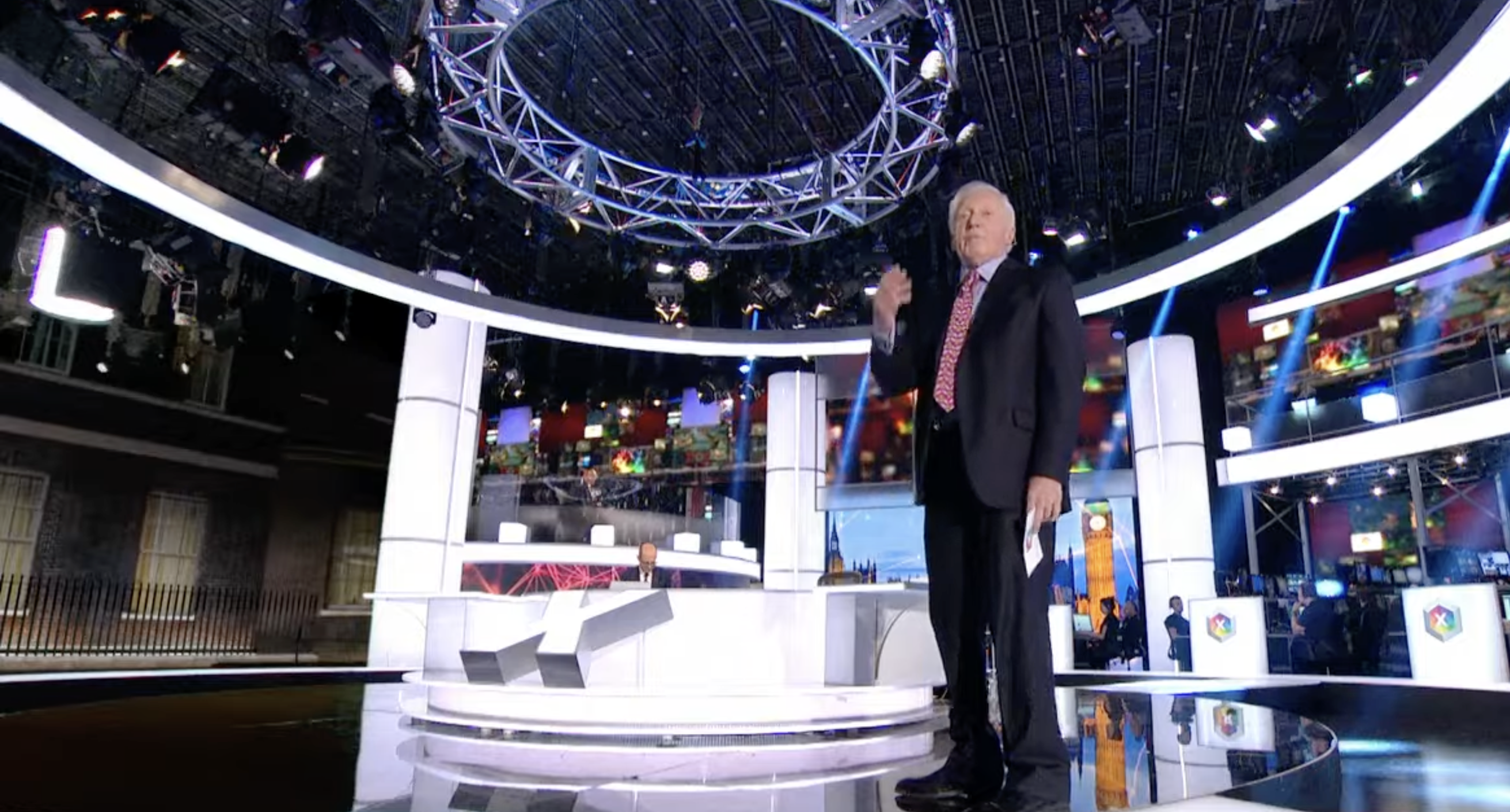
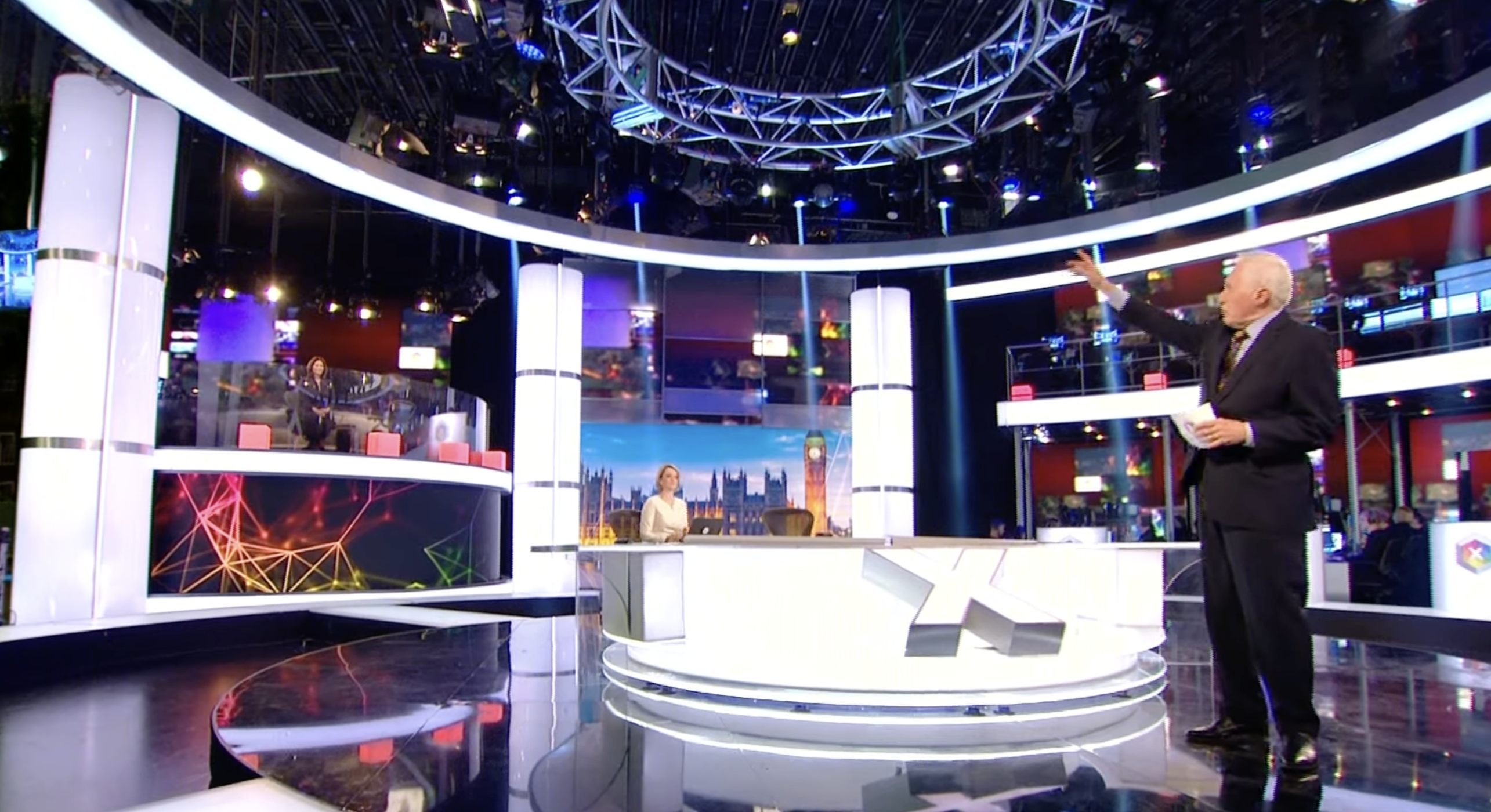
Top & bottom left: 2015; top & bottom right: 2017
You wonder what David Butler made of it all, when he appeared for a brief cameo towards the end of the 2015 coverage. His arrival was a firm but polite disturbance to the digital ether; a psephological echo from another age.
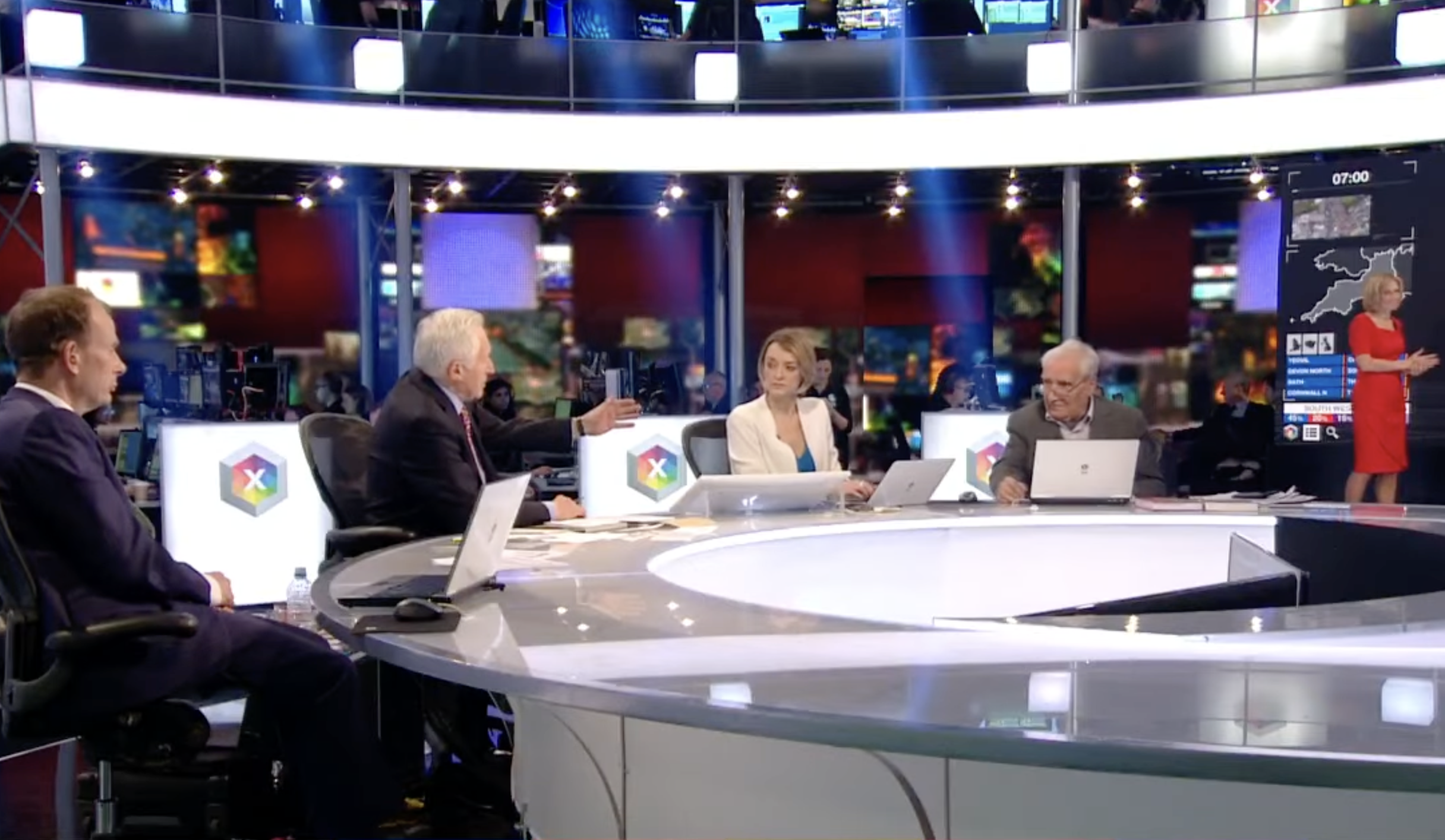
At least in 2015 and 2017 most of the BBC’s election team were together inside one location. By December 2019 this too had come to an end.
The operation splintered into separate pieces, with the main presenters in a small studio in Broadcasting House, looking lonely and isolated, while everyone else – Jeremy Vine, the result-checkers, the experts – beamed in from other locations.
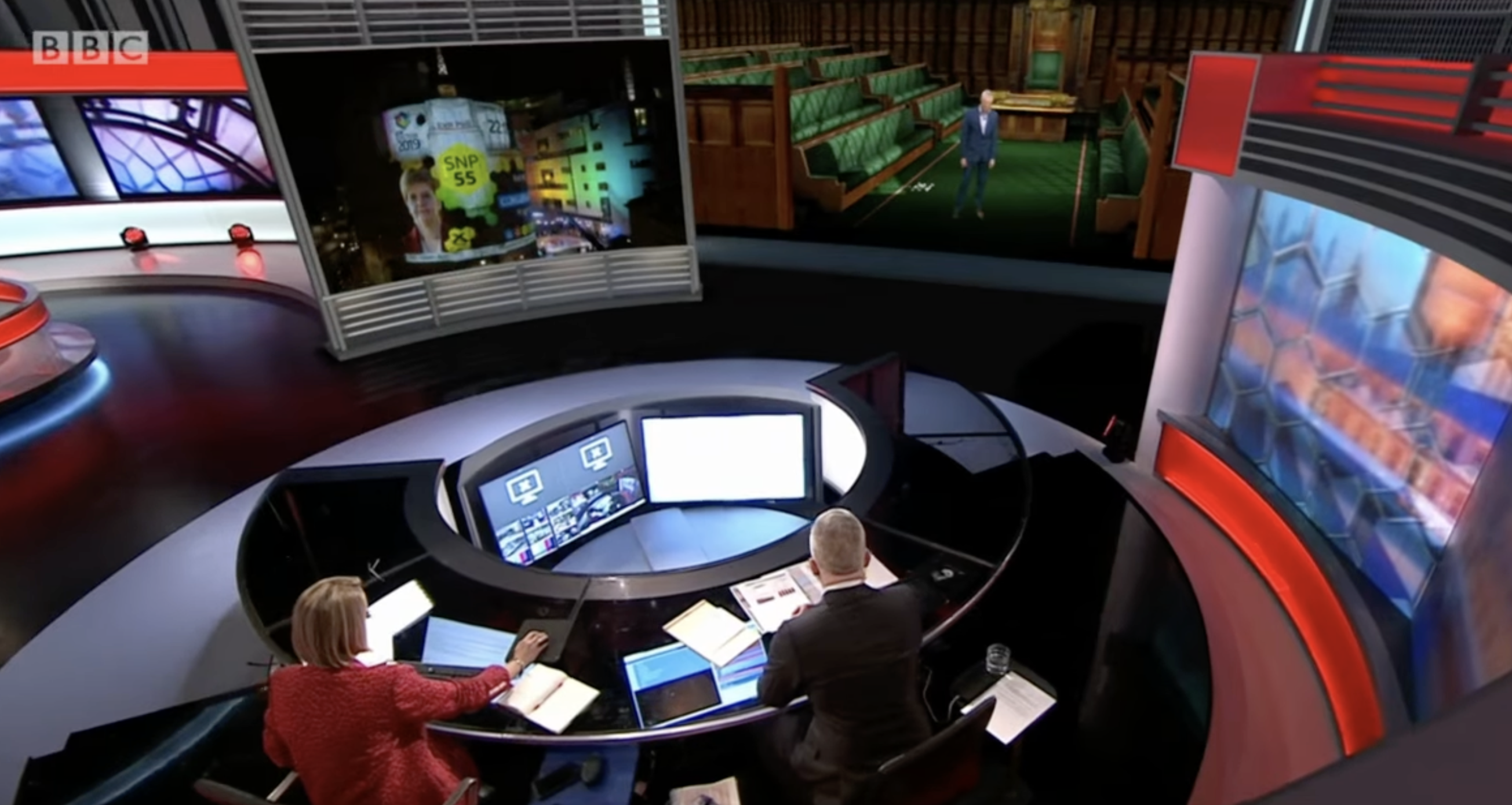
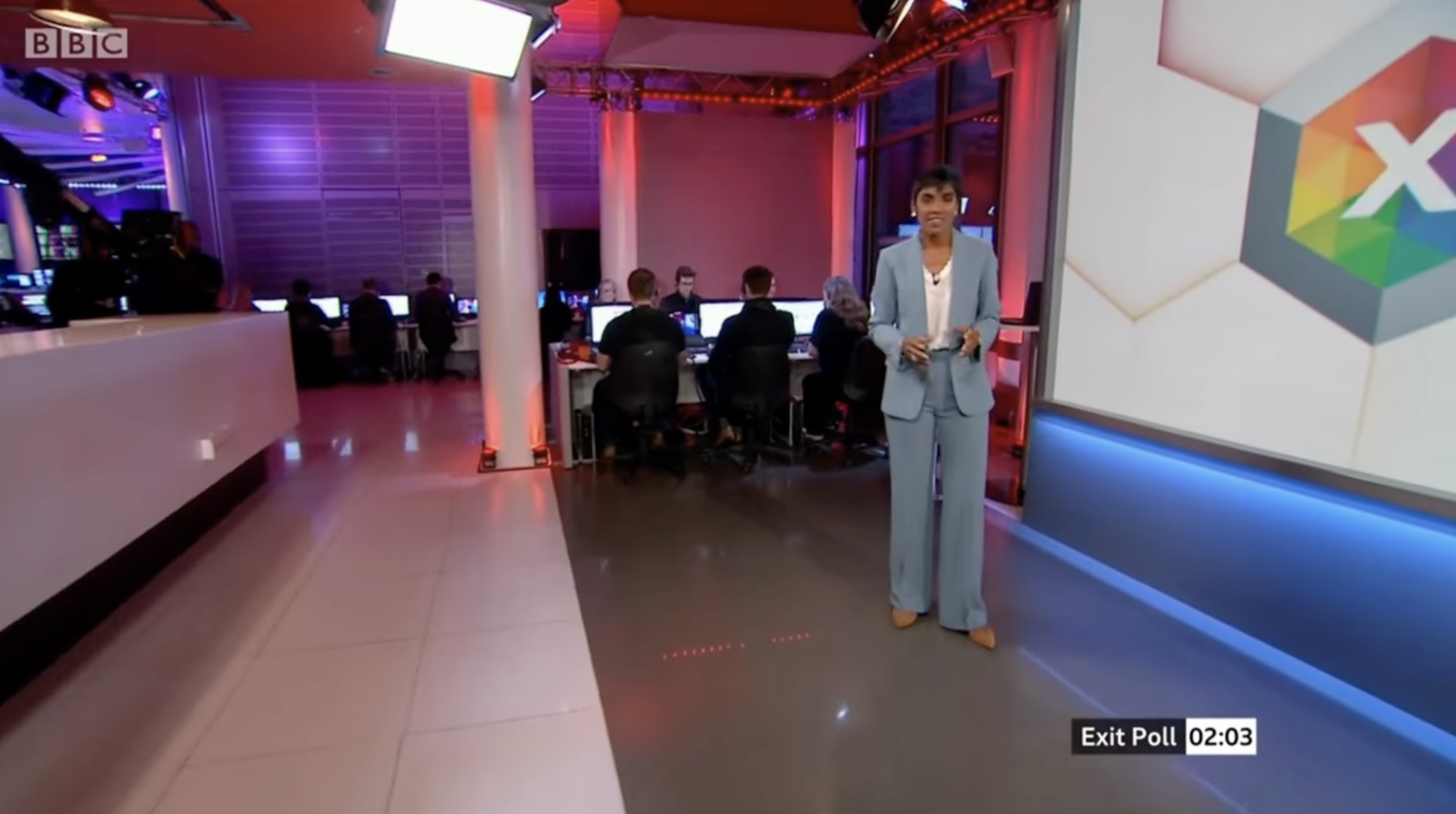
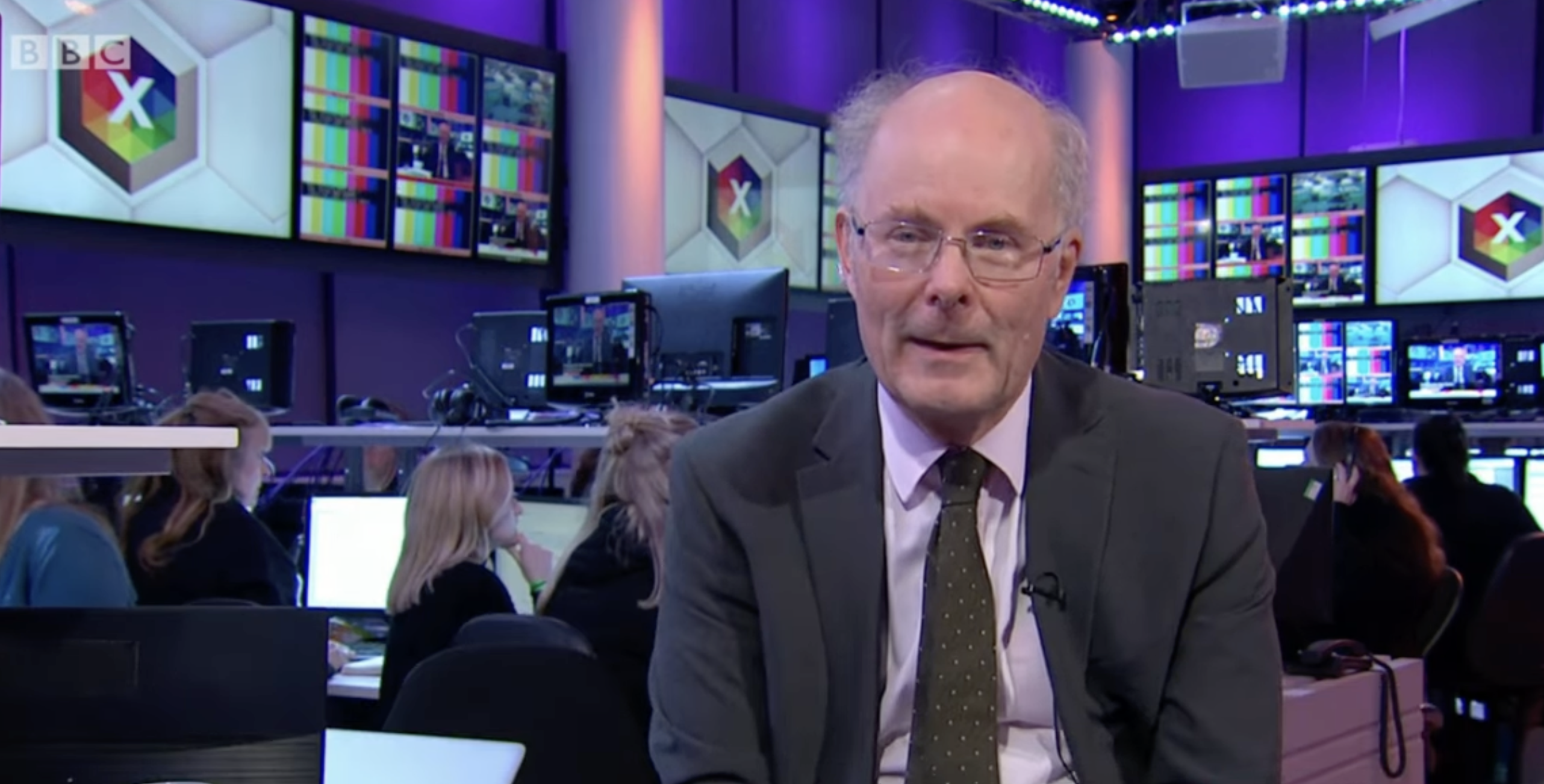
We’ve seen small election studios before, of course, but never one so devoid of a clear identity or dominant aesthetic. Even the downsized studios of 1983 and 1987 had bespoke colour schemes and co-ordinated furniture. Here is a location that neither attempts spectacle nor exploits anti-spectacle. This studio could be anywhere, reporting on anything.
Didn’t they know there was an election on?
*
And so to July 2024. Those observations about the 2024 coverage made at the start of this piece – the cramped studio, the absence of furnishings, the curiously-shaped desk with the presenters sitting a little too close together – now feel less of a surprise, though perhaps no less of a disappointment, when approached the long way round.
The choice of set, the organisation of the presentation, together with the look and feel of the coverage, all have much in common with the preceding election in 2019. That election, 2019, appears with hindsight to mark the start of a semi-permanent break from the template of previous decades. The decision to ditch one large studio in favour of a small central base, supported by a multitude of outside broadcasts, was repeated in 2024 and will probably be repeated again in 2029, when the next election is due. The era of huge studios, filled with stylish custom-made furniture and intricate carpentry, feels over. At least for the time being.
It won’t be like this forever. The past suggests as much. Things move in cycles. Over the past 70 years, election studios have swelled in size, shrunk, swelled again and shrunk again. But the past also suggests the cycles need time to turn. It took 19 years for the arc to curve downwards from the bright, wide-open spaces of the 2005 studio to the half-lit, half-computerised nowhere land of 2024. But it took almost as long – 18 years – for the arc to curve upwards, from the drab car showroom of 1987 to the pastoral expanse of 2005.
It was 17 years from the rich mix of pods, pulpits and eyries that was the 1970 studio, all the way down to 1987. Think also of the distance travelled – in technology, in presentation, in interior design – from the dusty nooks of Lime Grove in 1955 to the psephological fairground built in Studio 1 of Television Centre 15 years later.
It feels at the moment as if the idea of innovative and exciting election studio design has ended up in the same place as much of the furniture that filled all those innovative and exciting spaces: a huge bin. A bin that is so dark and huge that nobody dares peek inside to see if anything is worth retrieving.
Somebody will, though. They always do, if only when word goes out that the next election needs a new look, and the old look suddenly become fashionable again. There is nothing inevitable about how this story unfolds in the next 70 years – except that it will involve a desk, and a chair, and, with a bit of luck, a smartly-tailored banquette and stack of recessed monitors.

