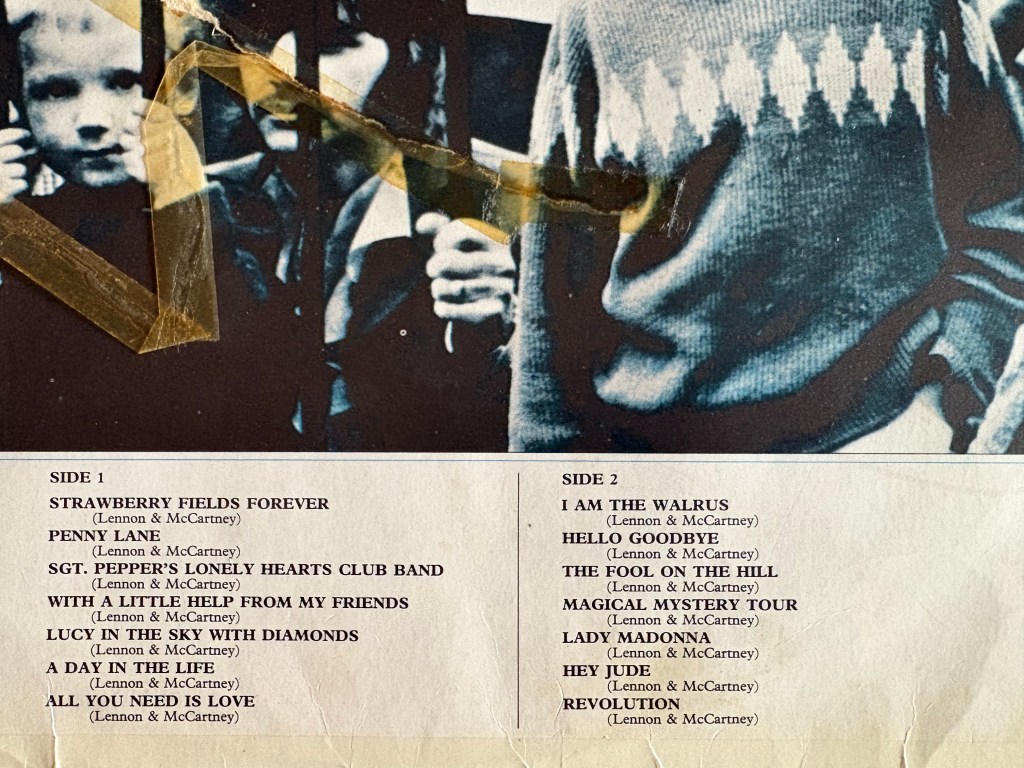
My parents bought a copy of The Beatles: 1967-1970 in summer 1973, a few months after it was released.
I was born in 1976 and during my early childhood the so-called ‘Blue Album’ was the only music by the Beatles in our house. This must have made my family something of an outlier. I’m sure the majority of UK households had more than just one Beatles record – a compilation at that – under their roof. It also meant my first knowledge of the group and of their songs was skewed completely towards the second half of their career. This remained the case for a long time. I heard and read about “marmalade skies” and “pictures of Chairman Mao”, even though I didn’t know what these things meant, many years before I first heard something as unambiguous as “Close your eyes and I’ll kiss you”.
My parents weren’t ignorant of popular music. They just didn’t like most of it. There were a handful of records by pop artists in the house – Simon & Garfunkel, Joni Mitchell, Peter Paul & Mary – but far more albums of classical material. Radios 1 and 2 were never played when I was growing up and nobody watched Top of the Pops. I had to discover pop music myself and this took a while. For the time being, the closest thing at hand for my infant school-age fingers – and the biggest attraction for my infant school-age ears and eyes – was 1967-1970.
The first time I heard the album was not when I played it myself, but instead when it was played to me – or rather, played at me. My mum put it on the turntable one day when I was very small, before I’d even started school, sat me down in front of the record player, gave me the sleeve to look at, and told me to listen.
I may have been exposed to Beatles music before this. A clip of the group performing a song might well have turned up during a television programme that my parents saw on their black-and-white Grundig set while I was in the same room being held, or fed, or half-asleep in a cot or high chair.
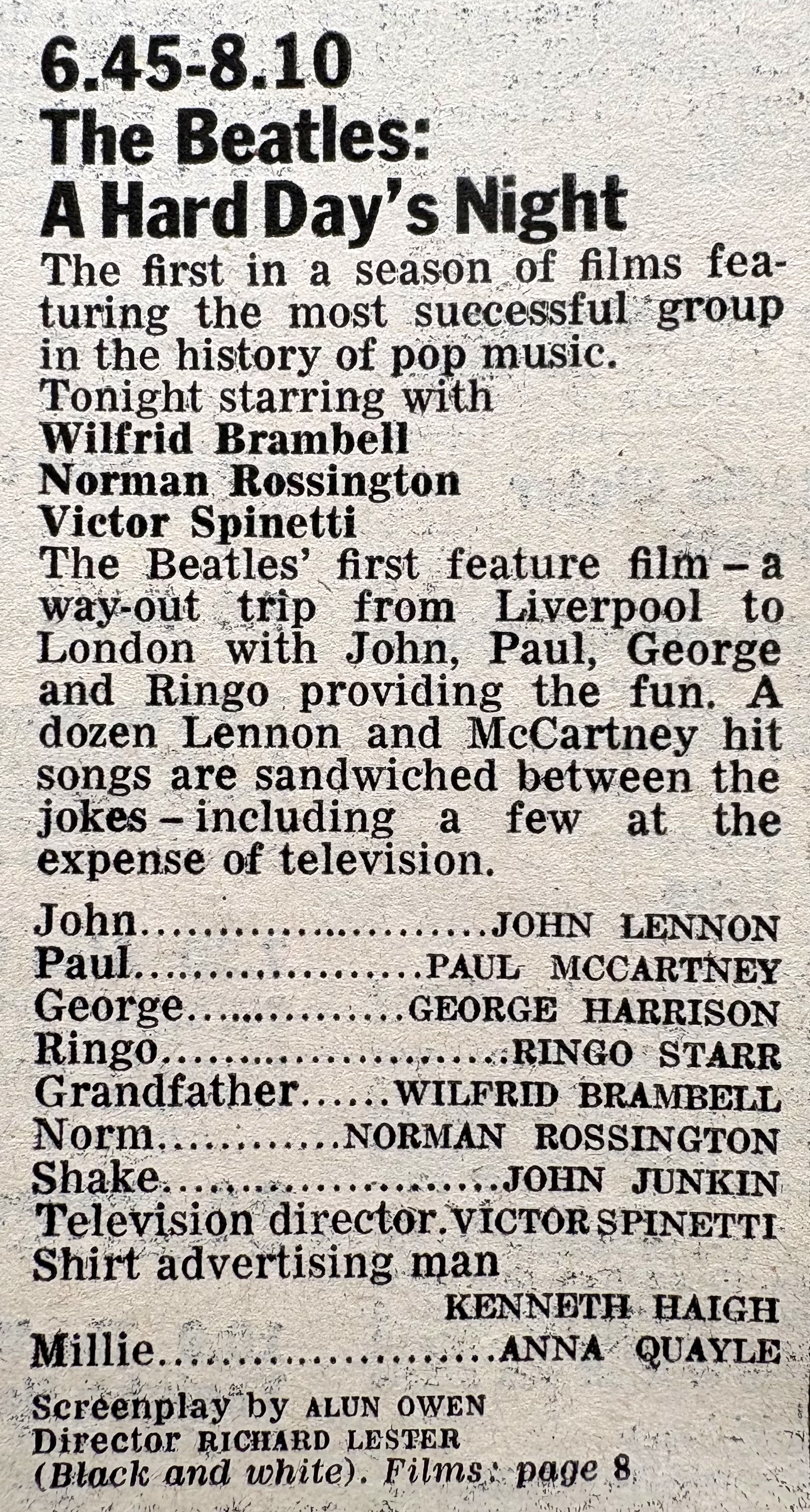
They may have watched the showing of A Hard Day’s Night on BBC1 at 6.45pm on 3 August 1976. I was six months old by this point, so I might have been in the room, eyes closed but ears open. My mum saw the film at the cinema at least twice when it was released in 1964 – once in the company of her own mother – so it’s possible she would have tuned in 12 years later to relive some teenage memories.
(My mum subscribed to the monthly Beatles Book fanzine for several years in the mid-1960s, though she told me had no idea what subsequently happened to the copies, much to her – and my – irritation.)
The film Help! was shown in the same time slot one week later on 10 August 1976, which might also have prompted my parents to tune in, again with me in earshot.
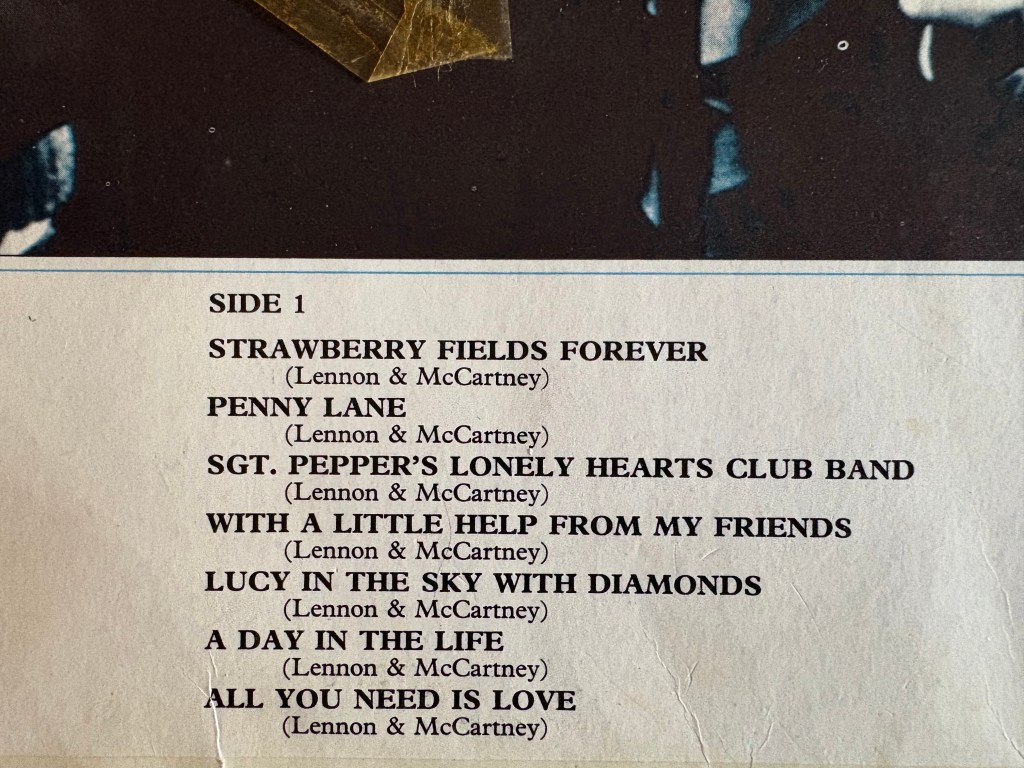
This is just speculation, however. Something of which I am certain is that before I started school I heard 1967-1970. As such, there’s a strong possibility that the first Beatles song I ever heard – or to be more precise, was made to hear, or directed to hear – was track one on side one of the ‘Blue Album’, Strawberry Fields Forever.
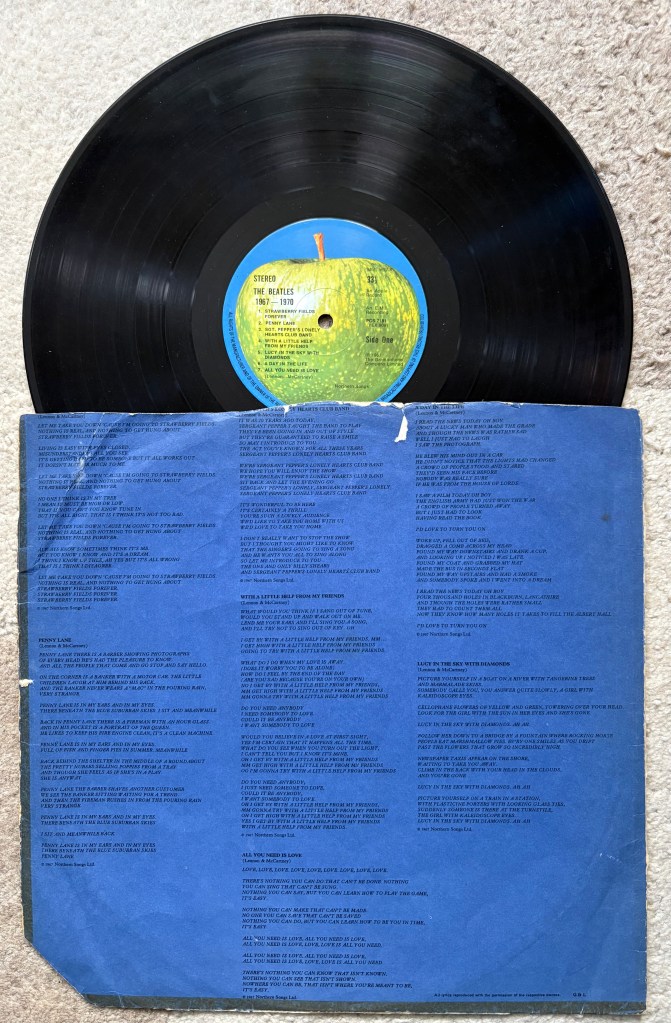
The moment of my passing from a world without the Beatles to one in which they were ever-present in my head was probably quite a prosaic occasion. I imagine my mum’s train of thought went: this is something Ian will enjoy hearing, it’ll keep him quiet, and he’ll probably appreciate looking at the pictures on the sleeve. She was correct on all three counts.
But I like to think there was something more to it than this. I like to think there was an unvoiced motivation inside my mum’s head, something less prosaic and more idealistic, signalling to her than now was the time for me to hear this music and to have my life changed for the better; to create an inflection point in my upbringing and share something precious with me that up to now she had kept to herself; to make a contribution towards my future happiness.
I have no idea if any of these things did run through her mind, consciously or otherwise. But I’m touched by the notion, the possibility, of her deciding on a very ordinary day to do something extraordinary and conclude: right, the time has come for Ian to hear, for the first time, the Beatles.
I’ve never been in the position she was in on that day. I’ve never had the privilege of being an onlooker, let alone the facilitator, when someone moves from a point in their life where the Beatles do not exist, to the point where they do. It must be quite something – those minutes, those seconds, just before the Rubicon is crossed, and then to witness the moment itself. Is it too hyperbolic to place it on a par with witnessing the first steps of a baby? I’ve never had the privilege of seeing this either, but were I able to arbitrate on some kind of universal ranking of milestones in a person’s life, I wouldn’t hesitate in placing near the top of the list the date on which you hear the Beatles for the first time.
Perhaps thankfully for me, and for the universe as a whole, nobody has offered me the role of such an arbiter and never will. But I wonder if my feelings on this subject are as a much of an outlier as the contents of my parents’ record collection. Someone’s initiation into the world of the Beatles probably only amounts to something worth remembering if it is distinctive or unusual enough to be remembered. And even then, it is only worth cherishing if the group becomes a cherished part of that someone and their world.
Yet there can be few people on the planet who go through their entire life without ever encountering the sound of the Beatles. The moment of hearing the group for the first time must be one of the most common characteristics of human existence. It’s not as certain as death and taxes, but it’s close behind. In his book Revolution in the Head, Ian MacDonald calls the track Revolution 9 “the world’s most widely distributed avant-garde artefact.” Hearing the Beatles for the first time must be the world’s most widely distributed pop-cultural experience.
The way people assimilate the Beatles into their lives feels like it has been through a number of phases since the band broke up in 1970. First came the post-split hangover. This is when an older generation, struggling to come to terms with the band’s demise, played their Beatles records to a younger generation, partly to stoke memories of the previous decade, partly almost to will the group back into existence. All the Beatles were alive; rumours of a reunion circulated every few months; Beatles records were still everywhere in the shops – especially in 1976, when Parlophone reissued a barrowload of singles and there was a week in April when the group filled six places in the UK top 40. The dying strains of the final chord of The End, on side two of Abbey Road, somehow managed to resonate for an entire 10 years.
There was then an interregnum lasting approximately from 1980 to 1987 when the generation that first heard the band in the 1970s turned their ears to other things, while the generation above them quietly moved their Beatles records to the back of their collection. Then the albums were issued for the first time on CD in 1987, Paul McCartney did his world tour, George Harrison seemed happy to be famous again, and assimilating the Beatles seemed almost to become a question of lifestyle choice as much as musical taste.
The focus tilted back towards the songs from 1995 onwards, thanks to the Anthology project and the endless namechecking by the Gallagher brothers. This gave way to the heritage industry years: the 1 greatest hits album, the Cirque du Soleil show, the 2009 reissues. Then from 2015 came the digital streaming years, and finally, most recently, the flog-em-anything years, a period that looks set to run and run.
It’s easier than it’s ever been to hear Beatles songs for the first time. Whether you’re hearing the original mix of those songs, or the correct mix, or the best mix… that’s where things get difficult for someone born in the 1970s, who boggles at how many iterations of Strawberry Fields Forever now exist and who wonders which will best recreate the sound he’s carried in his head since his mum first played him the song around 50 years ago.
My parents’ generation discovered the Beatles’ music in lockstep with the songs’ creation. There are a dwindling number of people left alive who heard the group for the first time when the group themselves released their first single or played their first session for BBC radio or appeared for the first time on Top of the Pops. That minority decreases with each passing day. The majority of us – an increasingly proportionate majority – had their first exposure to the band in the form of a song dating from any point in their career, and at a point in time somewhere in the ever-lengthening period since they broke up. Imagine if your first taste of the Beatles was something as tedious as I Want You (She’s So Heavy), as cloying as It’s Only Love, or as ghastly as Piggies. What must you have thought?
The order in which someone hears and goes on hearing the Beatles’ music must shape their opinion towards and appreciation of the band. It certainly did for me. The primary school-age me never wondered why my parents had a copy of 1967-1970 but not 1962-1966. I’m not sure I even knew there was a 1962-1966. There was more than enough to enjoy on 1967-1970 and for a while this was the totality of my knowledge of the band. But I must have assimilated other songs by other means, for by the time I started secondary school in 1987 I was familiar with Beatles material that wasn’t on 1967-1970, even though there were still no other Beatles records in the house. How was this?
I’m pretty sure I first encountered Yellow Submarine when I performed it as a member of my primary school recorder group. School choirs and musical ensembles must surely be a gateway to Beatles songs for most people. There can’t be many who haven’t at some point in their life taken part in an assembly or end-of-term production that has involved singing, acting out or dancing to some kind of Beatles number. As you read this, somewhere in the world Yellow Submarine and Octopus’s Garden are being performed by groups of schoolchildren whose shaky pitch and loose sense of timing are more than offset by their grinning eyes and raucous enthusiasm.
I probably first heard When I’m Sixty-Four not in its original form but as an instrumental cover version, when it was used as the signature tune for BBC TV’s Points of View. The same goes – I think – for Ticket to Ride, which for a while I associated only with the version that appeared in the 1981 eponymous BBC travel series presented by Keith Chegwin and Maggie Philbin. Nowhere Man was in a tuition book I used when I was learning to play the piano. In My Life was in there too. And so many people have covered Yesterday in so many forms and for so many reasons that I must have absorbed the tune by the age of five, simply by virtue of being alive.
All of these encounters involved only the music, never the words. I got to know the melodies of many Beatles songs long before I got to know their respective lyrics. I then got to know of the existence of even more Beatles songs before I got to hear either their music or their words. At some point in the mid-1980s I borrowed a book from the town library about the history of classical music. In the final chapter the author veered unexpectedly into pop and mentioned Eleanor Rigby and how the song was “groundbreaking” in its use of a string octet. The next paragraph used words like “elegiac” and “funereal”. Well, when I eventually heard Eleanor Rigby, I didn’t think George Martin’s string arrangement sounded elegiac or funereal at all. The book had led me to expect a slow, mournful ballad – not a pacy, brittle, almost angry piece of music.
This jolted me into action and I began filling in the gaps in my knowledge of the group. But I was still working backwards. By now it was the late 1980s and the reissued albums were readily available in the shops, on both CD and cassette. I couldn’t afford to buy them all at once, so I started with the era with which I was most familiar: the late 1960s. Then in 1989 I bought and read and endlessly re-read Mark Lewisohn’s Complete Beatles Recording Sessions. I now knew about every song the group had ever taped, but I still hadn’t heard these songs with my own ears. Such was the price of albums, and such were the competing priorities on my time and money, that it wasn’t until the mid-1990s that I finally completed my collection with the album Please Please Me.
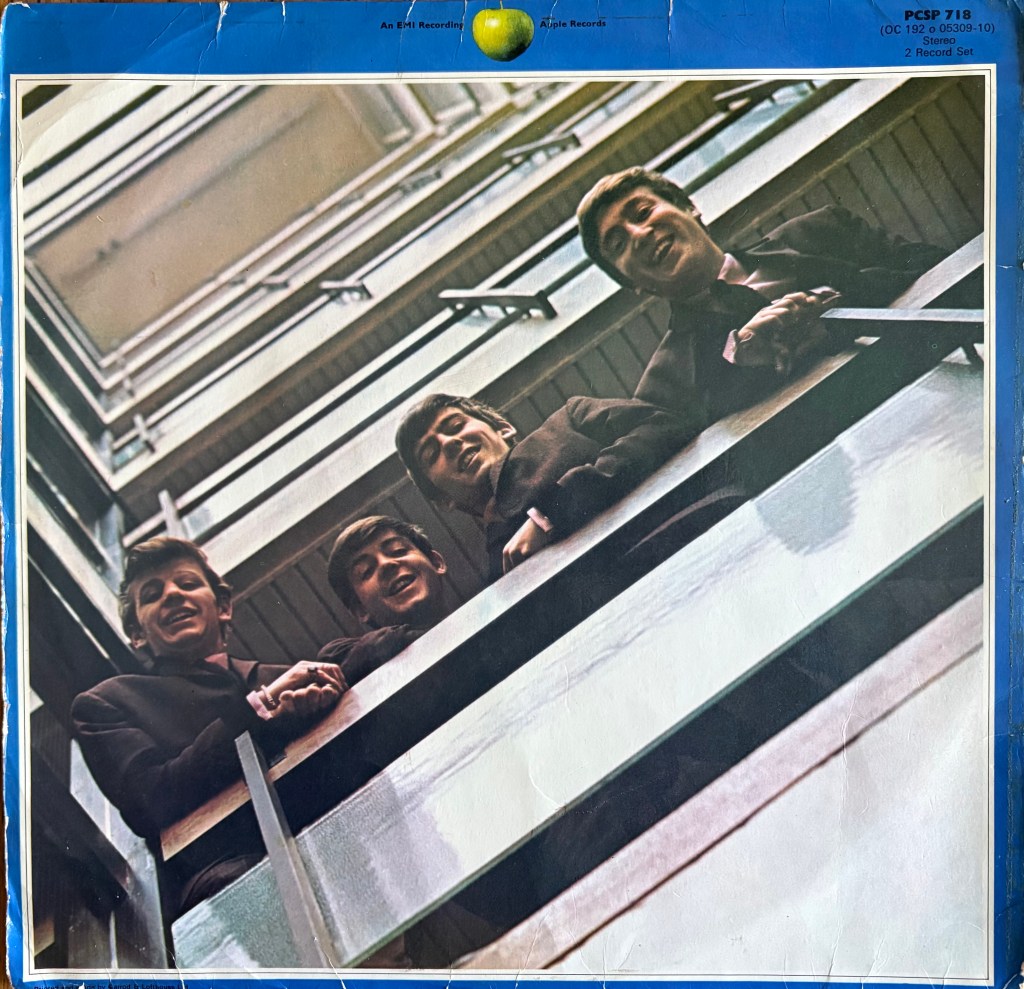
So it was that a gap of nearly 20 years spanned the moment a recording was first played to me of the Beatles’ last single, The Long and Winding Road (the final track on 1967-1970) and the moment I first played to myself a recording of the Beatles’ first single, Love Me Do.
Such a protracted and convoluted story sounds, when told in the context of the music industry of today, like something that ought to date from a time and a world much longer ago than a few decades. There is now no reason – no excuse – for not playing to yourself any Beatles song from any point in their career. But that is how it unfolded for me, and the protracted and convoluted way in which it unfolded has shaped my relationship with the band and their work. I have an attachment to the songs on 1967-1970 that is different from my attachment to any other Beatles material. This must be to do with the circumstances in which I first heard them. Songs implanted in your brain before you even start school, at a point in your life where you are absorbing sights and sounds unmediated to a degree that is never again possible, leave an imprint that is unique.
So yes, to this day I cannot hear that descending Mellotron phrase in the opening bars of Strawberry Fields Forever without feeling a shiver of wonder. The same goes for the way John Lennon’s voice sounds in the song – so deep and languid; and for the rich assortment and multiple combinations of instruments, particularly in the section where all you hear is Lennon’s vocal, the cellos and those other-worldly backwards cymbals; and for the point in the track where everything seems to smear sideways into a parallel sonic reality (the point at which, I learned first from Mark Lewisohn’s book, two different takes of the song were edited together).
I was absolutely enchanted by the sounds on this and the rest of 1967-1970. I loved the melodies and the variety of noises. It seemed to contain an infinite number of pleasures. I was particularly captivated by the puzzles. Why did some songs take ages to fade out – I Am The Walrus, Hey Jude – or segue directly into the next one, or, in the case of Strawberry Fields Forever, fade away then come back? I was frightened by the screaming at the end of Revolution. I loved the piccolo trumpet on Penny Lane and would sing along with its solo. I wasn’t sure who sang Back in the USSR (I didn’t realise it was McCartney doing his “rocker” voice) but I liked it. I thought Old Brown Shoe sounded awful – my young ears even then discerning how murky and badly-mixed is the production. My parents’ turntable made the opening piano chords on The Fool on the Hill sound fragile and quavery, likewise the opening guitar notes of Here Comes the Sun. This is how I still hear them in head and I’m surprised and unsettled when I hear them now and they are not as I remember.
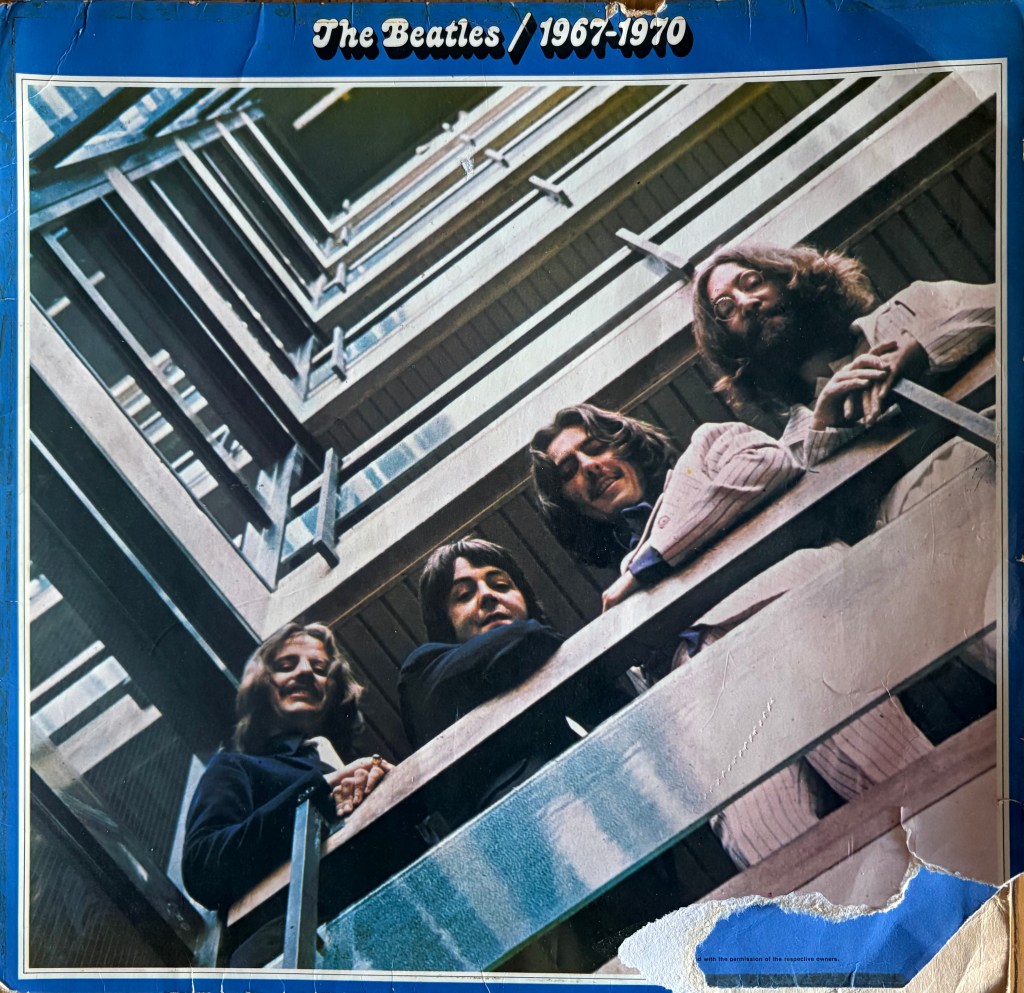
And it wasn’t just the songs. This was an album I absorbed visually as well as aurally. I would look at the picture on the front of the outer sleeve and be intrigued and a bit repulsed by all that long hair and those bushy beards. How did they manage to eat their food and brush their teeth? And how could it be the same band on the back of the sleeve? The bearded long-hairs looked most inelegant.
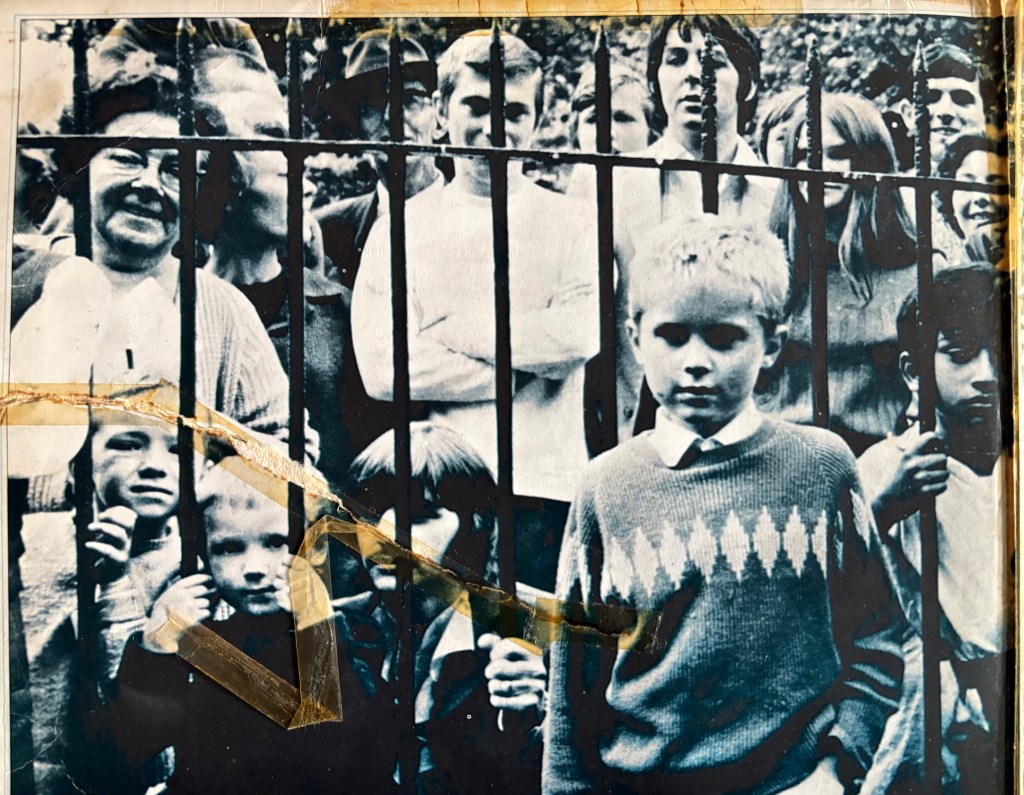
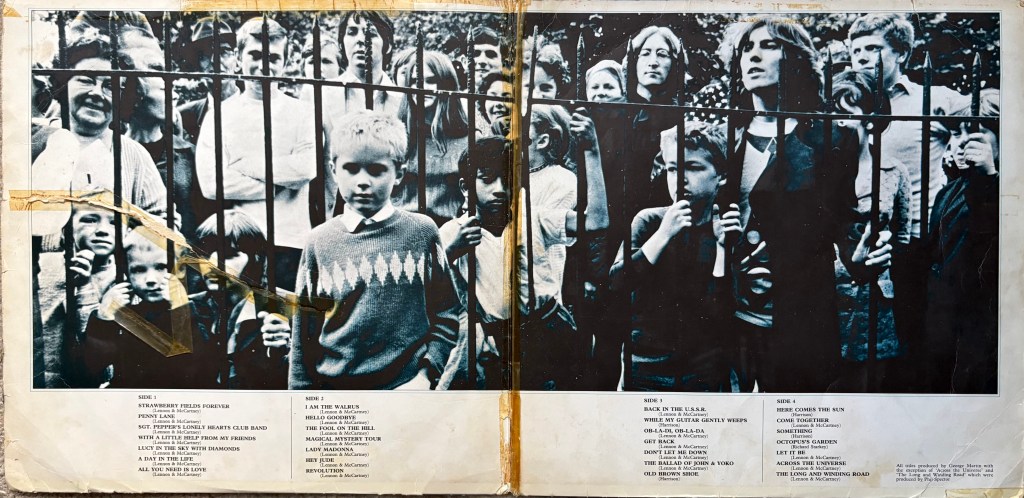
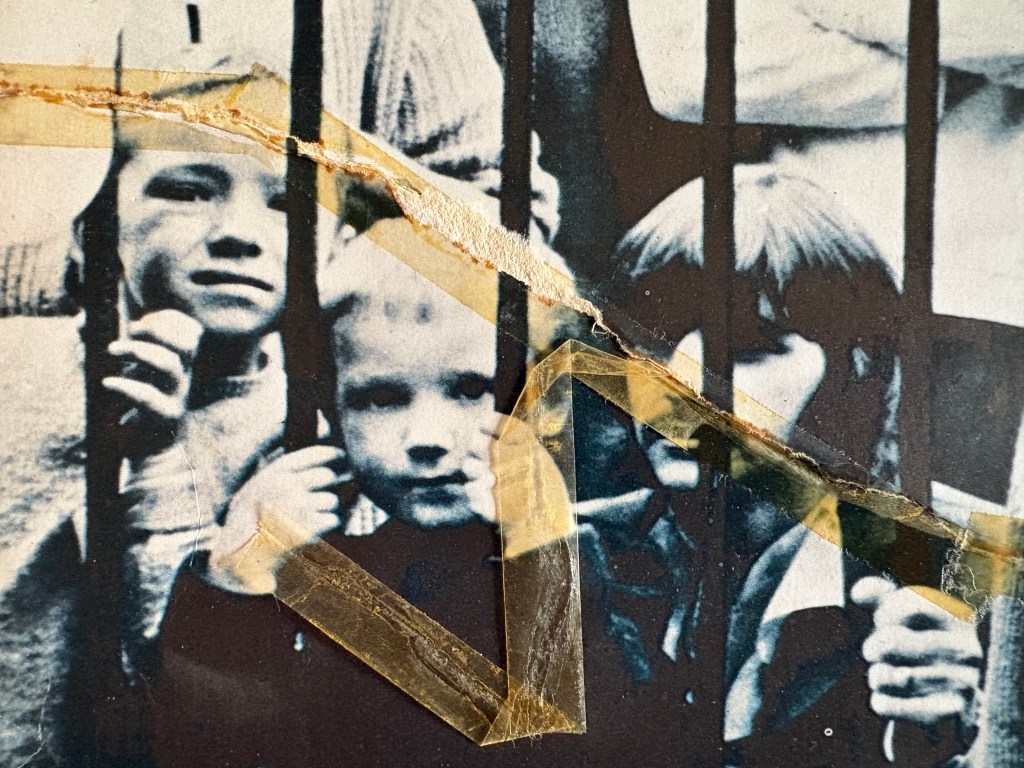
I studied the picture on the gatefold inner sleeve for hours. I couldn’t take my eyes off it. Who were all those people? Who was that boy and why was he standing in front of the railings? The vacant, becalmed expression on his face, coupled with his shadowy eyes, made him look like a space alien. Had he imprisoned all the others in a pen? If so, why were so many of them smiling?
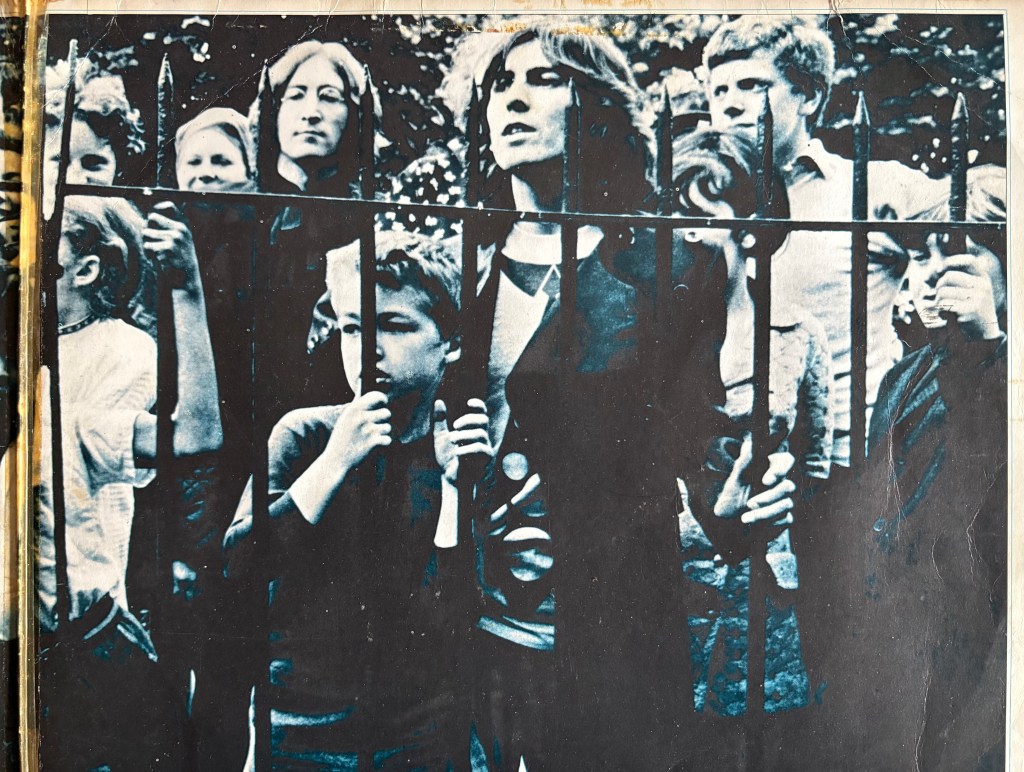
Some of them looked like people I knew or people I would see when I accompanied my mum on the weekly shop in Safeway. It was some time before I realised the Beatles were among them. I could never find Ringo.
A few years ago my parents passed their copy of 1967-1970 to me. The album is not in the best condition now. Much crusty Sellotape is in evidence. I still have trouble finding Ringo. But its frayed cover and patched-up sleeves have prompted new memories and associations, which have become as precious as those sustained by the songs themselves. It is something that connects the me of today with the me of 50 years ago, and there aren’t many of those connections left anymore.

