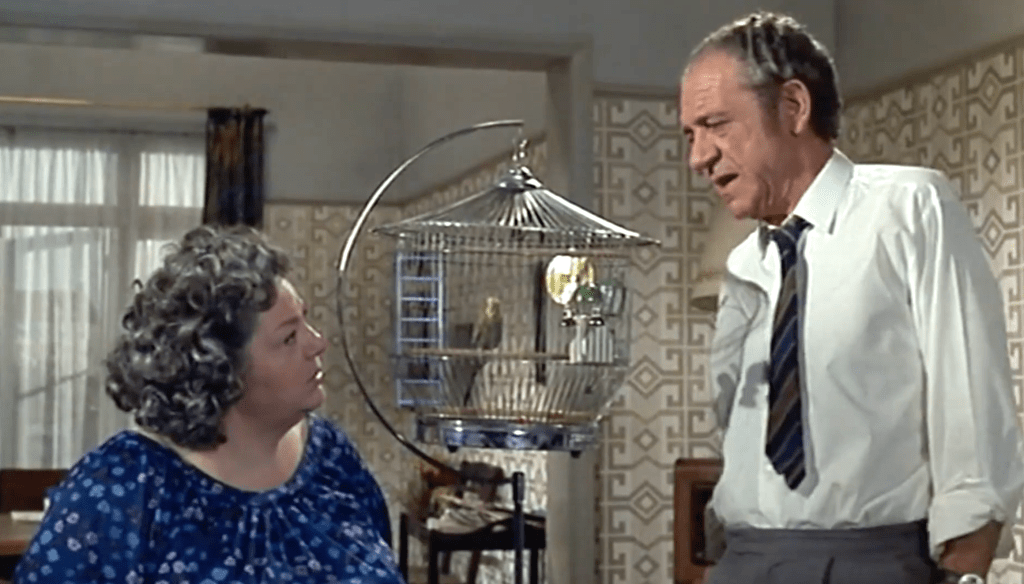
Jacques, James and Joey while away the afternoon in Carry On At Your Convenience
In the Carry On universe, time flies with the insouciance of a budgie that knows how to predict the winner of the three o’clock at Newmarket.
It might carve an arc through months in a handful of minutes, or it may spend half the length of a film following the events of a single day.
Time also has an elasticity that is all-too absent from the lining of Emile Prevert’s running shorts in Carry On Emmannuelle. It can expand (slide whistle sound effect) or contract (ditto) as circumstances demand – be those circumstances to do with plot, character, budget or, most demanding of all, laughs. It can handle a voyage halfway around the world or a trip down the pub. It can roam across centuries or restrict itself to the events of last weekend.
On some occasions in this universe, adherence to or even acknowledgment of what could be called “calendar time” is less important than letting jokes and storylines unfold at their own tempo. On other occasions the reverse is true, and calendar time becomes the dominant motor for both humour and action. The franchise can accommodate all horological scenarios, without its fabric ever fraying or snapping, let alone “hang down in pleats” like poor Monsieur Prevert’s derriere.
Once you start noticing the passage of time in Carry On films, it’s hard to let it go unnoticed. “Six days we’ve been here,” announces an exasperated Sid Boggle two-thirds of the way through Carry On Camping – but didn’t Sid and his friends arrive at the Paradise campsite just the other night? It’s more than 45 minutes into Carry On Matron, an awful lot seems to have happened… and is it really still day one of the plot? Did Desmond Simpkins and his fellow agents just travel from London to Vienna in Carry On Spying in the course of an afternoon – and one of them by bicycle? And for heaven’s sake, how long do Captain Fearless and crew (and cow) remain adrift on the ocean in Carry On Jack in their flimsy rowing boat?

Carry On Spying: morning in London – midnight in Vienna?
After a while it’s difficult not to keep an eye on the clock, whether in your own world or in that of the Carry On gang. It becomes an obsession; a harmless obsession (the best kind), but an obsession nonetheless.
The franchise has long encouraged empirical study: the number of times Kenneth Williams’ character is killed at the end of a film, for example (five); instances of Sid James playing someone called Sid (six); or the film with the most characters having the same first name as their actor (Camping: Sid, Kenneth, Joan, Charlie, Babs and Bernie). Missing from this list, however, is an appreciation of how and when time passes in each Carry On – and to what extent the depiction of time shapes or even determines a film’s success.
*
If there are any patterns to be found, or formulas to be deduced, they are almost certainly there by accident, not intention. The Carry Ons did not evolve according to any determinist theory or dogmatic principles. The films were not made by the sort of people who sat down at the start of each production and thought: we managed to fill 30 minutes of the last one with the events of a single day. Let’s try 40 minutes!
The Carry Ons evolved chiefly for monetary reasons. They were a hit at the box office and, as years went by, became a means of making money (plus, as far as producer Peter Rogers was concerned, saving money). As it happened, and due to no grand design or long-term plan, the most remunerative way for the Carry Ons to evolve was to shunt their format gradually from vocation-themed lampooning to ensemble-themed knockabout located in times and places wherever laughs were to be found. These times and places turned out to be olden-day turning points, present-day talking points, historical specifics and contemporary anywheres.
With this evolution came variety in the scope and the pacing of the films, sometimes prompted by the requirements of the plot, on other occasions by a need to set up a gag and get to a punchline. The longer the franchise went on, the greater the variety became – and with it, the greater the potential for the passage of time to be presented in ways that could tease, surprise and delight. The dimensional elasticity of the Carry On universe got manipulated in ways as imaginatively contorted as Pepe’s linguistic misunderstandings in Abroad.
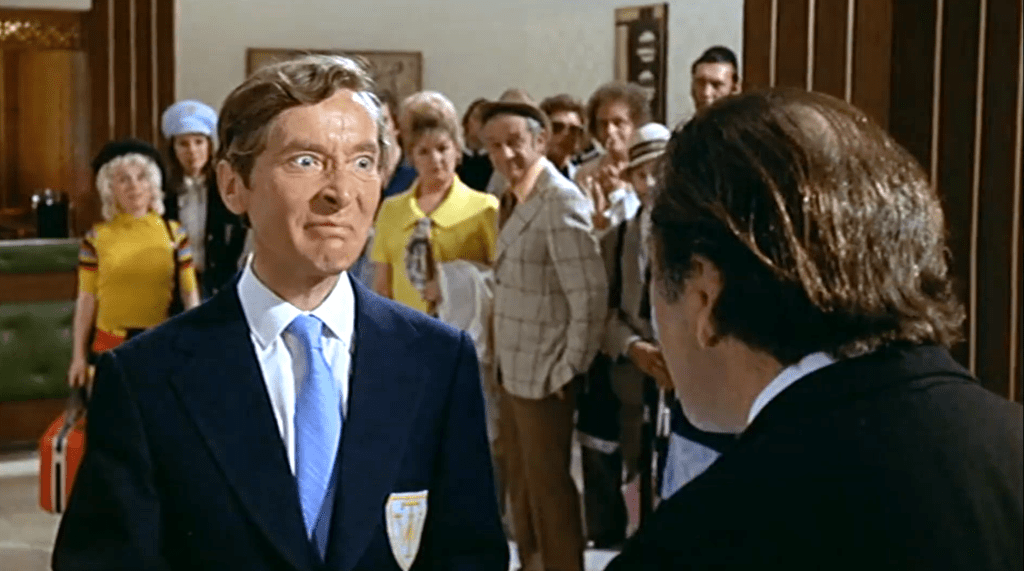
“Stuart Farquhar.” “Stupid what?”
Yet while time expands and contracts (slide whistle again) across all 30 Carry On productions – discounting the compilation That’s Carry On! – one of the few structural features the films have in common is that their stories unfold over periods lasting more than one “screen” day. What might a comparison of this shared characteristic reveal about the franchise and, potentially, its ratio of hits to misses?
A good way to start, by virtue of being reasonably straightforward, is to identify which of these screen days are the longest and to rank them accordingly.
Taking the top five in reverse order, in fifth place is a day in Carry On Cabby that runs on screen for 36 minutes and seven seconds.
It’s the first day depicted in the film and begins in the morning with Charlie Hawkins, aka Sid James, out cabbing, much to the disgust of his other half Peggy, aka Hattie Jacques (“There are lots of women who’d be only too pleased to be married to Charlie.” “So would I, and I’m his wife”). The day ends very late in the evening, with Charlie coming back from more cabbing, much to the renewed disgust of Peggy.
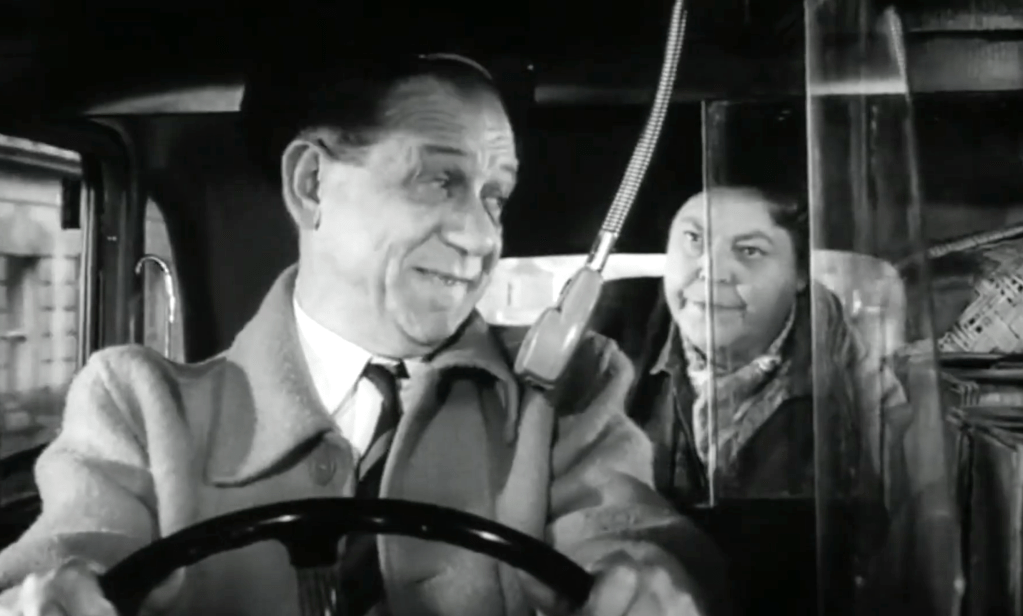
The main reason the film dwells for so long on this one day is because it is Charlie and Peggy’s wedding anniversary: a plot device that writer Talbot Rothwell exploits for as much dramatic and comic potential as he can manage, not least getting Jacques to essay a depiction of increasing drunkenness that is part charming, part unsettling. Even when you know this performance is coming, it’s still a jolt to see a Carry On venturing so far from the path of signposted comedy and into the weeds of emotional upset.
Unlike other and longer “screen days”, however, this one ends up dragging. It feels as if Rothwell, in his first script for the franchise, has yet to work out how to find a balance between his primary and secondary characters, while also making sure the whole ensemble is given equally absorbing things to do. He’s hindered further by the non-appearance of Kenneth Williams, whose rare absences in Carry On films are always to be regretted, though none are more regrettable than here. The presence of and interjections from Williams might well have elevated this 36-minute sequence up several notches, from the passingly admirable to the outstanding. Instead, the presence of and interjections from new taxi driver Terry Tankard (Charles Hawtrey) slow down rather than sustain the pace. The same applies to the tedious will-it-won’t-it arrival of the baby of the wife of Jim Dale (whose character isn’t even credited with a name). By this point the day has gone on for so long that it’s tempting to follow the example of Hattie Jacques and fall fast asleep.
The fourth longest day appears in Carry On At Your Convenience.
As with Cabby, it’s the first day depicted in the film. This one runs for 40 minutes and 45 seconds on screen, kicking off mid-morning at the WC Boggs toilet factory and continuing until late into the night. But unlike Cabby, this one doesn’t drag. It doesn’t even feel like it’s all the same day, thanks to what happens at the 15-minute mark. Here, in what is almost a separate Carry On – a film within a film – the script ditches the factory and pretty much anything to do with toilets, choosing instead to spend 25 minutes out and about in early-70s Rothwellian England.
It’s quite the audacious move. The pivot from the factory is so brutal and decisive that it does feel as if the filmmakers were aware – from the outset – of its limited potential as a location. (This would also help explain the second pivot later in the film, when we journey even further from Boggs and go all the way to the seaside.) In this context, Rothwell’s 25-minute snoop around the shopping streets and quiet suburbs of Uxbridge seems as much of a calculated distraction (forget about toilets – look over here!) as an exercise in creative liberation.
Still, it’s a delight to watch him rifle through his stash of domestic vignettes, trying this and that while doing his best to make audiences forget about the sight of a bidet. This is a different Talbot Rothwell from the one at the wheel of Cabby. He’s now got a full cast of well-loved actors and archetypes to deploy, and is armed with the skills and experience to know how best to deploy them.
Not everything works. Charles Hawtrey and Renee Houston playing strip poker, aside from being visually frightful, adds nothing to anyone’s net enjoyment of the film. The same goes for the tiresome stalking by Vic Spanner (Kenneth Cope) of young couple Lewis Boggs (Richard O’Callaghan) and Myrtle Plummer (Jacki Piper). It has been well telegraphed by the 15-minute mark, and even the five-minute mark, that Vic Spanner is an undignified buffoon with no self-awareness. Being reminded of this repeatedly, on and off, for another 25 minutes, dilutes the impact of his character to the point where he – and any scene in which he appears – becomes aggressively boring.

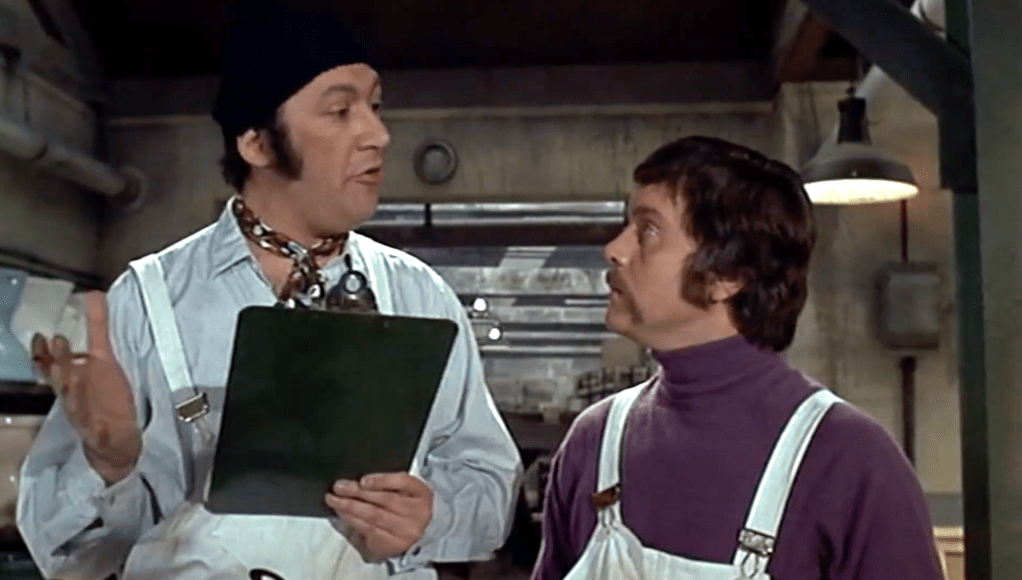


A journey through Rothwellian England: day one of Carry On At Your Convenience
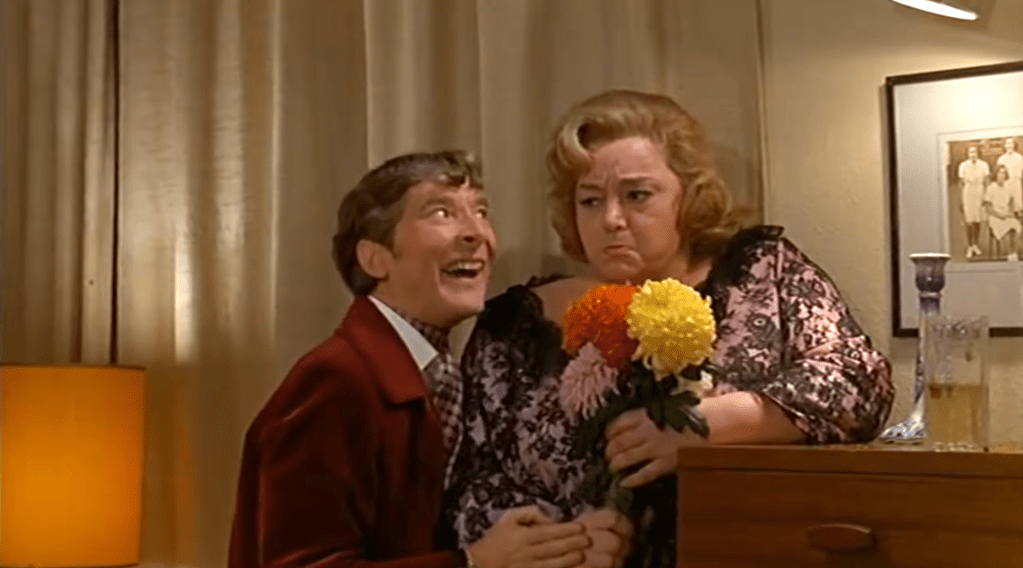
These are the downsides of this extended foray beyond the Boggs gates. The upside, and it is one enormous upside, is that it allows for one of Rothwell’s finest sustained pieces of Carry On writing: Sid Plummer (James) at home with wife Beattie (Hattie Jacques) and their budgie Joey.
Here is a triangular relationship – man, woman, bird – unparalleled in the franchise in the way it succeeds in fashioning comic riches from the grotesque and the humdrum. Rothwell’s dialogue raises the earthy granules of married life to the level of comic artistry. Yes, those granules include a pair of wet underpants, a pile of dirty crockery and a bird that either craps in its cage or squawks at the name of race-winning horses. But in the hands of James and Jacques, and the pen of Rothwell, these form the foundation for more exhilarating silliness and joy than in most other Carry Ons.
Sid: How about something to eat?
Beattie: I’ve had something.
Sid: For me, for Pete’s sake!
Beattie: Well, I could make you some beans on toast, I think.
Sid: No, nothing elaborate, thank you.
…
Beattie (referring to Joey): He must have seen the results in the paper.
Sid: What are you talking about? He can’t read, can he!
Beattie: Well, how do you know? You didn’t even know how they made love.
Sid: Well he’s getting information somewhere, that’s for sure. (To Joey) Where are you getting it? Come on, talk, talk!
The scenes in their house run for a combined total of nine and half minutes and represent the longest two-handed (and one-beaked) dialogues in the Carry On canon. They are worth every second.
The third longest day places James and Jacques again at the centre of proceedings. It’s the first full day of Carry On Loving, which runs for exactly 46 minutes from Bertram Muffet (Richard O’Callaghan) sitting on a bus ogling a lip-locked Valerie Shute and Barry off Last of the Summer Wine (“Going all the way?” asks ticket collector Kenny Lynch), to Sidney Bliss (James) in a string vest fleeing down the fire escape of Rogerham Mansions having just seen Gripper Burke (Bernard Bresslaw) throw Muffet across the living room of Esme Crowfoot (Joan Sims).
It’s quite the day for Muffet, who is a far more likeable character for O’Callaghan than the one he plays in Convenience. His bus journey takes him to the Wedded Bliss Agency, wherein dwells the pretending-to-be-married Sidney Bliss and Sophie Plummett (Jacques) along with their giant computerised/hand-cranked love-match machine. Between Muffet’s passage on the top of the bus to his passage through the air of Crowfoot’s lounge comes a day packed with this, that and attempts at the other. Rothwell has no shortage of ideas or gags, and also manages the feat of keeping most of the gang apart from each other while simultaneously in orbit around the lonely hearts agency, spinning in their own constellations of misunderstanding and innuendo with as much elan as the reels of the Bliss computer.

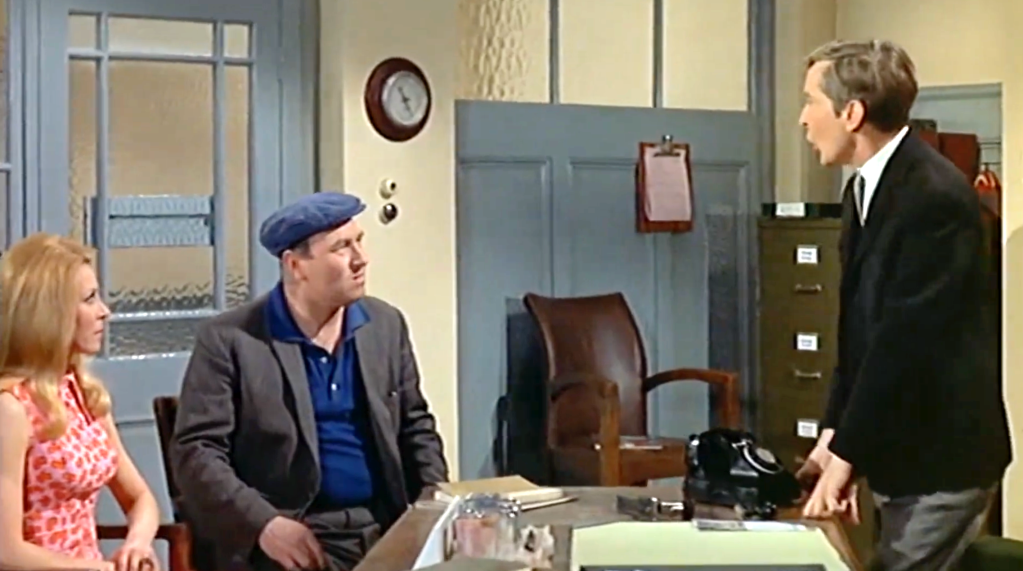

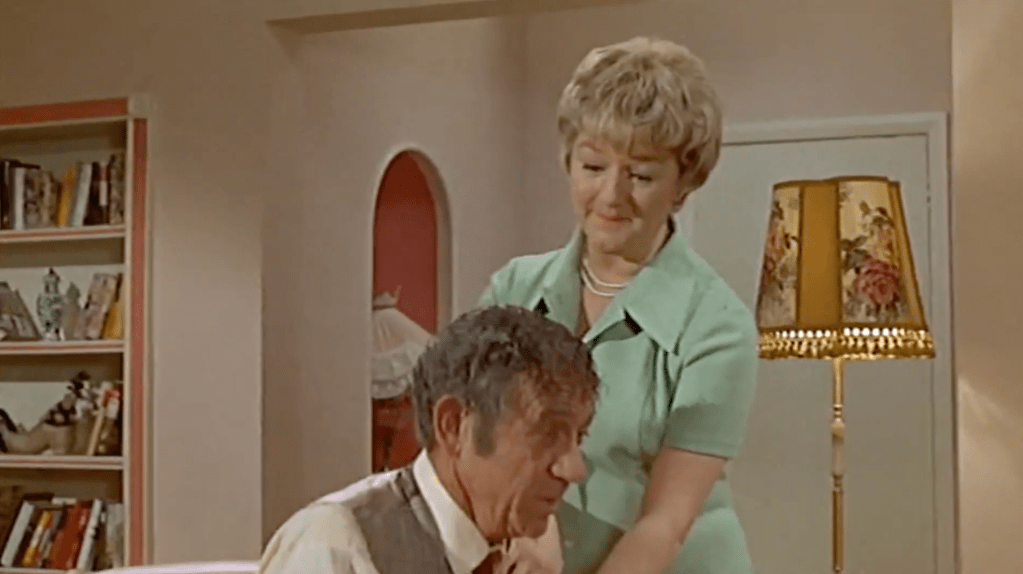
(Sidney) Bliss it was in that dawn to be alive: day one of Carry On Loving
So much is packed into these 46 minutes – including Kenneth Williams being informed by his boss that he must take a wife (“But I’m a confirmed bachelor!”) and Peter Butterworth making a cameo as a serial killer (“Wouldn’t eat the mushrooms”) – that barely anything drags and suddenly it’s halfway through the film. Few Carry Ons slip by as pleasingly and as effortlessly as this.
The same can’t be said of the second longest day, which sprawls like a crocked motorhome across more than half the running time of Carry On Behind.
A full 46 minutes and 58 seconds is given over to day one of Fred Ramsden (Windsor Davies) and Ernie Bragg (Jack Douglas) at the world’s muddiest caravan park, which coincidentally is also the day that Professor Roland Crump (Kenneth Williams) and Professor Anna Vooshka (Elke Sommer) begin their archaeological investigation in the adjacent field into how various Roman pieces got laid (“…on the cement!”), plus the first day on site of assorted humans and their pets, of which the only ones who seem to have a good time are the animals.
Dave Freeman is on script duties and he works hard to eke out the events of the day so they run late into the night – though unlike Rothwell you can really tell he is working, and also struggling. There is no effortless glide past the halfway mark here. By the time the end of this day is reached, and Kenneth Williams is in a hospital bed having a splinter removed from what you’re led to believe by everyone (including Williams and doctor George Layton) is his penis, but is actually his toe, everyone – cast, audience, writer – is exhausted.
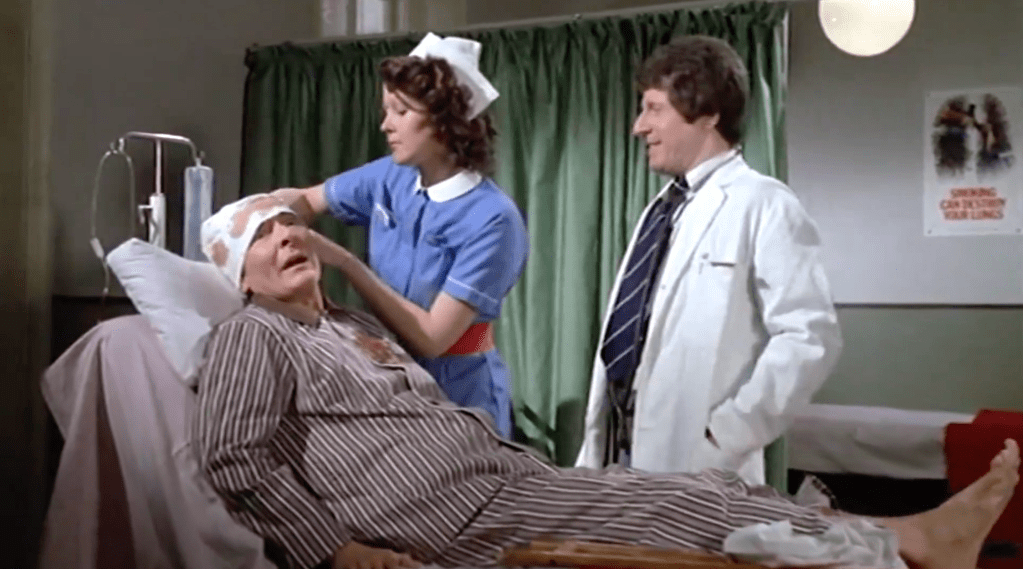
Not that Freeman doesn’t know how to set up and drive home the jokes (“Is professor of archaeology, he is bleeding terrible.” “Never mind his qualifications, is he hurt badly?”). Nor is Behind lacking memorable character turns, such as Peter Butterworth reprising Mr Fiddler from Carry On Camping in all but name and Kenneth Connor in his element as the frisky camp owner. The film simply lacks enough of the ignition that helps spark and sustain so many other Carry Ons.
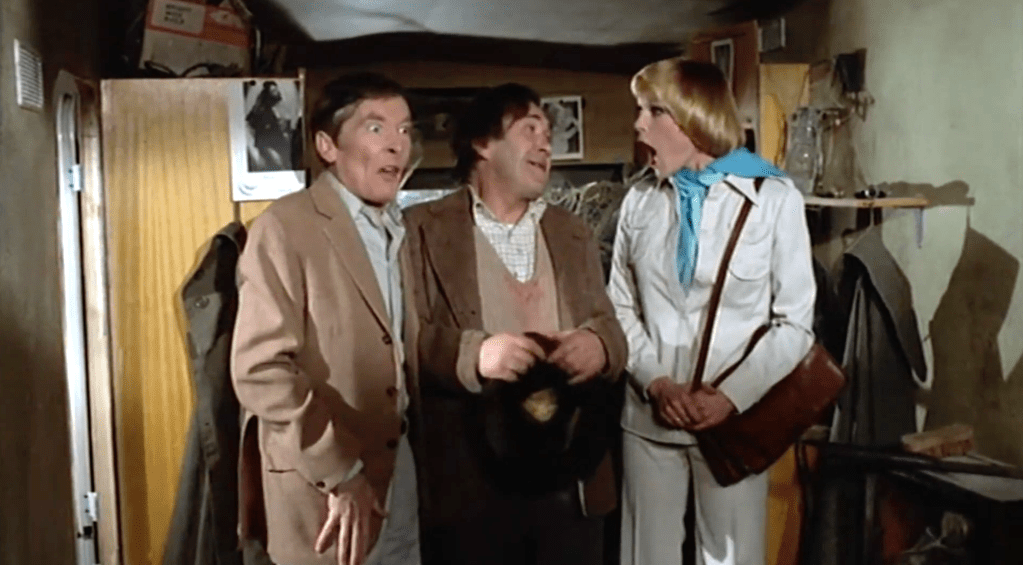

Peter Butterworth and Kenneth Connor revivify Carry On Behind
What feels like the longest day of all is not quite the longest day, however.
That honour goes to Carry On Matron, whose first day of action runs on screen for 50 minutes and 40 seconds. As with all of the top five, the day in question stretches well into the night. Unlike the rest of the top five, this day is blessed with the presence of Barbara Windsor, who earns her fee merely with the wonderful expressions of disgust she pulls whenever her character Nurse Ball has to exchange words with Terry Scott’s ghastly sex pest Doctor Prodd.
Besides boasting the longest screen day, Matron is also the Carry On that spans the shortest period of narrative time. All of the main action takes place over just two days, with the near-51 minute day one (ending with Cyril Carter, aka Kenneth Cope, delivering the triplets of Jane Darling, aka Valerie Leon) followed by a 33-minute day two. That just leaves 60 seconds at the very end, where the film flashes forwards by however long it would have taken Sir Bernard Cutting (Kenneth Williams) and the unnamed Matron (Hattie Jacques) to book their wedding, which could be as little as 48 hours, seeing as how randy is Sir Bernard by the conclusion.
Matron is essentially a caper, a comic heist, and as such the compact timeframe makes perfect sense. This isn’t a medical-based comedy that requires a narrative structure of several days, to allow for patients coming in and out of hospital or being prepared for complex operations, as per Nurse or Doctor. Here, nobody can hang around for long and everyone is on a short fuse. Sid Carter (Sid James, naturally) is anxious to pull the heist as soon as possible; Rothwell duly ensures the gang of thieves are forever sneaking, running or (in the case of Kenneth Cope in drag) tottering about the place, thereby ensuring the film is full of pace and is always heading towards a denouement.
The medical staff are also forever hastening about the premises, bustling up and down corridors, in and out of rooms, down fire exits or across car parks. The only waiting going on in the film is by the pregnant women in their beds or the men in the waiting room, but even this has a restless quality to it, be it Mrs Tidey (Joan Sims) fussing over her food or her husband (Kenneth Connor) twitching and falling about. Everything has the air of frenzy, even the manner in which Sir Bernard turns the pages of his book on Sex Techniques, or the way Dr F A Goode (Charles Hawtrey) fidgets while hiding in Matron’s wardrobe. The crescendo during the last half hour of the film, from Sir Bernard and Matron’s frantic courting (“You can be a wooed as you like with me!”) to the chase around the hospital, is a model example of how and when to discharge increasingly-powerful explosions of comic mania.
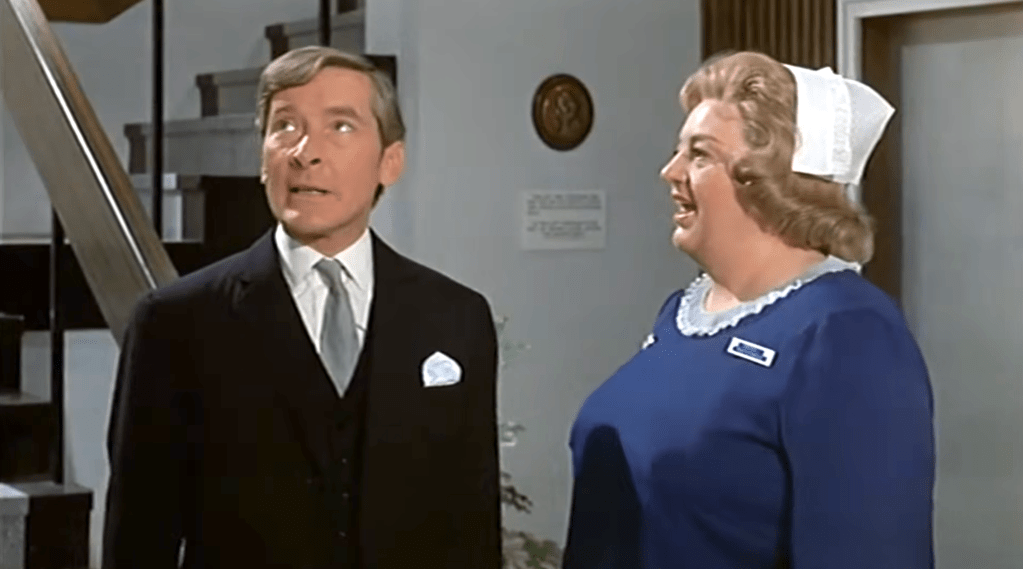

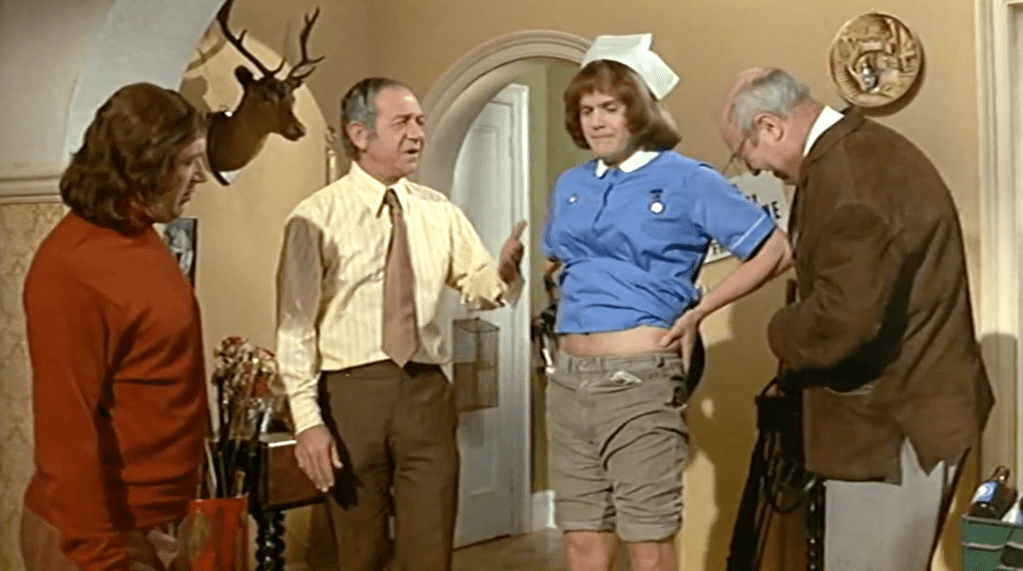
The longest of them all: day one of Carry On Matron
*
These, then, are the five days that take up the longest amount of time on screen. To recap, in ascending order, the days appear in Carry On Cabby (36 minutes and seven seconds), Convenience (40 minutes and 45 seconds), Loving (46 minutes), Behind (46 minutes and 58 seconds) and Matron (50 minutes and 40 seconds).
All five share one obvious characteristic: they are set in the present day. None are set in the past and none are genre pastiches (such as Spying or Screaming). It does seem as if it is easier – more tempting, perhaps – for Talbot Rothwell and director Gerald Thomas to let storylines unfold at length over the course of a single day if the film is set in contemporary England.
This type of Carry On certainly has more potential for the meticulous development of a compact timeframe than one where equal or greater attention must be paid to establishing period or stylistic context. In those films, part of the point – part of the fun – is to shuttle from one historical curio to another, or from one genre spoof to the next, as this is what catalyses the humour, which in turn necessarily accelerates the passage of time. With films set in the present day, there are no such curios or spoofs that require the narrative to be hauled forwards at speed.
Take Don’t Lose Your Head. Here, more than half the running time of the film is filled by Citizen Camembert (Kenneth Williams) and Citizen Bidet (Peter Butterworth) racing from France to England and back again in pursuit of the Black Fingernail, over the course of a narrative week. The pace of the film, along with the mixture of locations (some real, some in the studio) is thrilling. It would be a very different kind of film – less thrilling and certainly far less interesting – were the same amount of time taken up with following Camembert and Bidet traipse round the streets of Paris over the course of a single narrative day. The scope for historical-based knockabout and period tourism – the two strongest virtues of setting a Carry On in the past – would be much narrower. The film would be nobbled before it even got going. Plus, those Parisian streets would quickly start to look very familiar, and then dull. And there is little worse in life than a dull Carry On.

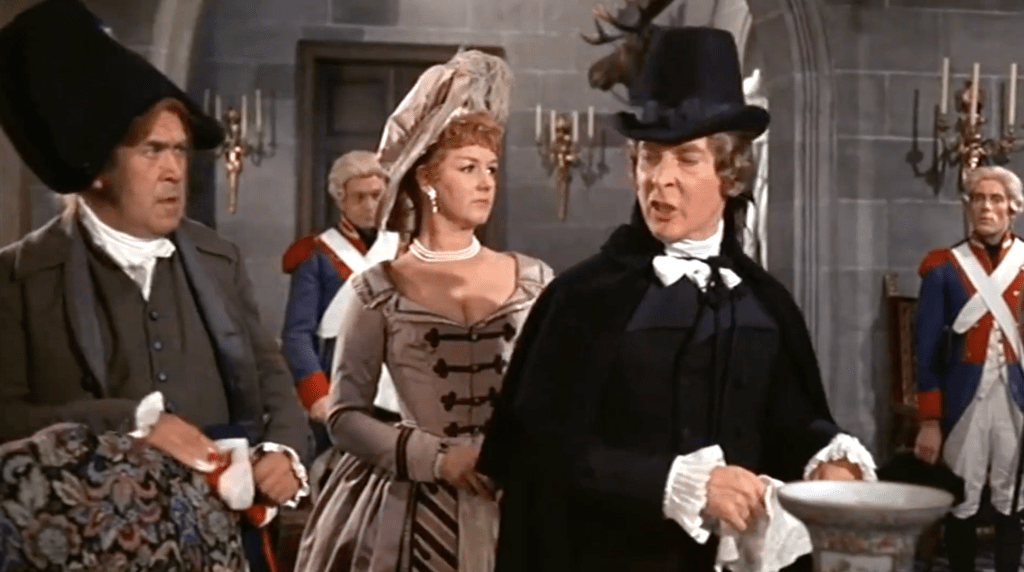
Citizen Camembert cheesed off in Carry On Don’t Lose Your Head
Four of the five longest days share another common characteristic: all are from the 1970s. Loving was released in 1970, Convenience in 1971, Matron in 1972 and Behind in 1975. Only Cabby hails from the early era of the franchise (1963); indeed, it is the only one of the five not made in colour. It is also the only one of this group that dwells more in the tradition of comic drama than broad humour, meaning the “long day” in Cabby is of a very different kind to those in the other four.
In Cabby the day runs long because of its significance to the two central characters, Charlie and Peggy, and because of the jeopardy that ensues. Will Peggy get to celebrate her wedding anniversary? Will Charlie make it home in time? In the other four films, the day runs long so lots of characters can do lots of things in lots of funny ways: an approach necessary when prioritising broad humour over comic drama, which was the settled strategy by this point in the life of the franchise, and one Rothwell and Thomas could execute with ease.
There is no standout pair of leading characters in Loving, Convenience, Matron or Behind. Some are more prominent than others, but none are so central to the arc of the plot as Charlie and Peggy in Cabby. The 1970s films are ensemble comedies built on interactions between different combinations of characters. Cabby is a light-touch love story built around the relationship of its two leads. Yes, Sid James and Hattie Jacques are at the heart of Loving and Convenience, but they are not the heart, in the way they are in Cabby.

*
The five longest screen days occur in films that, bar one, can be placed comfortably in the top half of a good-to-bad Carry On league table. Loving, Convenience and Matron are all robust, confident efforts whose defects are easily offset by their strengths. None of them have been terminally wounded by changing tastes or the turning of the decades. A solid case could be made for them being in the top 10. Cabby is a very different type of film and the absence of Kenneth Williams means at least one lifelong fan of the franchise can never rank it among the greats. It belongs in the top half of the table, however. Only Behind feels more at home in the lower half, though well away from the dregs at the very bottom.
Might these observations and shared characteristics suggest the faint outline of a trend – albeit one as flimsy, at least for the moment, as those advanced by Desmond Fancey in his hunt for Big Dick? Could a pattern be starting to appear?
To help firm things up (not a problem likely to have been experienced by the aforementioned Mr Turpin) here’s a second way to assess the passage of time in the Carry On universe: by logging the most and least number of days of narrative action depicted in a film.
It’s not always clear when one day finishes and the next begins, so a degree of informed guesswork is required. But at the upper end of this measure are Follow That Camel (11 different days of action), Jack (12 days), Regardless (12), Columbus (at least 12) and Emmannuelle (at least 13). It would be a bold move to place any of these in the upper half of a league table, let alone a top 10.
At the other end are Matron (two days of action, plus the epilogue), Abroad (four days, plus the epilogue), Screaming (four days and nights, plus epilogue), and a group all tied on five days: Behind, Camping, Constable, Convenience, Cowboy, Doctor and Spying. Here are films that almost without exception – Cowboy – could sit comfortably in the top half of that league table, with most going into the top 10.
More evidence of a trend, perhaps? Are we – in the words of Professor Crump in Behind as he lectures on stone age archaeology while unwittingly showing footage of Miss Emilia Fosdyke stripping off her bra – about to uncover something of enormous interest?
How satisfying it would be if this were so. Such a correlation would suggest there is order below the surface-level chaos of the Carry Ons: a pattern embedded within the genetic code of the franchise, which dictates whether a film will turn out to be a hit or a flop. It might even point to a foundational syntax on a par with that advanced by Leonard Bernstein in his 1973 Harvard University lectures on the evolution of music. Well, maybe not quite on a par, but near enough to help account for why Dick is so much more enjoyable than Jack, or why Abroad is so preferable to England.
Yet while it’s fair to say that most of the films that range over the largest number of days are not as enjoyable as those that focus tightly on a much shorter period, the Carry Ons in the mid-range of this metric defy even a sweeping generalisation.
In the group of films tied on six days of action are Nurse, Loving and Teacher (all hoots), Dick (more hits than misses) and Girls (ditto), plus the previously discussed Cabby (six days, if you exclude the multi-day montage showing the evolution of Glamcabs). But also here are the tiresome Up The Khyber, the awful Up The Jungle and the absolutely rotten England.

Fit for the bin: Carry On England
And after that comes another mixed bunch: Cleo with eight days, Henry with nine, while Again Doctor, Cruising and Don’t Lose Your Head all have at least 10. There’s just too much inconsistency here to support a trend – especially when you realise Don’t Lose Your Head, one of the greatest Carry Ons, features almost the same number of days as Follow That Camel, one of the very worst. Maybe it’s best to leave this particular empirical exercise buried up to its neck in Camber Sands.
(The film it’s impossible to rank fairly by this method is Carry On Sergeant, as more than 30 minutes consists of a sequence depicting an imprecise number of days on which the troops do their training exercises.)
*
There’s a third way the passage of time is treated in Carry On films. It doesn’t reveal any universal truths, but it does illuminate further the means by which the franchise kept itself ticking over.
The focus here is not on the number of days of action depicted on screen, but the overall period of narrative time that elapses between the opening and closing credits of a Carry On. These two measures are far from similar. For example, there are at least 10 separate days of action in Again Doctor, but those 10 days take place over a period of five to six months in the world in which the film is set. There are only five days depicted in Convenience, but they are spread over five to six weeks in Boggs-land.


Carry On At Your Convenience: clocking off
The five films where the main action takes place over the shortest passage of narrative time are Matron (two days), Screaming (four days), Abroad (four days), Behind (five days) and Constable (five days). Admittedly those first three all conclude with a brief epilogue set in the near future, but the central plot has already been resolved by this point and doesn’t really advance any further, be it Matron and Sir Bernard tying the knot (Matron), Emily Bung (Joan Sims) winking at the camera from inside the plaster-cast effigy in which she is trapped for all eternity (Screaming), or Jack Douglas hurling his beer around the pub a second time (Abroad).
The next five films based on this ascending unit of measurement are Doctor (spanning a narrative period of five or six days, depending on how quickly Dr Kilmore is reinstated after his sacking); Spying (at least five days, more likely six, accounting for how long it takes the gang to reach Vienna); England (six days); Up The Khyber (six to seven days); and Nurse (seven).
Ranked 11th to 15th by order of narrative time are Cowboy (at least one week); Teacher (eight days); Camping (eight days, including two before the camping begins); Dick (around 10 days); and Cruising (at least 10 days).
Many of these films contain instances of unimportant or irrelevant “real world” days being left out of the script to help hurry things along. The eight narrative days spanned by Teacher includes a period (a weekend) when the school is closed and which the plot skips entirely, meaning we see only six days of action on screen. In Nurse, the seven narrative days include one day we don’t see at all, for the same reason: it’s not important to the story and would only slow down the pace.
Camping has one of the best examples of Talbot Rothwell fast-forwarding narrative time with gusto. He is concerned – rightly – with hastening the film towards its eruptive conclusion, yet he does so in a way that lets the audience know an awful lot has tried the patience of Sid Boggle en passant. Hence we see day one on the Paradise campsite in fine detail and at great length (34 minutes); day two – when the Chaste Place contingent arrives – gets 11 minutes; then there’s a cut to Sid announcing “six days we’ve been here!” and suddenly it’s the final day, with the trip to the monastery and the rave-up in the next-door field. What happened on days three, four and five is left to our fertile imagination.
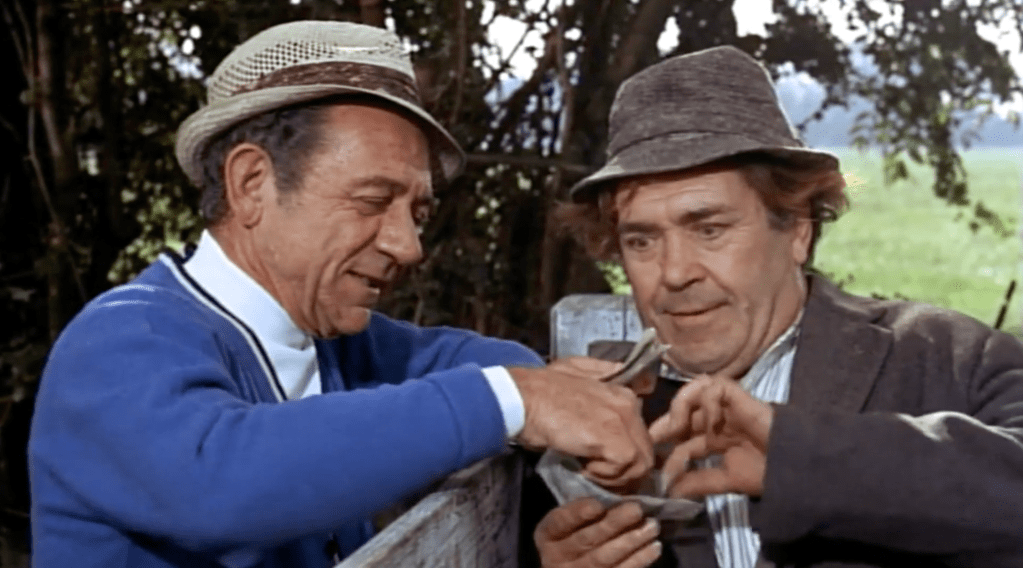

Carry On Camping: Paradise found, Paradise lost
By contrast, Norman Hudis hasn’t quite got the hang of things in Cruising, with the ship appearing to take at least 10 days to get to the African coast, which is the point where it begins its return trip, only for a character to announce “there are only two days left” before they’re due home.
In 16th position on this list is Regardless, which spans at least 12 days, though these are possibly dotted across a longer period of time, as Sam Twist (Kenneth Connor) certainly wouldn’t be able to make it back from a night on the Forth Bridge to lie in a bed at the Ideal Home Exhibition in London the following morning. Then comes Girls (around two weeks) and Loving. This spans two to three weeks; despite more than half the film taking place on one day, we’re told Terry Philpott (Terry Scott) visited the Grub family “the other week”, while later Sidney and Sophie decide to marry “next week”. Then it’s Don’t Lose Your Head (up to a month, what with all the traipsing back and forth across the Channel) and Follow That Camel (ditto, what with all the traipsing back and forth across Camber Sands).
In 21st place is Convenience, which covers a period of five to six weeks and is another example of Rothwell playing merry with time, with almost the whole first half of the film – as mentioned – set entirely on one day, before the action jumps forwards abruptly by three weeks (skipping over Sid piling up all his winnings from the soothsaying budgie), then later jumps forward another two weeks, wisely avoiding repeated – and narratively unnecessary – scenes of the workers on strike.
Cabby (22nd place) employs a similar device, with at least eight weeks of narrative time concertinaed into six days of on-screen action, in this instance sparing audiences all but a snippet of the “few weeks” Peggy needs to set up Glamcabs, as well as the “three weeks and four days” Peggy and Charlie are estranged.
The events depicted in Columbus (23rd place) cover two to three months, the chronology like most things in the film being a well-intentioned shambles. Sergeant (24th), fittingly, deploys military precision, spanning exactly 10 weeks. Audiences are told at the start that Grimshaw (William Hartnell) has precisely that period of time left before his retirement from the army; the film ends on the day of his departure.
Jack (25th) is even more vague than Columbus, both films dragging out their running time with joyless sea voyages whose specific duration is only hinted at on screen. Here our subjects spend “three months” in the galleon, then “days and days” in their rowing boat, before turning up at Cadiz almost overnight. Jack probably covers a period of four to five months in its own world. It feels even longer to watch in this one.
The five films spanning the longest stretches of narrative time comprise of one of the greats, one partial retread of a great, one that can feel like a great if you’re in the mood, plus two absolute stinkers.
The great is Cleo, which throws a square-wheel-sized spanner in the works of the theory that short narrative timespan = good, long narrative timespan = bad. While the film depicts only eight days of action, these are spread over a period of five or six months, thanks mainly to the absence in the Roman Empire of any form of motorised transport. As such Caesar (Kenneth Williams) takes two months to travel from England to Rome, while a further month elapses every time Anthony (Sid James) makes a round trip to Egypt to fall in Cleopatra’s bath of milk.
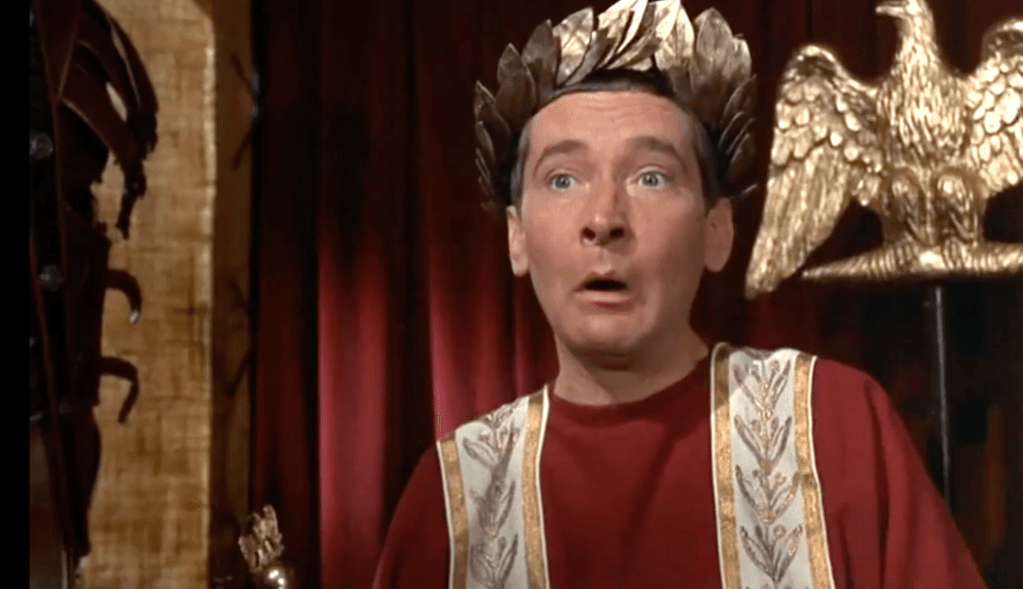
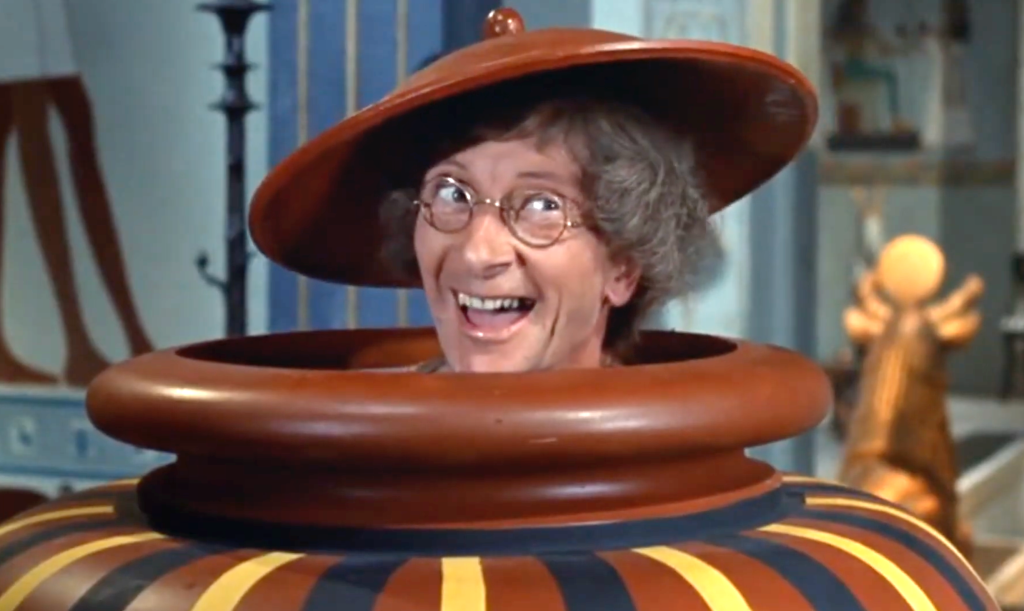
Carry On Cleo: age cannot wither them
Cleo avoids the mistake made by both Columbus and Jack, however, by keeping to a minimum any scenes of people travelling. The journeys don’t matter to this plot. Rothwell doesn’t need to rely on them to either pad out the running time or for contriving jokes. The storyline, one of the most solidly-crafted in the franchise, is propelled forwards by encounters between different characters in different locations. There is little need to see these people en route anywhere. The gags flow and the plot unfolds only when characters arrive in each other’s presence.
The partial retread of a great is Again Doctor, which uses Doctor as its template for the first half, before turning suddenly into a tale of colonial quackery, societal body shame and serum-induced sex change. The film takes places over a period lasting potentially up to six months, given the time it takes Dr Nookey (Jim Dale) to complete his round trip to the Beatific Islands. Wisely, as with Cleo, these journeys are barely depicted on screen, likewise the similar voyages taken by Dr Carver (Kenneth Williams), from which he returns dishevelled and unshaven – a look that just doesn’t belong in any Carry On.
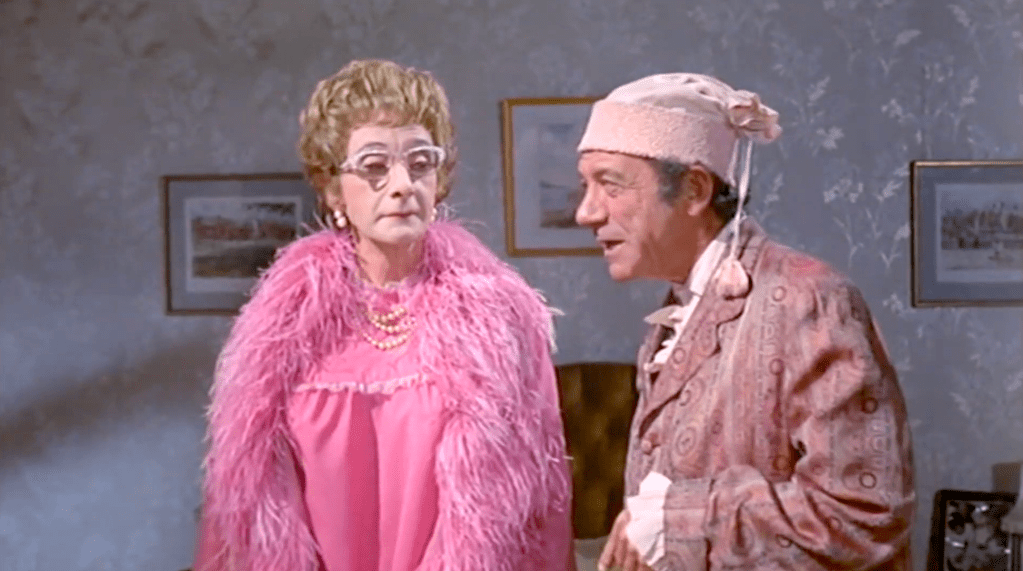
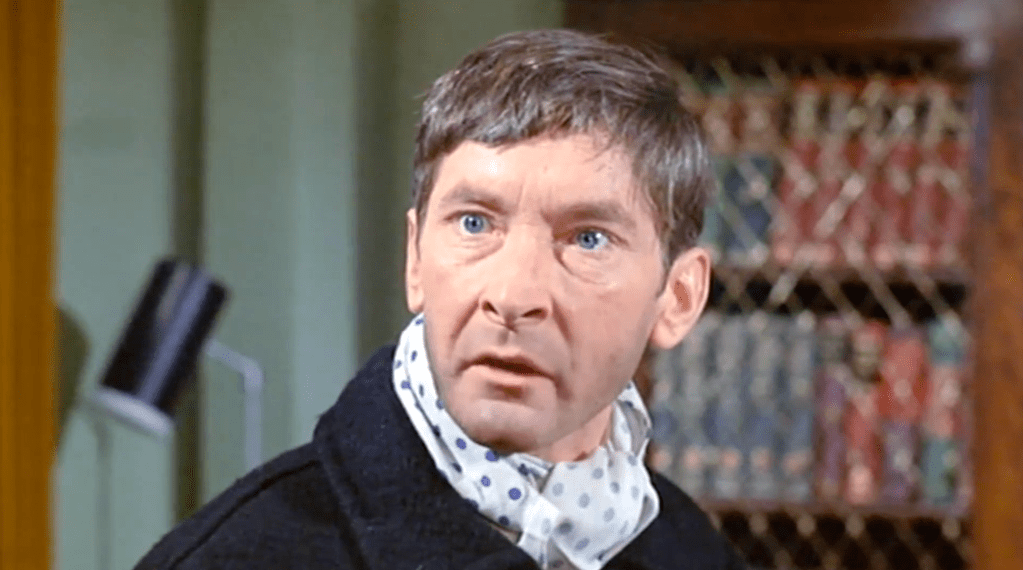
Wardrobe triumphs and disasters in Carry On Again Doctor
Henry divides opinion more than most, though there’s much to enjoy if you’ve a proclivity for Kenneth Williams turning his ‘bawling bureaucrat’ setting up to 11, Joan Sims attempting a French accent but getting no further than the backstreets of Limehouse, Charles Hawtrey as a predatory heterosexual, and Barbara Windsor tricking Sid James he’s cupping one of her breasts but is in fact holding a marrow. The film covers a period of around six months but feels shorter.
That just leaves the two stinkers. Up The Jungle depicts only six days of action, four on the expedition and two in London, but there is a gap of “a few months” between two of the days in Africa, during which – the script implies – the ‘jungle boy’ (Terry Scott) has been penetrating June (Jacki Piper) relentlessly. This is only one of the film’s many disagreeable elements, but it’s the only one the audience is (blessedly) spared from seeing. Accounting for the prologue and epilogue set in England, Jungle spans at least six months.
And then there is the longest of them all, which is also one of the worst of them all. Emmannuelle straddles unappealingly over a period of at least 10 months, encompassing the titular character’s impregnation by Emile Prevert – and possibly others – and subsequent delivery of his child – and many others – in the mirthless final scene. Emmannuelle only learns she is pregnant three minutes before the end of the film, however. The preceding one hour and 21 minutes span several weeks of uniformly unfunny goings-on, including Kenneth Williams’ bare buttocks on three separate occasions, director Gerald Thomas repeatedly being racist about professionals of Asian nationality, and the most appalling back projection in the entire franchise.

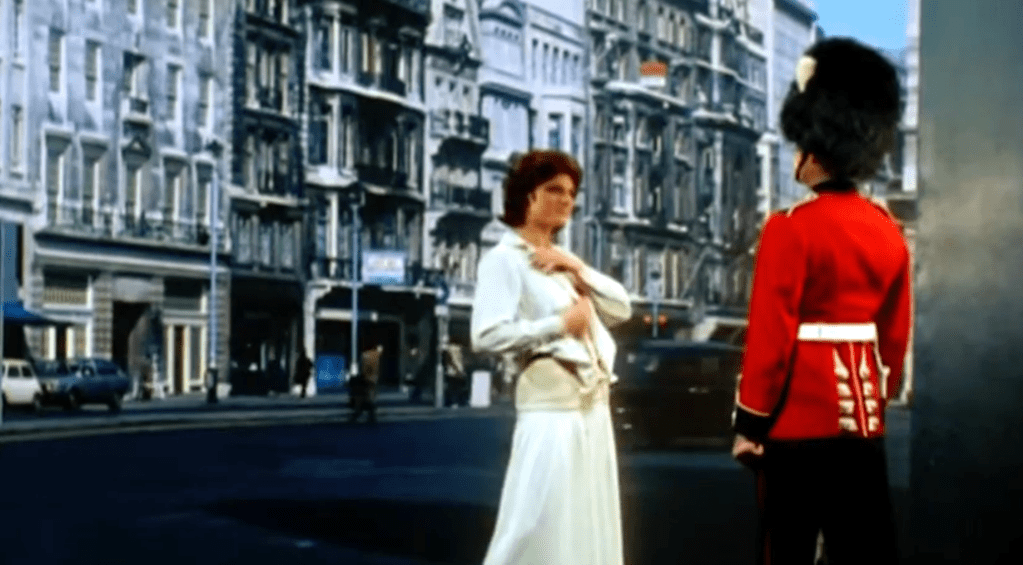
Carry On Emmannuelle: nasty and cheap
*
Do Carry On films that span a passage of narrative time lasting a few days or weeks tend to outclass those that sprawl over many months? The answer, as Matron tells Sir Bernard after hearing his proposal of marriage, is yes… and no. (“Yes AND no?!”).
It is true that the longest passage of narrative time is in one the most inferior films (Emmannuelle) and the shortest is in one of the most superior (Matron). And it is also true there are far more good Carry Ons than bad among those that follow events that last a few days or weeks, while the reverse largely applies to those whose action covers months on end. With a fair wind and enough puff, there’s just about enough evidence to get a theory up. But as Dr Soper cautions Babs in Camping, it’s all very well getting it up, it’s getting it to stay up, that’s what counts. And this one starts to sink down to earth as a handful of exceptions make their weighty presence felt.
They manifest themselves with the inevitability of a scrap of paper bearing the sign of the Black Fingernail. Here’s Cleo, one of the very best in the franchise, but with one of the longest passages of narrative time. Here’s Convenience, another gem, but one that takes place across several weeks rather than consecutive days. Here are Constable and Behind, mid-ranking efforts but both among those with the shortest narrative timeframes. And here’s England, to remind you that one of the shortest time periods graces quite possibly the most hideous film of the lot.
Let’s not end on a bum note, however. Unlike England, with its defining image of Kenneth Connor face down in a puddle of shit, the majority of the Carry Ons have qualities rich in substance and depth that will always be worth celebrating – and that includes their diversity of tempo. This horological tour of the Carry On universe has measured the passage of time in three ways: the longest screen days; the number of different days depicted on screen; and the span of narrative time covered by the plot. All three show there is a fair amount of correlation between how time is depicted and a film’s strengths or weaknesses, as well as presenting examples that don’t fit any such pattern.
Carry Ons with fewer days of action and long on-screen days tend to outclass those that prioritise the opposite, but not exclusively so. Talbot Rothwell and Gerald Thomas both knew how to bend and shape the depiction of time to serve the twin demands of plot and humour, becoming more confident and skilled as time itself went on. Yet sometimes they give the impression of forgetting more than they have learned – or rather, they do if you watch their work in sequence in short order: something that was neither intended nor possible at the time the films were made.
It’s useful to remember that, as far as Rothwell and Thomas were concerned, the only time that mattered was usually the here and now, not the last film they did and certainly not the next. Such was the nature of the industry in which they worked. As for producer Peter Rogers, the only time that mattered was opening weekend at the box office (closely followed by the start of the new tax year). For audiences watching the films in the cinema on their release, real-world time mattered little when the passage of “Carry On time” ensured you were only ever a few seconds away from the next familiar face or equally familiar gag. As for real-world time itself, that was filled with enough distraction to enable the franchise to bounce from stunner to stinker and back again, sometimes in the space of little over 12 months (Don’t Lose Your Head in December 1966, Follow That Camel in September 1967, Doctor in December 1967).

Forcing yourself to sit through that kind of sequential ricochet is a choice, not a duty, and not a particular constructive choice at that. You end up looking for patterns and trends that exist outside the fiction of Carry On universe and within the passage of time in the real world: which film is the peak of the franchise? When does the rot set in?
This is a futile task. Viewed with keen eyes and an open mind, the Carry Ons did not climb in quality to a single point and then begin a shallow decline that got steadily steeper. Forcing the 30 films to follow the sort of diktat that demands a clean rise and fall is to diminish, not augment, our enjoyment of the franchise on its own terms. Sometimes the hunt for a big, exterior truth succeeds only in obscuring the small, interior details; such as how each Carry On plays deftly and impishly with the passage of its own time, zipping through months in minutes or taking half the length of the script to stroll casually through a single day.
Of the many ways the franchise sought to vary its presentation of humour, the depiction of time is one that – for the sort of person who enjoys noticing such things and becoming mildly obsessed by them – rewards attention far more than it frustrates. Crudely, it’s the difference between a race-winning squawk and a cage-soiling shit by Joey the budgie. Less crudely, it enhances your understanding and appreciation of the way the Carry Ons manage to remain so joyous and exhilarating so many decades since their creation. It’s just as well the films are so elastic when it comes to time. It’s what makes their appeal so timeless.

