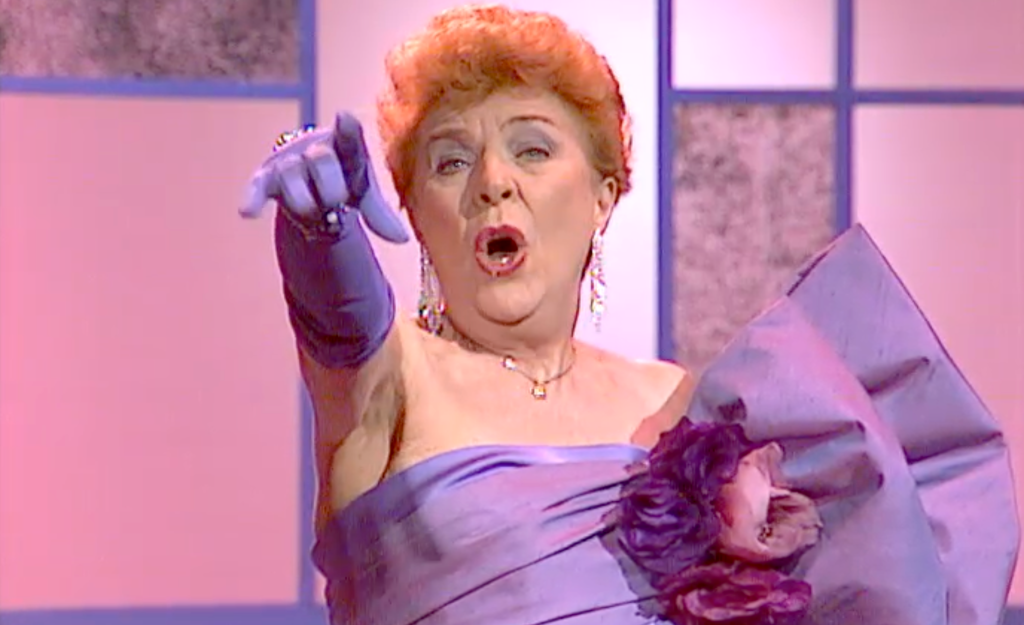
Noele Gordon on LWT’s Sunday Sunday in 1983, 45 years after her first TV appearance
Of all the moments in television history most in need of a reliable witness, the day John Logie Baird met Noele Gordon takes some beating.
Here was the inventor of the world’s first mechanical system for the transmission of moving pictures, crossing paths with the future tsarina of the small screen. To have been a fly on the wall at such an occasion. Did Baird encourage the teenage Gordon to ditch her interest in musical theatre and instead pay more attention to what he was up to in his laboratories? Might NG in turn have told JLB to stop fooling around with noisy machines involving pistons and spinning plates, and focus more on perfecting the sort of apparatus in which the BBC was actually interested? Did they then go for a meal somewhere and decide over coffee to have more influence on the course of 20th century popular culture than almost anyone else?
We will never know for sure what passed between the pair, for only one of them left an account of their collaboration, and it was Gordon. “You’re the first actress in the world to be seen on colour television,” he reportedly told her, after she agreed to take part in some tests at his studio in Crystal Palace in south London. So says Gordon in her 1975 memoir My Life at Crossroads, a book that devotes almost all of its chapters to the author’s experiences as the star of the eponymous soap opera (“They call me The Godmother and I sign myself The Godmother on my Christmas cards”).
In the few pages that bother to cover the decades of Gordon’s life before Crossroads, she mentions visiting Baird’s laboratories in 1938, aged just 18, to sit in front of a giant colour TV camera while a team of technicians tried out a variety of effects and gadgets. For some of these tests, she had to wear brightly-coloured straw hats, lined with flowers and ribbons; others required her to have her face painted with broad green vertical stripes. The pictures were relayed mechanically to monitors in the same building and were “all very lifelike, though not as realistic as today.”
The circumstances that led the teenage Gordon to be coated in lime paste and get peered at intently by a group of men were typical of Baird’s impulsive, often indecorous approach to what he saw as his life’s vocation. Needing a subject for his tests, Baird apparently sent one of his assistants to the nearby Penge Empire theatre with the instruction to sit through a performance of whatever play was currently being staged, then choose the cast member who had the most defined and colour-contrasting features. Gordon believed it was her “black hair and blue eyes” that got her the job.
She doesn’t recount precisely how she was approached, what words were exchanged or how an agreement was reached. She notes simply that Baird then began sending his personal Rolls-Royce to the theatre to scoop her up after performances – alone, without any chaperone – and deliver her to his lair, where she would spend the night taking part in the experiments, before being returned to her accommodation early the following morning.
Gordon supplied the world with a few observations about these all-night sessions in an article for TV Times in November 1969 to mark the long-awaited arrival of colour programmes on ITV (a mere 31 years since Baird first ran his tests):
I was paid at film extra rates, between £3 and £4 a night. Between ‘takes’ I drank bottled beer and ate sandwiches with these gorgeous young men Baird had working for him. It was great fun but I sometimes used to wonder what the neighbours thought when I was delivered back at my digs in a chocolate Rolls-Royce at six o’clock in the morning.
Leaving aside the fact the Rolls-Royce wasn’t chocolate, merely chocolate-coloured, Gordon’s anecdotes from 1969, together with her 1975 memoir, provide useful details of just what she got up to in the small hours of 1938. Precisely when she got up to it is another matter. For the exact chronology of these events is rather undermined by Gordon’s tendency to get dates muddled when writing about her early career – and that applies both to her meeting with John Logie Baird and her first actual appearance on television.
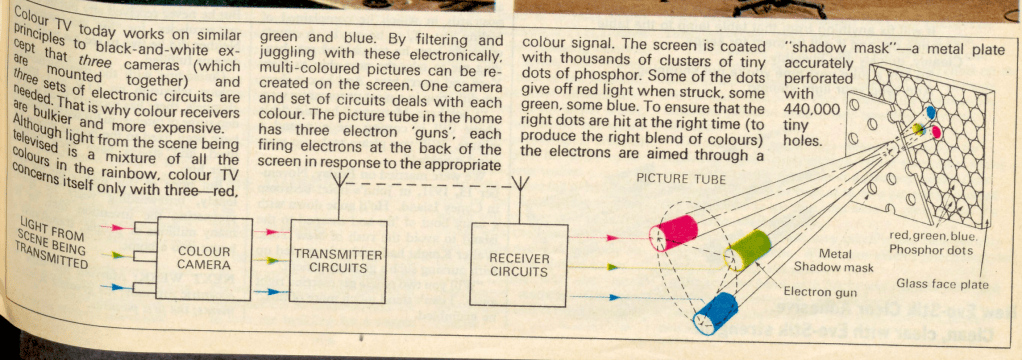
TV Times explains colour television to readers, 13 November 1969
Gordon says in her memoir that she spent “a whole summer” visiting Baird’s studios “twice a week” and that she also “took part in his big screen TV experiments in a Tottenham Court Road cinema.” These were demonstrations of live closed-circuit colour television that were mounted at the Dominion Theatre in central London, where members of the public could watch pictures transmitted from the south tower of Crystal Palace. Gordon’s accounts in both TV Times and her memoir imply this started in summer 1938. In TV Times she says these activities even continued “into 1939”. Contemporary sources show the Dominion Theatre demonstrations began in February 1938, however.
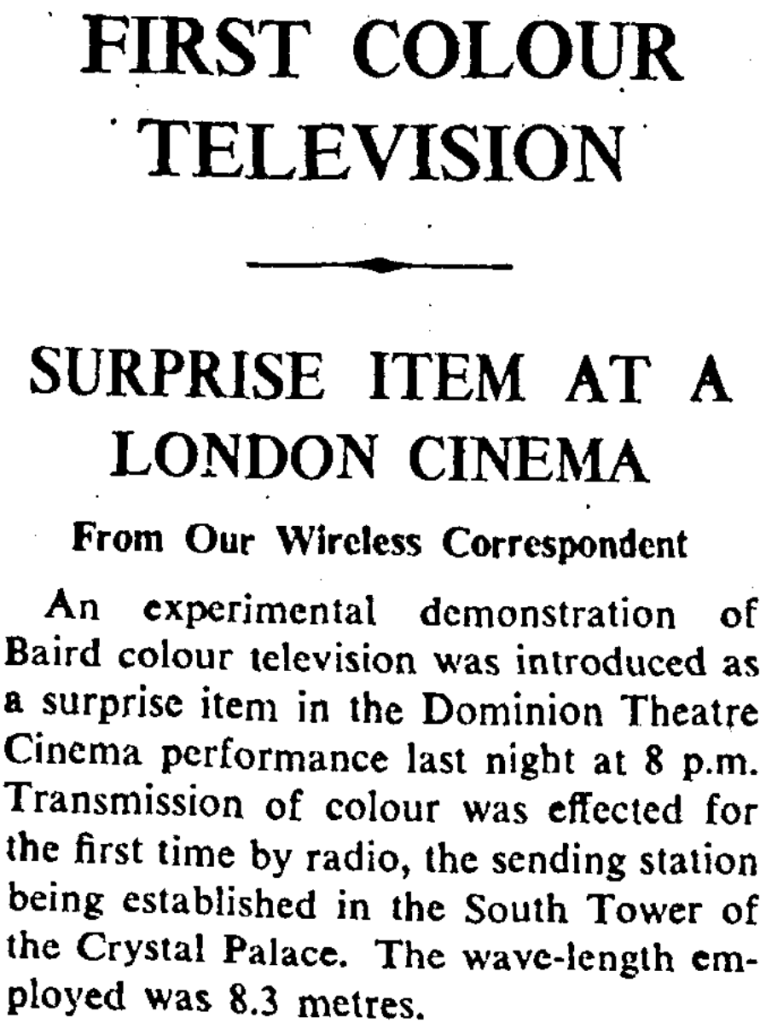
The Times, Saturday 5 February 1938
The first one took place on 4 February 1938 at 8pm when, according to The Times, audiences at the Dominion were treated to a surprise programme that included a Popeye cartoon and some “fashion plates” – presumably a sequence of illustrations showing multi-coloured outfits.
These demonstrations continued throughout February, with the public invited to admire the sight of, among others, the Union flag, someone dressed as a military officer, someone else dressed as “an Arab sheik”, and a photograph of King George VI. It was “the outstanding television event of the month”, according to the magazine Television and Short-Wave World, with the reporter L. Marsland Gander adding:
The colour is exceedingly good and on the whole more pleasing to the eye than are the latest colour films… I offer to Mr J. L. Baird and his technical staff my sincerest congratulations.
The magazine also says “two ladies exhibited various coloured hats” during the broadcasts, and reproduces a photograph of a woman sitting in front of Baird’s camera, looking distinctly unimpressed. The photograph is not of great quality, but it doesn’t appear to be Noele Gordon. Perhaps it was one of Baird’s staff posing for the shot. As for the “two ladies”, these might have been those “fashion plates” the magazine mentioned earlier, and not moving images of human beings.
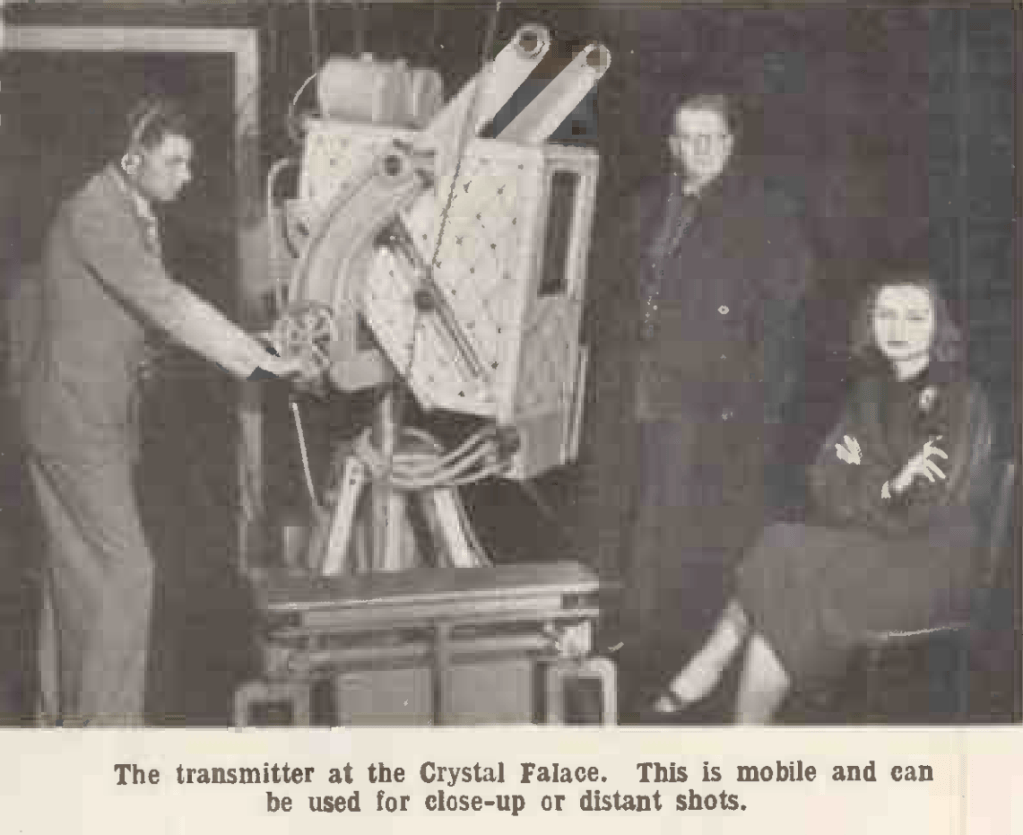
Television and Short-Wave World, March 1938
The reason to doubt Gordon was involved in these February demonstrations is that she did not make her first appearance at the Penge Empire until later in 1938 and so could not have been recruited for the screen tests this early in the year.
Baird left the UK in late February to sail to Australia, where he had been invited to address an international convention on broadcasting. This is one of the few events of 1938 Baird mentions in his memoir, Television and Me: a book that was published posthumously, is full of grudges and point-scoring, and which doesn’t mention Noele Gordon at all.
He stayed in Australia until at least April 1938, then returned to London to resume his experiments. At some point he must have then enlisted Gordon for the screen tests, but this would have been a few months after the initial Dominion Theatre demonstrations had finished.
Baird writes of holding screenings in the Dominion that lasted only “for a few weeks” and which included “a demonstration to the audience there of a transmission in colour on a twelve foot screen, the first time this had ever been done”. This must be a reference to the events of February 1938. He makes a passing reference in his memoir to further screenings in the Dominion, but does not mention dates. It must have been these with which Noele Gordon was involved, rather than the February events, but there is no source material from the time to provide confirmation.
If only Baird had included in his memoir some mention, even obliquely, of working with Gordon. He drafted the text in 1941 and died five years later, before any of his writings had been published. He therefore failed to live long enough to see Gordon make the switch from theatre to television and become a household name. His memoir is full of namechecks for other engineers, inventors and businessmen, typically individuals with whom he had a falling out or who he feels wronged him in some way. But there is no room for “the first actress in the world to be seen on colour television”.
Gordon’s own account of this period offers no clarification on when precisely she worked with Baird. She gets particularly muddled when she tries to put her pre-war career into chronological order. The production in which she was appearing at the Penge Empire on the night in 1938 she was headhunted by one of Baird’s “gorgeous young men” was, according to her, an adaptation of Somerset Maugham’s short story Rain. But there is no record of this play being staged at the Penge Empire in 1938 – at least, not according to the many newspapers in the British Library online archive. There is a production of Rain listed as being staged at the Empire in 1948, so perhaps Gordon got her decades confused. She writes of playing the part of Sadie Thompson (“one of my favourite roles”), though this was performed by Sarah Stannard for at least some of the 1948 run.
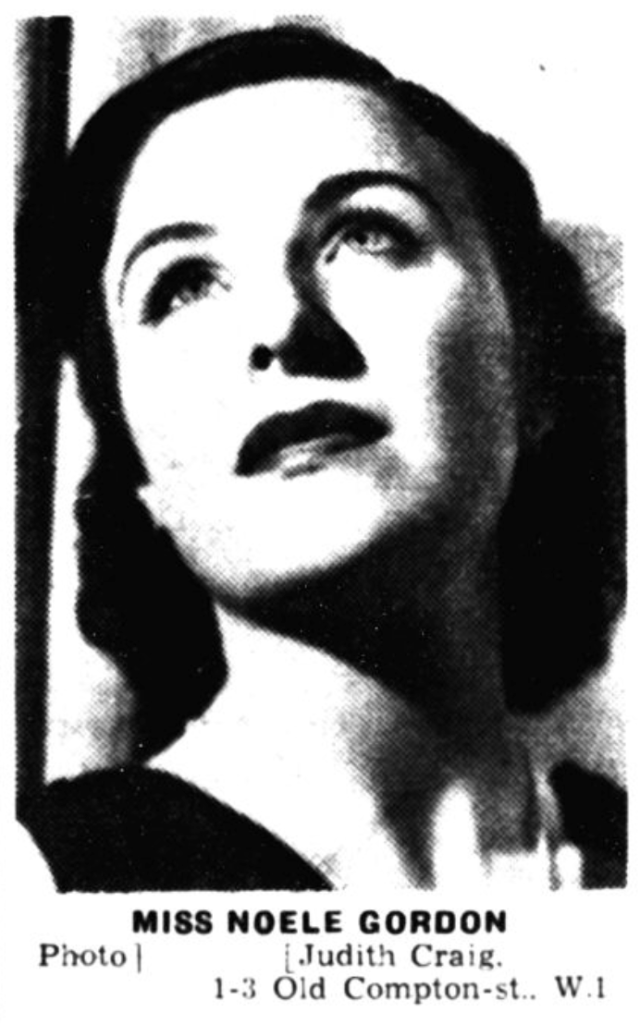
Norwood News, Friday 26 May 1939
A profile of Noele Gordon from May 1939 in the Norwood News records she had “just celebrated her first anniversary at Penge.” This would tally with other mentions of her stage work in the archives, which confirm she was definitely based at the Empire for a few weeks in May 1938, as a member of the Harry Hanson Court Players repertory company – but soon afterwards she shifted with her fellow actors to Birmingham for a summer season that ran until the start of September. The Court Players, including Gordon, were then based at the Empire from the end of 1938 and were still there when the Second World War began in September 1939.
Adding further confusion to the timeline of this period, the same Norwood News article of May 1939 says Gordon was engaged in John Logie Baird’s colour television experiments “early last year”, i.e. 1938. This tallies with Baird’s run of demonstrations in February 1938, but not with Gordon’s account of being at the Penge Empire when she was selected by Baird’s team, which can’t have happened until May 1938 at the earliest, once Gordon was at the Penge (and when Baird was back from his trip to Australia). At a push, “early last year” could mean May 1938, and perhaps this is the closest it is possible to get to a reliable chronology of when Baird met Gordon and began their collaboration, with the first sessions in May and June 1938, then a break when Gordon went to Birmingham (so clearly not “a whole summer” in Baird’s studio), then more sessions on and off in the autumn and through into 1939.
If only one, or preferably both, of these pivotal figures in the development of the mass media had kept a detailed chronology of their encounters, both for posterity and for the assistance of mildly obsessive writers of the future.
Placing the pair’s first encounter in May or June 1938 adds a further twist to the story, as it means Noele Gordon sat for her first colour experiment just weeks, or possibly days, after making her proper debut as a television performer.
Here again Gordon gets her dates muddled. She mentions in her memoir that she visited the BBC’s studios at Alexandra Palace in 1937 to take part in two live televised broadcasts of Eugene O’Neill’s play Ah Wilderness. These actually occurred in 1938, on 29 April and 3 May. She correctly remembers the play was performed twice, but gets the days wrong: she says the broadcasts were on a Saturday and the following Thursday, while contemporary newspapers give the dates as Friday and Tuesday.
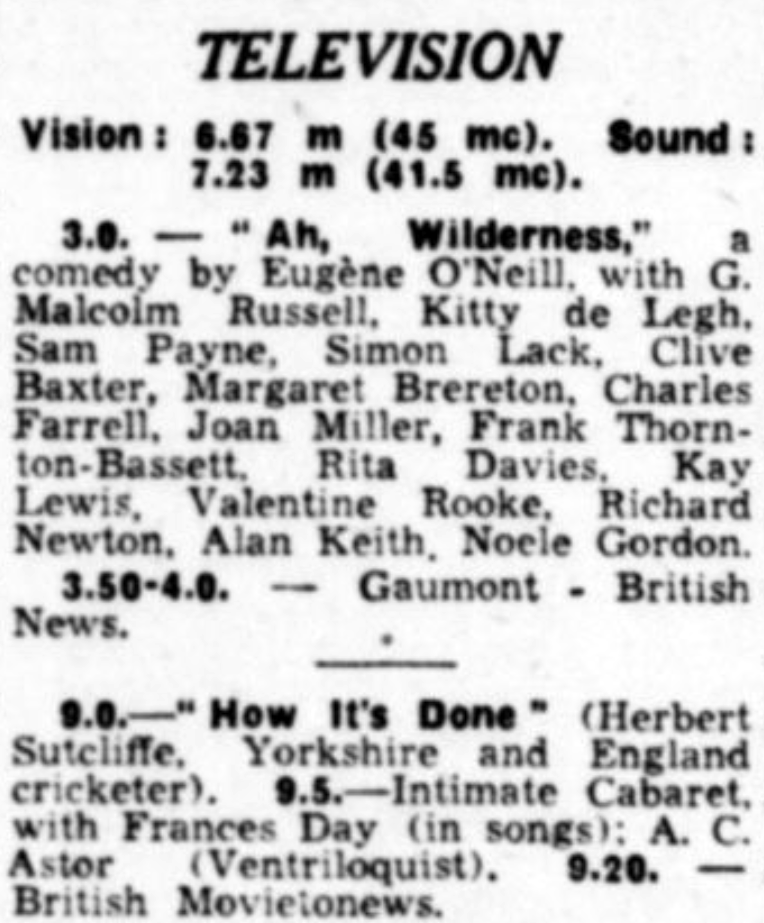
Evening News, Friday 29 April 1938
Gordon definitely appeared in the broadcast, however. Her name is included in television listings in the press. And while she had only a tiny role in the play as a maid, she writes vividly of the pressure of live performance, in particular the “fierce” heat from the studio arc lamps, which became so intense that at one point she had to drop a silver tray she was holding because the temperature of the metal was burning her fingers. It was live television “with a vengeance”, utilising three studios, meaning every so often the cast had to rush down a corridor in order to get into position for the next sequence (“Good training for Crossroads,” Gordon notes with the benefit of hindsight).
As was typical of the time, this was not a production specifically conceived for television, but a reworking of a play currently being performed on stage – in this instance, at the King’s Theatre in Hammersmith, a location that Gordon remembers correctly, but which again she places in 1937. The play opened at the King’s Theatre in February 1938, two months before the BBC version. This was the same month that Baird was carrying out his first demonstrations of colour television. Here is another piece of evidence to suggest Gordon was nowhere near Penge at this point in the chronology, and which supports the theory that the two of them did not meet until later that year.
For a location as unassuming as Penge to occupy a central role in the proceedings of a story so consequential as this seems somewhat fitting, given the two people involved had careers that embraced both the humdrum and the spectacular.
Baird’s career in 1938 had only a short time left to run. He was 50 years old but had already suffered, for him, the snub of his life when the BBC decided to ditch his unwieldy 240-line mechanical system for television transmission in favour of the more efficient and clearer Marconi-EMI 405-line electronic method. The BBC launched its television service on 2 November 1936 with both systems at its disposal, intending to alternate weekly between them for a trial period of two years. But by the end of January 1937 the corporation had seen enough (and possibly tired enough of Baird’s penchant for grudges and sulks). A huge fire at Baird’s laboratories at Crystal Palace the previous month did not help the man’s chances. The colour television experiments of 1938 were almost his last hurrah. When war began on 1 September 1939 the BBC closed down its television service completely; Baird died on 14 June 1946, just one week after the service resumed.
By contrast, Noele Gordon’s career in 1938 had an awful lot of time left to run. Her trip to Alexandra Palace in the spring, and her work with Baird later in the year, proved to be her last experience of television for a decade. She spent most of the war working in revues in Manchester, returning to the BBC only in 1948 for two small roles in the plays Acacia Avenue (16 September) and Children to Bless You (14 October).
A breakthrough of sorts came the following year, but in theatre, not television. Gordon landed the part of Meg Brockie in the first British production of the musical Brigadoon at Her Majesty’s Theatre in London. She stayed with the show as it toured the country and ended up doing over 1,000 performances: enough, surely, to catch the attention of every talent spotter in the country. But no. “When Brigadoon opened everyone said ‘A star is born!’” she remembered in an interview for The Guardian in 1983, “and then nothing happened.”
She did get herself an agent, however. Lew Grade was then in the process of assembling what would become a formidable roster of personalities and business interests. He liked what he saw of Gordon and snapped her up. Gordon was promptly rewarded in 1949 with a spot on the Royal Variety Performance, rubbing glittery shoulders with the likes of Maurice Chevalier and Tommy Trinder. But though more West End shows followed in the next few years, Gordon writes of feeling stuck in a rut and believed Grade was not getting her the material – or more plausibly the attention – she deserved.
By 1954 she’d had enough. She went to Grade, intent on announcing she was getting out of the business. Grade was having none of it. Deploying that mixture of deftness and flattery for which he was already becoming (in)famous, he turned the tables and transformed her complaint into a challenge: “Go into television,” Gordon remembered him barking. Grade revealed he was about to launch a company that he hoped would form part of the new ITV network, due to launch the following year. Was Gordon interested in joining him? And if so, would she like to go to New York, all expenses paid, to learn how to be a television producer and director?
For the second time in her life, Gordon found herself unexpectedly pitched into the engine room of the TV industry. Again, it was thanks entirely to an encounter with one of the giants of the medium – and again, there is only Gordon’s account as evidence, for Grade devotes only two paragraphs to her in his memoir Still Dancing, and those are next to useless (he recalls the mid-1950s Gordon as “a well-known actress and singer”). But there is no doubt he was fundamental to what next happened to her, and was the prime force in making her decide, there and then, to turn her back on the theatre and embrace completely the world of television.
She lapped it all up. Still only in her-30s, Gordon began 12 months of total immersion in the world of the US media, studying TV production at New York University, doing a few shifts as a continuity announcer at local stations, and watching hundreds of hours of output, from soaps to light entertainment to talk shows. “I built up possibly more TV experience than anybody in Britain,” she claimed in the Daily Mirror in 1978, modestly.
What she did with all this experience on her return to the UK is another story – one that may well have given John Logie Baird, had he lived long enough, cause to reconsider his decision to omit Gordon from his own autobiography. For by the mid-1970s, even the wife of the prime minister was giving a namecheck to Baird’s sometime teenage dogsbody:
I am sure many woman see Noele Gordon in the character of Meg Richardson as the type of woman they themselves would like to be: understanding, sensible, able to cope with any situation.
So wrote Mary Wilson in 1975 in her introduction to Gordon’s memoir. She also praised her subject for being “always so well-dressed and groomed”. From being smeared with green paint in a laboratory in pre-war London to being lauded by an occupant of 10 Downing Street, television started off as Gordon’s playground and became her ecosystem. In the end, she could not flourish outside it.

